USAJobs Specialized Experience: How to Prove You Qualify
Christopher was selected for GS-13 on his first-ever USAJOBS application.
Christopher, E-7, Coast Guard, now writes policy for the work he did on active duty
You find a federal job posting on USAJobs. The title matches. The pay grade is right. You read the duties section and think, "I did all of this in the military." Then you apply, wait six weeks, and get a notice that says "Not Referred." You did not meet the specialized experience requirement.
This happens to veterans every single day. Not because they lack experience. Because their resume does not prove it in the way federal HR needs to see it.
Specialized experience is the single biggest reason qualified veterans get screened out of federal jobs. The good news: once you understand how it works, you can fix it. I have been hired into six different federal career fields. Every time, I built my resume around the specialized experience statement. That is the formula.
This guide breaks down exactly how specialized experience works on USAJobs. You will learn how to read the qualifications section, match your military background to the right grade level, and write resume bullets that prove you qualify.
What Is Specialized Experience on USAJobs?
Every federal job announcement on USAJobs includes a "Qualifications" section. Inside that section is a specialized experience statement. It describes the exact type of work you must have done for at least one year at the next lower grade level.
This is not a wish list. It is a legal standard set by the Office of Personnel Management (OPM). HR specialists must evaluate your resume against this statement before they can refer you to the hiring manager. If your resume does not clearly show you meet it, you do not move forward.
A typical specialized experience statement looks like this:
"You must have one year of specialized experience equivalent to the GS-9 level in the federal service that includes: managing logistics operations for an organization of 100 or more personnel; analyzing supply chain data to identify trends and recommend process changes; and coordinating with external agencies on procurement actions."
Notice three things. First, it names a specific grade level (GS-9). Second, it says "one year." Third, it lists specific tasks you must have performed. Your resume needs to address all three parts to get you referred.
Key Takeaway
Specialized experience is not about whether you CAN do the job. It is about whether your resume PROVES you already did similar work for at least one year at the required level. The proof is in the writing.
How to Read the Qualifications Section on a USAJobs Announcement
The qualifications section of a USAJobs announcement has a specific structure. Understanding it saves you from applying to jobs you cannot prove you qualify for. It also tells you exactly what your resume needs to say.
Find the Grade Level Requirement
The statement always names the grade level your experience must equal. If the job is a GS-11, the specialized experience requirement will say "equivalent to the GS-9 level." That means one grade below the posted position. Your experience must match that lower grade in scope and complexity.
Watch for "Such As" vs "Must Include"
This distinction is critical. Many veterans miss it.
- "Such as": The listed tasks are examples. Similar experience in the same general area counts. You have flexibility here.
- "Must include" or "which includes": Every listed task is mandatory. Your resume must address each one or you will not qualify.
Read the exact wording carefully before you start writing your resume. One phrase changes the entire game plan.
Count the Requirements
Break the statement into individual tasks. If it lists four things separated by semicolons, you need four matching bullets on your resume. Missing even one can get you marked "Not Qualified."
Pull each requirement out and write it on a separate line. This becomes your checklist when you build your USAJobs resume.
Check for Education Substitutions
Some announcements let you substitute education for specialized experience, especially at GS-5 and GS-7 levels. A master's degree can qualify you for GS-9 in some series. But at GS-11 and above, most jobs require actual work experience. Education alone will not cut it.
Do Not Skip the "How You Will Be Evaluated" Section
Below the specialized experience statement, most announcements explain how your application will be scored. This often mentions category rating, which is how federal HR ranks qualified applicants. Understanding this tells you whether being "minimally qualified" is enough or whether you need to aim higher.
How the GS Grade Ladder Works for Specialized Experience
The federal pay scale follows a ladder. Each grade level requires specialized experience at the grade below it. Understanding this ladder helps you target the right jobs and avoid wasting time on positions you cannot prove qualification for yet.
Here is how the progression works:
- GS-5: Requires one year of experience equivalent to GS-4, or a bachelor's degree. Many entry-level positions. Veterans with 4+ years of military service often qualify here through experience alone.
- GS-7: Requires one year at GS-5 level, or a bachelor's with Superior Academic Achievement, or one full year of graduate study. This is where many junior NCOs (E-4 to E-5) land based on their military duties.
- GS-9: Requires one year at GS-7 level, or a master's degree. Mid-level NCOs (E-6 to E-7) and junior officers (O-1 to O-3) typically have experience at this level.
- GS-11: Requires one year at GS-9 level. Education substitution is limited at this grade. You need real work experience managing programs, leading teams, or running complex operations.
- GS-12: Requires one year at GS-11 level. No education substitution at this grade. Period. Senior NCOs (E-8 to E-9) and mid-grade officers (O-4 to O-5) often have experience at this level.
The key phrase is "equivalent to." Your military experience does not need to be in the federal system. It needs to match the scope, complexity, and responsibility level of work done at that GS grade. If you want to understand how your military rank maps to GS levels, that context helps you target the right grade.
GS Grade Ladder: Experience Requirements
GS-5
1 year at GS-4 level OR bachelor's degree
GS-7
1 year at GS-5 level OR bachelor's with honors/GPA 3.0+
GS-9
1 year at GS-7 level OR master's degree
GS-11
1 year at GS-9 level (limited education substitution)
GS-12
1 year at GS-11 level (NO education substitution)
Where Does Military Experience Fit on the GS Scale?
There is no official OPM chart that converts military rank to a GS grade. But general guidelines based on the scope and complexity of your work apply. Here is how it usually breaks down.
E-4 to E-5 (Junior NCOs): You supervised small teams and executed established procedures. You ran equipment, managed inventory, or led training. This typically maps to GS-5 through GS-7 level work.
E-6 to E-7 (Mid-Level NCOs): You managed larger teams, built training programs, and made independent decisions. You advised officers on technical matters. This typically maps to GS-7 through GS-9.
E-8 to E-9 (Senior NCOs): You ran major programs, shaped policy at the organizational level, and mentored leaders. You coordinated across departments and managed significant resources. This maps to GS-9 through GS-12.
O-1 to O-3 (Company Grade Officers): You led units from platoon to company size. You managed budgets, planned operations, and made decisions with real consequences. This typically maps to GS-7 through GS-11.
O-4 to O-6 (Field Grade Officers): You led large organizations, developed strategy, managed multi-million dollar budgets, and represented your command to outside agencies. This maps to GS-12 through GS-15.
These are guidelines. What matters most is what you actually did, not your rank. An E-7 who ran a battalion-level logistics program has experience at a higher GS equivalent than an E-7 who stayed in a purely technical role. Focus on the scope, complexity, and independence of your work when you write your resume.
How to Mirror the Announcement Language in Your Resume
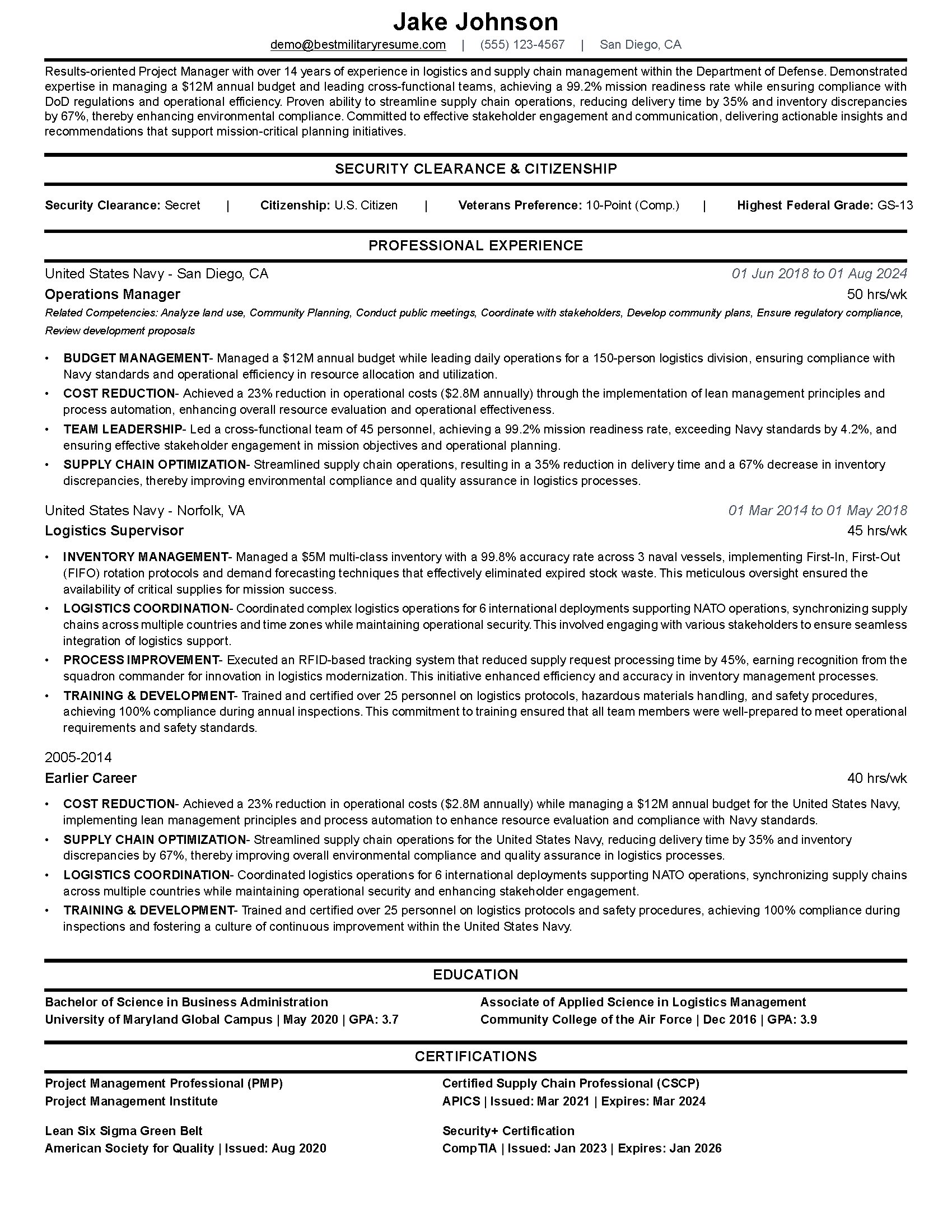
This is where most veteran resumes fail. You have the experience. You did the work. But your resume describes it using military language that a civilian HR specialist cannot evaluate.
Federal HR does not interpret your resume. They compare it to the specialized experience statement. If the words do not match, you do not qualify. It sounds rigid because it is rigid. OPM built the system to be objective and consistent.
Here is the process that has worked for me across six federal career fields.
Step 1: Pull the Exact Requirements
Copy the specialized experience statement word for word. Break it into individual tasks. If it says "developing policies and procedures, managing budgets, and supervising staff," that is three separate requirements.
Step 2: Match Each One to Your Military Experience
For each requirement, identify where you did that work. Do not limit yourself to your primary MOS or rating. Think about additional duties, collateral assignments, deployment roles, and temporary positions. The time you served as the unit safety officer counts as safety management experience even if your MOS was something else.
Step 3: Write Bullets That Use the Announcement Language
Your resume bullets should use the same key phrases from the announcement. If the announcement says "analyzing program performance data," your bullet should say "analyzed program performance data" and then describe the military context with numbers.
"Served as BN S4 OIC. Managed GCSS-Army operations and oversaw property book for 600-PAX organization. Conducted 10% inventories monthly."
"Managed supply chain operations for a 600-person organization using enterprise resource planning (ERP) systems. Oversaw inventory valued at $38M. Conducted cyclic audits and maintained 100% accountability across two annual inspections."
The second version says the same thing. But it uses the language a federal HR specialist can match to the specialized experience statement. That match is what gets you referred.
Step 4: Add Numbers and Scope
Federal HR wants to see the scale of your work. How many people did you supervise? What was the dollar value? How many units or clients did you support? Numbers prove that your experience matches the complexity level the announcement requires.
An E-6 who "supervised 12 personnel and managed equipment valued at $4.2M" shows GS-7/GS-9 level scope. An E-8 who "directed operations for a 200-person organization and managed a $15M annual budget" shows GS-11/GS-12 scope. The numbers tell the story.
Step 5: Verify Every Requirement Is Covered
Go back to your checklist from Step 1. Read each requirement. Then find the matching bullet on your resume. If one requirement is missing, add it. Missing even one element can result in a "Not Qualified" determination.
If you want a deeper look at the translation process with career-specific examples, check out our specialized experience translation guide.
The One-Year Rule and How to Meet It
Specialized experience requires 52 weeks of qualifying work at the required grade level. This is not flexible. HR counts the months on your resume to verify you meet the time requirement.
How the Clock Works
Your resume must show month and year start/end dates for each position. If you held a relevant job for 14 months, you meet the one-year requirement. If you held it for 8 months, you do not. Even if the experience was outstanding.
Make sure your hours per week and dates are formatted correctly on your federal resume. HR uses both fields to calculate total qualifying time.
Can You Combine Multiple Positions?
Yes. You can combine experience from different jobs to reach one year. But each position must involve the type of work described in the specialized experience statement. Six months as a logistics manager and six months as a supply NCO can combine if both involved the tasks the announcement requires.
Here is what you cannot do. You cannot combine six months of logistics work and six months of infantry work to qualify for a logistics position. Both positions must involve the relevant work.
Military Time Counts
Federal specialized experience does not have to come from federal jobs. Military experience counts. Contractor experience counts. Private sector experience counts. As long as the work matches the type and level described in the announcement, it qualifies.
This is where veterans have a real advantage. Four years of active duty often covers the one-year requirement many times over. You just need to describe it in the format federal HR expects.
"I spent 1.5 years applying for federal jobs after separating and got zero callbacks. Every single time, it was the specialized experience section that tripped me up. My resume had the experience but not the language. Once I figured out the formula, I changed federal career fields five more times."
Common Mistakes That Get You Marked "Not Qualified"
After helping 24,744 veterans through BMR, these are the patterns we see over and over. Each one results in a "Not Referred" notice even though the veteran had the experience to qualify.
Mistake 1: Writing a Generic Resume
One resume for every job does not work in the federal system. Each announcement has a unique specialized experience statement. Your resume needs to address that specific statement. A resume that worked for a GS-9 Program Analyst at the Army Corps of Engineers will not work for a GS-9 Program Analyst at DHS unless the statements happen to match.
Tailor every resume to the specific announcement. Use the BMR Federal Resume Builder to match your experience to each posting.
Mistake 2: Using Military Jargon Without Translation
Your resume says "managed the BDE TOC during JRTC rotation." A federal HR specialist who has never served reads that and cannot match it to "managed operations center during large-scale training exercises coordinating 4,000+ personnel." Same experience. The second version qualifies you. The first one does not.
Mistake 3: Missing One Requirement
The specialized experience statement lists five tasks. Your resume covers four of them well. You still get marked "Not Qualified." Federal HR cannot give you credit for requirements your resume does not address. Cover every single one.
Mistake 4: Not Showing the Right Grade Level
You have GS-12 level experience but you describe it like GS-7 work. Saying "assisted with budget management" sounds like support-level work. Saying "managed a $6.2M annual operating budget, allocated resources across four departments, and briefed senior leadership on quarterly variances" sounds like GS-11/GS-12 work. The difference is scope, complexity, and independence.
Mistake 5: Wrong Date Format or Missing Hours
Federal resumes require month/year start and end dates plus hours worked per week for each position. If your resume says "2019 - 2022" with no months and no hours, HR cannot calculate whether you meet the one-year time requirement. They will not guess in your favor.
1 Read the Announcement First
2 Match Each Requirement
3 Write Matching Bullets
4 Verify Dates and Hours
5 Cross-Check Before Submitting
How Specialized Experience Connects to the Questionnaire
Most USAJobs announcements also include a self-assessment questionnaire. This is separate from the specialized experience requirement, but they work together.
The questionnaire asks you to rate your own skill level on tasks related to the job. You select "Expert," "Advanced," "Intermediate," or "No experience" for each question. Here is the problem: many veterans undersell themselves on the questionnaire and then get ranked lower than they should.
If you supervised 30 people and managed a multi-million dollar budget, you are an expert at supervision and budget management. Do not select "Intermediate" out of modesty. The questionnaire score determines which category rating bucket you land in. "Best Qualified," "Well Qualified," or "Qualified." The higher the bucket, the better your chances.
But your questionnaire answers must match your resume. If you rate yourself "Expert" at budget management, your resume must show budget management experience. HR can (and does) downgrade applicants whose questionnaires do not match their resumes. Answer honestly, but do not sell yourself short.
What to Do Next
Specialized experience is a system. Once you understand the rules, you can work them. Here is your action plan.
First, find a job on USAJobs that matches your background. Read the specialized experience statement carefully. Break it into individual requirements and write each one on a separate line.
Second, match each requirement to your military experience. Think beyond your primary MOS or rating. Additional duties, collateral assignments, and deployment roles all count. Find your military job series equivalent to know which federal positions are the best fit.
Third, write resume bullets that mirror the announcement language. Use the same key phrases. Add numbers and scope. Verify that your dates and hours are formatted correctly.
Fourth, use the BMR Federal Resume Builder to tailor your resume to each announcement. Paste the job posting and the tool matches your experience to the requirements. It handles the translation and formatting so you can focus on applying.
Your resume should be 2 pages max with all the federal-specific details: hours per week, supervisor contact info, and detailed duty descriptions. That is the current standard.
The system works. You just have to know how to work it.
Frequently Asked Questions
What is specialized experience on USAJobs?
Does military experience count as specialized experience?
How do I know what grade level my military experience equals?
What does equivalent to the next lower grade level mean?
Can I substitute education for specialized experience?
Why did I get Not Referred if I have the experience?
Do I need to tailor my resume for every USAJobs application?
What is the difference between such as and must include in specialized experience?
About the author
Brad Tachi is the CEO and founder of Best Military Resume and a 2025 Military Friendly Vetrepreneur of the Year award recipient for overseas excellence. A former U.S. Navy Diver with over 20 years of combined military, private sector, and federal government experience, Brad brings unparalleled expertise to help veterans and military service members successfully transition to rewarding civilian careers. Having personally navigated the military-to-civilian transition, Brad deeply understands the challenges veterans face and specializes in translating military experience into compelling resumes that capture the attention of civilian employers. Through Best Military Resume, Brad has helped thousands of service members land their dream jobs by providing expert resume writing, career coaching, and job search strategies tailored specifically for the veteran community.
