Military to Warehouse Management: Skills That Get You Hired
Michael got only rejections. Then a $100K facilities manager role.
Michael, E-7, Navy, tried a ton of outside help before BMR
You ran a motor pool with 40 vehicles and a maintenance cycle that never stopped. You tracked serialized gear across three continents. You moved 200 pallets of ammunition from a ship to a staging area in under 12 hours.
And now you are staring at a warehouse manager job posting that asks for "inventory control experience" and "team leadership in a fast-paced distribution environment." You have all of that. You just need to prove it in words a civilian hiring manager will recognize.
Warehouse management is one of the best fits for veterans with supply, logistics, or operations backgrounds. The pay is solid. The demand is high. And the skills you already have map directly to what employers need. This guide breaks down exactly how to make that move.
Why Warehouse Management Fits Veterans So Well
Warehouse management is about controlling chaos on a schedule. Product comes in. Product goes out. Everything gets counted, stored, tracked, and shipped on time. If that sounds like your last duty station, it should.
The military trains people to manage inventory under pressure. You counted sensitive items at 0300. You ran cyclic inventories during field exercises. You signed hand receipts worth millions. That is warehouse management. The only difference is the building.
BLS data shows the median pay for transportation, storage, and distribution managers was $99,200 per year as of May 2023. Entry-level warehouse supervisor roles start around $50,000 to $65,000. Senior operations manager positions at large distribution centers can push past $120,000.
The warehouse and distribution industry is not slowing down. E-commerce growth means more fulfillment centers, more distribution hubs, and more people needed to run them. Amazon alone has over 1,000 facilities in the U.S. Add in Walmart, FedEx, UPS, XPO Logistics, and dozens of regional distributors. The jobs are there.
Which Military Backgrounds Translate Best?
You do not need a specific MOS or rating to break into warehouse management. But some backgrounds give you a head start. Here are the ones that translate most directly.
Army: 92A (Automated Logistical Specialist), 92Y (Unit Supply Specialist), 88M (Motor Transport Operator), 88N (Transportation Management Coordinator), 92W (Water Treatment Specialist with storage operations)
Navy: LS (Logistics Specialist), SK (Storekeeper, now merged into LS), SH (Ship's Serviceman)
Marine Corps: 0431 (Logistics/Embarkation Specialist), 3051 (Inventory Management Specialist, formerly Warehouse Clerk), 0491 (Logistics/Mobility Chief)
Air Force: 2S0X1 (Supply Management), 2T1X1 (Vehicle Operations)
Coast Guard: SK (Storekeeper), YN (Yeoman with supply duties)
But here is what matters more than your specific job code. If you managed inventory, led a team, tracked equipment, or ran a supply room, you have warehouse management experience. The job title on your military records does not have to say "warehouse." Your duties do the talking.
Use BMR's MOS-to-civilian career tool to see exactly which warehouse and distribution roles match your military background.

What Do Warehouse Managers Actually Do?
Before you apply, you need to know what the civilian side looks like day to day. Warehouse management breaks into a few key areas.
Receiving and Shipping
Product arrives on trucks. Your team unloads it, checks it against purchase orders, logs it into the warehouse management system (WMS), and puts it away. On the outbound side, orders get picked, packed, staged, and loaded for delivery. If you ran a supply point or ammo holding area, you did this exact process.
Inventory Control
This is where veterans shine. Cyclic counts, wall-to-wall inventories, discrepancy resolution, and shrinkage tracking. You know what a 100% inventory looks like. You know what happens when things go missing. Civilian warehouses run the same process with different software.
Team Supervision
A warehouse supervisor typically manages 10 to 50 associates across multiple shifts. You schedule people, handle call-outs, run safety briefings, and track productivity numbers. If you led a squad, a section, or a platoon, you already know how to manage a shift.
Safety and Compliance
OSHA regulations, forklift certifications, hazmat handling, PPE requirements. The military drills safety into everything. Warehouses need that same discipline. Your experience with risk assessments, safety stand-downs, and compliance inspections gives you an edge.
Warehouse Management vs. Logistics vs. Supply Chain
Warehouse management focuses on the physical building: receiving, storing, picking, packing, and shipping. Logistics covers the transportation and distribution network between locations. Supply chain management sits above both and includes procurement, planning, and vendor relationships. This article covers the warehouse floor. For broader logistics roles, check our veteran logistics career guide.
How to Translate Your Military Experience for Warehouse Jobs
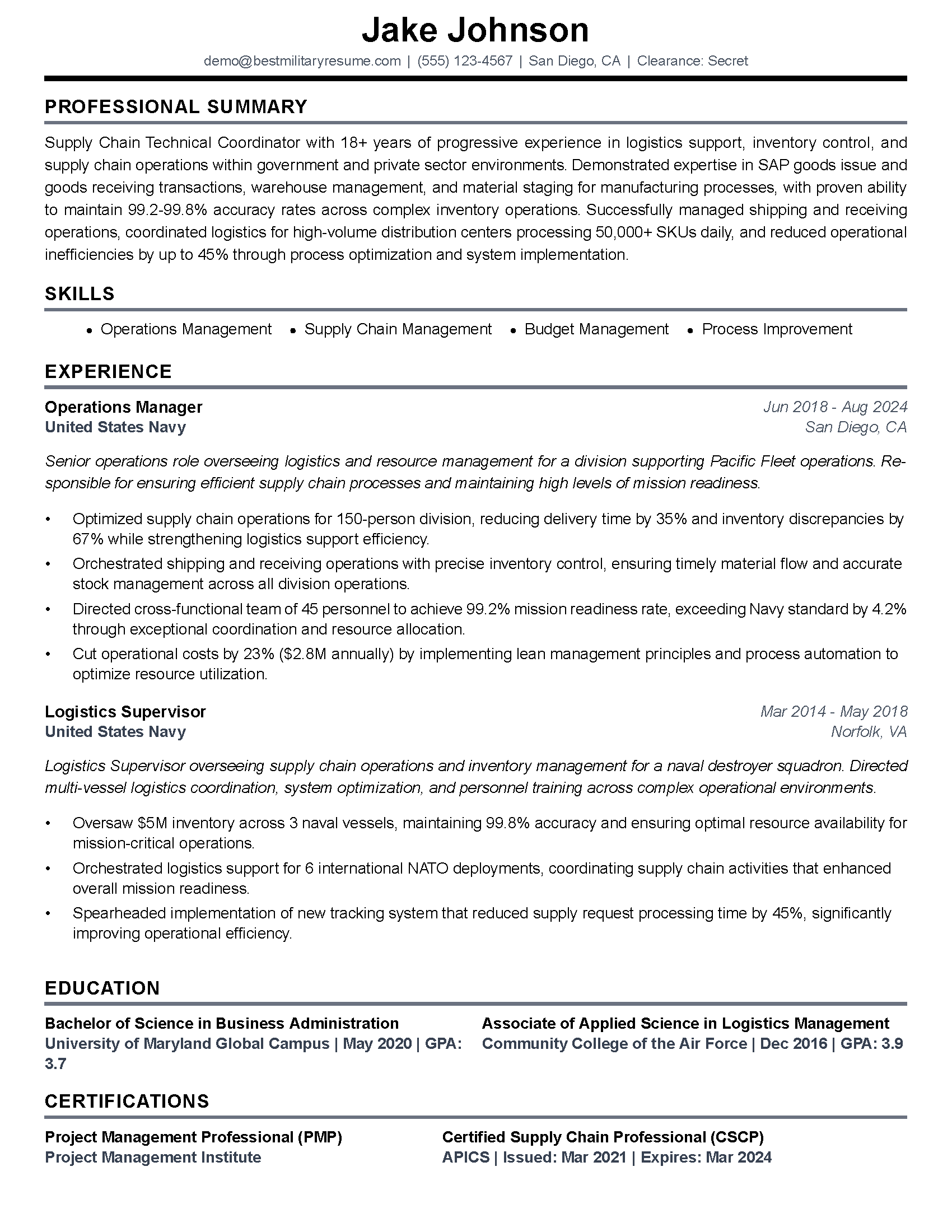
The skills are the same. The language is different. Here is how to translate what you did into what warehouse employers want to see on a resume.
"Managed Class IX repair parts for a 44-vehicle motor pool. Conducted 100% CSDP inventories IAW AR 710-2. Maintained zero discrepancies across 3 consecutive command inspections."
"Managed $2.1M parts inventory supporting 44 vehicles. Ran quarterly cycle counts and annual wall-to-wall inventories. Maintained 100% accuracy across 3 consecutive audits with zero shrinkage."
Notice what changed. The military acronyms are gone. The regulation numbers are gone. But the numbers and results stayed. That is the key. Keep your metrics. Drop the jargon.
Here are more translations that work for warehouse resumes:
- GCSS-Army or DPAS experience: "Proficient in enterprise inventory management systems (WMS/ERP)"
- Hand receipt holder for $5M in equipment: "Accountable for $5M in inventory across multiple storage locations"
- Led a 12-soldier supply section: "Supervised 12-person warehouse team across receiving, storage, and distribution operations"
- Ran a container staging area during deployment: "Managed high-volume staging and shipping operations processing 100+ containers per week"
- Conducted sensitive item inventories: "Executed daily and weekly cycle counts on high-value inventory with 100% accountability"
Your resume needs to show these translations clearly. BMR's resume builder handles the military-to-civilian translation and formats your experience for warehouse hiring managers.
Top Employers Hiring Veterans for Warehouse Roles
The biggest warehouse employers actively recruit veterans. Many have veteran hiring programs with dedicated recruiters. Here are the companies to target.
Major Distribution and E-Commerce
- Amazon: Military hiring program with direct pathways to Area Manager and Operations Manager roles. Over 1,000 U.S. facilities.
- Walmart: Veterans Welcome Home Commitment guarantees a job offer to any eligible veteran within 12 months of discharge. 190+ distribution centers.
- FedEx: Veteran hiring initiatives across Ground, Express, and Freight divisions. Hub manager and sort manager roles.
- UPS: Over 30,000 veterans employed. Warehouse supervisor and package operations manager positions.
Third-Party Logistics (3PL)
- XPO Logistics: One of the largest 3PL companies. Warehouse operations manager roles across 750+ locations.
- C.H. Robinson: Warehouse coordinator and distribution supervisor positions.
- DHL Supply Chain: Site manager and shift supervisor roles. Global operations with military-friendly hiring.
- Ryder: Warehouse management positions tied to their fleet management operations.
Defense and Government Contractors
- Defense Logistics Agency (DLA): Federal warehouse and distribution jobs. Your military supply experience counts directly toward qualifications. GS-2001 (Supply Management) and GS-2010 (Inventory Management) series.
- Lockheed Martin: Warehouse and material management roles supporting defense contracts.
- General Dynamics: Parts and inventory management at production and repair facilities.
Many of these companies also participate in SkillBridge programs. You can start working at a distribution center during your last 180 days of service and transition directly into a full-time role.
Certifications That Give You an Edge
You do not always need certifications to get hired in warehouse management. Many employers train on the job. But the right cert can move you from warehouse associate to warehouse manager faster. Here are the ones that matter most.
For Warehouse Operations
- OSHA 10 or OSHA 30 (General Industry): Shows you understand workplace safety regulations. Many employers list this as preferred. Cost is $25 to $200 depending on provider. Some TAP programs offer it free.
- Forklift Operator Certification: Required at most warehouses. Usually provided by the employer, but having it in advance shows initiative. Takes 1 to 2 days.
- Certified Logistics Associate (CLA): Entry-level cert from MSSC (Manufacturing Skill Standards Council). Good for proving foundational knowledge. GI Bill eligible through approved training providers.
For Management Advancement
- APICS CSCP (Certified Supply Chain Professional): Industry-standard cert for moving into senior operations roles. Requires 3 years of experience. Costs around $2,000 to $3,500 with study materials. GI Bill eligible.
- Lean Six Sigma Green Belt: Shows you can improve processes and reduce waste. Warehouses love this. Many veterans get this through SkillBridge or free programs. Cost ranges from free to $3,000.
- PMP (Project Management Professional): Valuable for senior warehouse and distribution center management roles. Your military project experience counts toward the hours requirement.
Key Takeaway
Do not wait until you separate to start certifications. OSHA 10 and forklift certs take days, not months. Lean Six Sigma Green Belt can be done through free military programs. Stack these before your transition date and you will already be ahead of civilian candidates.
What the Career Path Looks Like
Warehouse management has a clear ladder. Unlike some industries where promotions are vague, distribution centers have defined roles with measurable jump points.
Warehouse Associate / Material Handler: $35,000 to $45,000. Entry point. Picking, packing, receiving. Most veterans should aim higher than this, but it is a starting point if you need to get your foot in the door fast.
Warehouse Supervisor / Shift Lead: $50,000 to $70,000. You manage a team of 10 to 30 associates on a shift. This is where most E-5 and E-6 veterans should target. Your military leadership experience maps directly.
Warehouse Manager / Operations Manager: $70,000 to $100,000. You run the full facility or a major section of it. Budget responsibility, staffing, safety compliance, and productivity metrics. E-7 and above, plus junior officers, are well-positioned for this.
Distribution Center Director / Regional Manager: $100,000 to $150,000+. You oversee multiple facilities or a high-volume distribution center. This requires 5+ years in warehouse management or equivalent experience. Senior NCOs and field-grade officers with logistics backgrounds can target this within a few years.
The jump from supervisor to manager often comes down to one thing: can you talk about process improvement with numbers? If you reduced inventory discrepancies by 15%, cut load times by 20 minutes per truck, or improved pick accuracy from 97% to 99.5%, those stories get you promoted. The military gave you those stories. You just need to tell them.
For help mapping your military rank to the right civilian title and salary range, check out our military rank to civilian title guide.
How to Write Your Resume for Warehouse Management
After helping 24,744 veterans build resumes through BMR, I see the same resume mistakes from people targeting warehouse jobs. Here is how to fix them.
Lead With Numbers
Warehouse hiring managers care about volume, accuracy, and speed. Every bullet on your resume should include at least one number. Dollar values of inventory managed. Number of people supervised. Throughput rates. Accuracy percentages.
Weak: "Responsible for managing supplies and equipment."
Strong: "Managed $3.2M equipment inventory across 4 storage locations. Processed 150+ supply requests weekly with 99.7% fill rate."
Use Warehouse Industry Keywords
These are the terms that warehouse hiring managers look for. Work them into your resume naturally.
- Warehouse Management System (WMS)
- Inventory control and cycle counting
- Receiving, put-away, pick, pack, ship
- OSHA compliance and safety protocols
- Forklift operations (sit-down, stand-up, reach truck)
- KPI tracking (fill rate, on-time shipping, accuracy)
- Lean operations and process improvement
- RF scanners and barcode systems
- Cross-docking and staging
- Labor planning and shift scheduling
You do not need to have used the exact civilian software. If you used GCSS-Army, Global Combat Support System, DPAS, or any military inventory system, you can learn SAP, Manhattan, or Oracle WMS. The concepts are the same. The buttons are different.
Show Leadership as a Function, Not a Title
Civilian employers do not know what an E-6 does. They do know what a shift supervisor does. Frame your military leadership in terms of team size, shift coverage, and operational outcomes.
Weak: "Served as squad leader with direct oversight of soldiers."
Strong: "Led 12-person team across day and night shifts. Responsible for task assignment, performance tracking, safety compliance, and meeting daily throughput targets."
Use our career transition timeline guide to plan when to start building your resume before you separate.
Federal Warehouse Jobs: GS Positions for Veterans
The federal government runs massive warehouse and distribution operations. DLA alone manages 26 distribution centers across the country. If you want to stay connected to the military mission while working a civilian job, federal warehouse management is a strong option.
Key GS series for warehouse management careers:
- GS-2001 (General Supply): Supply management and distribution roles at federal facilities
- GS-2010 (Inventory Management): Inventory control specialist positions. Your military inventory experience qualifies directly.
- GS-2030 (Distribution Facilities and Warehouse Management): This is the direct match. Manages federal warehouses and distribution centers.
- GS-2003 (Supply Program Management): Senior supply management roles overseeing programs
- GS-2032 (Packaging): Specialized packaging and crating operations
- WG/WS Wage Grade positions: Hands-on warehouse worker and supervisor roles at federal depots. Often faster to get hired into than GS positions.
Federal resumes are 2 pages max. They need more detail than a private-sector resume. Include hours per week, supervisor name and phone number, and specific duties. But keep it to 2 pages.
Veterans get preference points on federal applications. If you have a service-connected disability rating, you get additional priority. Use BMR's federal resume builder to format your warehouse experience correctly for USAJOBS.
"After I separated from the Navy, I found out that federal agencies like DLA were hiring for skills I already had. The work was familiar. I just had to put it on paper in a format they recognized."
Interview Tips for Warehouse Management Positions
Warehouse interviews are practical. Hiring managers want to know you can run a shift, solve problems, and keep people safe. Here is what to expect.
Common questions you will face:
- "Tell me about a time you improved a process." Use a military example. Reorganizing a supply room to cut issue times. Redesigning a load plan to fit more cargo. Changing an inventory procedure to reduce errors.
- "How do you handle an underperforming team member?" This is leadership 101 in the military. Counseling, retraining, setting clear standards, and following up. Just tell it in civilian language.
- "What experience do you have with WMS or inventory software?" Be honest about which systems you used. Then explain that you learned military systems quickly and can pick up civilian platforms the same way.
- "How do you prioritize when multiple shipments are due at the same time?" You triaged competing priorities in the military daily. Tell that story.
Prepare for your warehouse interviews with our veteran interview questions guide to practice the 15 most common questions.
Related Careers Worth Exploring
Warehouse management is a strong path. But it is not the only option for veterans with supply and operations backgrounds. Here are related careers that use similar skills.
- Supply chain analyst: More data and planning. Less floor operations. Good for veterans who prefer spreadsheets to forklifts. Read our military logistics to supply chain guide for details.
- Transportation and distribution manager: Focuses on getting products between locations. Overlaps with warehouse work but centers on routes, carriers, and shipping schedules.
- Railroad operations: Steady pay, union benefits, and a structured work environment. Check our military to railroad career guide if this interests you.
- Production and manufacturing supervisor: Similar team leadership skills. Focuses on building products rather than moving them.
- Federal logistics management (GS-0346): Government logistics planning and coordination. Requires more formal education but pays well at the GS-11 to GS-13 level.
Search all your options with BMR's jobs by MOS matching tool.
What to Do Next
Warehouse management is a career that rewards the exact skills the military taught you. Inventory accuracy, team leadership, safety discipline, and the ability to move product under pressure. The demand is high and growing.
Here is your action plan:
- Figure out which warehouse roles match your rank and experience level. Use the career path section above to find your starting point.
- Translate your military experience into warehouse language. Focus on numbers, outcomes, and team size.
- Get your OSHA 10 and forklift cert if you do not already have them. These are quick wins.
- Build a resume that speaks to warehouse hiring managers. BMR's resume builder handles the translation and formatting automatically.
- Apply to the big employers listed above. Target their veteran hiring programs for the fastest path in.
You already know how to run a warehouse. You just called it a supply room, a motor pool, or a staging area. Now put it on paper and go get the job.
Frequently Asked Questions
Do I need a degree to become a warehouse manager?
What is the starting salary for a veteran in warehouse management?
Which military MOS codes translate best to warehouse management?
Should I get certifications before applying to warehouse jobs?
Are there federal government warehouse jobs for veterans?
How do I explain military inventory systems on a civilian resume?
What is the difference between warehouse management and supply chain management?
Can I use SkillBridge to transition into warehouse management?
About the author
Brad Tachi is the CEO and founder of Best Military Resume and a 2025 Military Friendly Vetrepreneur of the Year award recipient for overseas excellence. A former U.S. Navy Diver with over 20 years of combined military, private sector, and federal government experience, Brad brings unparalleled expertise to help veterans and military service members successfully transition to rewarding civilian careers. Having personally navigated the military-to-civilian transition, Brad deeply understands the challenges veterans face and specializes in translating military experience into compelling resumes that capture the attention of civilian employers. Through Best Military Resume, Brad has helped thousands of service members land their dream jobs by providing expert resume writing, career coaching, and job search strategies tailored specifically for the veteran community.
