SkillBridge Programs List by Industry (2026)
Justin was hired during terminal leave. "The best resume I have ever seen."
Justin, E-7, Air Force, network engineering, named his number and got it
What Is DOD SkillBridge and Who Qualifies?
SkillBridge is a Department of Defense program. It lets active duty service members spend part of their final 180 days working with a civilian company. How much of that window you actually get now depends on your rank and your branch. Coast Guard members have no rank cap at all. Navy E-5 and below can still use the full 180 days. Everyone else usually gets 120, 90, or 60 days under 2025 and 2026 service policies. Air Force colonels need an exception to policy to take part at all. You stay on military pay and benefits while gaining hands-on experience in a civilian role. The company gets a trained, vetted worker at no labor cost. You get a running start on your post-military career.
Eligibility has a few parts. You need at least 180 days of active duty already behind you. You need to be within 180 days of your separation date. And you need approval from the right commander, which now depends on your rank. All branches participate: Army, Navy, Air Force, Marines, Space Force, and Coast Guard. The official list of approved programs lives at skillbridge.mil, which DOD maintains and updates regularly.
I built BMR specifically because my own transition was a mess. When I separated as a Navy Diver about ten years ago, SkillBridge existed but wasn't well-known. Today the directory lists thousands of approved programs across 24 industry categories. The challenge isn't finding a program. It's picking the right one and putting together an application that actually gets you selected.
Key Takeaway
SkillBridge is not an internship in the traditional sense. You keep your military pay, BAH, and benefits the entire time. The civilian company pays nothing for your labor, which is why so many Fortune 500 companies participate.
One important distinction: SkillBridge is about the employer relationship, not command paperwork. Your resume for SkillBridge targets the company you want to work with. Command approval runs on a separate track, and the paperwork differs by branch. The Army uses a Soldier participation memorandum signed by the approval authority in your chain of command. The Air Force and Space Force route everything through AFVEC and issue a Memorandum of Participation.
How Do You Find Approved SkillBridge Programs?
The DOD SkillBridge website at skillbridge.mil is the official directory. You can filter by location, industry, and company. As of DoD's Q4 2026 reporting it lists 6,154 approved organizations and 11,646 positions. Those sit across 24 industry categories, and new ones get added every enrollment cycle. But the website alone won't tell you which programs lead to job offers. Some use you for free labor and send you on your way.
Start by filtering for your target industry and preferred location. If you're open to relocating, cast a wider net. Some programs are remote or hybrid, especially in tech and business operations. Note that the Air Force does not issue expedited orders for online or local SkillBridge programs. That only matters if you are relocating more than 50 miles. Ask every program for its own hiring rate. Some have the numbers ready and some don't, which tells you something.
Talk to veterans who've completed specific programs. LinkedIn is the best place for this. Search for the company name plus "SkillBridge" and you'll find people who've posted about their experience. Send them a message. Most veterans are happy to share what their program was actually like. Ask about the workload, the mentorship, and whether the full-time offer materialized.
Watch Out for Low-Quality Programs
Some SkillBridge programs are essentially free labor arrangements with no real training or path to employment. Before committing, ask directly: what percentage of participants received full-time offers in the last year? If they can't answer that question, keep looking.
Your installation's Transition Assistance office (SFL-TAP in the Army) keeps a list of programs. Those are the ones service members from your base have used. That local knowledge matters. It tells you which programs have a track record with your command.

Which Industries Have SkillBridge Programs?
SkillBridge programs span nearly every civilian industry. Here are a few of them, organized by industry with notable companies in each.
Information Technology and Cybersecurity
Tech shows up all over the SkillBridge directory. Military members with any tech exposure fit naturally here. That covers communications, signals intelligence, and cyber operations. But you don't need a technical MOS to qualify. Many IT SkillBridge programs include training that teaches you from the ground up.
Major programs: the Microsoft Software and Systems Academy (MSSA), Salesforce, and Cisco. These programs often include certification training alongside hands-on project work. Think CompTIA Security+ or Salesforce Admin.
Manufacturing and Skilled Trades
Mechanics, electricians, HVAC techs, welders: if you worked with your hands, manufacturing programs transfer your skills directly. Companies like Boeing, Lockheed Martin, Northrop Grumman, and General Dynamics run programs at facilities nationwide. Caterpillar and John Deere have programs for heavy equipment specialties.
Healthcare
Military medics, corpsmen, nurses, and healthcare administrators have growing options. Search the industry filters named Healthcare Support and Healthcare Practitioners and Technical on skillbridge.mil. Some programs help with civilian credential conversion. That's often the biggest barrier for military healthcare workers moving into civilian jobs.
Logistics and Supply Chain
This is where a huge number of military specialties translate directly. Amazon appears on the DoD authorized provider list. Check its current listing on skillbridge.mil for the actual roles. FedEx (listed in the directory as Federal Express Corporation) and J.B. Hunt are on the list too. If your MOS involved supply, transportation, or warehouse management, these are strong fits.
Industries With Strong SkillBridge Options
IT / Cybersecurity
Microsoft, Salesforce, Cisco
Manufacturing / Skilled Trades
Boeing, Lockheed Martin, Northrop Grumman, Caterpillar
Logistics / Supply Chain
Amazon, FedEx, J.B. Hunt
Business / Finance / Project Management
JPMorgan Chase, USAA, Deloitte, Booz Allen Hamilton
Healthcare
Filters: Healthcare Support, Healthcare Practitioners and Technical
Business, Finance, and Project Management
Financial services firms have ramped up SkillBridge participation. JPMorgan Chase and USAA are both approved providers. So are the consulting firms Deloitte and Booz Allen Hamilton. Military officers and senior NCOs with leadership, budgeting, and project management experience are strong candidates. Many of these programs fast-track PMP or Six Sigma certification.
Construction and Energy
Combat engineers, utilities specialists, and power generation MOSs align well here. Fluor and AECOM both run programs. So do a range of regional contractors under the Construction and Extraction industry filter. These paths lead into construction management, energy infrastructure, and facilities engineering. Civilian demand for skilled trades is strong, so these programs have a real reason to hire you.
What Does the SkillBridge Application Timeline Look Like?
Timing matters more than most people realize. You can't just decide you want to do SkillBridge and start next month. The process takes planning. Wait too long and you run out of time in your window.
12+ Months Out: Research Programs
Browse skillbridge.mil, connect with alumni on LinkedIn, then pick your top 4-5 programs.
9 Months Out: Apply to Programs
Submit applications to your target companies. Many competitive programs fill spots months in advance. Apply to multiple programs as backup.
6 Months Out: Secure Command Approval
Once a company accepts you, start the approval paperwork. The Army uses a Soldier participation memorandum. The Air Force and Space Force use AFVEC. Brief your commander on the program details.
Your Start Date: 180, 120, 90, or 60 Days Out
Your rank and branch set the maximum. Check your service's SkillBridge rank restriction table before you plan anything. In the Navy that cap is inclusive, so terminal leave and PTDY count against the same total. You begin while still on active duty pay and benefits. Focus on proving yourself, because this is a long job interview.
The biggest mistake I see through BMR is waiting until 6 months out to start looking at programs. By that point the most competitive programs may already be full for your window. That includes Microsoft MSSA and Salesforce. Start researching at the 12-month mark even if you can't formally apply yet.
Command approval varies wildly by unit, and since 2025 the required approval level scales with your rank. Junior enlisted need a field grade commander in every service. Mid-grade enlisted often need the first O-6 in the chain. In the Army, Marine Corps, and Space Force the most senior tiers need a general officer. The Navy stays at a field grade officer at every rank. Navy O-4 and above also need an OPNAV endorsement. Start that conversation early, because higher approval authority means longer routing. Some commands are fully supportive and process the paperwork in weeks. Others push back, especially if you're in a critical billet or your unit is short-staffed. Apply to more than one program. A backup protects you if your first choice falls through or approval drags.
How Should You Write a Resume for SkillBridge?
Your SkillBridge resume goes to the civilian company, not your command. This is a critical distinction. Command approval is handled through separate military channels, and the forms differ by branch. The resume is your pitch to the employer about why they should pick you for their program.
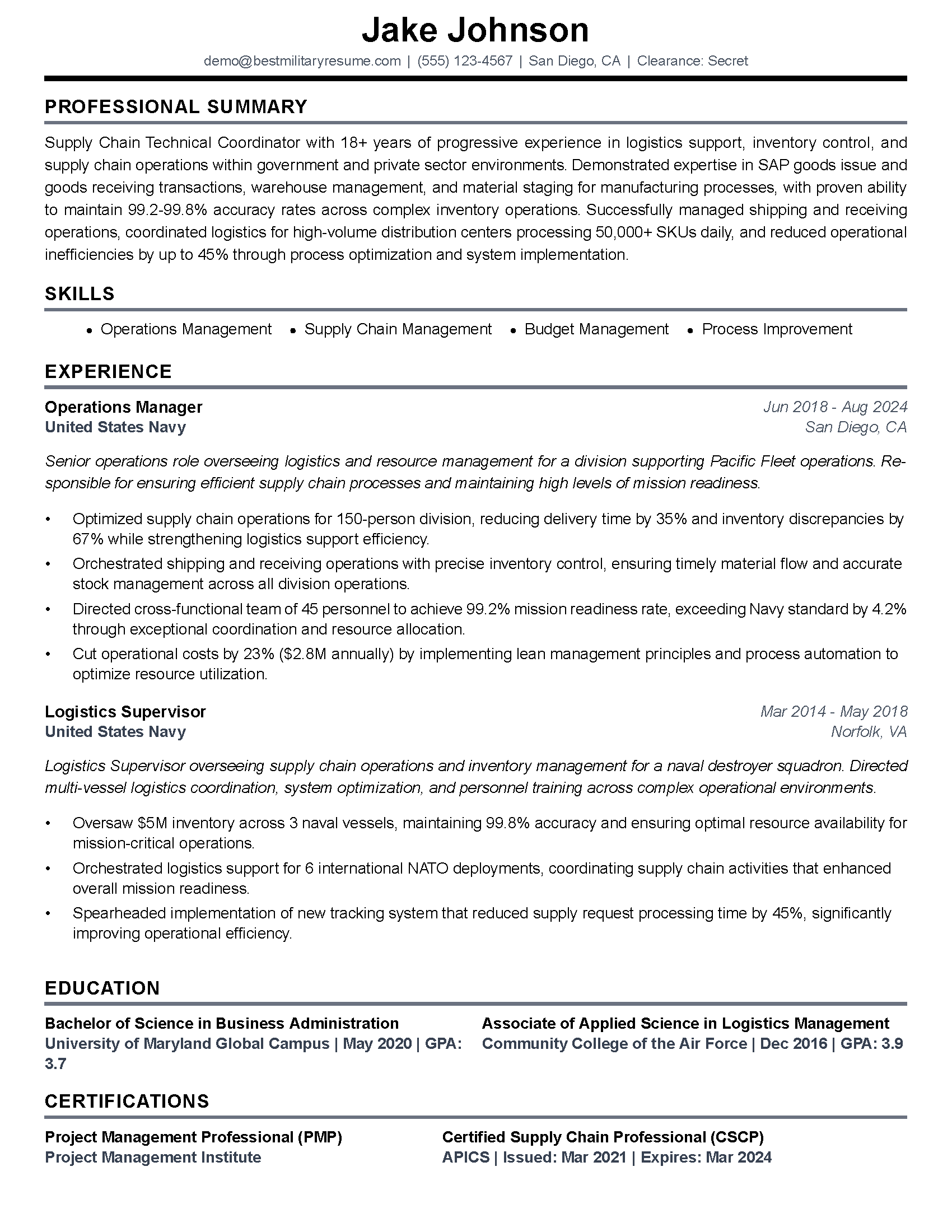
That means your resume needs to read like a civilian document. Translate your military terms into civilian equivalents. Drop the acronyms. Focus on outcomes and measurable results, not duty descriptions.
"Served as E-6 in charge of 12-person team conducting PMCS on wheeled and tracked vehicles IAW TM 9-2320. Maintained 98% OR rate across 47 pieces of rolling stock."
"Fleet Maintenance Supervisor managing 12 technicians across a 47-vehicle fleet. Maintained 98% operational availability through preventive maintenance scheduling and parts inventory management, reducing unplanned downtime by 22%."
Tailor the resume to the specific SkillBridge program and role. A resume aimed at an Amazon operations role should emphasize logistics, process improvement, and team leadership. A resume for Microsoft MSSA should highlight technical aptitude, problem-solving, and any coding or IT experience. Same person, different resume for each application.
BMR's Resume Builder handles the translation and tailoring automatically. Paste the SkillBridge program description in. It builds a resume matched to what that employer wants. The free tier gives you two tailored resumes, which is enough to apply to your top two programs.
What Makes a Strong SkillBridge Application Stand Out?
Getting selected for competitive SkillBridge programs takes more than meeting the eligibility rules. That goes double at companies like Microsoft, Amazon, or Salesforce. The best known programs are genuinely competitive. You're not the only person in your separation window applying. You need to stand out.
First, demonstrate genuine interest in the industry. If you're applying to a cybersecurity program, show that you've already started learning. Mention any self-study, certifications in progress, or relevant online coursework. Companies want participants who will hit the ground running. Not people who picked a program at random.
Second, connect your military experience to the role in specific terms. Don't just say you're a leader. Show how your actual job duties connect to what they need. A logistics NCO applying to Amazon should talk about inventory systems and throughput. They should also talk about managing distribution under time pressure. Those are the same problems Amazon solves at scale.
Third, reach out to the SkillBridge program coordinator directly if possible. A short, professional email expressing your interest and asking about the program structure shows initiative. Many coordinators are veterans themselves and appreciate direct communication over a cold application. Check LinkedIn for the program coordinator's contact info and connect with previous participants.
After helping 23,208 veterans and military spouses through BMR, the pattern is clear. The service members who get into top SkillBridge programs treat it like a job application. Not a military request form. They research the company, tailor their materials, and make personal connections before applying.
Does SkillBridge Actually Lead to Full-Time Jobs?
This is the question that matters most. SkillBridge is only valuable if it leads somewhere. There is no DOD-wide hiring statistic to lean on. GAO reported in 2024 that the services do not track SkillBridge outcomes consistently. What does exist is the standard every commercial provider signs. The DOD memorandum of understanding sets the bar. A high probability of employment means 75% or more of completers get a qualifying job offer. The MOU also sets an 85% offer rate as the goal. Ask a program how it performs against that bar.
But not all programs are equal. Some smaller companies use SkillBridge for free labor with no real intention of hiring. Before you commit, ask these questions: How many participants did you have last year? How many received full-time offers? What's the average starting salary for those who were hired? A legitimate program will have these numbers ready. Under paragraphs 4.2.21 and 4.2.22 of the DOD MOU, providers must report offer, hire, and salary data.
Treat your SkillBridge like a long job interview, because that's exactly what it is. Show up early. Ask questions. Take on extra projects. Build relationships beyond your immediate team. The people you work with during SkillBridge become your references, your network, and potentially your future coworkers.
"SkillBridge is a job interview where you still collect military pay. There is no better deal in the transition process. But you have to treat it like a job interview, not a vacation from the military."
If your SkillBridge doesn't end in a full-time offer, you still leave with civilian work experience. You also leave with industry contacts and possibly certifications. That puts you ahead of veterans who separate cold with only military experience on paper. Use a solid transition timeline to keep your job search moving during SkillBridge. Do that even while you're hoping for a direct hire.
The bottom line: SkillBridge works when you pick the right program. Prepare a strong employer-focused resume and treat the whole thing as an audition. Do those things and you walk out of uniform and into a paycheck. No gap in between.
Related: How to write a SkillBridge resume that gets you hired. Also see the complete Army ETS checklist for 2026.
Explore SkillBridge: Find SkillBridge opportunities and build your application with BMR.
Frequently Asked Questions
What is DOD SkillBridge?
Who is eligible for SkillBridge?
How do I find approved SkillBridge programs?
Does SkillBridge guarantee a job?
When should I start planning for SkillBridge?
Do I need a civilian resume for SkillBridge?
Can I do SkillBridge if my command says no?
What are the best SkillBridge programs in 2026?
About the Author
Brad Tachi is the CEO and founder of Best Military Resume and a 2025 Military Friendly Vetrepreneur of the Year award recipient for overseas excellence. A former U.S. Navy Diver with over 20 years of combined military, private sector, and federal government experience, Brad brings unparalleled expertise to help veterans and military service members successfully transition to rewarding civilian careers. Having personally navigated the military-to-civilian transition, Brad deeply understands the challenges veterans face and specializes in translating military experience into compelling resumes that capture the attention of civilian employers. Through Best Military Resume, Brad has helped thousands of service members land their dream jobs by providing expert resume writing, career coaching, and job search strategies tailored specifically for the veteran community.
