Andreas Story: How Experience and Certifications Changed His Career
Michael got only rejections. Then a $100K facilities manager role.
Michael, E-7, Navy, tried a ton of outside help before BMR
Andreas came to BMR the way a lot of veterans do — frustrated, about six months into his job search, with a resume that read like a military evaluation and a stack of applications that had gone nowhere. He had eight years of signals and network experience in the Army, a current Secret clearance, and two certifications he had just paid for out of pocket. On paper he looked strong. In the inbox of every recruiter he was targeting, he looked like noise.
This is his story, and I am telling it because the pattern shows up in my BMR dashboard every week. Experience plus certifications is the combination that actually moves veterans from stuck to hired. Not a new degree. Not a career coach. Not another round of TAP. Not a career pivot into something unrelated to what you already know. The right mix of what you already did in uniform and one or two certifications that give a civilian hiring manager a reason to pull your resume to the top of the pile.
Here is what changed for Andreas, what we built together on his resume, what cert stack moved the needle, and what you can pull from his path for your own.
Where Andreas Was When He Reached Out
Andreas had separated about seven months before he signed up for BMR. He was a 25B Information Technology Specialist in the Army, promoted to Sergeant, two deployments, and a final assignment running a small signal shop of six soldiers. His plan was straightforward. He wanted to move into a mid-level IT or cybersecurity role in the private sector, keep his clearance active by working for a cleared contractor, land somewhere near San Antonio because his spouse had a steady job there, and avoid a pay cut from his active duty base and allowances.
He had sent out well over a hundred applications. A small handful had turned into phone screens. A couple of those even went to final rounds, but the offers went to someone else. The rest were silence — no rejection email, no callback, nothing.
When I looked at his resume, the problem was not his background. His background was fine. The problem was that his resume was written for the Army, not for a civilian hiring manager running a 25-person pipeline through Workday.
Andreas by the Numbers
8 years active duty Army. 25B Information Technology Specialist. Secret clearance. Two certifications earned on active duty. A stack of applications going nowhere. Zero offers after roughly seven months of searching.
His resume had his MOS code in the job title line. It used terms like "S6 shop," "NIPR," and "BCT" without translation. His bullets were command voice — "Responsible for maintenance of tactical network infrastructure in deployed environment" — the exact phrasing you would see in an NCOER. And his certifications were listed at the very bottom, under his hobbies, in a font two sizes smaller than the rest of the document.
A hiring manager running a systems administrator search with 40 applicants in the queue is not going to sit with that resume and decode it. They are going to scan for keywords, miss them, and move on. ATS tools rank his resume lower than candidates who used the exact phrases from the job posting. That is how he ended up invisible.
What Was Actually Wrong with His Resume
The resume itself was not the disaster. The translation was. Andreas had every skill the jobs he was applying for required. He just was not speaking the language of the people doing the hiring.
Here is what I flagged when we went through it line by line.
Military Jargon With No Civilian Anchor
He was using acronyms like they were common knowledge. "Managed S6 operations for a 180-soldier maneuver company" means something specific to an Army reader. To a hiring manager at a cleared contractor, it reads as noise until they translate it themselves, which they will not do. The fix is not deleting the military context. It is adding the civilian equivalent right next to it.
"Served as S6 NCOIC responsible for NIPR/SIPR network operations and C4 systems maintenance in deployed OEF environment."
"Led IT operations for 180-person unit, managing classified and unclassified networks, endpoint security, and communications systems across a 9-month overseas deployment."
Same accomplishment. One reads as something an NCO understands. The other reads as something a hiring manager at Booz Allen can see on a resume and match to a job description. For a broader walkthrough of how to do this across every bullet, the military skills translation list covers dozens of examples across career fields.
Certifications Buried Instead of Leading
Andreas had Security+ and CCNA. Both are heavy hitters in cleared IT work. On his resume, they sat at the bottom of page two, right above "Hobbies: Running, home brewing." That order tells a hiring manager these are afterthoughts.
They should have been in the top third of page one, right under his summary, visible in the six-second scan a recruiter does before deciding to read more. A hiring manager scanning for "Security+" as a minimum qualification will not scroll through two pages to find it. They will move on.
No Keywords From Target Jobs
He was applying to "Cybersecurity Analyst," "Network Administrator," "Systems Administrator," and "SOC Analyst" roles but his resume used none of those exact phrases. Army terminology has its own vocabulary. If the job description uses "systems administrator" and your resume says "information technology specialist," ATS will rank you below candidates whose words match. You are not getting filtered out. You are sinking to the bottom of a stack that hiring managers never scroll through.
Accomplishments Without Numbers
Every bullet was a duty description. "Responsible for." "Tasked with." "Served as." "Assisted with." Zero numbers. No team sizes, no budgets, no uptime percentages, no incidents resolved. Army evals read that way by design. Civilian resumes do not. Hiring managers need to see scale to assess fit. "Managed network operations" reads weak next to "managed network operations for a 180-person organization with 99.7% uptime across a 12-month deployment."

The Certifications That Actually Moved the Needle
Andreas already had Security+ and CCNA when he came to BMR. Both are required or preferred for most cleared IT and cybersecurity roles, so he had done the work. The problem was pairing them with the right experience on the page.
We talked about what he wanted to do long-term. He liked the operations side more than the pure engineering side. He wanted to stay in cleared work. He was open to moving into a Security Operations Center role if it meant steady hours and fewer on-call nights. That pointed us at a specific set of job titles: SOC Analyst, Cybersecurity Analyst, Information Systems Security Officer, and mid-level Systems Administrator.
Looking at the job postings for those titles in his area, a few patterns showed up:
- Security+ was non-negotiable for 8570/8140 compliance. He had it. Checkmark.
- CCNA was a strong differentiator but not required for most SOC roles.
- A cloud certification was showing up in a big chunk of postings — AWS Certified Cloud Practitioner at minimum, AWS Security Specialty for senior roles.
- An active clearance was assumed, which Andreas already had. Without it, the same postings either disqualified him or offered a significantly lower band.
Andreas did not have the cloud piece. That was the gap. We talked about whether to pause the job search and go earn AWS Cloud Practitioner first, or keep applying and add it later. He decided to knock out AWS Cloud Practitioner in parallel while we rebuilt his resume. The exam is affordable, the prep is well-documented, and GI Bill-eligible veterans can get it covered. If you are looking at your own cert gaps, the GI Bill certifications list covers what is reimbursable and how to claim it.
Andreas's Certification Stack
CompTIA Security+
Non-negotiable for cleared IT roles under DoD 8140 compliance. He earned this on active duty.
Cisco CCNA
Strong differentiator for network-focused roles. Also earned on active duty.
AWS Certified Cloud Practitioner
Added during the job search to match the cloud experience showing up across a large share of his target postings.
Secret Clearance (Active)
Not a certification but treated like one on the resume — top of page one, clearly labeled.
The value of Security+ is well-documented for vets. It covers the 8140 requirement and most cleared employers will not hire for IT roles without it. If you are in a similar spot and need to knock it out fast, BMR has a piece on CompTIA Security+ free training for veterans that covers the actual paths to get funded.
How We Framed Experience and Certifications Together
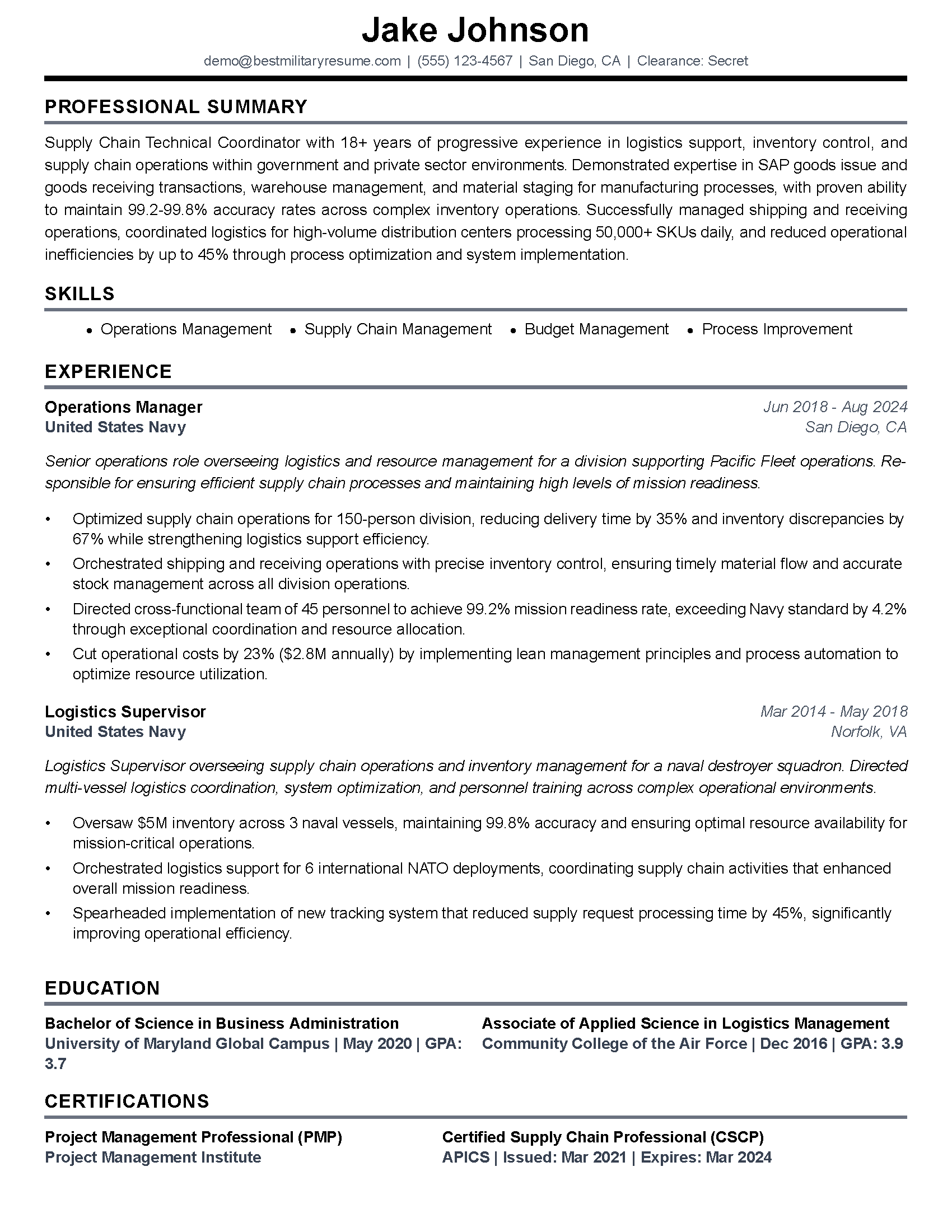
This is the part that actually changed Andreas's outcomes. Having the experience and having the certs was not enough. They needed to tell one story on the page, not live in separate sections.
We restructured his resume so the top third of page one hit a hiring manager with the full picture in one glance:
- Header line: Name, contact, Secret clearance (active) stated right next to his city
- Summary: Four sentences — years of experience, primary skill areas, certifications listed by name, target role
- Core competencies / keywords block: A tight list of the exact phrases recruiters search for, pulled from the job descriptions he was targeting
- Certifications section: Moved up, named clearly, with issue dates
Then the experience section below that backed everything in the summary with real examples. Every bullet was rewritten to show a result with a number attached. Instead of "Responsible for network operations," it became "Led network operations supporting 180 users across three sites, maintaining 99.7% uptime during combat deployment." Same fact. Completely different signal.
Key Takeaway
Certifications are proof. Experience is evidence. They only work together when the resume shows them in the same field of view — not with certs buried at the bottom and experience disconnected from the skills the job actually needs.
The other thing we did was write a tailored version of the resume for each job category. One version for SOC Analyst roles that led with security operations examples. One for Systems Administrator roles that led with network and endpoint management. One for ISSO-track roles that emphasized compliance and audit work he had done in unit inspections. One for general Cybersecurity Analyst roles that balanced the two. Same base resume, same experience, different emphasis on what got surfaced to the top.
This is what tailored resumes actually mean. Not rewriting from scratch for every application, but shifting the order and the bullet emphasis so the top third matches what that specific job posting asked for. A tool that does this automatically is a Military Resume Builder that takes a job posting and a base resume and produces a tailored version in a minute. That is the core of what BMR does.
What Changed After the Rebuild
Andreas passed AWS Cloud Practitioner in under a month, faster than the 30-day window he had given himself. We added it to the resume that afternoon. He started applying with the new version the next day.
Within a few weeks of sending the rebuilt resume, here is what the pipeline looked like:
- Far fewer applications than the first seven months, but each one more targeted
- A steady flow of recruiter screens, most of them reaching out within days of the application going in
- Multiple hiring manager interviews booked, with real back-and-forth about scope and team fit
- A couple of final-round panels
- One offer accepted — a mid-level SOC Analyst role at a cleared contractor in San Antonio, in the mid-$90s base with a clearance bonus on top
The callback rate jumped from near zero to something he could actually measure. Same person. Same background. Same clearance. Same years of service. The only things that changed were how his experience was framed and the addition of one cert that closed a visible gap on his resume.
That offer came in before he had even finished the second round of a different interview he had already scheduled. He ended up with competing offers by the end of the cycle and used one to negotiate the base pay up on the other.
What Veterans Can Pull From Andreas's Path
I am not going to sell you the idea that every transition works out this cleanly. Some take longer. Some require a career pivot that adds months. But the core pattern here holds across almost every BMR success story that shows up in my dashboard.
Your Experience Is Not the Problem
If you have solid time in service, a clean record, and a skill set that maps to civilian work, your experience is not the reason you are not getting callbacks. The reason is almost always that your resume is not letting a hiring manager see what you actually did in a format they can use. Fix the framing before you conclude you need more experience.
Certifications Fill Specific Gaps, Not All Gaps
Andreas did not need a new degree. He needed one cloud cert that kept showing up across his target postings. Before you pay for a bootcamp or start a second bachelor's, look at twenty job postings in your target role. Pull out every required and preferred cert. See which ones come up repeatedly. That is your list — not whatever a career coach tries to sell you. For a deeper look at which programs actually pay off, the career coach cost and ROI breakdown is worth reading before you spend real money.
Stop Applying While Your Resume Is Broken
This is the hard one to accept. Every application you send with a broken resume burns a shot at that job. You are putting yourself in a ranked stack below the candidates whose resumes were written for the civilian hiring process. Fix the document first, then apply. I know it feels productive to send 20 applications a day. It is not. It is creating a cycle of rejection that feeds into burnout and imposter syndrome.
Think in Certifications Stacks, Not Single Certs
One certification rarely changes a career on its own. What changes a career is a stack that signals competency across a full role. For Andreas, that was Security+ plus CCNA plus AWS Cloud Practitioner plus his clearance. For a project management path it might be PMP plus a specific industry cert. Think about what set of credentials your target role needs and work backward from there.
Apprenticeships Are an Underused Path
Andreas went the cert route because he already had the experience. If you are earlier in your career or pivoting into a new field, the veteran apprenticeship programs path can combine paid work with credentials in a way that civilian training programs cannot match. Worth considering before you commit to a full degree program.
The First 90 Days Matter Too
Landing the offer is half the job. The first 90 days of a civilian role are where veterans either build credibility or stumble. If you are closer to the offer stage than the application stage, the first 90 days guide is worth a read before your start date.
Where to Start If You Are Where Andreas Was
If you are in the middle of a job search that is not working, here is what I would do first — based on what moved the needle for Andreas and the thousands of BMR users whose resumes I have pulled apart.
Pull 20 target job postings
Pick the exact role you want. Save the descriptions. Highlight every required and preferred cert, skill, and keyword.
Identify your gaps honestly
What shows up in most of your postings that you do not already have? That is your priority cert. Everything else is secondary.
Rebuild the resume before you apply again
Translate every military term. Move certs to the top. Rewrite every bullet with a number. Kill the jargon.
Tailor for each job category
One base resume, multiple emphasis variants. Match keywords from the posting. Let the top third do the work.
Track the metrics
Applications out, screens booked, interviews landed. If your callback rate is barely moving the needle, the resume is still broken. Iterate.
BMR's Military Resume Builder handles the mechanics of this automatically. You paste the job description, paste your background, and it produces a tailored version with your military experience translated into the language of the specific role. It is what Andreas used to cut his rewrite time from hours down to minutes per application. The free tier covers two tailored resumes and two cover letters, which is enough to validate whether this approach works for your field before you do anything else.
But the tool is not magic. The inputs still have to be real. Your experience has to be described honestly, your certifications have to be current, and your target role has to match what you are actually qualified for. Andreas put in the work on his end — the cert, the targeting, the discipline to stop applying to broken jobs, and the patience to rebuild the resume before firing off another round. The resume just let the work he had already done finally show up for the hiring managers who needed to see it.
That is the lesson. Experience plus certifications, framed right, on a page a civilian hiring manager can read in six seconds. That is what changed everything for Andreas. It is what changes things for most of the veterans who come through BMR stuck in the same spot he was in. The background was never the issue. The translation was.
Frequently Asked Questions
What certifications helped Andreas land his IT job?
How long did it take Andreas to find a job after rebuilding his resume?
Why was Andreas getting no callbacks with a strong background?
Do I need a degree to transition into civilian IT from the military?
What is the single biggest resume mistake transitioning veterans make?
Should I pause my job search to get a new certification?
How do I know which certifications will actually help my career transition?
Can BMR help me do what Andreas did with my own resume?
About the Author
Brad Tachi is the CEO and founder of Best Military Resume and a 2025 Military Friendly Vetrepreneur of the Year award recipient for overseas excellence. A former U.S. Navy Diver with over 20 years of combined military, private sector, and federal government experience, Brad brings unparalleled expertise to help veterans and military service members successfully transition to rewarding civilian careers. Having personally navigated the military-to-civilian transition, Brad deeply understands the challenges veterans face and specializes in translating military experience into compelling resumes that capture the attention of civilian employers. Through Best Military Resume, Brad has helped thousands of service members land their dream jobs by providing expert resume writing, career coaching, and job search strategies tailored specifically for the veteran community.
