Military Skills for Resume: The Complete Translation List
Desiree landed a $135K hybrid senior financial consultant role.
Desiree, E-5, Army National Guard, the interviewer loved the resume from the top down
You spent years building skills that can run circles around what most civilian candidates bring to the table. The problem is your resume still says things like "supervised 12 personnel in a high-tempo operational environment" and the hiring manager has no idea what that means for their open project manager role.
This is the gap that costs veterans interviews. Not a lack of qualification — a lack of translation. The skills are there. The language on your resume just needs to match what recruiters and hiring managers are scanning for.
I built this list after spending 1.5 years post-separation sending out resumes that got zero callbacks. Once I figured out how to rewrite my Navy Diver experience into language that matched civilian job postings, I started landing interviews within weeks. Below is the exact framework: military skills organized by category, each one translated into civilian resume language with a ready-to-use bullet example.
Why Military Skills Need Translation on Your Resume
Military experience builds transferable skills faster than almost any civilian career path. A 24-year-old E-5 has more leadership, logistics, and crisis management reps than many mid-career civilian professionals. But when your resume uses military terminology — "NCOIC," "battle rhythm," "OPORD execution" — it creates a wall between your qualifications and the person reading your application.
Recruiters spend about 6 seconds on an initial resume scan. In those 6 seconds, they are looking for keywords that match the job description. If your skills section says "maintained PMCS on wheeled vehicles" and the job posting says "preventive maintenance" and "fleet management," you have the exact same skill described in a language the recruiter will not connect.
This is not about dumbing down your experience. It is about making sure the person reading your resume — who may have never served — can immediately see the match between what you have done and what they need. Your resume's first impression matters, and skills translation is what makes that impression land.
"I had six years of military experience and a resume full of acronyms. Zero callbacks for four months. I rewrote my skills section in one afternoon using civilian language, and I had two phone screens that same week."
Leadership and Management Skills
Every branch produces leaders. Whether you led a fire team of 4 or a battalion staff of 200, the core competencies are the same — and they are exactly what civilian employers pay a premium for. The key is framing your leadership in terms of team size, scope, and measurable outcomes.
Team Leadership
Military version: "Led a squad of 12 Soldiers during training exercises and field operations."
Civilian translation: Team Leadership, Cross-Functional Team Management, Direct Supervision
Resume bullet: "Led a 12-member team through daily operations, coordinating task assignments, performance evaluations, and professional development plans across a 24/7 schedule."
Personnel Development and Training
Military version: "Served as primary instructor for unit-level MOS training."
Civilian translation: Training Program Development, Employee Onboarding, Workforce Development
Resume bullet: "Designed and delivered a 40-hour technical training program for 85+ employees, reducing onboarding time by 30% and improving first-year retention rates."
Decision-Making Under Pressure
Military version: "Made time-critical decisions during high-stress operations."
Civilian translation: Crisis Management, Risk Assessment, Rapid Decision-Making
Resume bullet: "Managed real-time crisis response for a 150-person organization, coordinating resources across four departments to resolve critical incidents within established SLAs."
For more on quantifying your military experience with real numbers, check our dedicated guide with before-and-after examples.

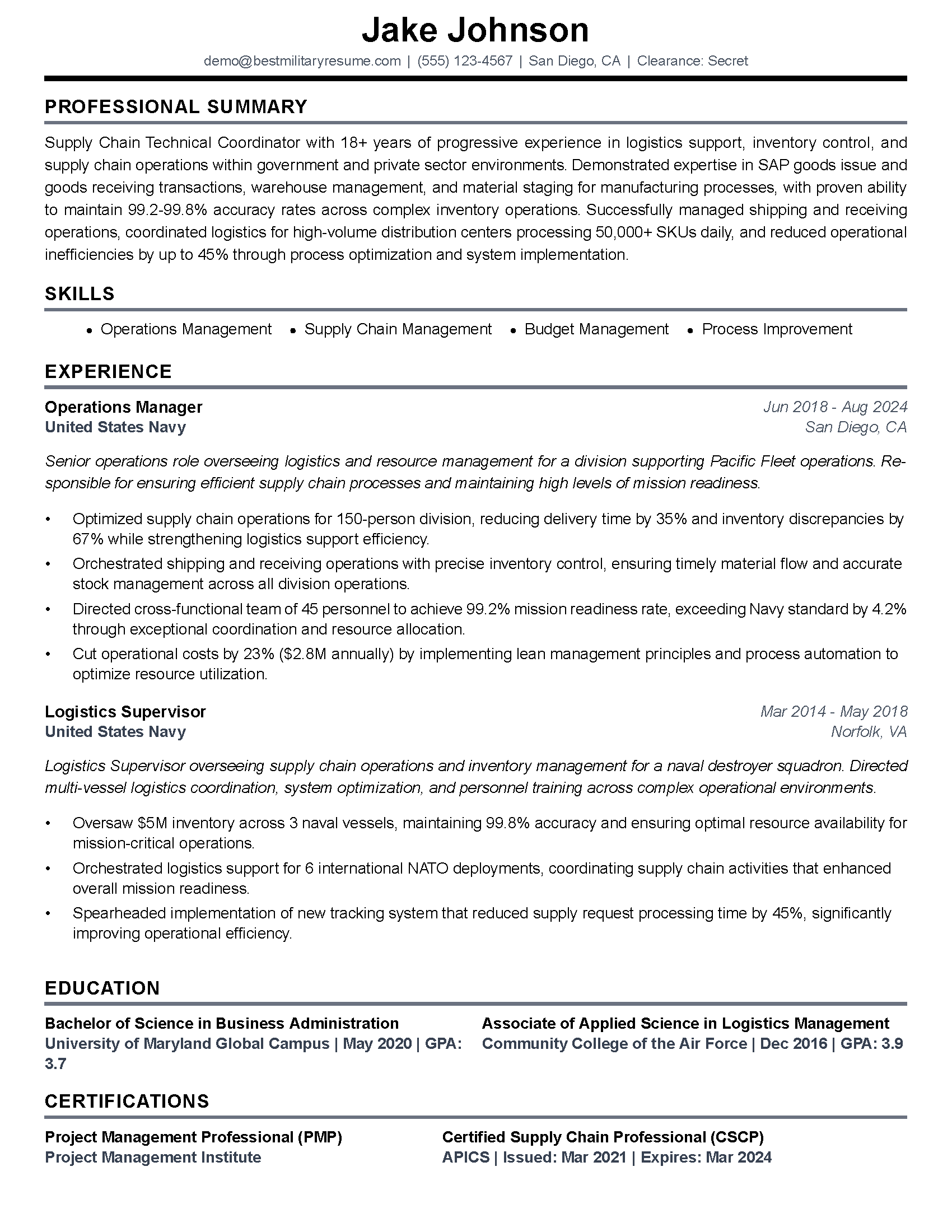
How to Translate Operations and Logistics Skills
If you touched supply, transportation, maintenance, or any kind of resource management in the military, you have logistics skills that civilian companies desperately need. Supply chain is one of the biggest hiring areas right now, and military logistics professionals are built for it.
Supply Chain Management
Military version: "Managed unit supply operations and maintained accountability for $2.3M in equipment."
Civilian translation: Supply Chain Management, Inventory Control, Asset Management
Resume bullet: "Managed a $2.3M inventory across 1,200+ line items, maintaining 99.2% accountability through cycle counts, audits, and automated tracking systems."
Route Planning and Distribution
Military version: "Planned and executed convoy operations across multiple FOBs."
Civilian translation: Route Optimization, Distribution Planning, Fleet Coordination
Resume bullet: "Planned and executed daily distribution routes for 14 vehicles serving 8 locations, reducing delivery times by 18% through route optimization analysis."
Maintenance and Equipment Readiness
Military version: "Maintained PMCS on all assigned wheeled and tracked vehicles."
Civilian translation: Preventive Maintenance, Fleet Management, Equipment Reliability
Resume bullet: "Directed preventive maintenance programs for a 40-vehicle fleet valued at $12M, achieving 95% operational readiness rate through scheduled inspections and parts forecasting."
"Maintained accountability of all MTOE equipment IAW AR 710-2 and conducted 100% inventories quarterly."
"Managed $4.8M equipment inventory for a 200-person organization, conducting quarterly audits and maintaining 100% asset accountability across 2,400+ items."
Process Improvement
Military version: "Identified and corrected deficiencies in unit SOPs."
Civilian translation: Process Improvement, Standard Operating Procedures, Continuous Improvement
Resume bullet: "Identified workflow bottlenecks in a 6-step procurement process, redesigning procedures to reduce processing time from 14 days to 8 days — a 43% improvement."
What Communication Skills Should You List?
Every military job requires communication — briefings, written reports, coordination across units, counseling subordinates. The civilian world values these same skills but calls them different things. Here is how to translate your communication experience into resume-ready language.
Briefings and Presentations
Military version: "Conducted daily operations briefs to command staff."
Civilian translation: Executive Presentations, Stakeholder Briefings, Data-Driven Reporting
Resume bullet: "Delivered daily status briefings to senior leadership (Director-level and above), synthesizing data from four operational divisions into actionable recommendations."
Written Communication
Military version: "Drafted award packages, counseling statements, and evaluation reports."
Civilian translation: Technical Writing, Business Correspondence, Performance Documentation
Resume bullet: "Authored 60+ performance evaluations, recognition nominations, and policy documents annually, maintaining compliance with organizational standards and deadlines."
Cross-Functional Coordination
Military version: "Coordinated operations between S-3, S-4, and attached units."
Civilian translation: Cross-Functional Collaboration, Interdepartmental Coordination, Stakeholder Management
Resume bullet: "Coordinated project timelines and resource allocation across four departments and two external partners, ensuring aligned deliverables for a $1.2M initiative."
Your professional summary is where these communication skills often make the biggest impact — it is the first thing a recruiter reads.
How to List Technical and Analytical Skills
The military trains you on systems, platforms, and analytical processes that directly map to civilian tech roles, data analysis positions, and IT jobs. Some of these are obvious (cybersecurity, networking). Others — like the analytical thinking you used for intelligence prep or maintenance troubleshooting — need a clearer label on your resume.
Information Security and Cybersecurity
Military version: "Maintained COMSEC accountability and OPSEC compliance."
Civilian translation: Information Security, Data Protection, Security Compliance
Resume bullet: "Managed information security protocols for a classified network serving 300+ users, conducting monthly access audits and maintaining zero security incidents over 18 months."
Data Analysis and Reporting
Military version: "Analyzed intelligence reports and prepared threat assessments."
Civilian translation: Data Analysis, Trend Analysis, Risk Assessment, Reporting
Resume bullet: "Analyzed datasets from 12+ sources to produce weekly risk assessment reports, identifying trends that informed resource allocation decisions for a $3.5M annual budget."
Systems Administration
Military version: "Administered unit SIPR/NIPR networks and managed user accounts."
Civilian translation: Network Administration, Systems Administration, IT Infrastructure
Resume bullet: "Administered enterprise network infrastructure for 450+ end users across two sites, maintaining 99.7% uptime through proactive monitoring and patch management."
Match Keywords to the Job Posting
Pull the exact skill names from the job posting you are applying to. If the posting says "network administration" and your resume says "network management," swap yours to match. ATS platforms rank resumes based on keyword alignment, and even small mismatches can push you down the list.
Project Management
Military version: "Planned and executed battalion-level field exercises."
Civilian translation: Project Management, Program Coordination, Milestone Tracking
Resume bullet: "Managed planning and execution of a 500-person, multi-phase project with a $800K budget, delivering all milestones on schedule across a 90-day timeline."
What About Safety, Compliance, and Quality Control Skills?
Military operations run on compliance. Safety inspections, regulatory adherence, quality assurance — these are built into every MOS and rating. Civilian industries like manufacturing, healthcare, construction, and government contracting pay well for exactly these skills.
Safety Management
Military version: "Served as unit safety officer and conducted risk assessments for all operations."
Civilian translation: Occupational Safety, Risk Management, OSHA Compliance, Safety Program Management
Resume bullet: "Developed and managed a workplace safety program for a 200-person organization, conducting risk assessments for 40+ operational activities and reducing incident rates by 35% year over year."
Quality Assurance and Inspections
Military version: "Conducted CSDP inspections and maintained unit readiness reporting."
Civilian translation: Quality Assurance, Compliance Auditing, Inspection Management
Resume bullet: "Led quarterly compliance audits across 6 operational areas, documenting findings and corrective actions that improved overall quality scores from 82% to 96% within two inspection cycles."
Regulatory Compliance
Military version: "Ensured unit operations complied with applicable regulations, directives, and SOPs."
Civilian translation: Regulatory Compliance, Policy Implementation, Audit Readiness
Resume bullet: "Maintained compliance with 15+ federal and organizational regulations, preparing documentation packages for annual audits and achieving zero findings in consecutive review periods."
How to Translate Security Clearance Into a Resume Skill
Your security clearance is one of the most valuable assets you carry out of the military. A Top Secret/SCI clearance can be worth $10K-$15K more in annual salary in the defense contracting and federal sectors. But you need to list it correctly.
Do not bury it at the bottom of your resume. List your clearance level in your professional summary and again in a dedicated "Clearance" line near the top. Recruiters for cleared positions filter for this first.
How to list it:
- Active clearance: "Security Clearance: Top Secret/SCI (Active)"
- Current but investigation date aging: "Security Clearance: Secret (Last investigated: March 2024)"
- Expired but reinvestigatable: "Security Clearance: Top Secret (Inactive — eligible for reinstatement)"
If you are targeting the defense industry or federal contracting, your clearance is often the single biggest differentiator between you and a civilian candidate with similar technical skills. Make it visible.
Where to Put These Skills on Your Resume
Knowing what skills to list is half the equation. Where you place them on your resume determines whether they actually get seen. Here is the structure that works, based on what we see performing well across the 15,000+ veterans who have built resumes through BMR.
Skills Section
A dedicated skills section near the top of your resume — right after your professional summary — gives recruiters an immediate keyword hit. List 8-12 of your strongest skills here, pulling directly from the job posting you are applying to. Use the civilian translations from this article, not the military versions.
Format them as a clean, scannable list. No paragraphs. No sentences. Just the skill names:
Project Management | Supply Chain Operations | Team Leadership | Data Analysis | Safety Compliance | Budget Management | Process Improvement | Stakeholder Communication
Experience Section
Your skills section gets the keyword match. Your experience section proves you actually used those skills. Every bullet point under each job should demonstrate a skill in action — with numbers. The full section-by-section resume walkthrough covers exactly how to structure each entry.
Professional Summary
Your top 4-5 skills should also appear in your professional summary paragraph. This is the first thing a recruiter reads, and it sets the frame for everything below it. A strong summary names the role you are targeting, your years of relevant experience, and the specific skills that make you qualified.
Key Takeaway
Your military skills belong in three places: the skills section (keyword match), the experience section (proof with numbers), and the professional summary (first impression). Miss any one of these and you are leaving interviews on the table.
How to Match Your Military Skills to a Specific Job Posting
A generic skills list is better than military jargon, but a tailored skills list is what actually lands interviews. Every job posting you apply to will emphasize different skills — even if the titles sound similar. Two "Project Manager" postings at two different companies will have different priority keywords.
Here is the process:
- Pull the job posting into a document. Copy the full text — requirements, preferred qualifications, and the job description body.
- Highlight every skill, tool, and qualification mentioned. Count how many times each one appears. The ones mentioned twice or more are the highest priority.
- Map your military experience to each highlighted skill. Use the translations from this article as a starting point, then adjust the wording to match the exact phrasing in the posting.
- Reorder your skills section. Put the most-mentioned skills from the posting first. Recruiters scan left to right, top to bottom.
If you want to skip the manual translation process, BMR's Resume Builder handles this automatically — paste a job posting and it translates your military experience into the exact language that posting is looking for.
You can also use BMR's Military-to-Civilian Jobs tool to see which civilian job titles match your MOS or rating, along with the skills those roles typically require.
Common Translation Mistakes That Sink Military Resumes
After helping 15,000+ veterans build resumes through BMR, these are the translation errors we see weekly. Avoid all of them.
Leaving acronyms unexpanded. "NCOIC of BDE S-4 section managing Class IX" tells a civilian hiring manager nothing. Write it out: "Supervised the supply operations section for a 3,500-person organization, managing repair parts inventory valued at $1.8M." You can find more examples of military-to-civilian job title translations in our full guide.
Using passive voice and duty-description language. "Responsible for the maintenance and accountability of equipment" is how the military writes job descriptions. Resumes need action verbs: "Managed," "Directed," "Reduced," "Increased," "Delivered." Start every bullet with what you did, not what you were responsible for.
Listing skills without context or proof. Putting "leadership" in your skills section is meaningless without a bullet that says how many people you led, what you led them through, and what the outcome was. Skills get you past the keyword scan. Bullets get you the interview.
Copying the same skills list for every application. If your skills section looks identical across five applications for five different roles, you are not tailoring. Each application should reflect the specific keywords from that specific posting. This is where generic phrases that hiring managers skip right past cost you the most.
Leadership | Communication | Problem Solving | Teamwork | Attention to Detail | Hard Worker | Adaptable
Project Management | Supply Chain Operations | Budget Forecasting ($2M+) | Cross-Functional Team Leadership | Preventive Maintenance Programs | Data-Driven Reporting | OSHA Compliance
What to Do Next
You have the translations. Now put them to work. Pull up the last job posting you were interested in, highlight the skills it mentions, and rewrite your skills section and experience bullets using the civilian language from this guide. If a skill on the posting maps to something you did in the military, it belongs on your resume — in their words, not yours.
If you have already been through this article and want to go deeper, check out the hidden military skills that most veterans forget to list — the ones that are not obvious from your MOS but are extremely valuable to civilian employers.
For a faster path, BMR's Resume Builder does the translation automatically. Paste a job posting, and it matches your military experience to the exact keywords and skill language that posting is looking for. Two free tailored resumes included.
Frequently Asked Questions
What are the best military skills to put on a civilian resume?
How do I translate military skills into civilian terms?
Should I list my military rank on a civilian resume?
How many skills should I list on my resume?
Does a security clearance count as a resume skill?
What military skills are most in demand for civilian jobs in 2026?
Should I use the same skills list for every job application?
About the Author
Brad Tachi is the CEO and founder of Best Military Resume and a 2025 Military Friendly Vetrepreneur of the Year award recipient for overseas excellence. A former U.S. Navy Diver with over 20 years of combined military, private sector, and federal government experience, Brad brings unparalleled expertise to help veterans and military service members successfully transition to rewarding civilian careers. Having personally navigated the military-to-civilian transition, Brad deeply understands the challenges veterans face and specializes in translating military experience into compelling resumes that capture the attention of civilian employers. Through Best Military Resume, Brad has helped thousands of service members land their dream jobs by providing expert resume writing, career coaching, and job search strategies tailored specifically for the veteran community.
