What Recruiters See First on a Military Resume
Desiree landed a $135K hybrid senior financial consultant role.
Desiree, E-5, Army National Guard, the interviewer loved the resume from the top down
I spent 1.5 years after separating from the Navy sending out resumes and getting absolutely nothing back. Zero callbacks. Zero interviews. And the worst part was that I had no idea why. I assumed recruiters were reading everything I wrote, weighing each bullet point carefully, and then deciding I was not qualified. That assumption was completely wrong.
Recruiters do not read your resume top to bottom like a novel. They scan it. Research from the Ladders (a widely cited 2018 eye-tracking study) found that recruiters spend an average of 7.4 seconds on an initial resume review. Other studies pin it closer to 6 seconds. From my own experience sitting on the hiring side of federal panels, I can confirm this is accurate. You get a few seconds to prove you belong in the stack, or you get passed over. For veterans, this creates a very specific problem: the things recruiters look at first are often the exact places where military-to-civilian translation falls apart. And once your resume passes the recruiter screen, what the hiring manager looks for shifts in ways that matter.
This article breaks down where a recruiter's eyes actually go during that initial scan, what they expect to see in each zone, and exactly how to fix a military resume so the right information shows up in the right places.
How Does a Recruiter Actually Scan a Resume?
Eye-tracking research consistently shows recruiters follow an F-pattern when scanning resumes. They read across the top of the page, drop down and read partway across the middle, then scan vertically down the left side. This means the top third of your first page gets the most attention, the left margin gets a quick vertical sweep, and anything buried at the bottom of page two barely registers.
For military resumes, this F-pattern matters because many veterans front-load their content with military-specific headers, rank abbreviations, and unit designations. A recruiter scanning in an F-pattern hits all of that military jargon in the first two seconds, forms an impression, and may never scroll past it. The fix requires understanding exactly which zones of your resume get attention and engineering each one for a civilian reader.
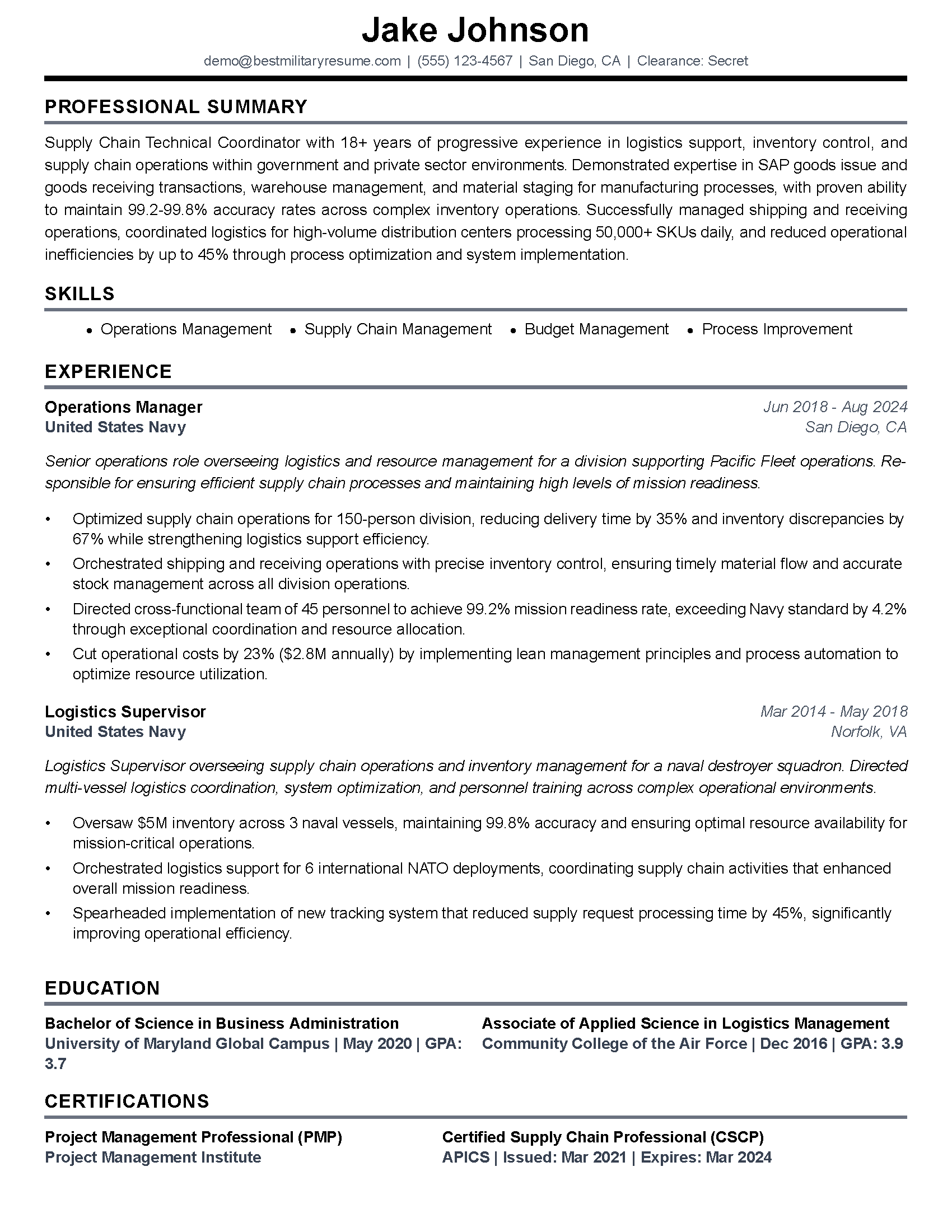
Think of your resume as having four distinct zones, each with a different job during the scan. Zone 1 is the header and contact block. Zone 2 is the professional summary or profile statement. Zone 3 is the first job entry (title, company, dates). Zone 4 is everything else. Recruiters spend roughly 80% of their initial scan time in Zones 1 through 3.
Key Takeaway
Recruiters follow an F-pattern: across the top, partway across the middle, then down the left side. The top third of page one decides whether they keep reading or move to the next resume.
Zone 1: What Does Your Header Tell a Recruiter in Two Seconds?
The header is the first thing recruiters see, and it takes less than two seconds to form an impression. Eye-tracking data shows recruiters fixate on the name, current title or tagline, location, and contact information in that order. They are looking for three signals: who you are, what you do, and where you are located.
Military resumes often fail Zone 1 because they include rank in the name line (SGM John Smith, Ret.), list a military installation as the location, or skip a professional tagline entirely. A recruiter scanning your header in two seconds and seeing "E-7, USN" with no civilian-equivalent title has to work to figure out what you actually do. Many will not bother doing that work.
Your header should include your full name without rank, a professional tagline that states your civilian function (like "Operations Manager | Supply Chain & Logistics"), city and state (not a base), phone number, email, and a LinkedIn URL. Make sure your LinkedIn skills section matches what is on your resume so recruiters see consistency. That tagline line is doing heavy lifting. It tells the recruiter your function before they even read the summary. If you need help translating your military job title to a civilian equivalent, get that dialed in before anything else.
SGM John Smith, USA (Ret.)
Fort Liberty, NC
[email protected]
John Smith
Operations Manager | Supply Chain & Logistics
Fayetteville, NC | (910) 555-0142 | [email protected]

Zone 2: Does Your Summary Pass the 6-Second Test?
After the header, a recruiter's eyes drop to the professional summary. This is the single most important block of text on your resume because it sits in the heart of the F-pattern's first horizontal scan. Eye-tracking shows recruiters spend 2-3 seconds here. They are looking for a match between what you do and what the job posting asks for.
Many veterans skip the summary entirely or write something generic like "Dedicated professional with 12 years of military experience seeking a challenging opportunity." That tells a recruiter nothing. It does not match any job description. It does not contain any keywords their ATS will rank highly. It wastes the most valuable real estate on the page.
A strong summary does four things in four lines: states your civilian function, quantifies your scope, names the industry or domain, and matches 2-3 keywords from the target job posting. Something like: "Logistics manager with 10 years of experience overseeing supply chain operations for organizations with 2,500+ personnel and $40M in assets. Expertise in inventory management, vendor negotiations, and distribution center operations." That gives the recruiter a match signal immediately. And when the ATS ranks your resume, those keywords push you toward the top of the list where hiring managers actually look.
If you are targeting federal positions, your summary works the same way but needs to hit the specific language from the job announcement. Federal resume summary statements have their own nuances, but the principle is identical: match the language in the posting within the first few lines of the resume.
Do Not Skip the Summary
A missing or generic summary forces the recruiter to dig through your bullet points to figure out what you do. In a 6-second scan, they will not do that. They will move to the next resume.
Zone 3: Why Your First Job Entry Matters More Than the Rest Combined
After the summary, recruiters look at your most recent position. Eye-tracking shows they focus on four elements in this order: job title, company or organization name, dates of employment, and the first two bullet points. That is it. The remaining bullets in that job and every job after it get dramatically less attention during the initial scan.
For veterans, Zone 3 is where military-to-civilian translation either works or completely breaks down. If your most recent job title reads "Platoon Sergeant, 3rd Battalion, 75th Ranger Regiment" and the recruiter is hiring a Project Manager, the mismatch registers instantly. The recruiter sees a title that does not match the role, an organization name they cannot contextualize, and they move on.
The fix is straightforward. Use a civilian-equivalent job title followed by the military context in parentheses. "Operations Supervisor (U.S. Army, 3rd Battalion)" reads differently to a recruiter than the pure military version. The civilian title creates an immediate match signal, and the military context adds credibility without creating confusion. For some job titles, translating military terms to civilian language can help you find the right wording.
Your first two bullet points under this job need to do the same work as the summary: match the job posting. Put your strongest, most keyword-aligned accomplishments first. Not "Responsible for daily operations of a 42-person platoon." That is a duty description. Lead with outcomes: "Directed daily operations for a 42-person team across 4 sites, reducing equipment downtime by 30% through a preventive maintenance scheduling system." The recruiter's eyes land on that first bullet, see numbers and outcomes, and keep reading.
What Recruiters Look at in Your First Job Entry
Job Title
Does it match or closely relate to the role they are filling?
Organization Name
Can they quickly identify what type of organization you worked for?
Dates of Employment
How recent is the experience? Any unexplained gaps?
First Two Bullet Points
Do they show outcomes and numbers, or just list duties?
What Makes Recruiters Stop Reading a Military Resume?
Eye-tracking research identifies specific patterns that cause recruiters to abandon a resume mid-scan. For military resumes, the top triggers are dense walls of text, unexplained acronyms, unclear job titles, and missing context for the organization. Each of these forces the recruiter to work harder than they want to during a quick scan.
Dense text is the biggest killer. If your bullet points run 3-4 lines each with no white space, the recruiter's eyes skip over the entire block. Break long accomplishments into shorter bullets. Two lines maximum per bullet point is a solid rule.
Acronyms are the second problem. Military acronyms on your resume need careful handling. Something like "Managed C4ISR systems integration for JSOC operations" might make perfect sense to another veteran, but a civilian recruiter at a defense contractor might only recognize half of those terms, and a recruiter at a tech company will recognize none. Spell out acronyms on first use or drop the ones that do not add value for your target audience.
Unclear job titles are the third issue and we covered that in Zone 3. The fourth, missing organizational context, is one many veterans overlook. "U.S. Army" as your employer name tells a recruiter very little about the scale or type of work you did. Adding brief context helps: "U.S. Army, 101st Airborne Division (24,000-person organization)" or "U.S. Navy, Naval Special Warfare Command" gives the recruiter a frame of reference without cluttering the page.
Some phrases that hiring managers consistently dislike on veteran resumes also show up in this category. Vague duty descriptions like "responsible for" and "assisted with" are weak signals during a fast scan. We cover the top 10 phrases hiring managers hate on veteran resumes in a separate guide. Recruiters are pattern-matching against the job posting. Give them something concrete to match against.
"When I reviewed resumes for federal supply chain roles, the ones that lost me fastest were walls of military jargon with no civilian context. I could figure out what they meant, but if I have 80 resumes to get through, I am not spending extra time on yours."
Where Do Keywords Need to Appear for ATS and Recruiters?
ATS platforms like Workday, iCIMS, and Taleo rank resumes based on keyword density and placement. The fonts, margins, and formatting rules that affect ATS parsing also play a role in how your resume gets ranked. Recruiters then look at the top-ranked resumes first. So your keywords need to serve both audiences: the software that ranks you and the human who reads you.
Based on how ATS systems weight content and where recruiter eyes actually land, there are five high-priority keyword zones on your resume:
- Professional summary — highest impact for both ATS ranking and the recruiter's first horizontal scan
- Job titles — ATS systems weight titles heavily, and recruiters look at them first in each entry
- First two bullets of each job — where the recruiter's eyes go and where ATS counts early-document keywords
- Skills section — a quick-scan zone for both ATS keyword matching and recruiter verification
- Education and certifications — recruiters glance here to check for requirements, ATS scans for hard qualifications
The mistake many veterans make is stuffing keywords into a skills section at the bottom and nowhere else. If the ATS ranks you higher because of those keywords, great. But when the recruiter opens your resume and scans Zone 1 through 3 in six seconds, they do not see those keywords at all. You need keywords in both places: the sections ATS weights for ranking AND the zones where recruiters actually look.
This is why tailoring matters so much. A generic military resume that uses military terminology will rank lower in ATS because the keywords do not match the job posting, and it will confuse the recruiter during their scan because the language does not match what they expect. If you are not tailoring each resume to each specific job posting, you are fighting uphill on both fronts. ATS-friendly resume tools built for veterans can speed this up significantly.
How Should Officers vs. Enlisted Veterans Structure Their Resumes Differently?
The heatmap zones are the same for every resume, but the content that fills those zones should differ based on your career trajectory. Officers and senior enlisted veterans face different translation challenges in the high-attention areas.
For officers, especially O-3 through O-6 transitioning to director-level or senior management roles, Zone 2 (the summary) needs to emphasize strategic scope: budget authority, organizational size, cross-functional leadership, and policy or program development. A recruiter scanning for a Director of Operations wants to see "$50M budget authority" and "1,200-person organization" in the first scan pass, not "commanded a battalion." The military command language needs to be translated to corporate leadership language. Military officer resume strategies for O-3 to O-6 go deeper on this specific challenge.
For enlisted veterans, especially E-5 through E-7 targeting mid-level management or technical specialist roles, the emphasis shifts. Zone 3 (the first job entry) matters more because recruiters are looking for hands-on execution and technical skills. Your first two bullet points should lead with technical accomplishments: systems you managed, processes you improved, certifications you hold, and measurable results from your direct work. Combat veterans with infantry or special operations backgrounds need to work especially hard on this translation because the gap between military and civilian terminology is wider.
Regardless of rank, if you have 20+ years of service, be selective about what makes it onto the page. Recruiters scan the most recent 10-15 years of experience during their initial pass. Your first assignment from 2002 should not take up space in Zone 3 if you have more recent, relevant work. Retired military resumes cover how to position a long career without burying the most relevant experience.
Can Your JST or Transcript Help With Resume Keyword Placement?
Your Joint Services Transcript is useful as a reference document for identifying training, credit hours, and formal course titles that can be translated into resume-friendly language. Some of the course descriptions on your JST map directly to civilian certifications or skill areas, and those are legitimate keyword sources.
But the JST is not a resume template. Do not copy-paste JST descriptions into your bullet points. The language on a JST is institutional and reads like a course catalog, not like an accomplishment. Use it to identify what civilian keywords your training maps to, then write original bullet points using those keywords with quantified outcomes from your actual work.
For example, if your JST lists "Advanced Leadership Course" with descriptions about organizational management and resource allocation, those terms (organizational management, resource allocation) are valid keywords to weave into your summary and bullet points. Just make sure you are backing them up with real numbers from your experience.
How Do You Audit Your Own Resume Using the Heatmap Approach?
You do not need actual eye-tracking software to apply this framework. Print your resume or pull it up on screen, then simulate the recruiter's scan by giving yourself six seconds to read it. Use a timer. Where do your eyes go? What words do you notice first? What questions come up?
Run through these four checks, one per zone:
Zone 1 check (header): Does your name line include a civilian professional tagline? Is your location a city, not a base? Is your email a professional address, not a .mil?
Zone 2 check (summary): Read only the summary. Without reading anything else on the resume, can you identify what job this person does, how many years of experience they have, and what industry they work in? If any of those answers are unclear, rewrite the summary.
Zone 3 check (first job entry): Look at the job title. Does it match or closely relate to the job you are applying for? Read only the first two bullet points. Do they contain numbers and outcomes, or are they duty descriptions? If they start with "Responsible for" or "Assisted with," rewrite them.
Zone 4 check (everything else): Is there anything in the bottom half of your resume that is stronger than what appears in Zones 1-3? If so, move it up. Recruiters may never reach Zone 4 during their initial scan. Your best content needs to be visible in the first six seconds.
Quick Self-Audit Tip
Send your resume to a friend outside the military. Give them 10 seconds to look at it, then take it away. Ask them what job you do and what your biggest accomplishment is. If they cannot answer both questions, your high-attention zones need work.
What to Do Next
Pull up your current resume right now. Set a 6-second timer and scan it the way a recruiter would. Check each zone against the framework above. If your header still has your rank in it, if your summary is generic or missing, if your first job entry leads with military jargon and no civilian context, those are the areas that cost you interviews before a recruiter even finishes reading.
If you want to work with a recruiter effectively as a veteran, your resume needs to pass their scan test first. No amount of networking overcomes a resume that loses them in the first three seconds.
BMR's Resume Builder handles the military-to-civilian translation and tailors each resume to the specific job posting you are targeting. It was built for exactly this problem: making sure the right keywords and civilian language show up in the zones where recruiters and ATS systems actually look. The free tier gives you two fully tailored resumes. Paste in a job posting, and the builder does the translation work so your resume is optimized for both the 6-second scan and ATS ranking.
Frequently Asked Questions
How long do recruiters spend looking at a resume?
What do recruiters look at first on a military resume?
Should I put my military rank on my resume?
What is the F-pattern in resume scanning?
Where should I put keywords on my military resume?
How do I make my military resume ATS-friendly?
Should officers and enlisted veterans format resumes differently?
About the Author
Brad Tachi is the CEO and founder of Best Military Resume and a 2025 Military Friendly Vetrepreneur of the Year award recipient for overseas excellence. A former U.S. Navy Diver with over 20 years of combined military, private sector, and federal government experience, Brad brings unparalleled expertise to help veterans and military service members successfully transition to rewarding civilian careers. Having personally navigated the military-to-civilian transition, Brad deeply understands the challenges veterans face and specializes in translating military experience into compelling resumes that capture the attention of civilian employers. Through Best Military Resume, Brad has helped thousands of service members land their dream jobs by providing expert resume writing, career coaching, and job search strategies tailored specifically for the veteran community.
