Combat Veterans Resume: Translating Infantry & Special Ops
Desiree landed a $135K hybrid senior financial consultant role.
Desiree, E-5, Army National Guard, the interviewer loved the resume from the top down
If you spent your military career kicking in doors, clearing rooms, running patrols, or leading fire teams through some of the worst terrain on earth, you already know your experience is valuable. The problem is getting a civilian hiring manager to see it that way. Combat arms veterans — 11B Infantry, 0311 Marines, 18 series Special Forces, 75th Rangers, and similar MOSs — face a unique resume challenge that no other group of veterans deals with.
Your daily work involved violence, weapons, and life-or-death decisions. None of those things belong on a civilian resume. But buried inside that combat experience are leadership skills, decision-making abilities, and operational planning expertise that Fortune 500 companies pay six figures for. The trick is pulling those skills out of the military context and presenting them in language that makes a hiring manager think "this person can run my team" instead of "this person might be intense."
Why Do Combat Veterans Struggle With Resumes More Than Other MOSs?
A logistics specialist can point to supply chain management. A medic can list patient care hours. An IT specialist has certifications that directly translate. But what do you do when your primary job description literally reads "close with and destroy the enemy by fire and maneuver"? That job description does not have a civilian equivalent, and pretending otherwise makes your resume sound either sanitized to the point of meaninglessness or uncomfortable for a hiring manager who has never been around military operations.
The real issue is not that your skills do not transfer. They absolutely do. The issue is that most resume advice — including what TAP teaches — does not address the specific translation challenge that combat arms faces. Generic advice like "replace military jargon with civilian terms" barely scratches the surface when your entire job existed in a context that civilians have never experienced. You cannot simply swap "platoon" for "team" and call it done. The translation requires rethinking how you describe what you did, why it mattered, and what results you produced — all without the military framework that gave those actions meaning.
Common Mistake
Listing "combat operations" or "enemy engagement" on your resume does not make you look tough — it makes hiring managers uncomfortable. They are not rejecting your experience. They simply do not know how to evaluate it. Your job is to translate, not transcribe.
What Civilian Skills Are Hiding Inside Combat Experience?
Every combat arms veteran has transferable skills they cannot see because they seem too normal. When you have spent years leading soldiers in high-pressure environments, the leadership piece feels like breathing — it does not feel like a "skill" worth mentioning. But civilian hiring managers rarely encounter candidates who managed 30-40 people, controlled millions in equipment, planned complex operations under extreme time pressure, and made high-stakes decisions with incomplete information — all before age 30.
Here is what your combat experience actually translates to:
Operations management and planning. Every patrol, mission, or operation you led required a plan. Terrain analysis, resource allocation, contingency planning, timeline management, coordination with adjacent units — that is project management in the most demanding environment possible. When you briefed an operations order, you were presenting a project plan to stakeholders and direct reports.
Team leadership under pressure. Leading a squad or platoon in a combat zone means making real-time decisions with lives on the line. Civilian team leads rarely face consequences more serious than a missed deadline. You managed performance, resolved conflict, maintained morale, and developed subordinates in an environment where failure meant someone did not come home. That is a level of leadership development that no MBA program can replicate.
Risk assessment and crisis management. Every time you moved through an area, you assessed threats, identified risks, developed mitigation strategies, and executed under uncertainty. Companies in construction, energy, logistics, healthcare, and finance all need people who can evaluate risk and make decisions when the data is incomplete.
Training program development. NCOs in combat units spend enormous amounts of time planning, executing, and evaluating training. You built training schedules, developed evaluation criteria, tracked individual and team performance, and adapted programs based on results. That is exactly what corporate training and L&D departments do.
Combat Experience Translation Examples
Squad Leader → Team Supervisor
Led 9-person cross-functional team through 200+ operational missions. Maintained 100% personnel accountability and managed $2.1M equipment inventory with zero losses.
Platoon Sergeant → Operations Manager
Directed daily operations for 42-person organization across 3 shifts. Developed and executed training programs that improved team performance metrics by 35% over 6 months.
Company First Sergeant → Senior Operations Director
Managed personnel readiness, professional development, and welfare for 130+ employees. Coordinated logistics, scheduling, and resource allocation across a $15M annual operating budget.

How Should Infantry Veterans Structure Their Resume?
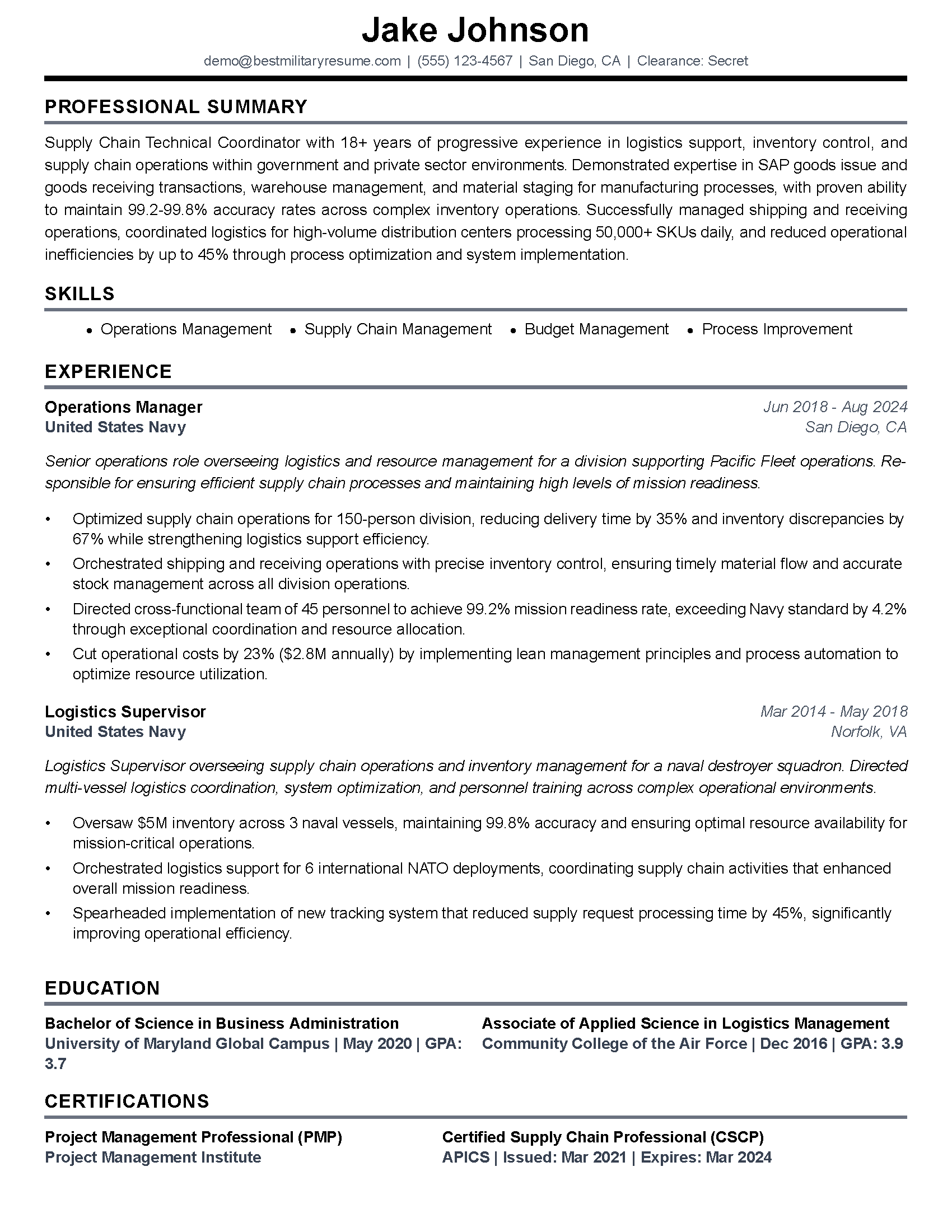
The format matters more for combat veterans than almost any other MOS. A chronological resume that starts with "Infantryman" in the job title immediately triggers assumptions. Instead, lead with a strong professional summary that frames your experience in civilian terms before the reader ever sees a military job title.
Your professional summary should mention leadership scope (number of people managed), operational experience (number of missions, deployments, or projects), and the specific civilian field you are targeting. Do not mention combat, weapons, or tactical operations in the summary. Save the military context for the experience section where you have room to translate properly.
For the experience section, use a hybrid format. List your military role with a translated title — "Team Leader / Operations Supervisor" instead of just "Fire Team Leader." Under each role, focus on the transferable skills that match your target industry. Quantify everything: personnel supervised, equipment value managed, training hours delivered, operational success rates.
What About Special Operations Veterans?
SOF veterans (Green Berets, Rangers, SEALs, MARSOC, PJs) have an additional layer of complexity. Your training pipeline alone demonstrates a level of selection, resilience, and capability that most civilians cannot comprehend. But "graduated Special Forces Qualification Course" won't resonate with a hiring manager at a tech company without context.
Instead, frame SOF experience around the skills that made you successful in selection and operations: autonomous problem solving, cross-cultural communication (especially for SF), advanced planning methodology, and the ability to operate effectively with minimal supervision in ambiguous environments. Defense contractors and intelligence agencies will understand your background immediately, but if you are targeting the private sector, you need to translate further.
SOF veterans who target defense contractors can keep more military terminology because those hiring managers speak the language. But for private sector roles, translate everything. "Foreign Internal Defense" becomes "international partner training and capacity building." "Unconventional Warfare planning" becomes "strategic program development in austere environments."
Which Industries Hire the Most Combat Veterans?
Combat arms veterans land across a surprisingly wide range of industries once they figure out the translation piece. The most common paths include:
Defense contracting. The easiest transition for many combat veterans, especially those with clearances. Companies like Lockheed Martin, Raytheon, Booz Allen, and CACI actively recruit veterans for program management, training, operations, and advisory roles. If you have a TS/SCI clearance, you are walking into a job market that has more openings than qualified candidates. That clearance alone can be worth $15K-$30K or more in additional salary compared to non-cleared roles.
Law enforcement and federal agencies. FBI, DEA, ATF, CBP, Secret Service, and state/local agencies value combat experience for tactical roles and investigation positions. Many agencies give veterans preference in hiring, and your weapons qualification, physical fitness, and operational experience are directly relevant.
Corporate operations and logistics. Companies with complex operations — Amazon, FedEx, UPS, large manufacturing firms — need people who can manage teams, optimize processes, and handle pressure. Your experience running a platoon-sized element translates directly to managing a shift, department, or distribution center.
Construction and energy. Project management in construction and energy sectors rewards the same planning, execution, and risk management skills you developed in combat. These industries also tend to have cultures that are comfortable with military veterans, and the project-based work structure feels familiar after years of mission-focused operations. Many construction project managers and energy field supervisors are veterans themselves.
Sales and business development. This one surprises people, but combat veterans often excel in sales. The discipline, competitiveness, resilience after rejection, and ability to build rapport quickly — all developed in the military — map directly to what makes top salespeople successful. From my own experience transitioning into tech sales after the Navy, the military mindset translates better than most people expect.
What Resume Mistakes Do Combat Veterans Make Most Often?
After helping thousands of veterans translate their military experience through BMR, patterns emerge. These are the mistakes that combat arms veterans make more than any other group:
Leading with military jargon. "Conducted COIN operations in Helmand Province" tells a civilian employer absolutely nothing about your capabilities. Strip the jargon entirely and describe what you actually did in terms any manager could understand.
Underselling leadership. You managed people in the most demanding leadership environment that exists. Do not bury that behind tactical descriptions. A hiring manager needs to know you supervised 40 people, not that you "executed dismounted patrols." The leadership is the sellable skill — the patrols were just the context.
Ignoring quantifiable results. Your NCOERs and evaluations are full of numbers you can use: personnel counts, equipment values, readiness percentages, training completion rates. Pull those numbers into your resume bullets. "Managed $4.2M in organizational equipment with zero losses across 12-month deployment" tells a story that hiring managers respond to.
One resume for every job. A resume targeting a defense contractor project manager role should look very different from one targeting an operations manager at Amazon. Use BMR's resume builder to create tailored versions for each target industry rather than sending the same generic document to every posting.
"Conducted 150+ combat patrols in hostile territory. Engaged enemy combatants in direct and indirect fire engagements. Maintained weapons systems and tactical equipment."
"Led 9-person team through 150+ high-risk field operations over 12 months. Managed $1.8M equipment inventory with zero losses. Maintained 100% team readiness through targeted training programs and daily performance assessments."
How Do You Handle the "Tell Me About Your Military Experience" Interview Question?
Your resume gets you in the door, but the interview is where combat veterans either win or lose the job. When an interviewer asks about your military experience, they do not want a war story. They want to understand how your experience makes you the right person for their opening.
Structure your answer around the STAR method (Situation, Task, Action, Result), but sanitize the military context. Instead of describing a firefight, describe a high-pressure situation where your team faced an unexpected challenge and you led them to a successful outcome. Focus on your decision-making process, how you communicated with your team, what resources you managed, and what the measurable result was. Civilian interviewers are evaluating whether you can think through problems methodically and lead people through challenges — the military context is just the backdrop.
Practice this before every interview. Record yourself answering common questions and listen back. If you hear military acronyms, tactical terminology, or descriptions that would not make sense to someone who has never served, rewrite those answers. Use BMR's career crosswalk tool to identify which civilian job titles align with your experience so you can frame your answers around specific positions.
The veterans who land the best jobs after combat arms careers are not the ones with the most impressive military records. They are the ones who learned to tell their story in a language that civilian employers understand and respond to. Your experience is extraordinary — the translation is what makes it accessible. Start with BMR's military resume builder to generate a professionally translated first draft, then refine it for your specific target role. The hardest part is getting the first version on paper — everything after that is iteration.
Related: Military resume keywords that beat ATS by industry and resume red flags that get veteran resumes rejected.
Frequently Asked Questions
Should I mention combat deployments on my resume?
How do I explain an infantry MOS to civilian employers?
Do combat veterans have an advantage at defense contractors?
What civilian jobs are best for former Special Forces soldiers?
Should I use a functional or chronological resume format?
How do I quantify combat experience on my resume?
Is it okay to list weapons qualifications on my resume?
How long should a combat veteran resume be?
About the Author
Brad Tachi is the CEO and founder of Best Military Resume and a 2025 Military Friendly Vetrepreneur of the Year award recipient for overseas excellence. A former U.S. Navy Diver with over 20 years of combined military, private sector, and federal government experience, Brad brings unparalleled expertise to help veterans and military service members successfully transition to rewarding civilian careers. Having personally navigated the military-to-civilian transition, Brad deeply understands the challenges veterans face and specializes in translating military experience into compelling resumes that capture the attention of civilian employers. Through Best Military Resume, Brad has helped thousands of service members land their dream jobs by providing expert resume writing, career coaching, and job search strategies tailored specifically for the veteran community.
