11B Infantry to Civilian: What Jobs Can You Get?
 Brad Tachi8 min read
Desiree landed a $135K hybrid senior financial consultant role.
Desiree, E-5, Army National Guard, the interviewer loved the resume from the top down
Introduction
11B Infantry veterans qualify for law enforcement, security operations, logistics coordination, and emergency management roles. Your combat experience translates directly into civilian careers that value tactical decision-making, team leadership, and performance under pressure.
The challenge: "Fire Team Leader" and "Squad Leader" sound too military on a resume. Hiring managers see combat experience and don't connect it to their open logistics coordinator or operations manager position. They miss the fact that you planned missions, managed equipment accountability, trained personnel, and made decisions in high-stakes environments.
After helping 24,273 veterans and military spouses translate their military experience, the pattern is clear. Infantry skills are valuable across multiple industries. You just need to speak civilian language on your resume. This guide covers specific job titles that match your 11B background, required certifications, salary ranges, and how to position your experience so hiring managers understand what you actually did. For a deeper breakdown of the specific civilian roles, salary ranges, and federal job series that hire infantry veterans, see the full 11B Infantryman civilian career guide.
What Civilian Jobs Match 11B Infantry Skills?
Law Enforcement and Federal Agencies
Police departments, sheriff's offices, and federal agencies actively recruit infantry veterans. Your patrol experience, threat assessment skills, and decision-making under pressure translate directly to law enforcement work. Police and detectives earned a median of $77,310 in May 2025, the Bureau of Labor Statistics reports. The lowest-paid 10 percent earned less than $48,160. Federal special agent pay depends on the agency and grade. In October 2026, USAJOBS listed DEA criminal investigator openings at $48,854 to $82,938 (GL-7 to GS-11). An FBI special agent opening listed $93,749 to $133,200.
The Census Bureau tracked 2.8 million enlisted veterans transitioning from 2002-2021. Army and Marine Corps infantry veterans mostly ended up in administrative and support services, manufacturing, and retail. Veterans from infantry and combat jobs also had relatively lower civilian earnings.
Security Operations and Executive Protection
Corporate security managers, physical security specialists, and executive protection agents need the same skills you used on patrol - situational awareness, risk assessment, and calm responses to threats. A clearance also makes you more valuable to defense contractors. ClearanceJobs' 2026 compensation survey put average total compensation for DoD Secret holders at $107,439. That average spans all Secret holders surveyed. It is not an entry-level security salary.
Security Clearance = Hiring Edge
If you held a Secret or Top Secret clearance, it is worth real money to defense contractors. New industry clearances took about 197 days for Secret and 243 for Top Secret. Those are DCSA's end-to-end figures for Q3 FY2026. Your eligibility does not stay active after you separate. It can be reinstated without a new investigation if you meet DoD's terms. Your last favorable investigation must have closed within five years. You must have been out 24 months or less. You certify on an SF 86C that nothing has changed. A record check must come back clean, with nothing showing you no longer meet the standards. Use it early.
Logistics and Supply Chain Management
Infantry squad leaders manage equipment accountability, supply distribution, and mission logistics daily. That experience translates to warehouse operations manager, distribution center supervisor, or supply chain coordinator roles. The Bureau of Labor Statistics projects employment of logisticians to grow 18 percent from 2025 to 2035. BLS lists a bachelor's degree as the typical entry-level education for logisticians.
Emergency Management and Training Roles
Emergency operations coordinators and disaster response specialists need your ability to execute under pressure and coordinate multi-team operations. Tactical instructors and corporate safety coordinators build on your experience training soldiers.
With 10,576 infantry soldiers separating in FY23 alone, competition is real - but these roles actively seek your skill set when you translate it correctly. Infantry skills carry over the same way no matter the service. If you served as an Army 11C indirect fire infantryman or a Marine Corps 0311 rifleman, you face the same translation challenge and qualify for the same civilian roles.

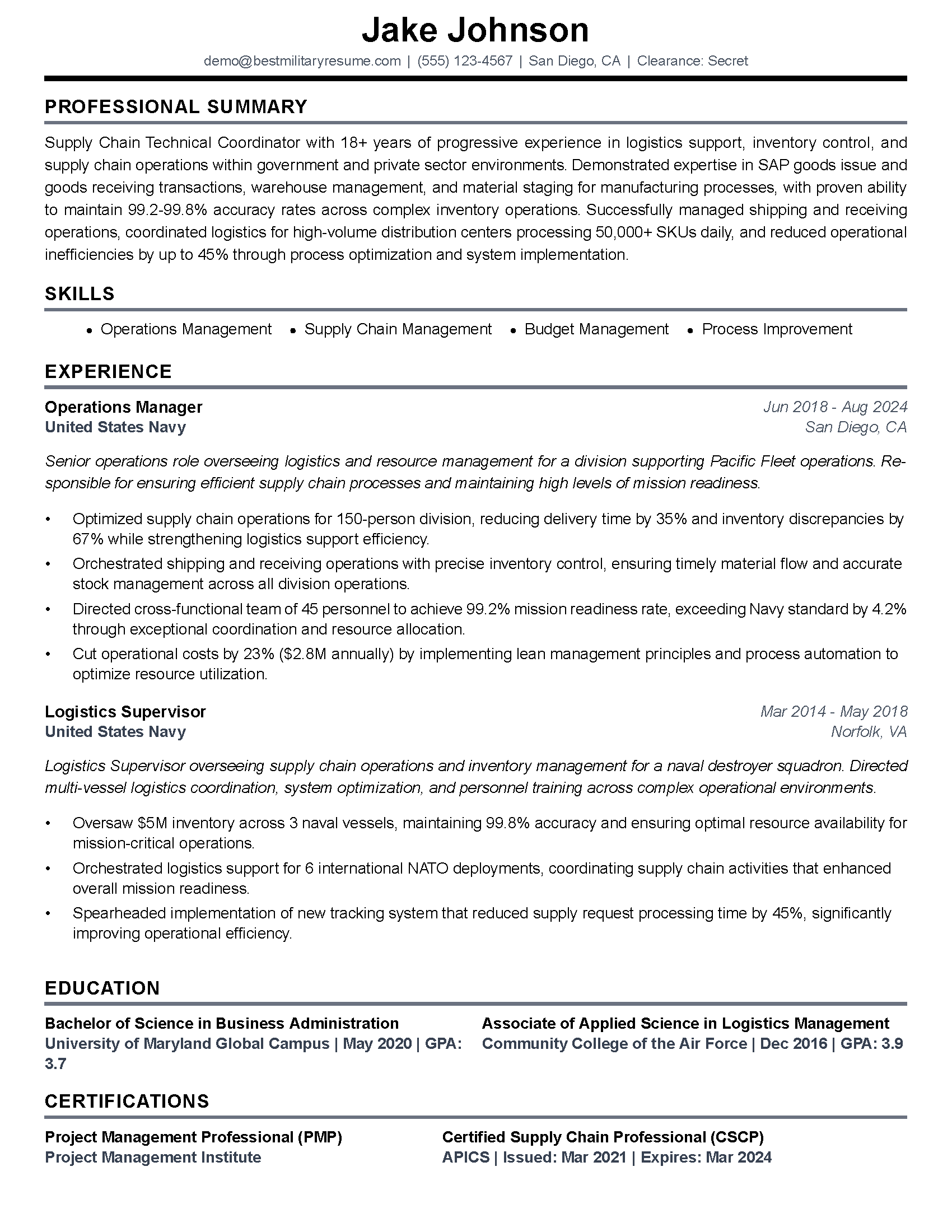
How Do You Translate Infantry Experience on a Resume?
"Squad Leader" and "Fire Team Leader" don't mean anything to a civilian hiring manager. That's the problem.
Your infantry experience is valuable. But if your resume says "Led infantry squad during combat operations," your resume sinks to the bottom before a human even sees it.
"Served as infantry squad leader responsible for soldiers and equipment during combat operations"
"Supervised 9-person team in high-risk environments, maintaining 100% accountability of $2M in equipment over 12-month deployment"
The Translation Framework
Think about what you actually did, not your job title. You managed people, equipment, budgets, and high-stakes operations. That's what civilian employers need.
Here's how to rewrite common 11B responsibilities:
Patrol operations → Risk assessment and threat mitigation in dynamic environments
Equipment maintenance → Managed preventive maintenance programs for $2M+ in assets, achieving 98% operational readiness
Training junior soldiers → Developed and delivered performance-based training programs for 9-person teams
Mission planning → Coordinated multi-phase operations requiring resource allocation, timeline management, and contingency planning
Before and After Examples
BAD: "Served as infantry squad leader responsible for soldiers and equipment"
GOOD: "Supervised 9-person team in high-risk environments, maintaining 100% personnel accountability and zero loss of $2M in assigned equipment over 12-month deployment"
BAD: "Conducted patrols and security operations"
GOOD: "Executed 150+ security assessments across 40-square-mile area, identifying and mitigating threats to protect personnel and infrastructure"
BAD: "Trained soldiers on weapons and tactics"
GOOD: "Designed and implemented training curriculum for 12 personnel, improving qualification scores by 35% and reducing safety incidents to zero"
Keywords That Pass ATS Filters
Different jobs need different keywords. For law enforcement roles: threat assessment, emergency response, report writing, evidence handling. For logistics positions: inventory management, supply chain coordination, asset tracking, quality control.
BMR's resume builder converts your 11B duties into civilian terms. It does this when it tailors your resume to a specific posting. Understanding the pattern still helps you customize for each application.
The goal isn't to hide your military background. It's to speak the language hiring managers understand.
What Certifications Help 11B Veterans Get Hired?
The right certification can cut your job search time in half.
Some credentials actually move the needle for infantry guys. Others are a waste of time and money.
Law Enforcement Certifications
POST certification (Peace Officer Standards and Training) is required for most police departments. Each state runs its own academy, typically 18-26 weeks. Many departments will sponsor you through the academy if you're hired.
LEOSA (the Law Enforcement Officers Safety Act) is not a certification. It does not cover veterans because of military service. It lets qualified current and retired law enforcement officers carry concealed across state lines. State limits on private property and state or local government property still apply. Retired officers generally need 10 or more years in law enforcement. That can include military police service with UCMJ arrest authority. They also need an annual firearms qualification at their own expense.
Security and Protection
Security+ is a cybersecurity certification, not a physical-security one. It matters if you're aiming at cyber work for defense contractors. DoD Manual 8140.03 replaced the old DoD 8570 baseline-certification system. Under it, certification is one of three foundational qualification options for cyber work roles. The exam voucher costs $439 when you buy it directly from CompTIA. A new version, V8, is expected to launch around November 17, 2026.
CPP (Certified Protection Professional) is the gold standard for corporate security management roles. Requires experience, but it's worth pursuing after you land your first security job.
Logistics and Operations
APICS CSCP (Certified Supply Chain Professional) translates your supply accountability experience into supply chain coordinator roles.
OSHA 10/30 and forklift training are quick wins for warehouse work. OSHA says its 10- and 30-hour Outreach cards are course completion cards, not certifications. Federal rules require your employer to train, evaluate, and certify you before you run a forklift. Many employers handle that on the job.
Quick-Win Credentials (Complete in 2 Weeks or Less)
1FEMA ICS Certifications
2OSHA 10/30
3Forklift Certification
Emergency Management
FEMA ICS certifications (100, 200, 700, 800) are free online courses that qualify you for emergency operations coordinator positions. Complete all four in two weeks.
EMT training opens first responder roles. EMTs earned a median of $44,470 in May 2025, according to the Bureau of Labor Statistics.
Your GI Bill can reimburse certification test fees, up to $2,000 per test. It can also pay for approved prep courses. VA charges your entitlement for either one. Don't pay out of pocket if you don't have to.
How Do Federal Jobs Work for Infantry Veterans?
Veterans preference gives you a real advantage in federal hiring - but only if you understand how to use it.
Veterans Preference Explained
5-point preference goes to veterans discharged under honorable conditions whose service meets one of OPM's qualifying periods. Under honorable conditions means an honorable or general discharge. One example is more than 180 consecutive days of active duty, not counting training. At least part of it must fall between September 11, 2001 and August 31, 2010. Another is service in a campaign or expedition with an authorized campaign medal or badge. If you joined after August 2010 and never earned a campaign medal, check before you claim it. 10-point preference goes to Purple Heart recipients, disabled veterans, and certain other categories. This bumps your application score after the initial qualification screening, but it doesn't replace meeting the job requirements.
Federal hiring works differently than civilian applications, so learn the process before you apply.
Federal Job Series for 11B Veterans
Infantry veterans often target these GS series. Each job announcement sets its own qualifications:
0083 Police - VA Police, DoD installation police, Pentagon Force Protection Agency (most openings GS-5 to GS-9, $40,736 to $80,243 in OPM's 2026 Rest of U.S. table, before special rates)
0080 Security Administration - Physical security specialists, antiterrorism officers (most openings GS-9 to GS-14, starting at $61,722 for GS-9 step 1 in OPM's 2026 Rest of U.S. table)
1801 General Inspection, Investigation, Enforcement, and Compliance - Federal Protective Service law enforcement specialists, immigration services officers, transportation security specialists
1811 Criminal Investigation - Special agents at DEA, ATF, and FBI (the FBI requires a bachelor's degree)
0346 Logistics Management - Supply chain operations, distribution management (most openings GS-9 to GS-14, starting at $61,722 for GS-9 step 1 in OPM's 2026 Rest of U.S. table)
BMR's Military to Federal Crosswalk lists the federal job series the 11B code maps to. Those include 0080, 0083, 1801, 1811, and 0346.
USAJOBS Resume Requirements
Federal resumes work differently. OPM now caps the resume at two pages for most federal jobs. Always check the announcement, because some jobs are exceptions. For each job, list title, employer, start and end dates by month and year, and weekly hours. Supervisor contact information and salary history are not on OPM's list. OPM also tells applicants to align each work description with the announcement and address every required qualification.
Timeline matters. OPM data put the governmentwide average time to hire at 101 days in fiscal 2024. The Merit Hiring Plan directs agencies to get under 80 days to an initial offer. If you are preference eligible, you can claim it before you separate. You submit a certification that you expect discharge under honorable conditions within 120 days. If you qualify, plan to apply during your last 120 days of service.
Infantry MOSs qualify for multiple federal paths - your combat leadership translates directly to operational roles that value decision-making under pressure.
Conclusion
Your 11B experience qualifies you for careers in law enforcement, security operations, logistics, and emergency management. The infantry veterans who land jobs fastest do two things: they pick a specific target (not "anything related to my skills"), and they translate their resume before applying.
Don't waste six months sending the same military resume to 200 jobs. In FY23 alone, over 10,000 infantry soldiers separated from active duty - you're competing against thousands of other 11B veterans using the exact same bullet points. The ones who get hired first are the ones who speak civilian language from day one.
Your next steps:
Pick one career path from this guide (law enforcement, security, logistics, or emergency management)
Get the certifications that matter for that specific field
Rewrite your resume in civilian terms that pass ATS systems
BMR's Resume Builder translates your 11B experience automatically - upload your current resume or Military Evaluations and get an ATS-optimized civilian version that hiring managers actually understand. No more guessing which keywords to use or how to explain "squad leader" to someone who's never worn a uniform.
Some of these fields are growing. The Bureau of Labor Statistics projects logistician jobs to grow 18 percent from 2025 to 2035. You just need to position your experience correctly from the start.
For more branch-specific guidance, see our Army resume guide with MOS translation. If you held a combat role, our Marine Corps resume guide covers similar infantry-to-civilian translations. Also check out how to translate military terms to civilian equivalents.
Related: The complete military resume guide for 2026 and how to list military experience on a resume.
Frequently Asked Questions
Do I need a college degree to get hired after infantry?
How long does the transition take from Army to civilian job?
Can I use my GI Bill while job searching?
What if I only have infantry experience and no other MOS training?
How do I explain combat deployments to civilian employers?
Do security clearances help 11B veterans get jobs?
About the Author
Brad Tachi is the CEO and founder of Best Military Resume and a 2025 Military Friendly Vetrepreneur of the Year award recipient for overseas excellence. A former U.S. Navy Diver with over 20 years of combined military, private sector, and federal government experience, Brad brings unparalleled expertise to help veterans and military service members successfully transition to rewarding civilian careers. Having personally navigated the military-to-civilian transition, Brad deeply understands the challenges veterans face and specializes in translating military experience into compelling resumes that capture the attention of civilian employers. Through Best Military Resume, Brad has helped thousands of service members land their dream jobs by providing expert resume writing, career coaching, and job search strategies tailored specifically for the veteran community.
