Complete Military Resume Guide for 2026: Veteran Playbook
Desiree landed a $135K hybrid senior financial consultant role.
Desiree, E-5, Army National Guard, the interviewer loved the resume from the top down
Building a military resume that actually gets you hired requires more than swapping out military terms for civilian ones. It requires understanding how civilian hiring works, what hiring managers look for in the first few seconds of reading your resume, and how to position your military experience as an asset rather than a mystery that needs decoding. This guide covers the complete process from start to finish — whether you are separating after 4 years or retiring after 20+, whether you are targeting the private sector or federal government, and regardless of your branch or MOS.
After helping over 15,000 veterans build resumes through BMR, the patterns are clear: the veterans who land jobs fastest are not necessarily the ones with the most impressive military careers — they are the ones who present their experience in a way that civilian employers immediately understand and value. This guide teaches you exactly how to do that, step by step. Whether you are building your resume from scratch or improving an existing draft, every section below includes actionable guidance you can apply immediately. I built BMR after spending 1.5 years applying for government jobs with zero callbacks after separating from the Navy. Once I figured out how to properly translate my experience, I changed career fields multiple times and kept advancing. The principles in this guide come from that experience and from helping thousands of veterans do the same thing.
What Makes a Military Resume Different
A military resume is not just a civilian resume with military experience plugged in. There are fundamental differences in how you need to approach it, and understanding these differences before you start writing will save you from the most common mistakes veterans make.
You are translating, not just formatting. Most civilian job seekers can describe their experience in terms that hiring managers already understand. Veterans cannot — you have to translate an entirely different vocabulary, organizational structure, and performance framework into civilian terms. This is not a cosmetic change. It requires rethinking how you describe every role, accomplishment, and qualification.
Your experience is likely undersold. Military veterans consistently underestimate the civilian value of their experience. An E-6 who managed 30 people, maintained $10M in equipment, and trained the next generation of leaders is doing work equivalent to a civilian operations manager — but most E-6s describe themselves as "staff sergeants" and list duties instead of accomplishments. The biggest opportunity in your military resume is accurately representing the scope and impact of what you actually did.
You need to target a specific audience. A generic military resume that works for "any civilian job" does not actually work for any civilian job. The most effective military resumes are tailored to a specific career field and ideally to a specific job posting. That means you may need multiple versions of your resume — one for operations management, one for project management, one for a specific company — each emphasizing different aspects of your military experience.
Choosing the Right Resume Format
There are three main resume formats, and the right choice depends on your career situation. Do not default to the one you have seen most often — choose strategically based on your specific transition.
Reverse chronological is the most common and usually the best choice for veterans. It lists your experience in order from most recent to oldest, which shows career progression and makes it easy for hiring managers to follow your trajectory. Use this format if you have a clear career path and your most recent military experience is your most relevant. This is also the most ATS-friendly format because applicant tracking systems are designed to parse chronological resumes.
Functional (skills-based) organizes your resume around skill categories rather than chronological work history. Some career advisors recommend this for veterans who are making a big career change, but most hiring managers and recruiters actively dislike functional resumes because they make it hard to see when and where you gained your experience. In most cases, avoid this format — it raises red flags rather than solving problems. Hiring managers often assume functional resumes are hiding something — gaps in employment, lack of progression, or irrelevant experience. For veterans, a functional format can actually make the translation problem worse by disconnecting your skills from the context where you developed them.
Combination (hybrid) starts with a skills summary section followed by a reverse chronological work history. This can work well for senior veterans (E-8+, O-5+) who have a broad skill set they want to highlight upfront while still providing the chronological detail that hiring managers expect. Use this format if you have 15+ years of experience and want to lead with your core competencies before diving into specific roles.

Essential Resume Sections for Veterans
Every military resume needs these core sections, structured in a way that guides the hiring manager through your qualifications efficiently.
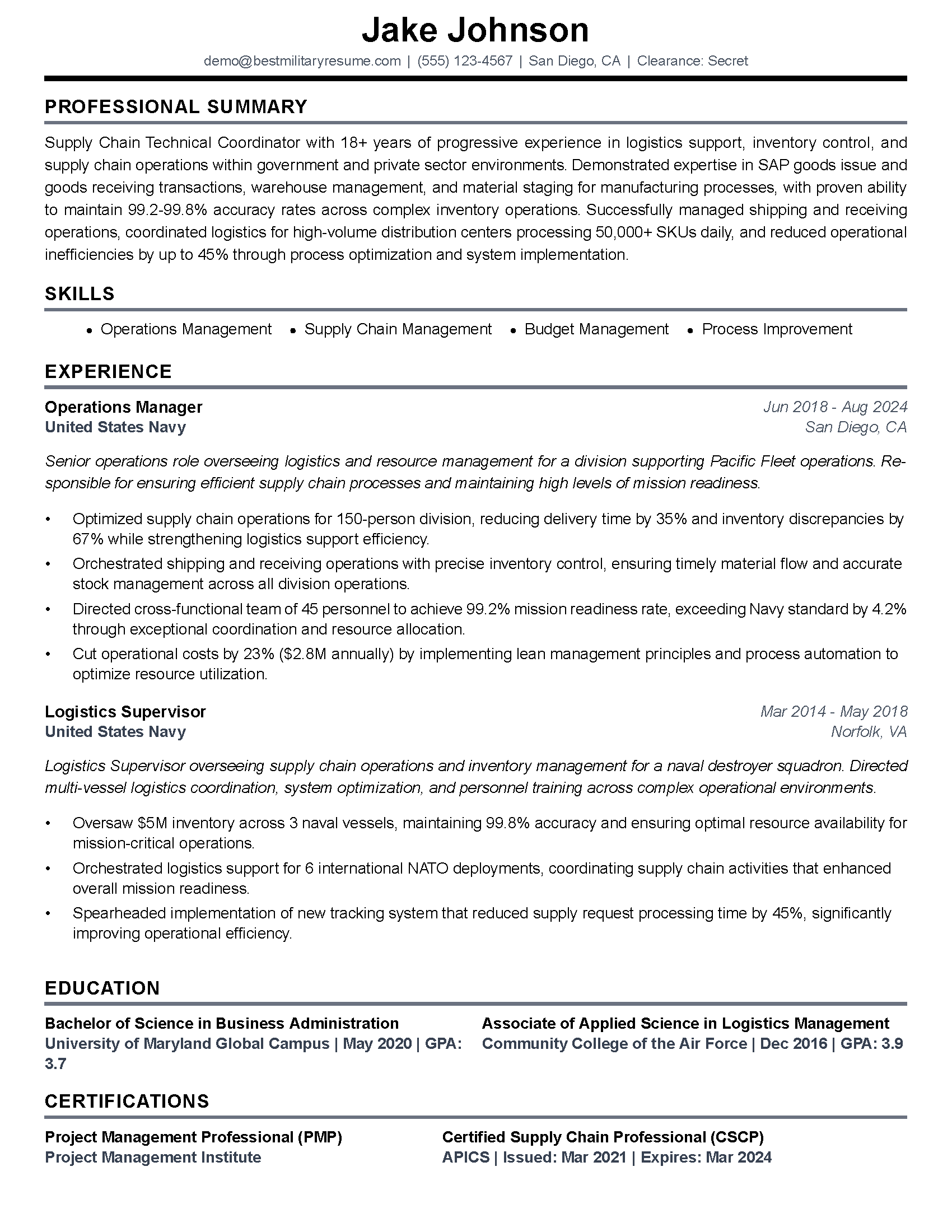
Professional Summary (3-4 lines): This is your elevator pitch. Lead with your total years of experience, your area of expertise, and 2-3 key qualifications that match the job you are targeting. Mention your military background as context, not the lead: "Operations manager with 12 years of progressive leadership experience, including 8 years managing logistics operations for the U.S. Army and 4 years in civilian supply chain management." Your professional summary determines whether someone keeps reading — make it count.
Work Experience: This is where your military experience goes — treated as professional employment, not as a separate "military" section. Use civilian-equivalent job titles, the name of your branch/organization, location, and dates. Each role should have 4-6 bullet points that start with strong action verbs and include quantified results. Focus on accomplishments, not job descriptions. "Led a 35-person team that achieved 98% equipment readiness, exceeding the organizational standard by 12%" is infinitely more powerful than "Responsible for equipment maintenance operations."
Skills Section: List your most relevant skills in a clean format. Include both hard skills (specific software, certifications, technical capabilities) and soft skills reframed as professional competencies (team leadership, cross-functional coordination, stakeholder management). Match the skills to the keywords in the job posting you are targeting — this is critical for getting past ATS screening.
Education and Certifications: List degrees, military education (translated to civilian equivalents where applicable), and professional certifications. NCOES courses can be described as "Advanced Leadership and Management Training." Military-specific certifications that have civilian equivalents (CompTIA Security+, EMT, etc.) should be listed by their civilian name.
How to Write Military Accomplishment Bullets
The single most important skill in military resume writing is turning military duties into quantified civilian accomplishments. Here is a framework that works for every rank, branch, and MOS:
The formula is: Action verb + What you did + Scale/scope + Measurable result. Every bullet should answer the question "So what?" If you managed equipment, how much was it worth? If you led people, how many? If you improved a process, by what percentage? If you trained others, what was the outcome? Numbers make your experience concrete and comparable to civilian benchmarks. Hiring managers cannot evaluate "maintained readiness" but they can evaluate "maintained 97% operational readiness across a $8.5M fleet."
Common metrics to include on your military resume: team size managed, budget responsibility, equipment values, readiness rates, training completion rates, safety records, process improvement percentages, cost savings, award recognition, and project completion timelines.
Branch-Specific Resume Considerations
Each branch has unique terminology and culture that requires slightly different translation approaches. Here are the key considerations by branch:
Army: Translate MOS codes and unit designations. "1st Battalion, 87th Infantry Regiment" becomes "1,200-person organization." Include NCOES completion as leadership training. Reference the SFL-TAP program if you completed it — it signals proactive career planning.
Navy/Coast Guard: Translate ratings (not "rates") and NEC codes. Ship assignments become "maritime operations facility" or describe the operational scope. Coast Guard ratings often have more direct civilian equivalents than other branches.
Air Force: AFSC codes need translation. Maintenance specialties translate well to aviation and manufacturing. Many Air Force specialties have strong civilian equivalents in technology and defense contracting.
Marines: Combat arms MOS codes require the most translation effort. Emphasize leadership scope, decision-making under pressure, and adaptability. Avoid over-relying on combat experience — highlight the management, logistics, and training aspects.
Common Military Resume Mistakes to Avoid
After reviewing thousands of veteran resumes, these are the mistakes I see most frequently — and they are all fixable once you know to look for them:
Using military jargon as if everyone understands it. "Conducted PCC/PCIs for battalion-level FTX" won't land with a civilian hiring manager. Every acronym, military term, and rank reference needs to be translated or explained. If a civilian with no military background cannot understand a bullet point, it needs to be rewritten.
Listing duties instead of accomplishments. "Responsible for vehicle maintenance" is a duty. "Managed preventive maintenance program for 45 vehicles valued at $8.5M, maintaining 97% readiness" is an accomplishment. Duties describe what everyone in your role does — accomplishments describe what YOU did and the impact it had.
Underselling leadership scope. An E-5 who led 12 people is a supervisor. An E-7 who managed 40 people and a $10M budget is a department manager. An O-3 who commanded 150 people is a director. Use the civilian equivalent for the level of responsibility you held — do not let modesty cost you interviews.
Creating a one-size-fits-all resume. A resume targeting operations management should emphasize different experience than one targeting IT project management, even if both draw from the same military career. Customize your professional summary and reorder your bullets for each application.
Using the TAP resume as your final product. The resume you built during TAP/SFL-TAP is a starting point, not a finished product. TAP provides basic guidance, but most veterans leave with a resume that needs significant improvement before it is competitive.
ATS Optimization for Military Resumes
Applicant tracking systems rank resumes based on keyword relevance. Military resumes often rank poorly because they use military terminology instead of the civilian keywords the ATS is looking for. Here is how to optimize your resume without keyword stuffing:
Mirror the job posting language. If the posting says "project management," use that exact phrase — not "mission planning" or "operation coordination." Read each job posting carefully and identify the 8-10 most important keywords, then work them naturally into your resume. Your professional summary, skills section, and accomplishment bullets should all include relevant keywords from the posting.
Use standard section headers. ATS systems look for headers like "Work Experience," "Education," and "Skills." Creative headers like "Military Career" or "Service History" may not be parsed correctly. Keep it standard and let the content within those sections tell your military story.
Avoid tables, graphics, and unusual formatting. ATS systems read resumes as plain text. Tables, text boxes, graphics, and multi-column layouts often get scrambled or ignored entirely. Use a clean, single-column format with standard fonts. Your resume should look great to a human AND be readable by software.
BMR's resume builder handles ATS optimization automatically — it translates your military experience into civilian keywords, uses ATS-friendly formatting, and generates a resume that ranks well in applicant tracking systems while still looking professional to human reviewers. You can build your first resume for free in about 15 minutes.
Key Takeaway
A great military resume translates your experience into civilian language, quantifies your accomplishments with specific metrics, targets a specific career field, and is optimized for both human readers and ATS systems. Do not try to create one generic resume for every job — tailor each version to the position you are applying for. Lead with your professional summary, use civilian job titles with military rank in parentheses, and let your quantified accomplishments prove that your military experience is not just relevant — it is exactly what the employer needs.
Make sure your resume uses the right terminology — see our military resume keywords by industry.
Detailed resume guides: rank to civilian job title chart, military to civilian job titles, military acronyms: keep or drop, quantifying leadership, quantifying military experience, listing awards on civilian resumes, using your JST, listing military education, should you list rank, and National Guard on your resume.
See real results: Read veteran success stories from service members who landed their target careers.
Frequently Asked Questions
What is the best resume format for veterans?
How do I translate military experience to civilian terms?
Should I list military experience as work experience?
How long should a military resume be?
What is the most important part of a military resume?
How do I optimize my military resume for ATS?
Do I need different resumes for different jobs?
Can I build a military resume for free?
About the Author
Brad Tachi is the CEO and founder of Best Military Resume and a 2025 Military Friendly Vetrepreneur of the Year award recipient for overseas excellence. A former U.S. Navy Diver with over 20 years of combined military, private sector, and federal government experience, Brad brings unparalleled expertise to help veterans and military service members successfully transition to rewarding civilian careers. Having personally navigated the military-to-civilian transition, Brad deeply understands the challenges veterans face and specializes in translating military experience into compelling resumes that capture the attention of civilian employers. Through Best Military Resume, Brad has helped thousands of service members land their dream jobs by providing expert resume writing, career coaching, and job search strategies tailored specifically for the veteran community.
