Why Your TAP Resume Isn't Working (And How to Fix It)
 Brad Tachi9 min read
Desiree landed a $135K hybrid senior financial consultant role.
Desiree, E-5, Army National Guard, the interviewer loved the resume from the top down
Introduction
Your TAP resume is a first draft. The problem is, most veterans treat it like a finished product.
You sat through the workshop.
Built the resume they told you to build.
Applied to dozens of jobs.
Heard nothing back.
I built BMR specifically because my own transition out of the Navy was a mess. The TAP resume I walked out with got me zero callbacks. It took rewriting everything — tailored to each specific job — before I started landing interviews.
That pattern hasn't changed. TAP gives you a starting point. But many veterans send that one classroom draft to every job. A draft built for one posting won't match the next one. So your resume often ranks low in the ATS software that searches for each posting's exact keywords.
This article breaks down why TAP resumes fail, how ATS keyword matching actually works, how to rewrite your bullets with real impact, and the step-by-step process to turn that classroom draft into a resume that gets callbacks.
What Makes a TAP Resume Different from a Real Resume?
The Template Problem
On paper, TAP teaches the right method. Keep a master resume with everything on it. Then build a targeted version for each posting. In practice, the class only has time for one draft. That draft often becomes the resume veterans send to every job.
Supervised team members and maintained equipment readiness
Supervised 8-person maintenance team achieving 98% equipment readiness across 45 vehicles, exceeding unit standards by 12%
Real resumes work the opposite way. Veterans who switch from blasting the same TAP template to 50 jobs to rewriting for 5 specific roles see a dramatic difference in callback rates.
What TAP Gives You vs. What Hiring Managers Need
TAP gives you:
A solid starting format (reverse chronological — which is correct)
General resume-building fundamentals
Bullets that often still read like duties, with no numbers
One draft built in class for one posting, often sent unchanged to every other job
Real resumes require:
Job-specific keywords pulled from each posting
Tailored language that mirrors the job description
Achievement bullets with metrics ("Reduced supply costs 23% while managing $4M inventory")
Customized versions for every job type
The Core Gap
TAP's two-day employment workshop teaches a master resume plus a targeted version for every job. But in class you build one draft. That draft is what many veterans end up sending everywhere. The civilian job market demands you rebuild it for every application.
TAP bullet:
"Supervised team members and maintained equipment readiness"
Tailored bullet for Operations Manager role:
"Supervised 8-person maintenance team achieving 98% equipment readiness across 45 vehicles, exceeding unit standards by 12%"
The second version matches what the job posting asked for and includes numbers a hiring manager can actually evaluate. That's the difference between a template and a targeted resume.
Why This Matters
TAP instructors are trying. Many of them are veterans themselves who genuinely want to help. But they're teaching a standardized curriculum to a full classroom in two days. In class, you target one draft to one job posting. Retargeting it for every other job lands on you after class.
The method is good. The class time is short. TAP gives you a starting point, but the gap between that classroom resume and what actually gets you hired is something you have to close on your own. The veterans who land jobs fast treat the TAP resume as a first draft and rewrite for each opportunity.

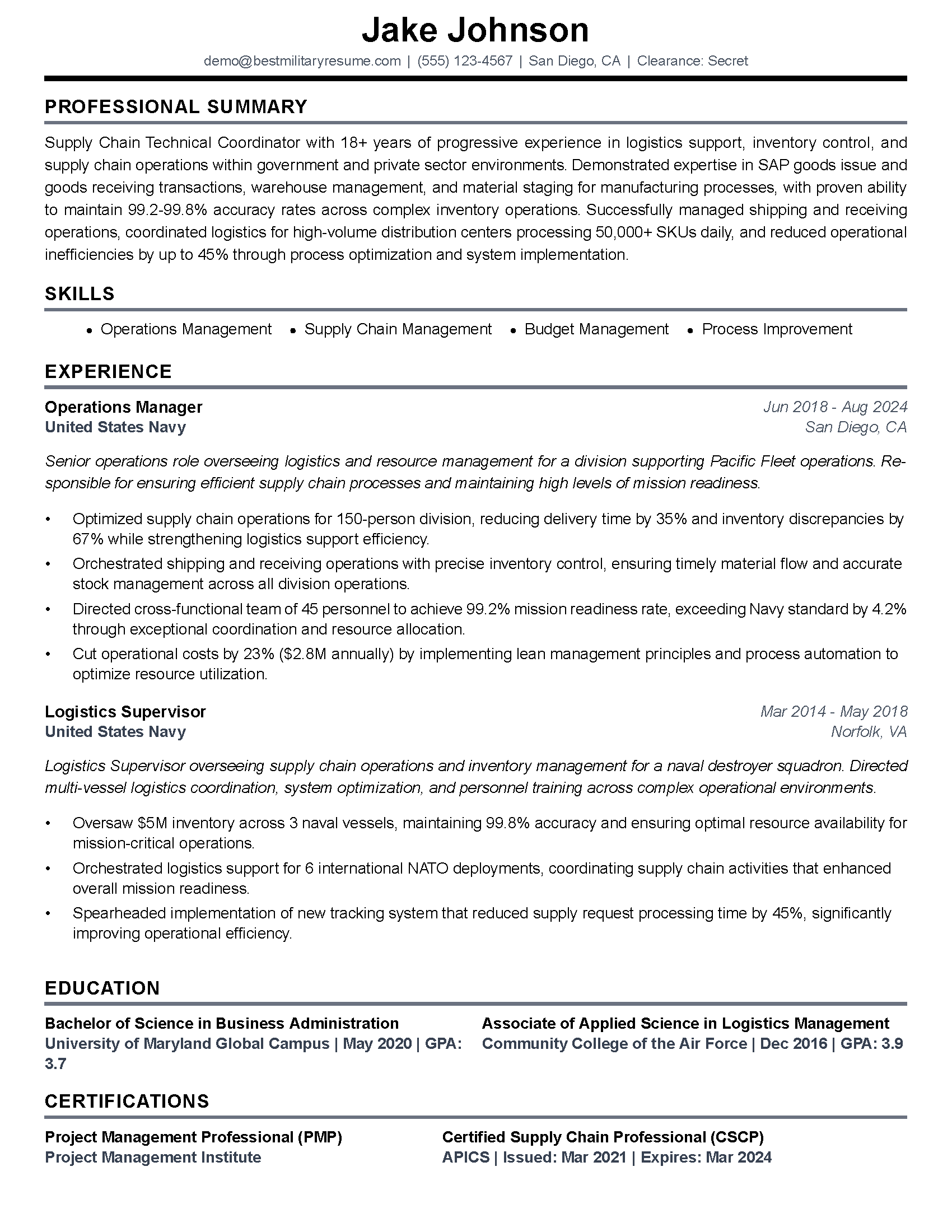
Why Do TAP Resumes Fail ATS Scans?
How ATS Actually Works
In many cases before a human ever reads your resume, software scans it. Applicant Tracking Systems like Workday, iCIMS, and Taleo parse your document for specific keywords from the job posting. Your TAP resume might say "Team Leader" while the posting says "Operations Manager." Many systems won't treat those as a match. A recruiter searching for "Operations Manager" may never see your resume, even if you did that exact job.
A first draft tends to use broad categories. ATS searches for the posting's exact keywords. So the words on your resume need to match the words in the job posting.
Why Your Resume Ranks Low
ATS ranks and searches resumes by how closely they match the posting's language. If the posting says "supply chain optimization" and you wrote "logistics management," the system may miss it. Use the employer's exact terms. A big reason TAP resumes get passed over is generic military language instead of each employer's terms.
Why One Resume for 50 Jobs Doesn't Work
Every job posting uses different language. An operations manager role at Amazon uses different keywords than the same title at Lockheed Martin. When you send the same TAP resume to both, you're only accidentally matching keywords — if you match any at all.
TAP tells you to target every application. In class, you target one draft to one posting you pick. Many veterans then send that draft to every job. ATS tools rank and search by the language in each specific posting. A generic resume that doesn't mirror the posting tends to rank low, however qualified you are.
This is why veterans who apply to 50 jobs with one resume hear nothing back, but the ones who tailor for 5 specific roles start getting calls.
The Skills Section Gap
First-draft TAP resumes tend to lean on soft skills like "leadership" and "communication." ATS searches for "SAP," "project management certification," or "SQL."
When I separated as a Navy Diver in 2015, my TAP resume had "equipment maintenance" in the skills section. The federal logistics job I wanted needed "supply chain management systems" and "inventory control software." The words didn't match, so the system or HR filtered me out — even though I'd done that work for years.
Federal applications add another layer. For USAJOBS, OPM tells you to list each job's title, employer, month and year dates, and weekly hours. Any federal job you list also needs its series and grade. Describe each job's duties in terms that line up with the announcement. A classroom draft built for a private-sector job won't meet OPM's rules for federal resumes.
Your TAP resume was built for a classroom exercise. The job market requires a document built for each specific role.
What Do TAP Resumes Get Wrong About Military Translation?
The Surface-Level Swap Problem
TAP covers translating military terms into civilian ones. "Squad Leader" becomes "Team Leader." "NCOIC" becomes "Manager." Problem solved, right?
Not even close.
The real issue is that translated titles without context tell a hiring manager nothing. "Managed personnel" — how many people? Doing what? With what results? Word swaps alone don't communicate value.
What Actually Fails
Vague action verbs: "Responsible for equipment maintenance" tells a hiring manager you showed up. It doesn't tell them you reduced downtime by 40% or managed $3M in assets.
Missing metrics: "Led training programs" could mean you taught one class or built an entire curriculum for 200 people. Hiring managers assume the smallest version.
Leftover jargon: Resumes full of CONOP, BN, and S-3 references get skipped by civilian hiring managers who have no idea what those acronyms mean.
Soft skills only: First drafts lean on leadership, teamwork, adaptability. Corporate job postings want specific tools — Salesforce, SAP, AutoCAD, Python. Your resume needs both.
What Works Instead
Here's what that looks like for a logistics NCO. "Managed supply operations" becomes "Supervised 8-person team processing 2,000+ requisitions monthly with 99.2% accuracy across $4M inventory." That's not a word swap. That's proving value in language hiring managers understand.
1Add metrics to every bullet
2Replace vague verbs with outcomes
3Strip all military acronyms
4Match technical skills to job postings
How Do You Turn Your TAP Resume Into a Real Resume?
Start With the Job Posting
Stop treating your resume like a static document. Every application needs a different version.
Pull the job posting. Read the requirements section. Highlight 10-15 specific phrases they use — not what you think they mean, but their exact words. If they say "supply chain optimization," your resume needs "supply chain optimization," not "logistics management."
Rewrite Every Bullet for This Job
Your TAP resume says "Managed maintenance operations for communication equipment."
The job posting asks for "Network infrastructure oversight with focus on uptime and vendor coordination."
Rewrite: "Maintained 99.7% uptime across 47-node communication network through preventive maintenance scheduling and vendor relationship management."
The rewrite uses the job posting's language and adds a measurable result. That's what gets you past both the ATS and a recruiter's first skim, which averages about 7 seconds.
Copy the job posting's exact language
Highlight 10-15 specific phrases from the requirements section. These are your target keywords.
Match each keyword to your experience
Find the military experience that maps to each requirement. If they say "vendor coordination," identify where you managed relationships with contractors or suppliers.
Rewrite bullets with metrics and their language
Combine the job posting's terminology with your specific numbers — team size, budget, percentages, timeframes.
Submit and repeat for the next job
Save each tailored version separately. The next posting will need different keywords and different emphasis — that's the whole point.
Add Numbers to Everything
TAP tells you to write achievement statements. But many first drafts still read like a list of duties. Hiring managers want to know the impact.
Team size. Budget. Time saved. Error reduction. Equipment value. Geographic scope. Training hours delivered.
"Led training" means nothing. "Trained 124 personnel across 6 locations on updated safety protocols, reducing incident reports 34% over 8 months" gets interviews.
A Note on Formatting
Stick to standard fonts like Arial or Calibri, and avoid tables and text boxes. PDF or .docx are both fine. Don't let formatting eat your time. Keep it simple and readable. Then put your effort into keywords and customization, where many resumes fall short. Get the content right first.
Build Multiple Versions
You need different resumes for different job types. One for project management roles. One for technical positions. One for operations. Federal applications follow completely different rules. Most federal jobs now cap the resume at two pages. Always check the announcement, because some of them are exceptions. Aim your federal resumes at the specific series and grade you're targeting.
Yes, this takes time. Budget 2 hours per tailored version. That's the actual job search work — not hitting "Easy Apply" on 50 postings with your TAP template.
This is exactly what BMR's Resume Builder was built for. Paste a job posting, and it pulls your military experience, translates it into the job's language, and matches the keywords that ATS is scanning for — automatically. Instead of spending 2 hours per version, you get a tailored resume for every job you want to apply to. The free tier gives you two tailored resumes to start, one federal and one private sector.
Conclusion
Key Takeaway
TAP gave you a first draft. The veterans who get hired fast are the ones who rewrite that draft for every job they apply to — with the right keywords, real metrics, and language that matches each specific posting.
Your TAP resume taught you the basics. Now build the version that gets you hired.
Pick two jobs you want this week. Rewrite your resume for each one. Match their keywords. Add your numbers. Strip the jargon. Tailor every bullet to what that specific hiring manager needs to see.
If you want the translation and keyword matching done for you, BMR's Resume Builder handles it automatically — built by a veteran who sat on both sides of the hiring desk.
Ready to build a resume that actually works? See our military resume templates that work and compare the best resume builders for veterans in 2026.
Related: Military resume keywords that beat ATS by industry and resume red flags that get veteran resumes rejected.
Frequently Asked Questions
Should I throw away my TAP resume completely?
How many different resumes do I need?
Will hiring managers know I used the TAP template?
What's the biggest mistake veterans make with TAP resumes?
Do I need different resumes for federal and corporate jobs?
How long should my resume be?
About the Author
Brad Tachi is the CEO and founder of Best Military Resume and a 2025 Military Friendly Vetrepreneur of the Year award recipient for overseas excellence. A former U.S. Navy Diver with over 20 years of combined military, private sector, and federal government experience, Brad brings unparalleled expertise to help veterans and military service members successfully transition to rewarding civilian careers. Having personally navigated the military-to-civilian transition, Brad deeply understands the challenges veterans face and specializes in translating military experience into compelling resumes that capture the attention of civilian employers. Through Best Military Resume, Brad has helped thousands of service members land their dream jobs by providing expert resume writing, career coaching, and job search strategies tailored specifically for the veteran community.
