Resume Action Verbs for Veterans: A Complete List
 Brad Tachi7 min read
Desiree landed a $135K hybrid senior financial consultant role.
Desiree, E-5, Army National Guard, the interviewer loved the resume from the top down
Introduction
Your EPR, EPB, or FITREP is full of phrases like "orchestrated mission-critical operations" and "liaised with joint stakeholders." Those verbs sound impressive in a military context — but a civilian hiring manager scanning your resume is looking for words like "managed," "coordinated," and "supervised."
When I reviewed federal resumes for openings I oversaw, I watched qualified veterans get passed over. Their bullets read like evaluation reports, not job applications. "Functioned as team lead" tells me you had a role. "Supervised 12-person team" tells me what you actually did.
This guide covers which action verbs work for different military roles, how to match them to job descriptions, and which military terms to drop completely. The goal is a resume that makes a recruiter or hiring manager immediately understand your experience — and want to call you for an interview.
What Are Resume Action Verbs and Why Do Veterans Need Them?
Action verbs are the difference between a resume that gets read and one that sinks to the bottom of the pile.
When you write "responsible for supply operations," you're using passive language. When you write "managed $2M inventory across 15 supply categories," you're using an action verb that tells a hiring manager exactly what you did.
Why Military Language Doesn't Work
Your FITREP or NCOER probably said you "orchestrated mission-critical operations" or "liaised with joint stakeholders." Civilian hiring managers don't scan for those phrases. They look for "managed," "supervised," "coordinated," "designed."
ATS systems rank resumes based on keyword matches to the job posting. If the job says "coordinate logistics" and your resume says "served as logistics NCOIC," the system doesn't make the connection. Your resume ranks near the bottom.
The Translation Problem
Military evaluations reward a specific writing style that doesn't translate. Terms like "battle rhythm," "CONOP," and "SITREP" won't register with civilian HR.
Here's what I mean:
Military: "Served as platoon sergeant for 40 personnel"
Civilian: "Supervised 40-person team across daily operations and training"
You did the same job — the second version just uses words a recruiter actually searches for. The second version uses verbs that ATS systems recognize and hiring managers understand.
Served as NCOIC • Conducted operations • Performed maintenance • Functioned as team lead • Executed training plan
Supervised • Coordinated • Maintained • Managed • Designed • Optimized • Directed • Implemented
The Department of Labor's Resume Essentials guide builds a whole exercise around this. It has you translate military-specific terms into language civilian employers can easily understand.
The gap isn't your experience. It's the words you use to describe it.
BMR's Resume Builder does this translation as part of building your resume. Pick the job, and it rewrites your military duties and jargon in civilian language for that posting.

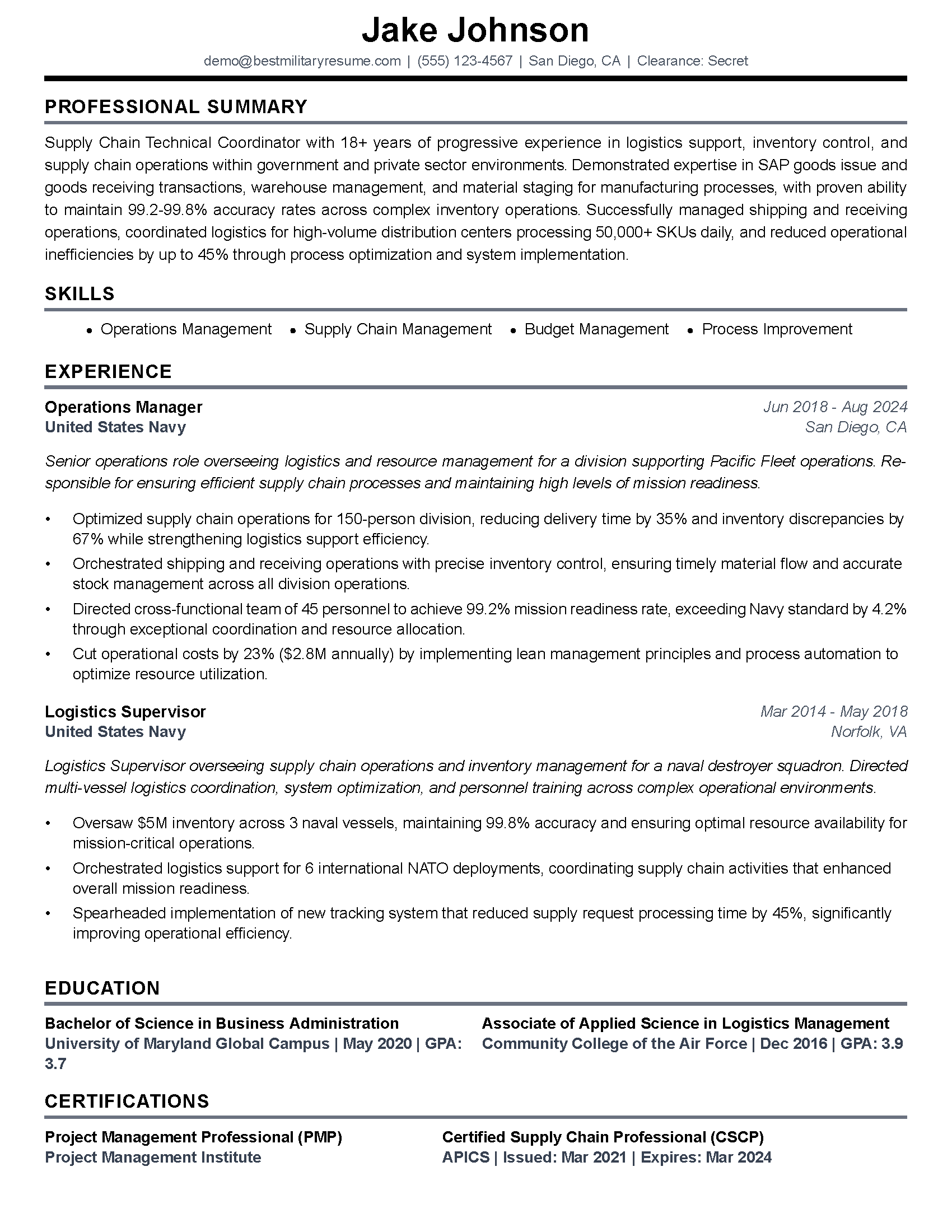
How Do You Choose the Right Action Verbs for Military Experience?
Start with the job description. When you see "coordinate cross-functional teams," that's your signal to use "coordinated" in your resume. ATS systems scan for exact verb matches.
ATS Pro Tip: Mirror the Job Posting
Pull the exact verbs from the job description into your resume bullets. If the posting says "coordinate," use "coordinated" — not "managed" or "oversaw." ATS systems match on specific keywords, and close synonyms don't always register.
Leadership Roles Need Specific Verbs
Don't default to "led" for everything. You have options: supervised, directed, managed, mentored, trained, coached. Each carries different weight.
After helping 24,011 veterans and military spouses, the pattern is clear. There's a huge difference between someone who "led a team" and someone who "mentored 12 junior analysts through certification programs." The second version tells a recruiter exactly what you did.
Technical Roles Demand Precision
For technical MOSs, generic verbs kill your chances. "Worked on communications systems" says nothing. "Configured satellite communications for 200+ users across four remote sites" shows capability.
Use: designed, implemented, troubleshot, configured, maintained, optimized, upgraded.
Match Your MOS to Verb Categories
Project management: coordinated, executed, planned, delivered, streamlined, scheduled
Logistics: tracked, procured, distributed, inventoried, forecasted, allocated
Training: developed, instructed, certified, evaluated
Operations: directed, monitored, assessed, reported
Before: "Functioned as maintenance NCOIC"
After: "Supervised 15-person maintenance team, reducing equipment downtime 40%"
The Department of Labor's Resume Essentials guide includes a general list of action verbs for your bullets. The real trick is pulling verbs directly from target job postings.
Skip weak verbs entirely: helped, worked on, responsible for, assisted with. These tell hiring managers you weren't in charge of anything.
In BMR's Military to Civilian Jobs guides, browse by branch and pick your MOS, Rating, or AFSC. Each guide shows matching civilian job titles and salary ranges from the Bureau of Labor Statistics. It also shows how the work reads on a resume.
Which Military Terms Should You Never Use on a Civilian Resume?
Some military terms kill your resume before a human reads it. ATS systems don't recognize them, and hiring managers don't understand them.
Jargon That Sinks Your Resume
Drop these immediately: NCOIC, OIC, battle rhythm, CONOP, FRAGO, OPORD, SITREP. None of these translate outside DoD.
Rank codes are just as bad. E-7, O-3, W-2 tell a civilian nothing about your actual job. Exception: federal resumes for DoD or VA roles can include rank context.
MOS codes, AFSC, NEC, Rating? Useless. "35F Intelligence Analyst" should become "Intelligence Analyst" or just describe what you did.
Overused Military Verbs That Weaken Your Resume
"Conducted" appears on every military resume I've seen. So does "performed" and "executed." They're vague and generic.
When I pivoted into tech sales, I had to rewrite every bullet on my resume. Tech sales taught me the civilian language I should have already learned ten years earlier. Same work, different language.
Replace weak verbs:
"Conducted operations" → "Managed daily logistics operations"
"Performed maintenance" → "Maintained $3M equipment fleet"
"Executed training plan" → "Designed 40-hour technical training program"
"Functioned as team lead" → "Supervised 8-person operations team"
Resume Verb Quick-Check
1Replace "responsible for" with a specific action verb
2Replace "conducted" with what you actually did
3Add numbers to every bullet (team size, dollars, percentages)
4Remove all military acronyms (MOS, NCOIC, AFSC, NEC)
5Start every resume bullet with a strong action verb
When Military Terms Actually Work
Federal resumes for DoD agencies can include some military context. A GS-12 logistics role at an Army depot? They'll understand "battalion-level supply operations."
But even then, translate first. "S-4 NCOIC" should still become "Supervised 15-person supply section managing $8M inventory."
Make the First 7.4 Seconds Count
In Ladders' 2018 eye-tracking study, recruiters spent 7.4 seconds on average on a resume's initial screening. Strong action verbs + specific numbers = instant credibility.
Conclusion
The difference between "conducted operations" and "coordinated logistics for 200+ personnel" is whether your resume ranks at the top of the ATS results. Action verbs aren't just style - they're the translation layer between military experience and civilian hiring systems.
After my own transition from Navy Diver to federal career fields and then tech sales, I can tell you the pattern is clear: veterans who use specific, results-oriented verbs get interviews. Those who stuck with military jargon didn't make it past the first screening.
Match your verbs to the job description. Skip the military acronyms. Show results with numbers. That's the formula.
BMR's Resume Builder does this for you. Upload your evals (NCOER, FITREP, EPR or EPB) or your existing resume, then pick the job. It rewrites your experience in civilian language for that posting. Most people finish a first resume in 10 to 15 minutes. It's free to start, including 2 tailored resumes, one federal and one private sector. No guesswork, no manual translation, just a resume that gets read.
Need help with the full translation? See our guide on translating military terms to civilian equivalents. And make sure your resume passes the first scan with our military resume writing guide for career fairs and professional summary guide.
Related: Military resume keywords that beat ATS by industry and resume red flags that get veteran resumes rejected.
Frequently Asked Questions
Can I use "led" too many times on my resume?
Should I use past tense or present tense action verbs?
Do federal resumes need different action verbs than corporate resumes?
How many action verbs should each bullet point have?
Are there action verbs I should avoid completely?
Can I use the same action verb from the job description?
About the Author
Brad Tachi is the CEO and founder of Best Military Resume and a 2025 Military Friendly Vetrepreneur of the Year award recipient for overseas excellence. A former U.S. Navy Diver with over 20 years of combined military, private sector, and federal government experience, Brad brings unparalleled expertise to help veterans and military service members successfully transition to rewarding civilian careers. Having personally navigated the military-to-civilian transition, Brad deeply understands the challenges veterans face and specializes in translating military experience into compelling resumes that capture the attention of civilian employers. Through Best Military Resume, Brad has helped thousands of service members land their dream jobs by providing expert resume writing, career coaching, and job search strategies tailored specifically for the veteran community.
