Military Resume Templates That Work for Veterans
 Brad Tachi10 min read
Desiree landed a $135K hybrid senior financial consultant role.
Desiree, E-5, Army National Guard, the interviewer loved the resume from the top down
Military resume templates are everywhere online — and most of them are terrible. They are either generic civilian templates with "insert military experience here" placeholder text, or they are so packed with military jargon that no civilian employer could read them. Neither helps you land an interview.
BMR has helped 24,744 veterans and military spouses build resumes. The patterns that actually work are consistent across every branch. The format matters less than what goes in it — but the wrong format can still sink a qualified candidate. A great resume in the wrong structure confuses ATS systems and frustrates recruiters who expect to find information in specific places.
This guide covers the exact resume formats that work for military veterans in both private sector and federal applications, what to put in each section, and the template mistakes that cost veterans interviews.
A template shows you the shape. To see it filled in, the military resume examples hub shows one complete resume per civilian job, rendered by the same engine that builds yours.
What Should a Military-to-Civilian Resume Template Include?
Every effective military resume has the same core sections — arranged in an order that puts your strongest qualifications in front of the reader first.
The Section Order That Works
Contact Information — Name, city/state (target location), phone, email, LinkedIn URL
Professional Summary — 2-4 sentences translating your military background into civilian value. No objectives.
Certifications and Clearances — Security clearances, technical certifications, licenses. Put these before experience if they are critical to your target role.
Professional Experience — Your military service translated into civilian language, most recent first
Education — Degrees, military education translated (an Army Advanced Leader Course becomes "Advanced Leadership and Management Program," etc.)
Technical Skills — Software, systems, tools, equipment relevant to your target role
Certifications Before Experience?
Does the job posting require a clearance or a certification like Security+, PMP, AWS, or CDL? Then put it above your experience section. Recruiters scan from top to bottom. A required credential near the top can be the reason they keep reading instead of moving on.
What Does NOT Belong
Objective statements — Outdated. Use a professional summary instead.
Photos — Not standard in the US job market
References — "Available upon request" wastes space. They will ask if they want them.
Full military unit designations — Use installation name and city/state only
Every PCS move — Include only the positions most relevant to your target job
How Is a Private Sector Resume Different From a Federal Resume?
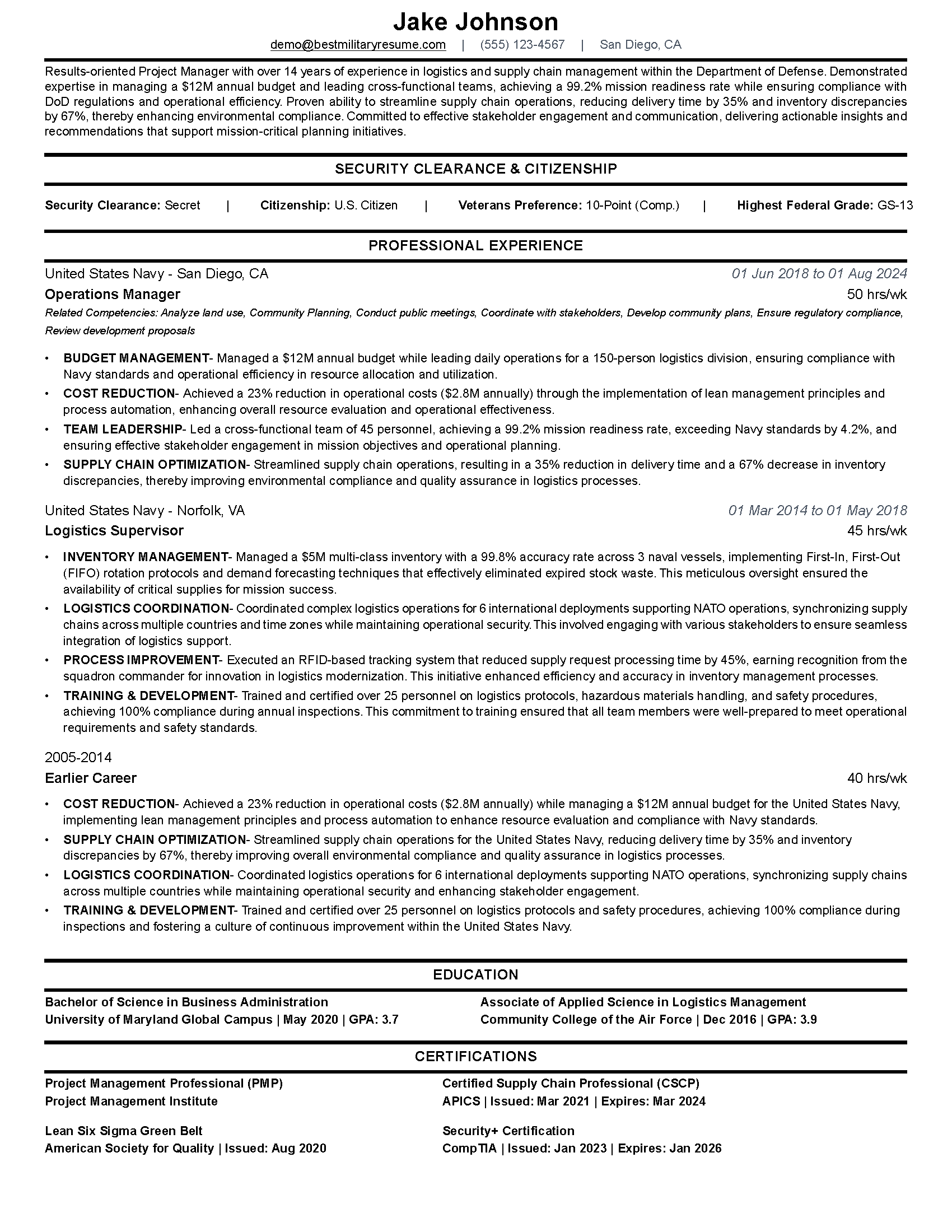
These are two completely different documents. Sending the wrong format to the wrong employer is one of the most common mistakes veterans make.
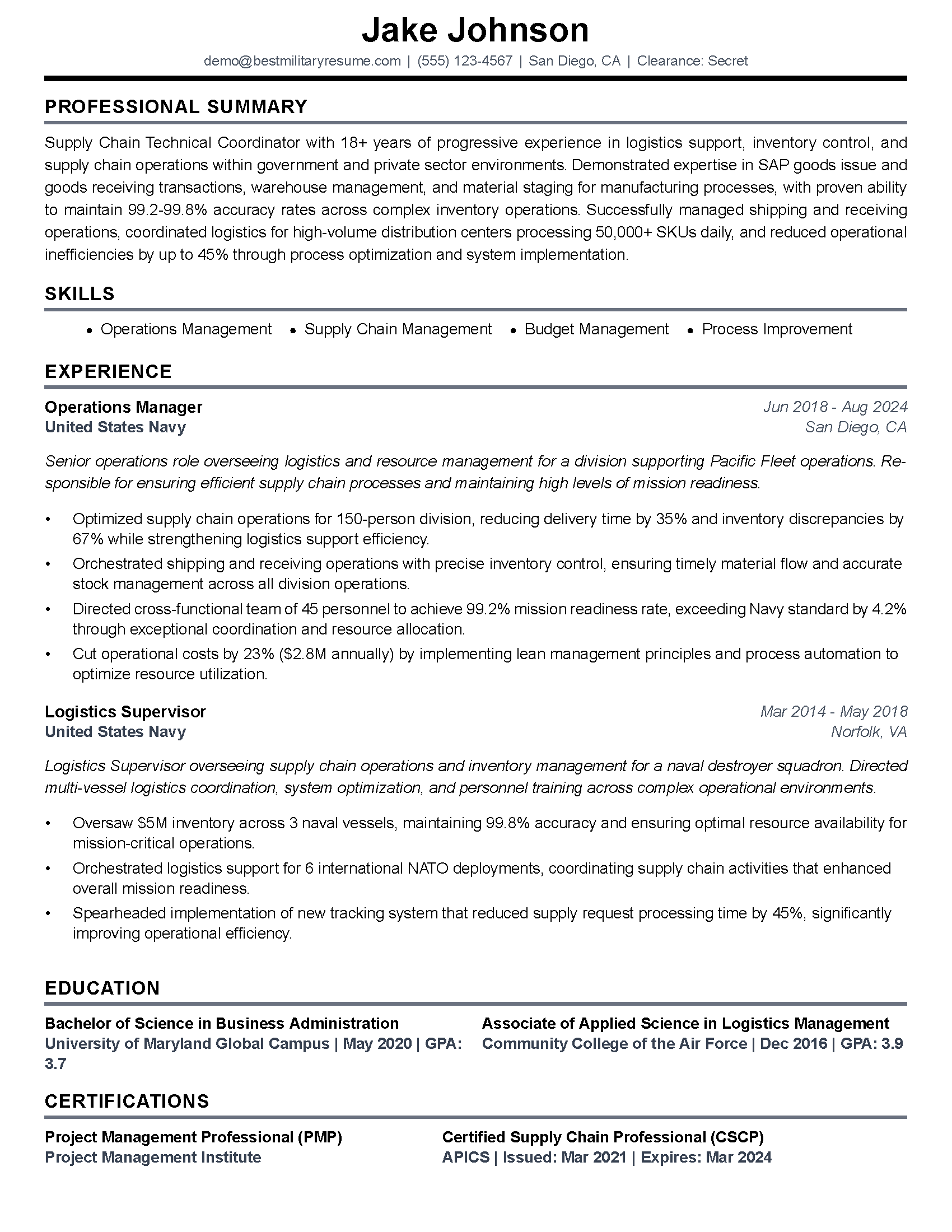
- •1-2 pages max
- •Concise bullet points (1-2 lines each)
- •Keywords from the job description
- •Clean design, easy to scan in about 7 seconds
- •Professional summary, not objective
- •2 pages for most federal jobs (check the announcement for exceptions)
- •Detailed bullets matching KSAs
- •Hours per week and month/year dates for every job
- •Keywords from the job announcement
- •Match every qualification in the posting
A federal resume sent to a private company looks bloated and confusing. A private sector resume sent through USAJOBS is too thin on detail to score well. You need both versions if you are applying to both sectors. For full federal resume guidance, see our federal resume writing guide.
What Does a Strong Military-to-Civilian Resume Actually Look Like?
Here is the structure that consistently gets callbacks, broken down section by section.
Professional Summary Example
"Highly motivated veteran seeking a challenging position where I can apply my military leadership skills to contribute to organizational success."
"Operations manager with 8 years leading 40-person teams through high-tempo logistics operations. Managed $4.2M in equipment with zero loss across 3 annual audits. PMP certified. TS/SCI cleared. Seeking supply chain leadership roles in defense or manufacturing."
The strong version has numbers, certifications, clearance, and a specific target. It gives a recruiter four reasons to keep reading during the first skim. A 2018 Ladders eye-tracking study clocked that skim at 7.4 seconds on average.
Experience Section Format
Each position should follow this structure:
Civilian Job Title (Military Rank/Grade)
United States [Branch] | [Installation], [City], [State]
[Start Date] — [End Date]
Then 4-6 bullet points, each starting with an action verb and including a measurable result. Here is a complete example:
Operations Manager (Staff Sergeant / E-6)
United States Army | Fort Bragg, Fayetteville, NC
March 2019 — June 2023
Supervised 22-person operations team responsible for mission planning, personnel management, and equipment accountability across a $4.2M inventory
Reduced equipment loss rate from 2.1% to 0.3% through improved inventory tracking procedures, saving $89K annually
Planned and executed 14 large-scale training events for 200+ personnel, meeting all readiness benchmarks ahead of schedule
Trained and mentored 8 junior supervisors, with 6 earning promotion within 12 months
Managed daily operations for 24/7 facility supporting 600+ personnel, maintaining 99.5% operational availability
Notice: no military jargon, every bullet has a number, and the job title is a civilian equivalent. The rank is in parentheses for context. Each bullet starts with a strong action verb — supervised, reduced, planned, trained, managed — and ends with a measurable result. This format works for every branch and every MOS.
For federal resumes, add more detail to each bullet. Federal hiring managers want to see the specific duties and how they match the qualification requirements. Include your hours per week (typically 40+) and month/year start and end dates for each position. OPM's two-page guidance does not require a supervisor's name, phone, or salary. Leave them off unless the announcement asks for them. Federal resumes are capped at 2 pages for most jobs. USAJOBS has enforced that cap since September 27, 2025. Always check the announcement, because some jobs are exceptions. See our guide on listing military experience for detailed examples.
How Should Veterans Format Education and Certifications?
The education section trips up more veterans than any other part of the resume. Military education does not fit neatly into civilian categories, and most templates only have space for "University, Degree, Year." You need a structure that accommodates both traditional degrees and military professional development.
Degrees and Formal Education
If you have a college degree, list it in standard format: Degree, Major, School, Year. If you completed your degree while on active duty, that is worth mentioning — it shows time management and commitment to professional growth outside your primary duties.
If you used your GI Bill after separating, list the degree normally. Do not mention the GI Bill on your resume — it is a funding source, not a qualification.
Military Education Translation
Professional military education goes in a separate "Professional Development" or "Military Training" section. Translate every course name:
"ALC (Advanced Leader Course)" becomes "Advanced Leadership and Management Program" (course length varies by MOS)
"Airborne School" becomes "Advanced Tactical Operations Training (3 weeks)"
"CWST" becomes "Combat Water Survival Training (aquatic survival and emergency response)"
"EO Leader Course" becomes "Equal Opportunity and Organizational Climate Assessment Training"
"Unit Movement Officer Course" becomes "Unit Movement Officer Course (logistics and transportation planning training)"
Translate what the course taught. Never call a course a certification unless it actually issued one. Include the training duration and year. For federal resumes, OPM's two-page guidance lists job-related training as an optional detail. Whether training counts toward a GS grade depends on the job's qualification standard. Check the qualifications section of the announcement before you cut training.
Certifications and Security Clearances
Certifications and Security Clearances
Clearances and certifications are high-value resume assets, but their importance depends on the industry and role. In federal contracting and national security roles, an active security clearance can matter more than years of experience. In most civilian industries, relevant job experience takes priority. Put certifications and clearances prominently only if they are specifically listed as required in the job description. Otherwise, lead with the experience section.
Format clearances and certifications like this:
Active Security Clearance: Secret
Previous Clearance: Top Secret/SCI (held 2018-2022)
Active Certifications:
- Project Management Professional (PMP), PMI, 2024
- CompTIA Security+, expires December 2026
- Certified Supply Chain Professional (CSCP), APICS
Clearances do not carry an expiration date. DCSA cites a December 7, 2016 Defense Department memo reminding agencies that clearances do not expire. Never write "expires" next to one. List the level and whether you hold it now. A past clearance is still worth listing with the years you held it, as in the example above. Certifications should include the issuing organization and the year earned or the date it is good through.
Certifications Worth Listing First
Security Clearances (TS/SCI, Secret)
ClearanceJobs' 2026 Compensation Report puts average total compensation for cleared professionals at $126,125. List status and investigation date.
PMP (Project Management Professional)
PMP requires 2 to 5 years of experience managing projects, depending on your education. You also need 35 hours of project management training or an active CAPM. Military leadership and planning work can count if you led the projects. High demand across industries.
CompTIA Security+ / CISSP
Under DoD Manual 8140.03, it is one way to meet foundational qualification for many DoD cyber roles. Qualifying education or training also counts. List it above your experience when the job requires it.
CDL (Commercial Driver License)
Recent military drivers can ask their state to waive CDL knowledge or skills tests (49 CFR 383.77). You must apply within a year of your military driving job. Opens jobs in logistics and transportation.
FAA Airframe & Powerplant (A&P)
Aircraft maintenance experience can count toward the FAA's experience rule to sit for the A&P exams. That means 18 months for one rating, or 30 months for both (14 CFR 65.77). You still have to pass the FAA tests. Opens civilian aviation careers.
What Template Mistakes Cost Veterans Interviews?
Using Fancy Designs With Columns and Graphics
Creative resume templates with sidebars, columns, icons, and graphics look great as PDFs, but can sometimes cause issues with ATS systems. Modern ATS systems have improved at handling two-column layouts, but some older systems still struggle. If you're applying to large corporations or tech companies that heavily use ATS screening, stick with a single-column format to be safe. For direct submissions to smaller companies or creative industries, a two-column design is acceptable. Test your resume through an ATS simulator before submitting to important applications.
Using the USAJOBS Resume Builder for Everything
The USAJOBS resume builder creates a text-heavy federal format that works for government applications. It is terrible for private sector. If you are applying to civilian companies, build a separate resume with a cleaner format.
Not Tailoring for Each Application
The most expensive template mistake is not about design at all. It's using the same resume for every job. A template is a starting structure. The content inside it needs to change for every position you apply to. Pull keywords from each job description. Rearrange your bullets to lead with the experience most relevant to that specific role. A supply chain manager application needs different lead bullets than a project management application, even if both draw from the same military experience.
Downloading a Generic "Veteran Resume Template"
Most free veteran resume templates online are generic civilian templates with military clip art slapped on top. They don't address the core challenge of translating military experience into civilian language.
When evaluating a resume template, look for:
- Single-column layout with clear section headers
- Space for military duty stations and branch names
- Education section that accommodates both degrees and professional military training
- Examples showing how to translate military job codes to civilian titles
- A professional summary section, not an objective statement
Avoid templates that:
- Use graphics, icons, or colored sidebars that might confuse ATS systems
- Assume all jobs fit one format (military service isn't formatted like civilian jobs)
- Don't explain how to translate certifications, clearances, or military education
- Use outdated elements like objective statements or "references available upon request"
A good template should accommodate military-specific information, not force it into civilian categories. The template structure is the easy part. The translation is where the real work happens.
Key Takeaway
A template gives you the structure. It does not give you the translation. The format of your resume matters far less than what you write in it. A perfectly formatted resume full of military jargon will still get ignored.
Are Branch-Specific Templates Necessary?
Not really. The resume format is the same across all branches — the content changes based on your branch, MOS/rating, and target career. An Army 92Y and a Navy LS write their resumes in the same template structure. The difference is in the job titles, duty station formatting, and terminology translation.
What DOES change by branch:
Job title translation — Each branch uses different job codes (MOS, Rating, AFSC, career field)
Address formatting — Ships, bases, stations, and installations vary by branch
Evaluation language — NCOERs, EVALs, FITREPs, and the Air Force's EPBs all use different formats
Rank translation — E-5 means different things in different branches
The one thing that does change significantly between branches is how you handle the transition from military job code to civilian title. An Army MOS, a Navy rating, a Marine Corps MOS, an Air Force AFSC, a Coast Guard rating, and a Space Force career field all use different naming conventions and translate to different civilian career families. But the resume structure underneath is identical.
For branch-specific guidance, see our dedicated guides: Army, Navy, Marine Corps, Air Force, Coast Guard, and Space Force.
"I spent weeks trying to find the right resume template after leaving the Navy. The template was never the problem. The problem was that I was writing 'Navy Diver' as my job title and expecting civilian hiring managers to figure out the rest. Once I translated the content, the template barely mattered."
Conclusion
The right resume template gives you structure. The right content gives you interviews. Most veterans spend too much time picking a template and not enough time translating their experience into language that civilian employers understand.
Use a clean, single-column format. Lead with a professional summary that has numbers and a clear target. Put certifications and clearances before experience if they are relevant to your target role. Translate your military education into civilian-readable training descriptions. Write bullets with measurable results — every bullet needs at least one number. And maintain two versions — one for private sector, one for federal — if you are applying to both.
Do not spend weeks picking the perfect template. The structure is the easy part. The translation — turning military jargon into language that makes a civilian hiring manager say "call this person" on the first skim — is where the real work happens. Get the content right first. The formatting will follow.
BMR's Resume Builder gives you the template and handles the translation automatically. Paste a job posting, and it builds a tailored resume with your military experience translated into the exact language that employer is looking for. Free for two tailored resumes, one federal and one private sector.
Frequently Asked Questions
What is the best resume template for military veterans?
Should I use a different template for each branch?
How long should a military resume be?
Can I use the USAJOBS resume builder for private sector jobs?
Should I include my military rank on the resume?
Where do I put my security clearance on a resume?
Do I need both a private sector and federal resume?
What resume format works best with ATS systems?
About the author
Brad Tachi is the CEO and founder of Best Military Resume and a 2025 Military Friendly Vetrepreneur of the Year award recipient for overseas excellence. A former U.S. Navy Diver with over 20 years of combined military, private sector, and federal government experience, Brad brings unparalleled expertise to help veterans and military service members successfully transition to rewarding civilian careers. Having personally navigated the military-to-civilian transition, Brad deeply understands the challenges veterans face and specializes in translating military experience into compelling resumes that capture the attention of civilian employers. Through Best Military Resume, Brad has helped thousands of service members land their dream jobs by providing expert resume writing, career coaching, and job search strategies tailored specifically for the veteran community.
