Veteran Resume Walkthrough: Every Section With Real Examples
Desiree landed a $135K hybrid senior financial consultant role.
Desiree, E-5, Army National Guard, the interviewer loved the resume from the top down
I spent 18 months after separating from the Navy sending out resumes that went nowhere. Zero callbacks. Zero interviews. And the frustrating part was that I had real experience — dive operations, logistics, team leadership, hazardous materials handling — but none of it was landing on paper in a way that made a hiring manager care.
The problem was section-level. My contact info was formatted like a military document. My summary read like an evaluation. My experience section was a wall of acronyms and duty descriptions that only another diver would understand. Every single section had a translation problem, and I was trying to fix them all at once without understanding what each one actually needed to do.
This walkthrough breaks your veteran resume into seven sections and shows you exactly what goes in each one, why it matters, and what the finished version looks like with real examples. If you want the full checklist of what to put on your resume after military service, start there. This article goes deeper — section by section, line by line.
How Should You Format Your Contact Information?
Contact info seems simple enough that people skip over it. That is a mistake. Hiring managers and recruiters form their first impression in the header, and if yours looks like a military recall roster, you have already started on the wrong foot.
Your contact block needs four things: full name, phone number, professional email, and city/state. That is it. No rank. No military address. No "ATTN:" formatting.
ND1 Marcus Johnson, USN
PSC 473 Box 12, FPO AP 96349
[email protected]
(619) 555-0142
Marcus Johnson
San Diego, CA
[email protected]
(619) 555-0142
A couple of specifics that trip people up:
- Email: Get a civilian email address before you start applying. Your .mil address expires, and a Gmail or Outlook address with your actual name looks professional. No nicknames, no numbers if you can avoid it.
- LinkedIn URL: Optional but worth adding if your profile is cleaned up. Place it on the same line as your email or below your city/state. If your LinkedIn still says "E-5 Logistics Specialist, United States Navy," fix that first.
- Full street address: Skip it. City and state are enough. Some veterans relocating list their target city here, which is fine — just make sure it matches the job location.
- Rank: Drop it entirely from the header. Your rank belongs in your experience section if it provides context (like supervisory scope), not next to your name.
What Makes a Strong Professional Summary for Veterans?
Your professional summary is the single most important section on the page. It is the first thing a recruiter reads, and if it does not immediately connect your background to the job they are filling, they are moving on. I have reviewed thousands of applications, and the summary is where I decided whether to keep reading or skip to the next candidate.
A good veteran summary does four things in 3-4 sentences: states your years of experience, names the civilian-equivalent field, highlights a measurable result, and signals what role you are targeting. For a deeper breakdown with more templates, check out our guide on writing a professional summary that gets interviews.
Highly motivated Navy Diver (ND1) with 8 years of honorable service. Experienced in diving operations, salvage, and underwater ship husbandry. Secret clearance. Looking for new opportunities.
Operations manager with 8 years leading high-risk underwater construction and inspection teams in the U.S. Navy. Managed $2.4M in specialized equipment across 14 deployments with zero safety incidents. Targeting project management and operations roles in maritime, energy, or construction sectors.
The translated version works because it names a civilian field (operations management), includes a dollar figure and a safety record, and tells the recruiter exactly what roles to consider this person for. The military version assumes the reader knows what "ND1" means and what "ship husbandry" translates to — and ends with the weakest possible closing: "looking for new opportunities."
Summary Formulas That Work
Here are two structures you can plug your own numbers into:
For operations/management roles: "[Civilian title] with [X] years leading [team size/scope] in [context]. [Measurable result — dollar amount, percentage, or scale]. Targeting [specific role type] in [industry]."
For technical/specialist roles: "[Technical field] professional with [X] years of hands-on experience in [2-3 specific skills]. [Certification or clearance if relevant]. Delivered [specific outcome] across [scope]."

How Do You Translate Military Experience Into Civilian Bullet Points?
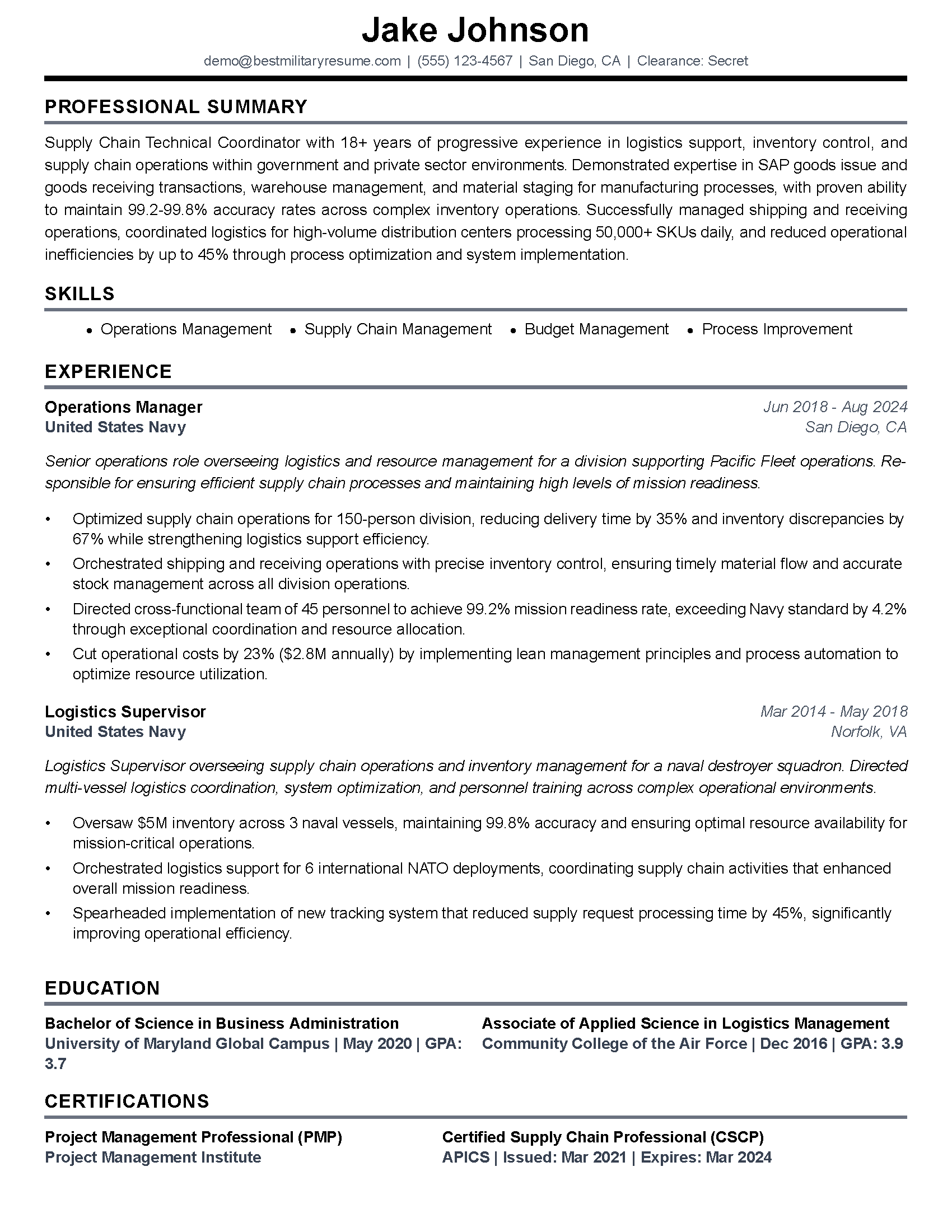
This is the section where veteran resumes live or die. Your experience section takes up the most space, gets the most scrutiny, and is where hiring managers decide whether you can actually do the job they are hiring for. It is also where the translation challenge is hardest.
Every experience entry needs: your civilian-equivalent job title, the organization (you can keep the branch — "U.S. Army" is fine), location, and dates. Then 4-6 bullet points per role, each one following a specific formula.
Key Takeaway
Every bullet point should start with a strong action verb, include a number or measurable outcome, and end with the business impact. "Managed" is fine. "Managed a team of 12 maintenance technicians, reducing equipment downtime by 30% across a 200-vehicle fleet" is what gets you interviews.
The Bullet Point Formula
Action verb + what you did + scale/numbers + result or impact.
Here is an Army 91B (Wheeled Vehicle Mechanic) translating a duty into a resume bullet:
- Raw military: "Performed PMCS on M1151 HMMWVs and M1078 LMTVs IAW TM 9-2320-387-10."
- Translated: "Conducted preventive maintenance inspections on 45+ light and medium tactical vehicles, identifying and resolving mechanical deficiencies that maintained a 94% fleet readiness rate."
The translated version keeps the technical credibility (preventive maintenance, fleet readiness rate) while removing the jargon that only a motor pool NCO would recognize. For more on this, read our full guide on how to quantify military experience on your resume.
What About Acronyms?
Some acronyms are fine to keep. "CPR certified" does not need to be spelled out. "OSHA 30" is widely recognized. But "NCOER," "PMCS," and "TDY" need translation or removal. The general rule: if your target employer would use the term in their own job postings, keep it. If they would not, spell it out or drop it.
How Many Roles Should You List?
For a 2-page resume, you have room for 3-4 roles with 4-6 bullets each. If you held the same MOS across multiple duty stations, treat each assignment as a separate role — different location, different scope, different accomplishments. A 92A (Automated Logistical Specialist) at Fort Bragg managing a company-level supply room is a different job than a 92A at a brigade S4 managing property books for 4,000 soldiers. Show that progression.
Does Your Education Section Need Special Formatting?
Education is straightforward, but veterans make two common mistakes: either burying it at the bottom with no detail, or listing every military school they ever attended as if it were a college degree.
Here is what belongs in your education section:
- Degrees: List your highest degree first. Include the school name, degree type, major, and graduation year. If you are still finishing a degree, write "Expected May 2027" or whatever the date is.
- Relevant coursework: Only if you are early career or changing fields and the coursework directly applies. An MBA with a concentration in supply chain management is worth noting if you are targeting logistics roles.
- Military education that translates: Senior NCO academies, Officer Candidate School, and branch-specific leadership programs can go here IF you translate the name. "Advanced Leadership Program — U.S. Army (equivalent to graduate-level organizational management)" works. Just listing "SLC" does not.
Your JST (or SMART transcript for Navy/Marines, CCAF for Air Force) shows college credits earned from military training. Many veterans have 30-60 credits they do not know about. Check yours before writing the education section — you may have more to list than you think.
What does NOT belong here: basic training, annual mandatory training (Cyber Awareness, SHARP, etc.), and anything that does not have a civilian equivalent or credit-bearing value. If you attended a 2-week military school that has no civilian translation, it either goes in certifications or gets cut.
How Should Veterans Build a Skills Section That Actually Works?
The skills section is where ATS keyword matching happens. When a recruiter searches their applicant tracking system for "project management" or "OSHA compliance" or "fleet maintenance," your skills section is one of the first places the system scans. If those terms are not there, your resume ranks lower in the results and a hiring manager may never scroll down to it.
But here is where many veterans go wrong: they either list soft skills that are too vague ("leadership," "teamwork," "adaptable") or they dump every military qualification they ever earned into a wall of text. Neither approach works.
Hard Skills vs. Soft Skills
Lead with hard skills — the specific, measurable, trainable abilities that match job posting requirements. Then add 2-4 soft skills maximum, and make them specific.
Example for an E-6 Army 25B (IT Specialist) targeting a Systems Administrator role:
Technical Skills: Windows Server 2019/2022, Active Directory, Group Policy Management, VMware vSphere, TCP/IP networking, Cisco IOS, DISA STIGs, vulnerability scanning (Nessus/ACAS), PowerShell scripting, ServiceNow ITSM
Additional Skills: Team leadership (supervised 8 technicians), technical training development, incident response coordination, ITIL framework
Notice the hard skills section reads like a job posting for a sysadmin role. That is intentional. Pull keywords directly from the postings you are targeting and mirror them in your skills section. If the posting says "Active Directory" do not write "AD" — match their language exactly.
Skills to Remove From Your Resume
Cut these immediately. They add nothing and take up space a real keyword could fill:
- "Microsoft Office" (assumed — everyone has it)
- "Detail-oriented" (show it in your bullets, do not claim it)
- "Hard worker" or "motivated self-starter" (filler)
- "Weapons qualified" (unless you are going into law enforcement or security)
- "PT score" or any physical fitness metrics (not relevant to civilian hiring)
For formatting guidance on how your skills section should look on the page, check our breakdown of ATS-friendly fonts and margins for military resumes.
What Certifications Should You Include (And How)?
Certifications can be the difference between getting an interview and getting skipped. In fields like IT, logistics, healthcare, and project management, specific certs carry serious weight — sometimes more than your degree.
List certifications in a dedicated section below education. Include the full certification name, the issuing body, and the date earned or expiration date. Active certifications go first.
Example layout:
- Project Management Professional (PMP) — Project Management Institute, 2025
- CompTIA Security+ CE — CompTIA, expires 2027
- OSHA 30-Hour General Industry — OSHA, 2024
- Lean Six Sigma Green Belt — ASQ, 2023
Military-Only Certifications
Certifications that only exist within the military system (like a specific weapons qualification or a unit-level instructor cert) do not belong here unless they have a direct civilian equivalent. If you earned your CDL through the Army, list the CDL — not the military course name. If you completed CLS (Combat Lifesaver), that does not equal EMT certification. Be honest about what transfers.
Which Certs Should You Get Before Separating?
This depends entirely on your target field, but a few carry weight across multiple industries:
- Project Management Professional (PMP): Valuable for any leadership role. Your military experience likely qualifies you for the hours requirement.
- CompTIA Security+ / Network+: Required for many DoD contractor and federal IT positions under DoD 8570/8140.
- OSHA certifications: Essential for construction, manufacturing, environmental, and safety roles.
- CDL (Commercial Driver's License): High demand and some bases offer free CDL training through SkillBridge or transition programs.
- Six Sigma (Green or Black Belt): Strong signal for operations, manufacturing, and process improvement roles.
Should You Include Awards and Honors on a Veteran Resume?
Yes, but selectively. Awards are the section veterans either overload with every ribbon and medal they received or skip entirely because they think no one cares. Both are wrong.
The rule is simple: include awards that demonstrate a skill, achievement, or recognition relevant to your target role. A Meritorious Service Medal for "exceptional leadership of a 120-person logistics operation" tells a hiring manager something useful. A National Defense Service Medal — which every service member receives — does not.
What to Include
- Performance awards: Navy/Marine Corps Achievement Medal, Army Commendation Medal, Air Force Achievement Medal — especially if the citation describes a specific accomplishment you can reference.
- Leadership recognition: NCO/Sailor/Soldier of the Quarter/Year. These signal competitive selection.
- Technical or impact awards: Anything tied to a specific project outcome — cost savings, safety improvements, mission-critical contributions.
What to Leave Off
- Campaign medals and service ribbons (everyone who deployed gets these)
- Good Conduct Medals (expected, not exceptional)
- Marksmanship badges (unless applying for law enforcement/security)
- Anything classified or that you cannot describe in civilian terms
When you list an award, add a one-line description of WHY you received it. "Army Commendation Medal" alone tells a recruiter nothing. "Army Commendation Medal — recognized for redesigning the battalion supply accountability process, recovering $340K in missing equipment" tells them you solve real problems.
"Your resume is a 2-page argument for why someone should hire you. Every section either builds that case or wastes space. There is no neutral territory on the page."
How Do You Put It All Together?
You have the seven sections. Now here is how they stack on the page and how to make sure the whole thing holds together as a single document — not just a collection of parts.
Section Order (Top to Bottom)
- Contact Information — header, always first
- Professional Summary — 3-4 sentences immediately below contact info
- Skills — keyword-rich section that ATS scans early
- Experience — your largest section, 3-4 roles with translated bullets
- Education — degrees and relevant military education
- Certifications — active, industry-recognized certs
- Awards — selective, with one-line context for each
Some people swap Skills and Experience in order. Either works, but if you are changing fields significantly, leading with skills gives the recruiter the keywords they need before they hit your military job titles. If your military roles translate closely to your target job, lead with experience.
Length and Formatting
Two pages maximum. Not one. Not three. Two. If you need help deciding whether your situation calls for one or two pages, we have a full breakdown on when to use a 1-page vs 2-page military resume.
Use a clean, single-column layout. No graphics, no photos, no colored sidebars. Stick with 10-11pt font in Calibri, Arial, or Garamond. Margins at 0.5 to 0.75 inches. Both .docx and PDF formats work fine for submission — do not let anyone tell you that one format is required over the other.
The Tailoring Step You Cannot Skip
This entire walkthrough gets you to a strong base resume. But that base resume still needs to be tailored for every single job you apply to. That means reading the posting, identifying the keywords and qualifications they are asking for, and adjusting your summary, skills, and bullet points to mirror that language.
I built BMR's Resume Builder specifically because this tailoring step was the part that burned the most time in my own transition. You paste a job posting, and it handles the military-to-civilian translation and keyword alignment automatically. The free tier gives you 2 tailored resumes — enough to see how the process works and start landing interviews.
What Are the Biggest Section-Level Mistakes to Avoid?
After helping 15,000+ veterans through BMR, the same section-level mistakes show up constantly. Here are the ones that cost people interviews:
- Summary that reads like an objective statement: "Seeking a challenging position where I can utilize my skills" is dead on arrival. Summaries sell. Objectives beg.
- Experience bullets that describe duties instead of results: "Responsible for maintenance of vehicles" tells a recruiter what your job was — they can get that from the title. "Reduced vehicle downtime by 22% through a preventive maintenance schedule covering 85 assets" tells them what you accomplished.
- Skills section full of soft skills: If more than a quarter of your skills list is words like "leadership" and "communication," you are wasting keyword real estate.
- Education section that lists every military school: Land Navigation Course, Basic Combatives, Annual SHARP training — none of these help. Keep it to degrees, transferable programs, and credit-bearing education.
- Awards with no context: A list of medal names without explanations is just alphabet soup. Add the "why" to every award or cut it.
For a side-by-side look at what these mistakes look like on a real resume, check out our military resume before and after rewrites.
Your resume is not a record of your service. It is a targeted document built to get you a specific interview for a specific job. Every section has a job to do. Contact info gets you contacted. The summary gets the recruiter to keep reading. Experience proves you can do the work. Skills feed the ATS. Education and certs check the qualification boxes. Awards add proof you performed above standard.
Build each section with that purpose in mind, tailor the whole thing for every application, and you will be ahead of the majority of veterans still sending out the same untranslated resume to every posting. If you want the translation and tailoring handled for you, BMR's Resume Builder was built for exactly this.
Frequently Asked Questions
How long should a veteran resume be?
Should I include my military rank on my resume?
How do I translate military job titles to civilian titles?
What military acronyms can I keep on my resume?
Should I list every military award on my resume?
Do I need a different resume for every job application?
Where should the skills section go on a veteran resume?
Can I use my DD-214 to build my resume?
About the Author
Brad Tachi is the CEO and founder of Best Military Resume and a 2025 Military Friendly Vetrepreneur of the Year award recipient for overseas excellence. A former U.S. Navy Diver with over 20 years of combined military, private sector, and federal government experience, Brad brings unparalleled expertise to help veterans and military service members successfully transition to rewarding civilian careers. Having personally navigated the military-to-civilian transition, Brad deeply understands the challenges veterans face and specializes in translating military experience into compelling resumes that capture the attention of civilian employers. Through Best Military Resume, Brad has helped thousands of service members land their dream jobs by providing expert resume writing, career coaching, and job search strategies tailored specifically for the veteran community.
