Convert NCOER, OER, or FITREP into Resume Bullets
 Brad Tachi8 min read
Michael got only rejections. Then a $100K facilities manager role.
Michael, E-7, Navy, tried a ton of outside help before BMR
Introduction
Your NCOER, OER, or FITREP already contains your best accomplishments. The problem? Hiring managers arent looking to decode military experience.
After helping 24,011 veterans and military spouses, the pattern is clear. Most veterans copy military language directly and wonder why callbacks never come. Your evals prove you performed at a high level - but only if civilians can read them.
The conversion process takes four steps: extract quantified results from your evaluation bullets, remove every acronym and military-specific term, rewrite in active voice with concrete outcomes, then format for ATS systems that scan resumes in seconds. This guide walks through each step with real NCOER, OER, and FITREP examples so you can turn your evals into a comprehensive civilian ready resume.
"Enhanced unit readiness through proactive maintenance protocols resulting in improved operational capability"
"Maintained 40 vehicles with 95% operational readiness, reducing downtime 30% and saving $120K annually"
Enhanced unit readiness through proactive maintenance protocols resulting in improved operational capability
Maintained 40 vehicles with 95% operational readiness, reducing downtime 30% and saving $120K annually
What Makes Military Evaluations Different from Civilian Resumes?
Your eval reads like a classified brief. Your resume needs to read like a billboard.
Military evaluations are written for other service members who speak the language. Civilian resumes are written for recruiters, who spend about 7.4 seconds on a first screen.
The Language Problem
Evals lean on abstract terms and duty language. Think "Provided oversight of maintenance operations" or "Ensured unit readiness through comprehensive protocols."
Resumes use concrete results: "Maintained 40 vehicles with 95% operational readiness" or "Reduced equipment downtime by 30%."
When I left the Navy, I sent federal applications for a year and a half with zero callbacks. What finally fixed it was rewriting how my work got described.
The Format Problem
Your NCOER bullets can run two full lines, packed with context and rank-appropriate language. A single block can stack three of them. A resume bullet should hit one line whenever it can.
Evals describe duties. Resumes prove impact.
The ATS Problem
Applicant tracking software scores your resume against the words in the job posting. NCOIC, LOGPAC, CONOP, and SITREP almost never appear in a civilian posting. They earn you nothing with the software, and they mean nothing to the recruiter reading its list.
Army Regulation 623-3 says NCOERs and OERs "focus on a Soldier's duty performance." They measure it against the Army's leadership model, in service-specific terms. That's perfect for promotion boards. It kills your resume.
The goal isn't dumbing down your accomplishments. It's making them accessible to people who never served.

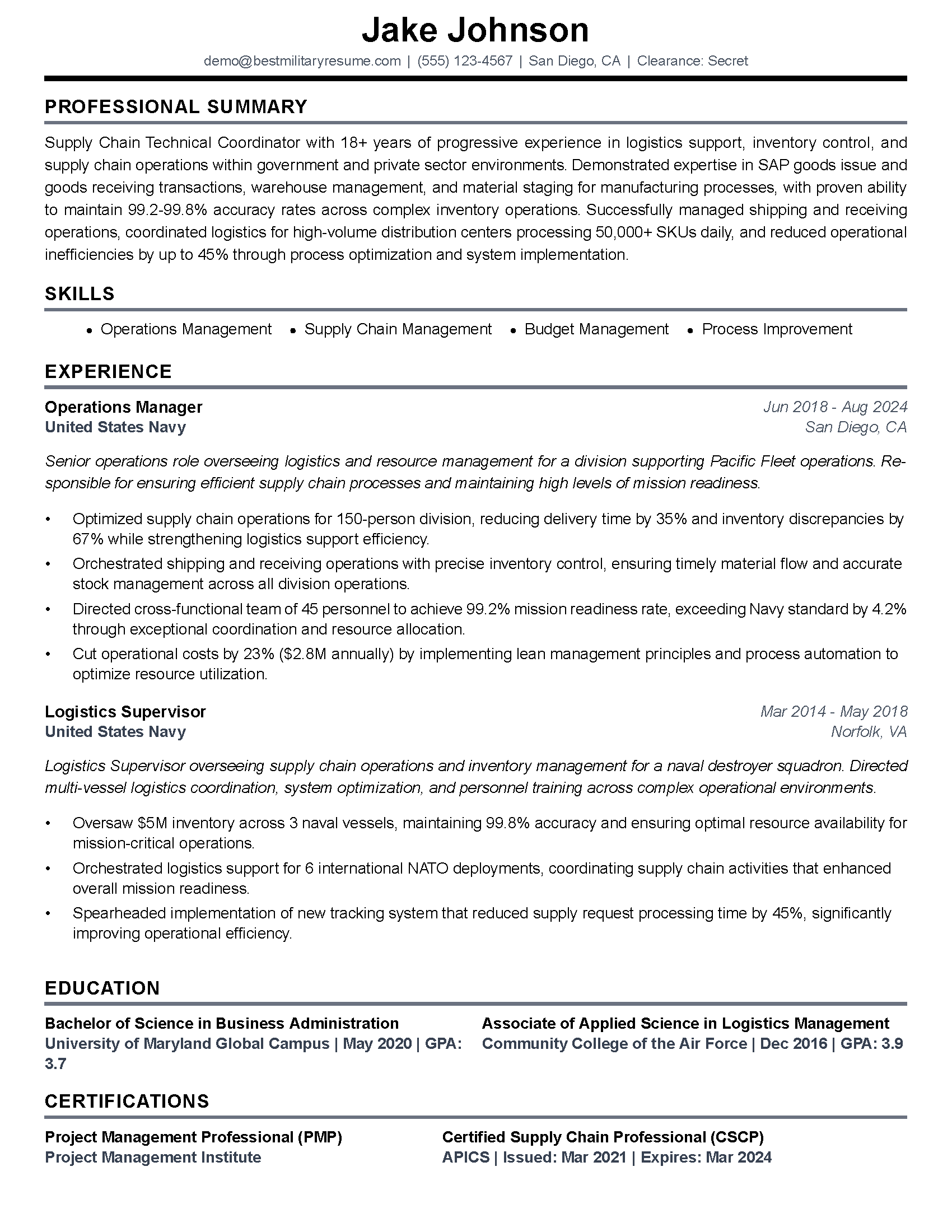
How Do You Extract Quantified Results from Your Evaluations?
Your eval already has the numbers. You just need to find them.
Pull Every Number First
Go through your NCOER, OER, or FITREP with a highlighter. Mark every number you see: dollar amounts, percentages, team sizes, timeframes, equipment quantities, mission counts. Don't analyze yet - just extract.
Army NCOER example: "Maintained 100% accountability of $4.2M in equipment across 12-month deployment"
Numbers found: $4.2M, 100%, 12 months
Navy FITREP example: "Managed $1.8M maintenance budget, achieving 98% aircraft readiness rate"
Numbers found: $1.8M, 98%
Officer OER example: "Led 45-soldier platoon through 200+ combat missions with zero casualties"
Numbers found: 45 soldiers, 200+ missions, zero casualties
Connect Numbers to Outcomes
The mistake I see most often: listing numbers without showing what they mean.
Bad: "Responsible for $2M budget"
Good: "Managed $2M budget, reducing costs 15% while maintaining 98% readiness"
The NCOER performance measures guide shows how evaluations structure achievements - but hiring managers need the outcome stated plainly.
Reconstruct Missing Numbers
Your eval says "Led team during deployment" with no specifics? Add them from memory:
How many people reported to you?
What was your budget (rough estimate works)?
How many projects did you complete?
How long was the assignment?
"Led team during deployment" becomes "Led 12-person team through 9-month deployment, completing 50+ missions with zero safety incidents."
Format for Resume Use
Strip the evaluation language. Keep the numbers and outcomes.
Before: "Demonstrated exceptional leadership capabilities while serving as Maintenance NCOIC, consistently maintaining high operational readiness standards"
After: "Supervised 8-person maintenance team, achieving 96% equipment readiness rate across 40 vehicles"
The second version can be read in one glance. That first screen is all a recruiter gives you.
What Military Terms Must You Remove for Civilian Readers?
Start with the acronyms. Every single one needs to go unless it's genuinely industry-standard (NATO, OSHA, FAA pass the test - NCOIC, CONOP, SITREP don't). Your resume gets ignored until you stop writing like you're still in uniform.
Replace Military Job Titles With Civilian Equivalents
Your eval says "NCOIC" - your resume should say "Operations Manager." "S-3" becomes "Strategic Planning Lead." "XO" translates to "Deputy Director." Hiring managers don't decode org charts, they scan for roles they recognize.
Real conversion: "Served as NCOIC for BN S-4, managing LOGPAC distribution across 6 FOBs" → "Managed supply chain operations for 800-person organization across 6 remote locations."
Convert Military-Specific Terms to Business Language
"Battle rhythm" means nothing outside the military. Write "operational schedule" instead. "Left and right limits" becomes "project scope." "Commander's intent" translates to "strategic objectives."
Army NCOER guidelines show exactly how military evals are structured - which is exactly why they don't work as resumes. The language is built for internal evaluation, not external job applications.
The #1 Translation Mistake
Veterans replace military jargon with vague corporate buzzwords that sound impressive but say nothing. That trades one readability problem for another. Use plain, direct language that anyone can understand.
Test Every Line With the Spouse Rule
If your non-military spouse can't understand a sentence, rewrite it. Don't replace military jargon with vague corporate buzzwords - that's just trading one problem for another.
FITREP example: "Qualified as OOD underway, standing 120+ watches during WESTPAC deployment" → "Certified as operations supervisor, completing 120+ duty shifts during 6-month deployment."
The goal isn't to hide your military service. It's to make your accomplishments accessible to people who never served.
How Do You Reformat Evaluation Bullets for ATS Systems?
The software scores your bullets against the words in the job posting. Then a recruiter reads its list, looking for action verbs and results. Your eval bullets fall short. They lean on military acronyms and abstract results. They can run two full lines, written for a promotion board.
Strip the Duty Language First
Duty-style bullet: "Was responsible for maintenance operations, ensuring 95% readiness across assigned equipment"
Resume format: "Maintained 40 vehicles with 95% operational readiness rate"
Remove "was responsible for," "provided oversight of," "ensured compliance with." These phrases describe duties, not results. A recruiter skims right past them. Lead with the verb: Managed, Led, Reduced, Increased, Implemented, Coordinated, Trained.
Compress to One Line
Your NCOER stacks two-line bullets because it's written for promotion boards who have time to read. Recruiters spend about 7.4 seconds on the first screen of a resume. One bullet = one line = one accomplishment.
NCOER: "Demonstrated exceptional leadership while serving as Squad Leader, maintaining high morale and discipline across 9-soldier team during 12-month combat deployment, resulting in 100% retention"
Resume: "Led 9-soldier team through 12-month deployment with 100% retention rate"
Cut the filler. "Demonstrated exceptional leadership" is implied by the results. "Maintaining high morale and discipline" is how you got 100% retention - you don't need to say it twice.
Eval-to-Resume Conversion Checklist
1Start with action verb
2Include at least one number
3Zero military acronyms
4One line per bullet
Match Job Posting Keywords
If the job posting emphasizes "budget management," lead with your budget numbers. If it's "team leadership," start with team size. ATS systems rank your resume based on keyword matches.
Bad: "Responsible for maintenance operations"
Good: "Managed maintenance operations for 40 vehicles, achieving 95% readiness rate"
The federal resume builder automatically reformats eval bullets for USAJOBS compliance. Federal resumes carry more context per bullet, but most federal jobs cap them at two pages. Always check the announcement, because some are exceptions. Corporate resumes need even tighter compression.
Real Result
Dustin, an Army Sergeant First Class (E-7), used BMR to keep his resume sharp through his job search. He landed his first job after the Army, a cybersecurity role with a contracting company. He negotiated the offer to $95K. His reason: he could show his fit "both on my resume and in the interview."
Conclusion
Your evaluations already contain your best accomplishments. The difference between a rejected application and an interview comes down to four steps: extract the numbers, strip the acronyms, rewrite in civilian language, and format for ATS systems.
Most veterans skip the translation step. They copy "Enhanced operational readiness through proactive maintenance protocols" directly onto their resume and wonder why hiring managers don't call back. The problem isn't your performance - it's that civilians can't decode military writing conventions.
Start with your most recent eval. Highlight every number, remove every acronym, and rewrite each bullet in active voice with a quantified result. "Maintained 40 vehicles with 95% operational readiness rate" beats "Responsible for vehicle maintenance operations" every time.
Federal applications need more context than corporate resumes, but both require civilian language. A GS-12 logistics specialist position wants to see your budget size and team scope. A corporate supply chain role wants the same information in half the words.
Don't reinvent your career from memory when your NCOERs, OERs, and FITREPs already document your best work. The Resume Builder turns your uploaded evals into civilian bullets that work for the software and the person. It was built from helping 24,011 veterans and military spouses across all branches. Upload your eval, paste a job posting, get a tailored resume in minutes. The free tier lets you build your base resume. It also includes two tailored resumes, one federal and one private sector.
Your evaluations prove you performed. Your resume proves civilians can understand that performance.
Related: Top companies hiring veterans in 2026 and the complete military resume guide for 2026.
Frequently Asked Questions
Can I use the same resume bullets from my NCOER/OER/FITREP for every job application?
What if my evaluations don't include numbers or quantified results?
Should I include my evaluation ratings (Far Exceeded Standard, Must Promote, etc.) on my resume?
How many bullets should I include per job on my resume?
Do federal resumes and corporate resumes need different bullet formats?
What's the biggest mistake veterans make when converting eval bullets?
Can I combine multiple evaluation bullets into one resume bullet?
About the Author
Brad Tachi is the CEO and founder of Best Military Resume and a 2025 Military Friendly Vetrepreneur of the Year award recipient for overseas excellence. A former U.S. Navy Diver with over 20 years of combined military, private sector, and federal government experience, Brad brings unparalleled expertise to help veterans and military service members successfully transition to rewarding civilian careers. Having personally navigated the military-to-civilian transition, Brad deeply understands the challenges veterans face and specializes in translating military experience into compelling resumes that capture the attention of civilian employers. Through Best Military Resume, Brad has helped thousands of service members land their dream jobs by providing expert resume writing, career coaching, and job search strategies tailored specifically for the veteran community.
