Professional Summary for a Military Resume: 20 Examples by Branch
Desiree landed a $135K hybrid senior financial consultant role.
Desiree, E-5, Army National Guard, the interviewer loved the resume from the top down
Your professional summary is the first thing a hiring manager reads. Not your job titles, not your certifications, not whatever fancy formatting you spent three hours on. The summary. That top block of 3-4 sentences sitting right under your name and contact info.
And if you spent any time in uniform, you already know what happens when you lead with jargon. The hiring manager who has never heard of an NCOER or a FITREP reads your summary, sees a wall of acronyms and military-specific language, and moves on. Six seconds. That is the window you get, based on my own experience sitting on the hiring side of the table reviewing federal applications.
This article gives you 20 professional summary examples organized by branch — Army, Navy, Marine Corps, Air Force, Space Force, and Coast Guard. Each one is written for a specific career target so you can see how to translate your background for the job you actually want, not just the one you held. If you need a broader breakdown of how professional summaries work in general, check out our complete guide to professional summaries for veterans.
What Makes a Military Professional Summary Actually Work?
A good professional summary does four things in 3-4 sentences. It names your experience level and general field. It highlights your strongest measurable result. It ties your background to the specific role you are applying for. And it reads like a human wrote it, not a jargon generator.
The mistake I see constantly through BMR — after helping 15,400+ veterans build resumes — is summaries that read like a military bio. You know the kind: "Highly motivated self-starter with 12 years of progressive leadership experience in dynamic environments." That sentence could describe anyone from an E-5 to a regional sales manager. It tells the reader nothing specific about what you did or what you can do for them.
"Highly motivated veteran with 10+ years of leadership experience seeking a challenging position where I can utilize my skills in a fast-paced environment."
"Operations manager with 10 years directing logistics across 4 overseas supply chains, reducing distribution costs by 18%. Certified PMP with Secret clearance and experience managing $12M+ annual budgets."
The targeted version works because it gives the hiring manager something to hold onto. A number. A scope. A certification. A clearance. That is what gets you into the "yes" pile. For more on what hiring managers actually scan for, read our breakdown on what recruiters see first on a military resume.
How to Build Yours in 4 Steps
Before you look at the examples, here is the formula. Every strong professional summary follows the same bones:
Lead With Your Civilian Title
Open with the job title from the posting, not your military rank or MOS. "Project Manager with 8 years..." not "Former E-7 with 8 years..."
Drop a Number in the First Sentence
Years of experience, team size, budget managed, or equipment value. Numbers anchor the reader and create instant credibility.
Add Your Strongest Result
One measurable accomplishment. Cost savings, efficiency gain, team performance metric, project delivered on time. Pick the one that matches the target role best.
Close With Certs or Clearance
If you hold a PMP, Security+, CDL, CISSP, Secret/TS clearance — put it here. These are differentiators that civilian candidates often lack.
That is it. Four sentences, four elements. Now let us look at how this plays out across every branch.

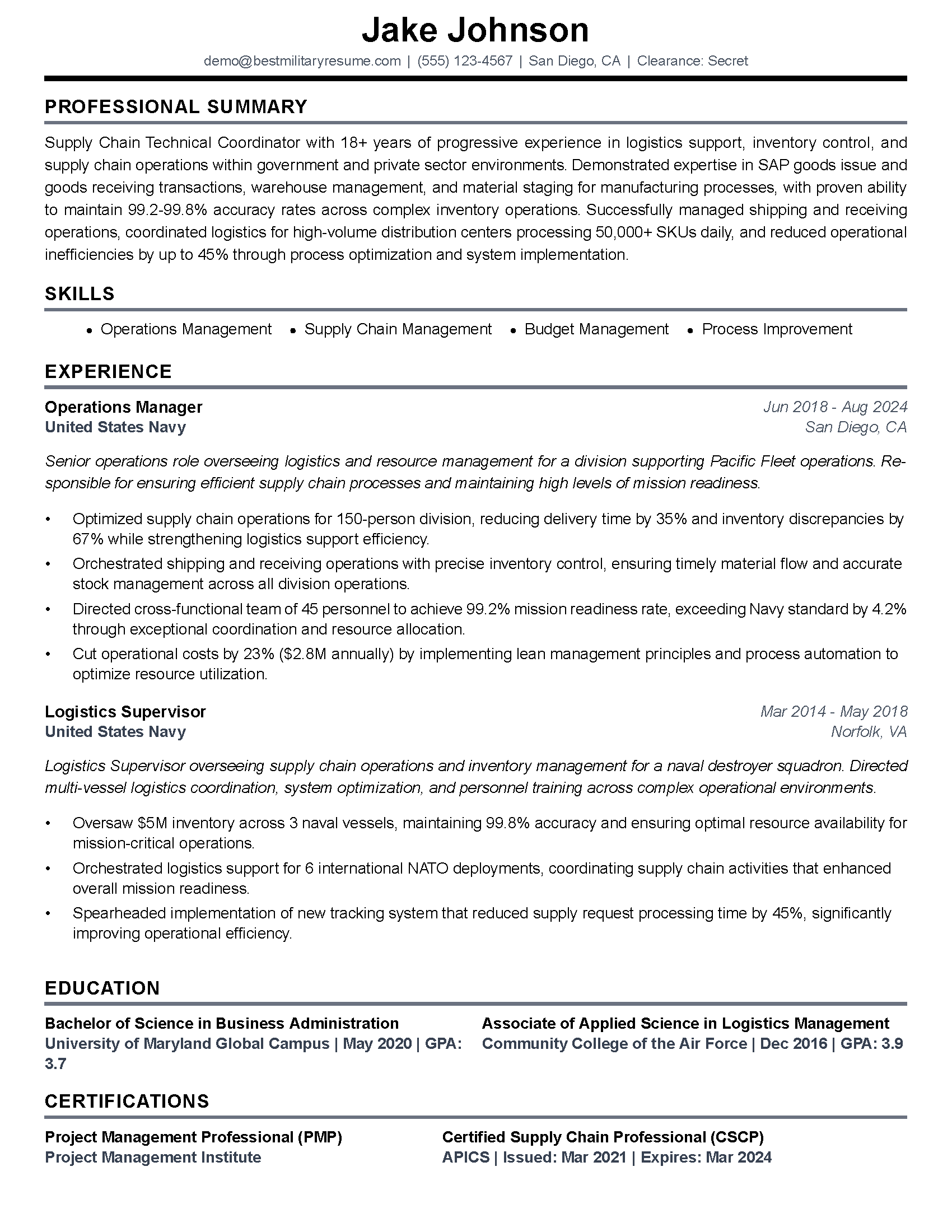
Army Professional Summary Examples
Army veterans cover everything from infantry to signal to medical. The translation challenge depends heavily on your MOS. A 25B (IT Specialist) translates almost directly. A 12B (Combat Engineer) takes more work. Here are four examples hitting different career targets.
Army Example 1 — Logistics Manager (Former 92A)
"Supply chain manager with 8 years directing inventory control and distribution operations across 3 overseas locations. Managed $45M in equipment accountability with zero loss rate over final 4-year assignment. Experienced in SAP, GCSS-Army, and automated warehouse management systems. Active Secret clearance."
Army Example 2 — IT Project Manager (Former 25B)
"IT project manager with 6 years deploying and maintaining enterprise network infrastructure supporting 2,400+ users. Led a system migration that reduced help desk tickets by 34% within 90 days. CompTIA Security+ and ITIL Foundation certified. TS/SCI clearance eligible."
Army Example 3 — Operations Manager (Former 11B)
"Operations manager with 12 years leading teams of 9-42 personnel through complex planning, execution, and after-action review cycles. Directed 14 field operations with a 100% on-time completion rate across austere environments. Skilled in risk assessment, resource allocation, and cross-functional team coordination."
Army Example 4 — Healthcare Administrator (Former 68W)
"Healthcare operations professional with 5 years coordinating patient care logistics for a 200-bed medical facility. Processed 1,200+ patient encounters monthly while maintaining 98.7% documentation accuracy. NREMT-certified with hands-on triage and emergency response experience."
Notice every one of those opens with a civilian job title and drops a number in the first sentence. No rank. No MOS code. No acronym soup. The military background is obvious from the context without needing to spell it out. For more on what to cut from your resume, see our list of phrases hiring managers hate on veteran resumes.
Navy Professional Summary Examples
Navy ratings range from highly technical (Nuke, IT, CTN) to hands-on operational (BM, DC, ND). The good news is that many Navy ratings map cleanly to civilian industries — shipyard work, nuclear energy, cybersecurity, logistics. The examples below show how different ratings land in different sectors.
Navy Example 1 — Cybersecurity Analyst (Former CTN)
"Cybersecurity analyst with 6 years conducting real-time network threat detection and incident response for Department of Defense networks. Identified and neutralized 40+ intrusion attempts across a 12-month deployment cycle. Security+ and CEH certified. Active TS/SCI clearance with CI poly."
Navy Example 2 — Facilities Manager (Former DC)
"Facilities maintenance manager with 9 years overseeing structural repair, HVAC, and fire suppression systems across vessels and shore installations. Supervised 18-person maintenance teams and managed $3.2M in annual repair budgets. OSHA 30 certified with extensive confined space entry experience."
Navy Example 3 — Project Manager (Former ND)
"Project manager with 8 years planning and executing complex underwater construction and salvage operations under extreme conditions. Managed multi-phase projects with budgets up to $5M and teams spanning 4 different work centers. Experienced in risk mitigation planning, equipment readiness, and regulatory compliance."
That third one is personal — when I separated as a Navy Diver, my first resume was a disaster. Full of diving terminology that only made sense to other divers. It took me 1.5 years and zero callbacks before I figured out that the hiring manager at a construction firm does not care that you are a Second Class Diver. They care that you managed a $5M project safely and on time.
Navy Example 4 — Electrical Engineer (Former Nuke ET)
"Electrical systems engineer with 6 years operating and maintaining nuclear propulsion plant electrical systems generating 60MW+ output. Reduced unscheduled maintenance events by 22% through a preventive maintenance program redesign. NEC 3364 qualified with extensive high-voltage troubleshooting experience."
Marine Corps Professional Summary Examples
Marines face a unique translation challenge: the branch is so associated with combat arms that many hiring managers do not realize the Corps has logistics, communications, aviation maintenance, intelligence, and finance MOSs. Your summary has to bridge that gap fast.
Marine Corps Example 1 — Program Analyst (Former 0111)
"Program analyst with 7 years managing administrative operations, budget tracking, and personnel readiness reporting for organizations of 800+ personnel. Streamlined quarterly reporting workflows that cut processing time by 40%. Proficient in SABRS, DTS, and advanced Excel financial modeling."
Marine Corps Example 2 — Security Consultant (Former 0311)
"Security operations consultant with 10 years planning and executing physical security programs for high-value facilities and personnel. Managed a 35-person security team across 3 sites with zero security breaches over a 2-year period. CPP-eligible with expertise in threat assessment, access control, and emergency response planning."
Marine Corps Example 3 — Aviation Maintenance Director (Former 6173)
"Aviation maintenance director with 14 years managing rotary-wing aircraft maintenance programs for CH-53E fleet. Oversaw 120-person maintenance department producing 94% mission-capable rate against an 85% target. FAA A&P license eligible with extensive quality assurance and safety program management experience."
Marine Corps Example 4 — Intelligence Analyst (Former 0231)
"Intelligence analyst with 6 years producing all-source intelligence products supporting strategic and operational decision-making. Authored 200+ intelligence briefs with a 97% acceptance rate by senior leadership. TS/SCI clearance with CI poly. Experienced in Palantir, ArcGIS, and Analyst Notebook."
Air Force Professional Summary Examples
Air Force veterans often have the cleanest transition path because many AFSCs map directly to civilian job titles. Cyber, logistics, medical, acquisition, intel — the corporate world has a slot for each one. The challenge is standing out from other qualified candidates, not just translating the language.
Air Force Example 1 — Contracts Specialist (Former 6C0X1)
"Contracts specialist with 8 years administering $180M+ in government acquisitions across supplies, services, and construction. Negotiated 45+ contract modifications with zero protests filed. FAR/DFAR proficient with DAWIA Level II certification in contracting. Secret clearance."
Air Force Example 2 — Network Engineer (Former 3D1X2)
"Network engineer with 7 years designing, deploying, and maintaining LAN/WAN infrastructure supporting 5,000+ users across 12 geographically separated units. Achieved 99.7% network uptime during a major infrastructure upgrade. CCNA and Security+ certified with TS/SCI clearance."
Air Force Example 3 — Training and Development Manager (Former 3F2X1)
"Training and development manager with 9 years designing curriculum and managing education programs for military personnel. Overhauled onboarding program that reduced new-hire ramp-up time by 28% across a 400-person organization. Experienced in LMS administration, instructional design, and compliance training."
"Your summary should be the easiest paragraph on your resume to customize. Swap the job title, swap the top metric, and you have a summary tailored to the next application in under two minutes."
Space Force Professional Summary Examples
Space Force is the newest branch, but the career fields it absorbed from the Air Force — space operations, cyber, intelligence, acquisitions — have been around for decades. The difference now is branding. Space Force veterans can lean into the specialized nature of their work without needing to explain that their branch existed before 2019.
Space Force Example 1 — Satellite Systems Engineer (Former 1C6)
"Satellite systems engineer with 5 years monitoring and controlling military satellite constellations supporting global communications and surveillance. Maintained 99.9% system availability across a 24/7 operations center. Experienced in AEHF, GPS III, and SBIRS platform operations. TS/SCI clearance."
Space Force Example 2 — Cybersecurity Operations Lead (Former 1D7X1)
"Cybersecurity operations lead with 7 years defending space-based and terrestrial DoD networks from advanced persistent threats. Led a team of 12 analysts that detected and contained 85+ incidents in a single fiscal year. CISSP and CySA+ certified. TS/SCI clearance with CI poly."
Coast Guard Professional Summary Examples
Coast Guard veterans have a unique selling point that many underplay: you have both military credentials and direct civilian-sector experience. Coast Guard missions — port security, environmental response, maritime law enforcement, search and rescue — map to real civilian agencies and private companies. DHS, FEMA, EPA, maritime shipping firms, port authorities. Your summary should highlight that dual value.
Coast Guard Example 1 — Environmental Compliance Manager (Former MST)
"Environmental compliance manager with 8 years conducting facility inspections, pollution response, and regulatory enforcement under MARPOL, OPA 90, and Clean Water Act authorities. Led 15 environmental response operations with zero compliance violations. Experienced in IRIS database management and hazmat incident documentation."
Coast Guard Example 2 — Maritime Security Director (Former ME)
"Maritime security director with 11 years conducting port facility security assessments, vessel boardings, and anti-terrorism force protection operations. Managed physical security programs for port facilities processing 2,000+ vessel transits annually. TWIC and MTSA proficient with federal law enforcement credentials."
How to Customize These for Your Target Job
These 20 examples are starting points, not copy-paste templates. Every job posting you apply to should trigger a summary rewrite. Here is the process that works:
Pull the top 5 keywords from the job posting. Look at the first paragraph, the required qualifications, and whatever the company repeats more than once. Those are the words your summary needs to include. If the posting says "program management" four times and your summary says "project oversight," you are leaving match potential on the table — and that means your resume will rank lower when the hiring manager sorts through applicants.
Match your top result to their biggest need. If they emphasize cost reduction, lead with your budget savings number. If they emphasize team leadership, lead with team size. If they emphasize technical skills, lead with your certifications and systems. The content stays true — you just reorder it.
Keep it to 3-4 sentences. Summaries that run 6-8 sentences are too long. By the fourth sentence, the hiring manager has already decided whether to keep reading. Make every word earn its place. For a deeper look at how to rewrite your resume sections with real before-and-after comparisons, check out our military resume before and after rewrites.
Do Not Copy These Word-for-Word
These examples show the structure and approach. Your numbers, your systems, your clearance, your certifications — those are what make your summary unique. If you drop in someone else's metrics, it will show in the interview when you cannot back them up.
Common Summary Mistakes Veterans Make
After reviewing thousands of resumes through BMR, the same patterns keep showing up. Here are the ones that sink a summary fastest.
Leading with rank or branch. "Retired Master Sergeant with 22 years in the United States Army" tells the hiring manager your career is behind you, not ahead of you. Lead with the job title you want, not the one you had.
Writing an objective statement instead of a summary. "Seeking a challenging position in operations management" is a 1990s relic. A summary says what you bring. An objective says what you want. Hiring managers care about the first one.
Listing soft skills without proof. "Strong leader, excellent communicator, detail-oriented team player" — every applicant writes this. None of it is verifiable. Replace soft skills with evidence. "Led 35-person team to 97% readiness rate" proves leadership better than the word "leader" ever could.
Using the same summary for every application. If your summary does not change between a GS-12 Logistics Management Specialist posting and a private-sector Supply Chain Manager role, it is not tailored enough. Those are different audiences reading for different signals.
Cramming in too many acronyms. One or two industry-recognized acronyms (PMP, CISSP, CDL) are fine. Five military-specific acronyms in a row will lose any reader who did not serve. Translate for the audience in front of you.
What to Do Next
Pick the example closest to your branch and target role. Rewrite it with your own numbers, your own systems, your own results. Then run it against the job posting you are applying to and make sure the top keywords match.
If you want to skip the guesswork, BMR's Resume Builder handles the military-to-civilian translation automatically. Paste a job posting, upload your existing resume, and it builds a tailored version with a professional summary that matches the role. Built by veterans who have been on both sides of the hiring desk.
The professional summary is your first impression — make it count. Three to four sentences. One strong number. One clear target. That is how you get past the six-second scan and into the interview pile.
Frequently Asked Questions
How long should a professional summary be on a military resume?
Should I include my military rank in my professional summary?
Do I need a different summary for every job application?
Should I mention my security clearance in the summary?
What if I do not have measurable results to include?
Is a professional summary the same as an objective statement?
Can I use military acronyms in my professional summary?
About the Author
Brad Tachi is the CEO and founder of Best Military Resume and a 2025 Military Friendly Vetrepreneur of the Year award recipient for overseas excellence. A former U.S. Navy Diver with over 20 years of combined military, private sector, and federal government experience, Brad brings unparalleled expertise to help veterans and military service members successfully transition to rewarding civilian careers. Having personally navigated the military-to-civilian transition, Brad deeply understands the challenges veterans face and specializes in translating military experience into compelling resumes that capture the attention of civilian employers. Through Best Military Resume, Brad has helped thousands of service members land their dream jobs by providing expert resume writing, career coaching, and job search strategies tailored specifically for the veteran community.
