Customs Officer Requirements for Veterans: How to Become a CBP Officer
Michael got only rejections. Then a $100K facilities manager role.
Michael, E-7, Navy, tried a ton of outside help before BMR
If you are a veteran eyeing a Customs and Border Protection (CBP) Officer job, you have already cleared the hardest mental hurdle most applicants trip on — you know what federal service actually looks like. You have worn a uniform, handled authority, stood a watch, and done the paperwork nobody wants to do. CBP is one of the most veteran-friendly federal law enforcement agencies in the country, and the work is closer to what you did in the military than most civilian jobs you will look at.
But the path in is not simple. Every year I hear from veterans who applied to CBP, waited nine months, then got a non-select email with no real explanation. Sometimes it is the polygraph. Sometimes they applied to the wrong GS grade. Sometimes they missed the age waiver window. Sometimes their federal resume looked like a civilian resume and never surfaced to the top of the referral list.
This is the article I wish I had when I was grinding through my own federal job search after separating. I spent 1.5 years applying to federal positions with zero callbacks before I cracked the code. I eventually got hired into six different federal career fields and sat on the other side of the table as a hiring manager. What follows is everything you actually need to know to go from applicant to sworn CBP Officer — requirements, the age limit with the veteran exemption, the polygraph reality, and how to write a federal resume that gets you referred.
What "Customs Officer" Actually Means at CBP
The term "Customs Officer" gets used loosely online, and it costs veterans time. Customs and Border Protection is one agency under the Department of Homeland Security with three distinct sworn career paths, and they are not interchangeable. You need to know which one you are actually applying for before you touch USAJOBS.
CBP Officer (CBPO). This is the role most people mean when they say "customs officer." CBPOs work at ports of entry — airports, seaports, land border crossings. They inspect people, cargo, and vehicles coming into the country, enforce customs and immigration law at the port, and intercept contraband. Job series is GS-1895. Blue uniform. Badge and sidearm. This is the role you probably want.
CBP Agriculture Specialist. Job series GS-0401. These folks also work at ports of entry but focus on agricultural inspections — catching prohibited plants, pests, and animal products that could wreck U.S. agriculture. Not an armed law enforcement officer role. If you have an ag or biology background from your service, this is worth looking at.
Border Patrol Agent (BPA). Job series GL-1896. Different agency within CBP (U.S. Border Patrol). Green uniform. Works between ports of entry — patrolling the actual border in the field. Different hiring process, different physical test, often different duty stations. If your picture of "customs work" is desert patrol and night operations, you want Border Patrol, not CBPO.
For the rest of this article, when I say "CBP Officer" I mean GS-1895 CBPO unless I note otherwise. The requirements overlap heavily across all three, but the application posting, physical test details, and duty locations differ.
Core CBP Officer Requirements
Here is the checklist every CBP Officer candidate has to clear. Miss one and you are out of the process, period.
- U.S. citizenship. No exceptions, no green cards, no dual citizens who have not renounced. If you became a citizen while serving, bring the naturalization certificate.
- Residency requirement. Three years of U.S. residency in the last five years. Time stationed overseas on active duty generally counts — but you will be asked for orders and travel vouchers, so start pulling that paperwork now.
- Valid driver's license. Unrestricted, no major violations. If you have a recent DUI or suspension, this is a disqualifier.
- Medical examination. CBP does a full medical including vision, hearing, and cardiovascular. Corrective lenses are fine. Color vision is tested — if you are red-green colorblind, that is usually a disqualifier for CBPO.
- Drug screening. Standard federal panel. Past marijuana use is addressed in the suitability review — be honest, do not lie on the SF-86.
- Physical fitness test. Three events, administered before you report to the academy. I cover what to expect below.
- Background investigation. Full-scope, including credit, criminal history, interviews with references, neighbors, former supervisors. This is the standard high-risk public trust / Top Secret-level vetting and it takes months.
- Polygraph examination. This is the one most applicants trip on. More below.
- Firearms qualification. You will qualify at the CBP Academy in Glynco, Georgia — no qualification required before you show up.
Every requirement on that list has knocked someone out of the process, but the two that catch veterans off guard the most are the age limit and the polygraph. Let's hit those head-on.
The Age Limit and the Veteran Exemption
Federal law enforcement jobs covered by the mandatory retirement provisions generally require you to be under 40 at appointment. CBP Officer is one of those positions. If you are 40 or older on the day the job is offered, the default answer is no.
Here is the part most veterans do not know: there is a veterans' preference exemption to that age limit for some federal law enforcement positions. Veterans who qualify for veterans' preference have historically been allowed to apply past the standard maximum entry age under specific authorities. CBP has posted vacancies that waive the age restriction for preference-eligible veterans.
This is not a blanket guarantee — the exemption is applied on a vacancy-by-vacancy basis depending on the announcement and the hiring authority being used. What this means practically:
- Read every job announcement. The age requirement section of a CBP announcement will tell you exactly who it applies to and what the exemptions are. Do not assume your age disqualifies you without reading the specific announcement.
- Preference eligibility matters. If you are not sure whether you qualify for 5-point or 10-point preference, read our 10-point veterans preference guide before you apply.
- Apply through the right authority. The hiring authority used on the announcement affects whether the age exemption applies to you. See the section on hiring authorities below.
I have seen veterans in their late 40s get hired at CBP. I have also seen 38-year-olds get waived off because they applied to the wrong announcement. Age is a gate, not a wall — but you have to read the fine print.
GS-5 vs GS-7: Which Grade Should You Apply At?
CBP Officer vacancies are typically posted at GS-5 and GS-7 entry grades, with promotion potential up to GS-12 (some specialty and supervisory positions go higher). Which grade you can apply at depends on your education and specialized experience. This is one of the most misunderstood parts of the application for veterans.
GS-5 entry. You qualify if you have a completed bachelor's degree in any field, three years of general experience where at least one year was equivalent to GS-4, or a combination of education and experience that adds up to the equivalent. General experience at the GS-4 level is the usual ceiling most separating enlisted service members already meet.
GS-7 entry. You qualify with one year of specialized experience equivalent to GS-5 — military time as an MP, MA, SF, Corrections specialist, or similar law enforcement role often counts. A bachelor's degree with superior academic achievement also qualifies, as does one full year of graduate-level education related to the work. Specialized experience is the most common path for separating veterans, since most of us do not leave the service with a freshly-minted graduate degree.
Here is what trips veterans up: many separate at E-5 or E-6 with years of specialized experience but apply to the GS-5 posting because it looks like the lower-risk pick. That is leaving money on the table. If your military job was military police (31B, 5811, MA), security forces (3P0X1), or a related investigative role, document that experience properly and apply at GS-7. The pay difference is substantial and the promotion ladder starts higher.
If you want to see what the pay actually looks like across grades, pull the locality-adjusted numbers on our GS pay scale calculator for veterans.
Hiring Authorities That Matter for CBP Veterans
CBP hires through multiple authorities, and the one you use changes who you compete against and what documentation you need. The three most veteran-relevant authorities for CBP Officer positions are:
Veterans Recruitment Appointment (VRA). Non-competitive authority for eligible veterans. CBP can hire VRA-eligible candidates without going through the standard competitive process up to GS-11. If you are a disabled veteran, Vietnam-era veteran, recently-separated veteran (within three years of separation), or veteran who served on active duty during a campaign or expedition for which a campaign badge was authorized, you may qualify.
Veterans Employment Opportunities Act (VEOA). Lets preference-eligible veterans or veterans with 3+ years of continuous active-duty service apply to positions that would otherwise be restricted to status (current or former federal) employees.
Schedule A / 30% or More Disabled Veteran. Non-competitive authority specifically for veterans with a VA disability rating of 30% or more. You can be appointed without competing against the general public.
Not sure which one fits you? Our hiring authorities for veterans guide breaks down every path into federal service with the exact eligibility rules for each.
The CBP Physical Fitness Test
CBP uses a pre-employment fitness test to screen candidates before the academy. The test measures a few basic fitness domains — upper body strength, core/trunk endurance, and cardiovascular capacity — and you will be told the exact events and passing thresholds once you are invited to test. Every announcement and every hiring cycle can adjust the specific standards, so I am not going to quote you numbers that may be wrong by the time you apply. CBP will tell you what to prepare for.
What I will tell you is how to prepare based on what I have seen work:
- Start training now, not when you get the invite. The test shows up with 2-4 weeks notice. If you are not already in shape, that is not enough time.
- Train the three domains. Push-ups/pull-ups for upper body, sit-ups/planks for core, a timed run (usually 1.5 mile or shorter) for cardio. Every military branch's PT test hits these.
- Stop lifting heavy 72 hours out. You want to be fresh, not sore.
- Do the run on the exact surface you will test on if possible. Gym treadmill times lie. Track and road times are what count.
If you passed your last military PT test, you can pass the CBP fitness test with focused prep. If you have been out for two years and have not run in a while, start now.
The Polygraph — Why So Many Veterans Fail It
The CBP polygraph is the single biggest reason otherwise qualified veterans wash out of the hiring process. And most of them fail it not because they are hiding something serious — but because they did not understand what the poly was actually asking.
Here is what the CBP polygraph examines, at a high level:
- Past drug use (including frequency, recency, circumstances)
- Involvement in serious criminal activity
- Contact with foreign nationals that was not reported
- Illegal activity in a professional capacity (particularly in prior law enforcement or military roles)
- Attempting to deceive the U.S. government on the application
The core principle: tell the truth on the SF-86 and on the pre-poly interview. If you used marijuana a handful of times in 2015, say that. If you had a college bar fight that got dismissed, say that. The polygraph is designed to catch omissions and lies, not to punish you for being human.
Veterans fail the poly most often for these reasons:
- They minimize past drug use on the SF-86 to "look clean" and then get flagged in the interview. CBP already knows the stats on what most people's actual history looks like. Minimizing looks like deception.
- They don't disclose foreign contacts from deployments. That interpreter you worked with, the local hire you shared meals with on a FOB, the girlfriend you had during an overseas tour — all of it is reportable on the SF-86. Leaving it off and having it come up in the poly is a disaster.
- They try to "beat" the poly by controlling their breathing or movements. The examiners see this constantly. It reads as deception even when you are being truthful.
- They answer with hedges instead of direct answers. "Not that I can remember" when asked if you have ever committed a crime reads as a yes. Answer direct questions directly.
If you still hold or have held a security clearance, you already have practice with this kind of vetting. The CBP poly is more intrusive than most DoD adjudications, but the principle is the same: disclose everything, answer directly, don't play games. Veterans whose clearances are still current or recently current have an edge — see our guide on DoD security clearance status after separation.
Federal Resume Tips for the CBP Application
Between my own six federal applications and the thousands of federal resumes that have moved through BMR, the pattern is clear: the resumes that get referred to hiring managers at CBP look nothing like the civilian one-pager you might send to a private-sector recruiter.
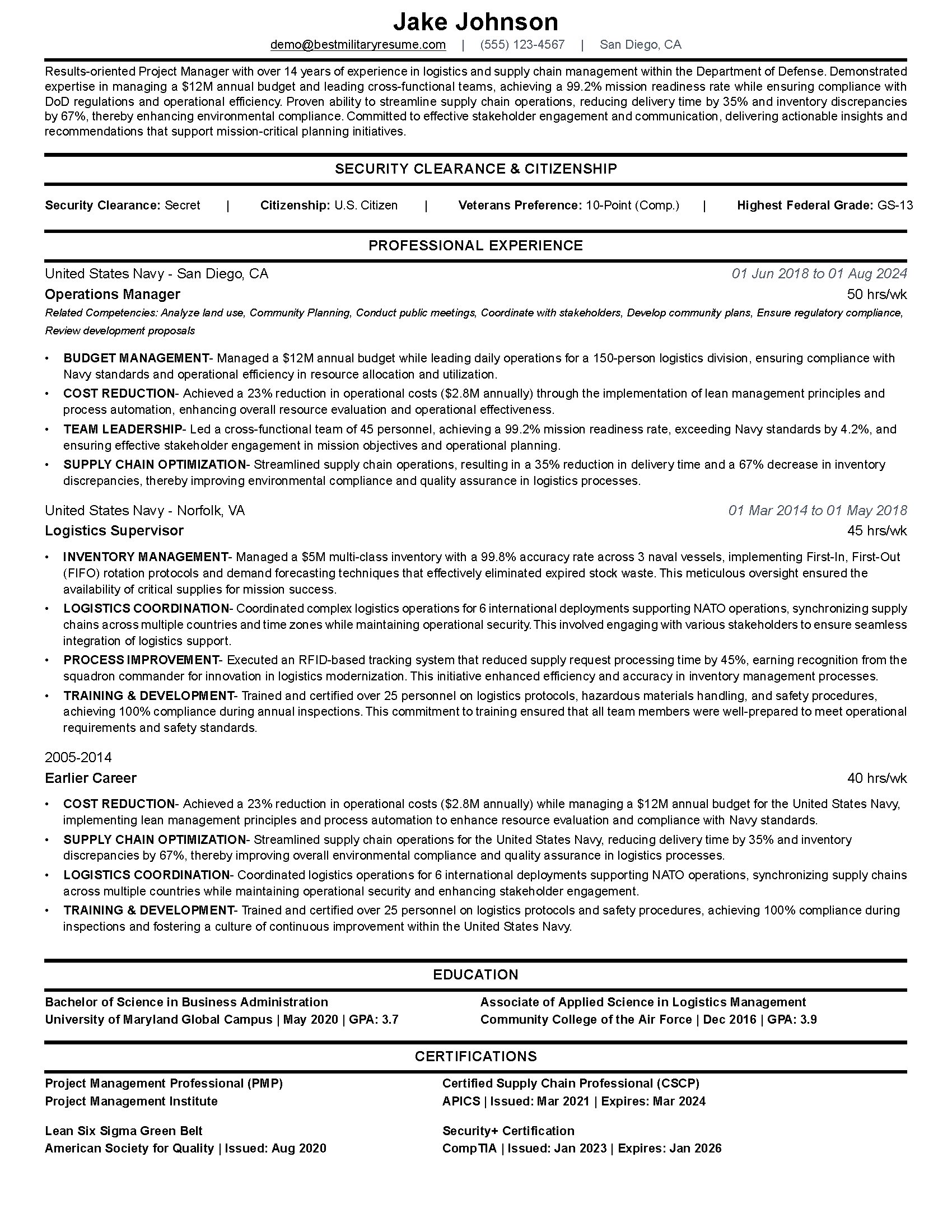
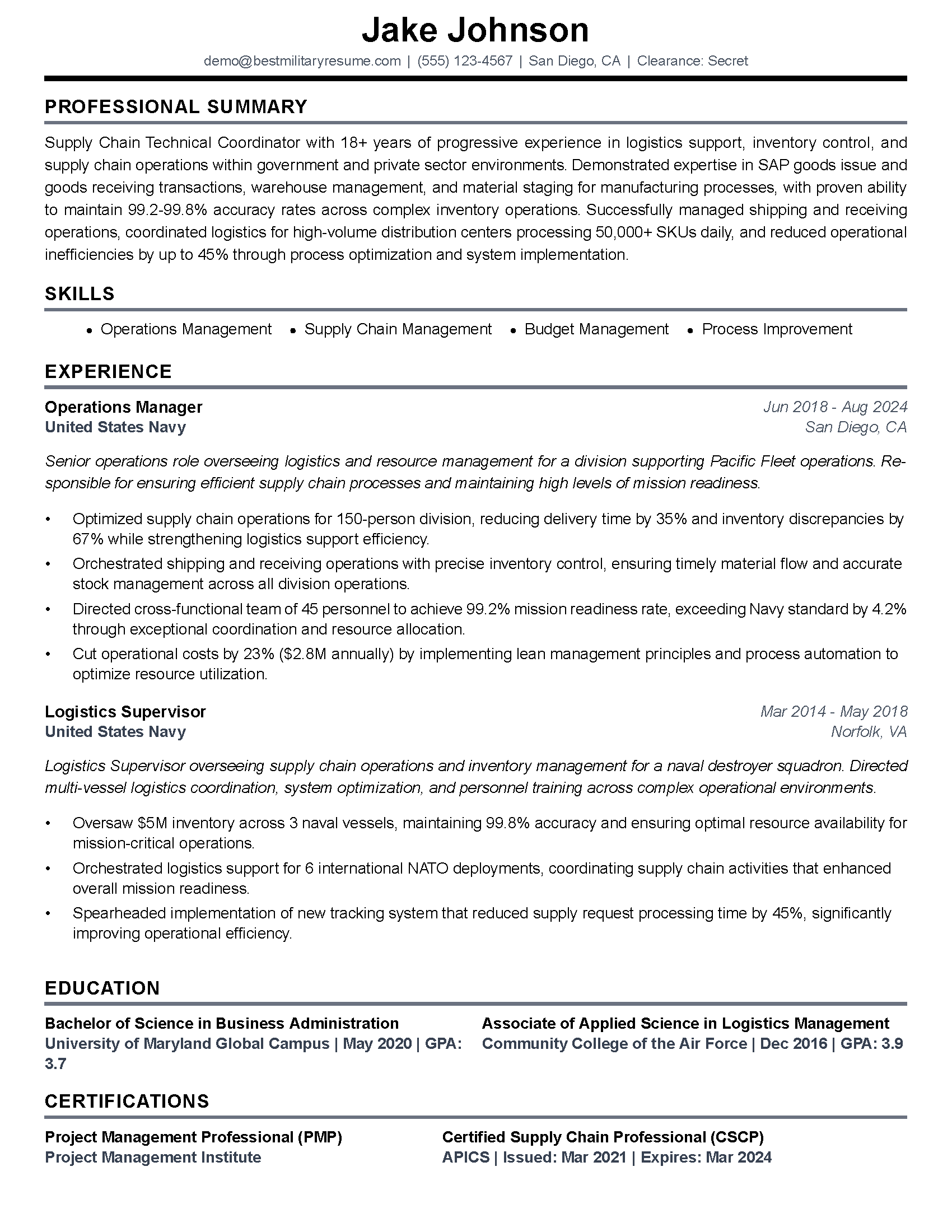
Federal resumes are written very differently. They contain more detail than a civilian resume — supervisor contact info, hours worked per week, specific duties tied to the qualifications language in the job announcement — but the current best practice is two pages maximum. (My own federal resumes used to run 16 pages. Those days are over. Modern federal HR specialists want focused two-page resumes.)
Here is what moves the needle for a CBP application:
1. Mirror the qualifications language from the job announcement
CBP announcements list specialized experience in very specific language — "enforcing laws and regulations," "conducting inspections," "interviewing individuals to elicit information," "identifying suspicious behavior or concealed contraband." If your military duties involved any of that, write it using the announcement's exact phrasing. HR specialists rack-and-stack resumes by keyword match. A resume that says "maintained law and order at a gate" ranks lower than one that says "enforced federal laws and installation regulations by conducting inspections and interviewing individuals." Same work, different language, different ranking.
For help pulling the right phrases, see our USAJobs keywords guide.
2. Show hours per week and supervisor contact on every position
This is not optional on a federal resume. Every role needs hours/week and a supervisor with a working phone number. For military positions, your company commander, first sergeant, or supervisor of record works — use your LES or evaluation report to confirm the name and dates. For help formatting this, see our federal resume hours per week format guide.
3. Translate your military job into the specialized experience CBP is looking for
If you were military police (31B, 5811, 3P0X1, MA), you already have CBP-relevant specialized experience — write it that way. If you were not in a law enforcement MOS but you stood force protection duty, ran entry control points, conducted ID checks, or supported installation security, that counts too. Document it with concrete volume and outcomes: how many vehicles inspected per shift, how many ID checks, how many incident reports written.
4. Attach every document the announcement requires
DD-214 (Member 4 copy), SF-15 if claiming 10-point preference, VA disability letter if using 30% disabled authority, transcripts if using education to qualify, SF-50 if you are current or former federal. Missing documents are an automatic non-qualification, and HR will not email you for clarification.
5. Don't copy-paste your CBP resume from your civilian resume
If you have a polished 1-page civilian resume, set it aside when you apply to CBP. The federal format is fundamentally different. Short bullet points that sound sharp in the private sector look thin on a federal resume and lose keyword density. Write a separate 2-page federal version. Our federal resume builder walks you through it step by step and handles the formatting automatically.
Typical CBP Hiring Timeline
Once you submit an application, expect the process to take 6 to 12 months. A rough sequence:
- Application review and referral (2-8 weeks). HR screens for minimum qualifications, applies veterans' preference, refers the qualified candidates to the hiring manager.
- Structured interview (1-2 weeks after referral). CBP uses a standardized interview with scoring.
- Tentative offer (if selected). Contingent on everything that follows.
- Medical, fitness test, drug screen (weeks to a couple months).
- Polygraph (scheduled after fitness/medical).
- Background investigation (longest stage — commonly 3-6 months or longer).
- Final offer and academy report date.
- CBP Field Operations Academy, Glynco, GA (approximately 20-23 weeks).
If you are still on active duty and planning to use SkillBridge or terminal leave to time this, start the application at least 12 months before your separation date. The process is not fast, and it is worth stacking into your ETS transition timeline.
Is CBP the Right Fit, or Should You Look at Other Paths?
CBP is a strong career. Starting pay is solid, locality adjustments in major ports and border areas push the numbers higher, the LEO retirement system is better than standard FERS, and the agency hires constantly. But it is not the only veteran-friendly federal law enforcement path, and it is worth knowing your other options before you commit a year to this one.
- U.S. Marshals Service (USMS) — federal fugitive apprehension and court security. Highly competitive but veteran-friendly. See our U.S. Marshal requirements for veterans guide.
- Bureau of Diplomatic Security (DS) — State Department's law enforcement arm, protective details and investigations.
- Federal Bureau of Prisons (BOP) — corrections officer and specialty roles. Larger intake, faster hiring.
- ATF, DEA, FBI — longer paths in, more competitive, higher entry bars.
- State and local law enforcement — often a solid landing pad before or instead of going federal. See our Marine 0331 to law enforcement guide — the principles apply regardless of MOS.
- Intelligence agencies — different work but similar clearance baseline. See our CIA careers for veterans guide.
If salary is a major driver, it is worth comparing the CBP ladder against other paths — our roundup of highest-paying civilian careers for veterans in 2026 shows how federal LEO stacks up against private sector and other federal options.
What to Do Next
If CBP Officer is the right target for you, here is the sequence that actually works:
- Set up USAJOBS searches for GS-1895 and related law enforcement series. Save searches with email alerts — CBP announcements open and close fast.
- Pull your SF-50s, DD-214, VA disability letter, SF-15, and transcripts into one folder. You will need them every time you apply. Don't dig for them in a hurry when an announcement opens.
- Start physical training now. Build a program that targets the three fitness domains. Even if the test is 6 months out, habits beat crash prep.
- Write the federal resume before the announcement opens. Not after. Once the announcement is live you want to be tailoring, not drafting from scratch.
- Get honest with yourself about the polygraph. Write down your full SF-86 history — drug use, foreign contacts, credit issues, everything. Then disclose all of it. Lying or omitting is what fails you, not the history itself.
When you are ready to write the resume, our federal resume builder is built specifically for this process — keyword matching against the announcement, hours-per-week formatting, supervisor fields, and the 2-page structure CBP HR is actually looking for. Free tier gives you two tailored federal resumes, which is enough to apply for your first CBP announcement and one backup.
You already did the hard part by serving. The federal hiring system is designed to reward veterans who understand it and punish those who don't. Use what you have, apply through the right authority, and don't lie on the poly. That's the game.
Frequently Asked Questions
What is the age limit for CBP Officer and does it apply to veterans?
What is the difference between CBP Officer and Border Patrol Agent?
Should I apply to CBP Officer at GS-5 or GS-7?
Why do so many veterans fail the CBP polygraph?
What hiring authorities should veterans use when applying to CBP?
How long does the CBP Officer hiring process take?
Do I need a law enforcement background to become a CBP Officer?
Can I use SkillBridge for CBP Officer?
About the Author
Brad Tachi is the CEO and founder of Best Military Resume and a 2025 Military Friendly Vetrepreneur of the Year award recipient for overseas excellence. A former U.S. Navy Diver with over 20 years of combined military, private sector, and federal government experience, Brad brings unparalleled expertise to help veterans and military service members successfully transition to rewarding civilian careers. Having personally navigated the military-to-civilian transition, Brad deeply understands the challenges veterans face and specializes in translating military experience into compelling resumes that capture the attention of civilian employers. Through Best Military Resume, Brad has helped thousands of service members land their dream jobs by providing expert resume writing, career coaching, and job search strategies tailored specifically for the veteran community.
