ETS Transition Timeline: 12 Months Out to Terminal Leave
Michael got only rejections. Then a $100K facilities manager role.
Michael, E-7, Navy, tried a ton of outside help before BMR
I spent my last year in the Navy thinking I had plenty of time. Twelve months felt like forever. Then suddenly I was six months out, scrambling to figure out what a civilian resume even looked like, with zero job prospects and a family counting on me. That 1.5-year stretch of applying to government jobs after I separated with zero callbacks? It started because I wasted the runway I had while I was still in.
This is the timeline I wish someone had handed me at the 12-month mark. Not a vague checklist of "update your resume" and "think about your goals." A month-by-month breakdown of exactly what to do, when to do it, and what happens if you skip it. Every section is built from what actually worked for the veterans I have helped through BMR and what I learned the hard way during my own transition from Navy Diver to the civilian workforce.
If you already know your ETS date and what it means, good. If you are Army-specific, there is a dedicated Army ETS checklist that goes deeper on branch-specific paperwork. This article covers the full 12-month countdown regardless of branch -- the career moves, the financial prep, and the administrative deadlines that catch people off guard.
What Should You Do 12 to 10 Months Before ETS?
This window is where you set the foundation. Nobody is going to force you to start planning this early, and that is exactly why so many people waste it. Your unit is still running ops. Your leadership might not even acknowledge you are leaving yet. But these months are your biggest advantage.
Start pre-separation counseling as soon as you hit the 12-month mark. This is mandatory -- your installation transition office needs to see you regardless. It is also the gateway to every other transition benefit. Without it, you cannot access SkillBridge, credentialing assistance, or additional TAP workshops.
Use these months to answer two questions: Do I want to go federal, private sector, or start something on my own? And what geographic area am I targeting? Those two decisions drive everything else. If you are eyeing federal jobs, the hiring timelines alone are 4-8 months -- meaning if you wait until month six to start applying, you are already behind.
Financial Inventory
Pull your LES and calculate your actual monthly expenses without BAH, BAS, and any special pays. That number is what you need to hit on the civilian side to keep your family stable. Check your TSP balance and rollover options now, not after you separate. Build an emergency fund of 4-6 months of expenses if you do not already have one. I have seen too many veterans accept the first job offer because they ran out of runway, not because it was the right fit.
Career Research
Start mapping your military skills to civilian job titles using BMR's military-to-civilian career crosswalk tool. Plug in your MOS, rating, or AFSC and see what comes back -- salary ranges, federal GS positions, and private sector roles that match your experience. Do not limit yourself to the obvious translation. A logistics NCO can go into supply chain management, project coordination, procurement, or operations analysis. An intel analyst can move into cybersecurity, data analysis, risk management, or compliance.
Do Not Wait for Your Command to Tell You to Start
Some units will push transition planning until 6 months out. That is too late for competitive federal positions, SkillBridge applications, and any job that requires a security clearance transfer. Start at 12 months regardless of what your chain says.
What Happens at the 9-Month Mark?
Nine months out is when your transition plan should shift from research to execution. You know your target sector. You know your geographic preferences. Now you start building the tools you need to compete.
Your resume should be your first priority here. Not a rough draft -- a polished, tailored document that matches the types of roles you are targeting. If you are going federal, that resume looks different from a private sector one. Federal resumes require hours per week, supervisor contact information, and detailed duty descriptions -- all in a 2-page format. Private sector resumes are also 2 pages, but the structure and language are completely different.
Build your LinkedIn profile at this stage. Not a placeholder with your rank and branch. A fully optimized profile with a civilian-facing headline, a summary that speaks to what you bring to employers, and your experience translated into language that hiring managers actually search for. Recruiters in defense contracting, tech, and healthcare are actively searching LinkedIn for transitioning military. If your profile reads like a service record, they will scroll past it.
TAP and SFL-TAP Scheduling
If you have not started SFL-TAP yet, schedule it now. The TAP workshop gives you a starting point on resumes, interviewing, and benefits. It is not going to get you hired on its own -- the curriculum is standardized and does not teach you how to tailor for specific jobs -- but it covers the administrative foundations you need. The instructors are trying, and some classes are genuinely useful. Just understand that TAP produces one generic resume when what you actually need are tailored versions for each role you apply to.
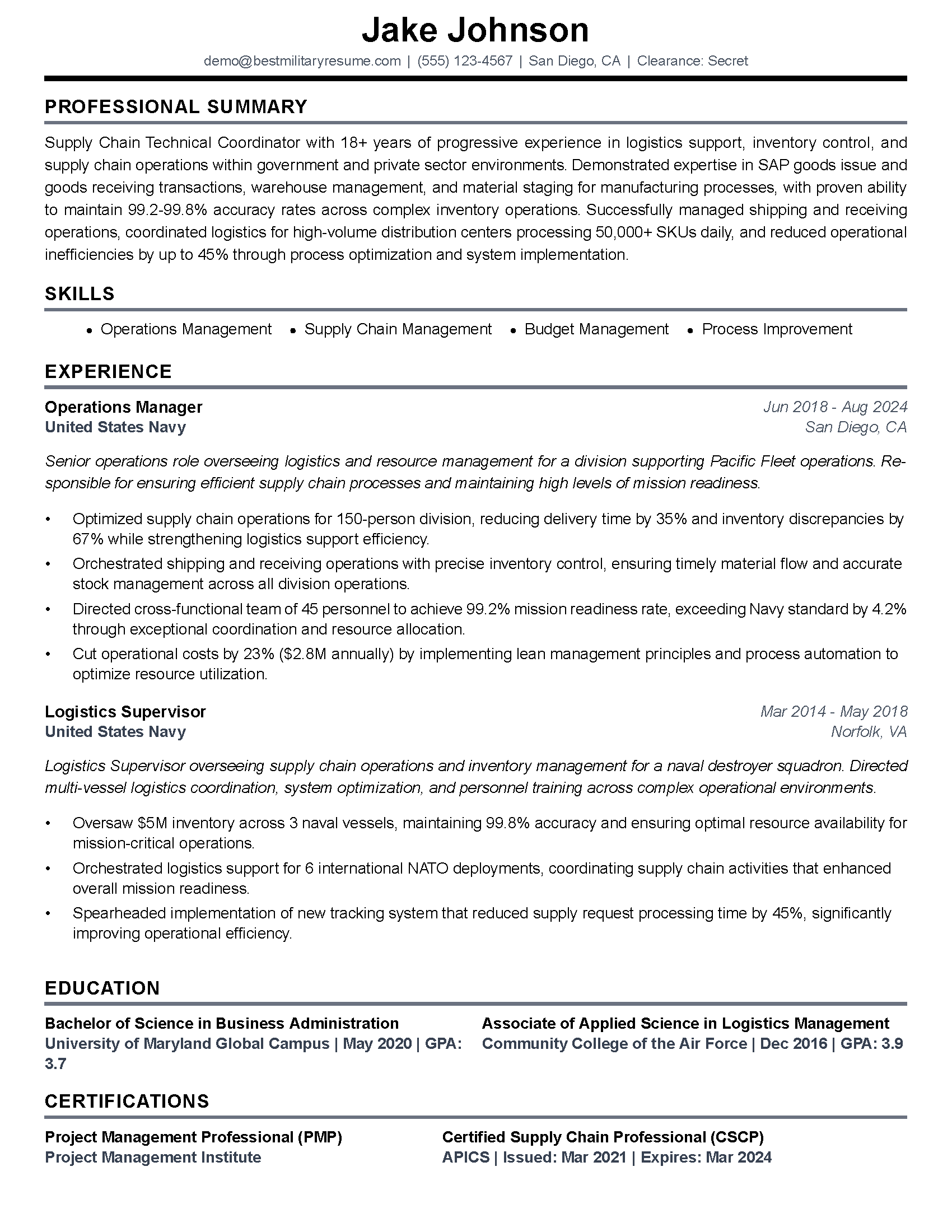
"Managed personnel and equipment in a fast-paced military environment. Responsible for training and mission readiness."
"Directed property accountability for 2,400+ line items valued at $14.2M across 4 warehouse locations. Reduced inventory discrepancies 31% by implementing cyclic count procedures aligned with DPAS requirements."

Should You Apply for SkillBridge at 6-8 Months?
If SkillBridge is on your radar, the 8-month mark is when you should be submitting your application to your command. The SkillBridge program lets you work full-time with a civilian employer during your last 180 days of service while still collecting military pay and benefits. It is hands-down the best transition program available -- if your command approves it and you find the right host company.
Command approval goes through military channels -- your DA-4187 or branch equivalent, not a resume. But the SkillBridge host company will need a resume, and that resume targets the employer only. Do not try to write one document that serves both your command and the company. The command cares about your service record. The employer cares about what you can do for them starting day one.
Even if SkillBridge is not available to you -- some units will not approve it, some MOSs are too undermanned -- use this window to start applying. Federal applications on USAJOBS take 60-120 days from submission to tentative offer in many cases. Private sector moves faster, usually 2-6 weeks, but you want options stacked before you separate.
What Is the 6-Month Countdown Critical Path?
Six months out is the panic point for people who waited. If you started at 12 months, you are in great shape. You have a resume, a LinkedIn profile, a financial plan, and applications in the pipeline. If you are just starting now, you can still make it work -- but you are going to be doing in parallel what should have been sequential.
Complete All TAP Requirements
Finish your mandatory transition classes, capstone verification, and individual transition plan. These are required to out-process.
File VA Disability Claim (BDD)
Benefits Delivery at Discharge lets you file between 180 and 90 days before separation. Filing in this window means your rating is processed faster after you are out.
Stack Job Applications
Federal positions need to be submitted now if you want an offer before your ETS date. Private sector roles should be targeted 2-4 months before your available start date.
Secure Housing and Relocation Plan
If you are PCSing to a new area for work, start your housing search now. Rental applications, home purchases, and VA home loan pre-approvals all take time.
The VA disability claim through BDD (Benefits Delivery at Discharge) deserves special attention. You can file between 180 and 90 days before separation. If you miss that window, you can still file after you are out, but processing takes significantly longer. Get your medical records together and schedule any C&P exams your VA rep recommends.
How Should You Handle the 4-Month Window?
Four months out is where your job search should be at full speed. If you are targeting federal positions, you should already have applications submitted and be tracking referral statuses on USAJOBS. If you applied at the 6-month mark, some of those should be moving through the pipeline now.
For private sector, this is prime job hunting territory. Start reaching out to your network -- not the generic "I am transitioning, any leads?" message that everyone ignores. Specific outreach works. "I am separating from the Army in 4 months with 8 years of logistics management. I am targeting supply chain coordinator or operations manager roles in the Dallas-Fort Worth area. Do you know anyone in that space I should talk to?"
That kind of message gets responses. Vague ones get archived.
Administrative Deadlines
Start your out-processing checklist with your S1 or personnel office. Every installation has a slightly different process, but the common items include clearing housing, turning in military ID cards for dependents (they get new ones), dental and medical record requests, and clearing any supply accountability. Do not wait until the last week. Some of these offices have 2-3 week wait times for appointments.
"I built BMR because my own transition was a mess. Twelve months of runway, and I used maybe two of it productively. Every veteran I talk to who had a smooth landing started early. Every one who struggled waited."
What Do You Need to Lock Down 2 Months Before ETS?
Two months out, your focus should be narrowing. You should have at least one strong job lead -- ideally a tentative offer or final-round interviews in progress. If you are still sending out cold applications at this stage, adjust your approach. Expand your geographic search, widen your target roles, or drop down a level to get your foot in the door somewhere.
This is also when your administrative out-processing hits peak intensity. CIF turn-in, medical and dental records, clearing post -- every base has its own version of the clearing process, and every one of them takes longer than you think. Some installations require 15-20 signatures from different offices. Start early in this window so you are not sprinting through it during your last week.
Benefits Transition
Understand exactly when your TRICARE coverage ends and what replaces it. You have 180 days of transitional TRICARE after separation, but it does not cover everything your active duty plan did. If you are starting a civilian job, check when their health insurance kicks in -- many employers have a 30-60 day waiting period. That gap is where a lot of families get caught.
Your GI Bill benefits follow you after separation, but you need to decide now whether to use them immediately or bank them while you work. If you are going the education route, research schools and programs before you separate so you can hit the ground running with Chapter 33 benefits.
How Should You Spend Your Final 30 Days and Terminal Leave?
Your final 30 days in uniform should be about closing out clean and starting strong. If you have terminal leave banked, decide how to use it strategically. Some veterans use terminal leave to start their new job early -- you are technically still on active duty, still getting paid, but you are working at your civilian company. That dual income window is real, and it is one of the few financial advantages of the transition.
Others use terminal leave to relocate, decompress, or knock out VA appointments. There is no wrong answer, but have a plan. Do not burn 30 days of leave sitting on your couch wondering what comes next.
- •Earn civilian salary while still receiving military pay
- •Build seniority and relationships at new job sooner
- •Health insurance from employer may start earlier
- •Less financial stress during the transition gap
- •Time to move your family and settle into a new area
- •Handle VA appointments and BDD follow-ups
- •Decompress and reset before starting civilian work
- •Finalize housing, schools for kids, and local logistics
DD-214 and Documentation
Your DD-214 is your official separation document. It is critical for VA benefits, veterans preference on federal applications, and proof of service. Make sure the information on it is accurate before you sign -- once it is finalized, correcting errors is a months-long process through the Board for Correction of Military Records. Check your characterization of service, dates, awards, and education.
Keep multiple certified copies. You will need them for VA claims, federal job applications, state veterans benefits, and potentially your property tax exemption depending on your state. Store digital copies somewhere secure and keep physical originals in a fireproof safe or safety deposit box.
What Are the Biggest Mistakes Veterans Make During the ETS Timeline?
After helping 24,538 veterans through BMR, the patterns are clear. The same mistakes show up again and again, and they all trace back to timing.
Waiting until the last 90 days to start job hunting. Federal hiring timelines make this a non-starter. Even private sector roles take 4-6 weeks from application to start date. If you wait until month two, you are almost guaranteed to have an employment gap after separation.
Submitting one generic resume to every job. This is what TAP produces, and it sinks to the bottom of every applicant tracking system. ATS platforms rank resumes by keyword relevance to the specific posting. A generic resume with broad military language will score low against candidates who tailored their experience to match the job description. You do not get rejected outright -- you just never surface to the top of the list where hiring managers are looking.
Ignoring the financial transition. Your take-home pay will change. Your benefits structure will change. Your tax situation will change. Veterans who do not plan for the gap between their last military paycheck and their first civilian one end up making desperate decisions -- taking the first offer regardless of fit, cashing out TSP at a penalty, or going into debt during the transition.
Skipping the VA disability claim window. BDD exists for a reason. Filing between 180 and 90 days before separation gets your claim processed faster. Every month you delay after that is a month of potential back pay you are leaving on the table.
Key Takeaway
The veterans who land on their feet are not luckier or more connected. They started earlier. Twelve months of structured preparation beats 90 days of panic every single time.
What Should Your Resume Look Like Before You Separate?
By the time you hit terminal leave, you should have at least two versions of your resume ready to go. If you are targeting both federal and private sector roles, those are two fundamentally different documents.
A federal resume includes your hours per week, supervisor name and phone number, and detailed duty descriptions that map to the specific GS series and grade you are targeting. The format is dense and specific. A private sector resume is tighter -- 2 pages max, focused on measurable accomplishments, and written in language that a hiring manager outside the military can immediately understand.
Both need to be tailored to specific job postings, not written once and blasted out. BMR's resume builder handles the military-to-civilian translation and generates tailored versions for each role you target. You paste in a job posting, and it builds a resume matched to that position -- keywords, formatting, and language all dialed in.
Do not pull resume content from your DD-214. It is a separation document, not a career summary. The information on it is too broad and too formatted for military use to translate directly into a resume. Your evaluations, counseling records, and position descriptions are better source material -- but even those need significant translation work.
What Comes Next After Your ETS Date?
The day after your ETS date, you are a civilian. That sounds obvious, but the identity shift catches people off guard. You went from a structured environment with clear rank, clear expectations, and a built-in community to figuring it out on your own. That adjustment is real, and there is no timeline for it.
On the practical side, these are your immediate priorities in the first 30 days post-separation:
- Register with your state VA office -- state benefits (property tax exemptions, education benefits, employment preference) are separate from federal VA benefits and require their own registration.
- Enroll in VA healthcare -- even if you have employer insurance, VA enrollment preserves your access for the future.
- Activate your GI Bill if you are using it -- apply through VA.gov and coordinate with your school certifying official.
- Update your resume for each application -- the job you applied to at month four might not be the one you end up pursuing. Keep tailoring.
- Follow up on pending federal applications -- check USAJOBS for referral status updates and be responsive to HR contact attempts.
If you followed this timeline, you are walking into the civilian world with applications in motion, a financial cushion, your VA claim filed, and a resume that actually competes. That puts you ahead of the majority of separating service members who are starting from scratch on day one.
If you are starting late -- six months out, four months out, or even already separated -- you can still execute this plan. You just compress it. Focus on the resume first, get applications out immediately, and backfill the financial and administrative pieces as you go. BMR's federal resume builder can get you from zero to a tailored, submission-ready resume in under an hour. Start there.
Related guides in this cluster
- Hard Orders Before ETS: When You Get Them and What to Do. When orders arrive by branch and the 5 things to do the day you get them.
Frequently Asked Questions
When should I start preparing for ETS?
What is the BDD window for VA disability claims?
Can I start a civilian job during terminal leave?
How many versions of my resume do I need before ETS?
What happens to my TRICARE after separation?
Is TAP enough to get me hired?
What should I do if I am already inside 6 months and have not started?
About the Author
Brad Tachi is the CEO and founder of Best Military Resume and a 2025 Military Friendly Vetrepreneur of the Year award recipient for overseas excellence. A former U.S. Navy Diver with over 20 years of combined military, private sector, and federal government experience, Brad brings unparalleled expertise to help veterans and military service members successfully transition to rewarding civilian careers. Having personally navigated the military-to-civilian transition, Brad deeply understands the challenges veterans face and specializes in translating military experience into compelling resumes that capture the attention of civilian employers. Through Best Military Resume, Brad has helped thousands of service members land their dream jobs by providing expert resume writing, career coaching, and job search strategies tailored specifically for the veteran community.
