Federal Promotion Freeze? What to Do When Your Career Ladder Stalls
 Brad Tachi7 min read
Christopher was selected for GS-13 on his first-ever USAJOBS application.
Christopher, E-7, Coast Guard, now writes policy for the work he did on active duty
Executive Order 14356, signed October 15, 2025, sets today's federal hiring rules, and it never mentions career-ladder promotions. The January 20, 2025 freeze guidance before it exempted "internal career ladder promotions" by name.
So if your ladder stalled, the freeze you read about may not be the reason. By the end of this page you'll know which rule covers your ladder. You'll also have a list of what to write down this week. There's a short email for human resources (HR). And there's the merit promotion route if your ladder is paused.
This page is for people already in a federal job. If you're still applying from outside, a hiring freeze hits you differently. Most of what follows will not apply to you.
Is there a federal promotion freeze right now?
No current order freezes promotions by name. These are the six documents people find for this search, in date order. The table shows what each says about a ladder promotion.
| Document | Date | What it says about your ladder | Still in force? |
|---|---|---|---|
| 2017 hiring freeze frequently asked questions (FAQ), Question 11 | February 11, 2017 | "Agencies may make career ladder promotions during the hiring freeze." | No. That freeze ended in 2017. |
| January 2025 freeze guidance, item 4(k) | January 20, 2025 | Lists "Internal career ladder promotions" as an allowed exemption. | Unclear. Order 14356 keeps earlier Office of Personnel Management (OPM) freeze exemptions unless OPM withdraws them. |
| Executive Order 14356 | October 15, 2025 | Says nothing about ladder promotions. A Strategic Hiring Committee approves filling each vacancy. | Yes. |
| Guidance on Executive Order 14356 | November 5, 2025 | Says nothing about ladder promotions. Exemptions OPM already granted stay unless OPM withdraws them. | Yes. |
| OPM memo on Annual Staffing Plans | July 30, 2026 | Says nothing about ladder promotions. Confirms the committee still approves hiring actions. | Yes. |
| Final time-in-grade rule | Effective January 19, 2027 | Removes the 52-week wait for covered General Schedule (GS) grades, GS-6 and up. | Not yet in effect. |
A separate OPM rule writes the committee into the Code of Federal Regulations (CFR) on November 30, 2026. It lands in 5 CFR part 250.
Sources, all checked November 2026:
- The 2017 freeze FAQ
- The Office of Management and Budget (OMB) and OPM freeze guidance of January 20, 2025
- Executive Order 14356
- The November 5, 2025 guidance
- OPM's July 30, 2026 staffing plan memo
- OPM's time-in-grade rule release
- The Federal Register 2026-22093 (October 29, 2026), which adds the committee to 5 CFR part 250
- The Federal Register final rule 2026-21319, which sets the effective date
The gap is real. None of the three current documents says how the order treats a ladder promotion. Your agency's HR office holds that answer. The rest of this page is about getting it in writing.
What the order does cover
The order says no vacant civilian position may be filled except as it allows. Each agency's Strategic Hiring Committee approves "the creation or filling" of each vacancy. Some jobs sit outside the order. These include positions tied to national security, immigration enforcement or public safety. The order also does not block reassignments to meet the highest priority needs.
The November 2025 guidance also set a hiring limit. Until its staffing plan was submitted, an agency could hire no more than one per four departures. That ratio does not apply to national security, immigration enforcement or public safety jobs.
Why can a ladder promotion happen without a job posting?
A career ladder is a set of grades you can climb in the same job without competing again. The rule that allows it is 5 CFR 335.103(c)(3)(i). It lets an agency promote you "without current competition." That applies when you were hired into a job meant to prepare you for the higher grade.
Two conditions sit inside that rule. First, the intent "must be made a matter of record." Second, "career ladders must be documented in the promotion plan." That second line matters, because the promotion plan is a document you can ask for.
One more gate applies to everyone. Under 5 CFR 335.104, your current rating of record must be "Fully Successful" (level 3) or higher. You also cannot be rated below Fully Successful on a critical element that carries into the next grade.
So a stalled ladder often traces to one of four things. It may be the order's approval step or the rating gate. It may be the 52-week wait. Or your supervisor has not sent the action yet. Each one has a different fix.
Does the time-in-grade rule still hold you back?
Yes, until January 19, 2027, per the Federal Register. The current rule is 5 CFR 300.604. For a job at GS-12 and above, you need 52 weeks no more than one grade lower.
For GS-6 through GS-11, you also need 52 weeks. In a two-grade-interval line of work, that can be up to two grades lower. In a one-grade-interval line, it is one grade lower.
OPM's final rule removes that wait for covered competitive-service GS-6 and above. The Federal Register sets its effective date as January 19, 2027. OPM's news release says January 14, but the Federal Register text says January 19, 2027. Agencies can still set their own wait, though. The release says they "may continue to establish job-related promotion prerequisites." That includes "a period of service in grade," set in their written merit promotion plans.
So after January 19, 2027, the question changes. It stops being "have I hit 52 weeks?" It becomes "what do my agency's plan and the job's qualification standard require?"
What should you write down this week?
Build a one-page record before you talk to anyone. Put these seven things on it.
- Your job announcement. Save the posting you were hired from. It shows the promotion potential, the highest grade the job can reach.
- Your latest personnel action. Note the grade and the effective date of your last promotion or appointment.
- Your 52-week date. Count 52 weeks from that effective date. Write the date down.
- Your rating of record. Write the level and the date. Note any critical element rated below Fully Successful.
- Your position description. Mark the duties you already do at the next grade.
- Your supervisor's word. Write the date they said you were ready, and what they said. Keep the email if there is one.
- Every reply you get. Date, name, and the exact reason given for the hold.
Need to start with your supervisor first? This guide on asking your supervisor for a career ladder promotion walks through it.
What do you ask HR, word for word?
Ask in writing so the answer comes back in writing. Keep it short and factual. Here's a version you can copy.
Subject: Career ladder promotion status, [your name], [series and grade]
I was hired into a career ladder position with promotion potential to [grade]. My 52-week date was [date], and my current rating of record is [level].
My supervisor told me on [date] that I am ready for the next grade. Can you tell me three things?
1. Does my agency treat career ladder promotions as needing Strategic Hiring Committee approval under Executive Order 14356?
2. Has a promotion action been started for me, and where is it now?
3. Is my ladder documented in the merit promotion plan, and can I have a copy of that plan?
Thank you, [name and phone]
Question three matters most. If the ladder is not documented in the plan, 5 CFR 335.103(c)(3)(i) is not met. That's something HR can fix with paperwork.
If you're in a bargaining unit, send the same three questions to your union representative too.
If the ladder is paused, how does merit promotion work now?
Merit promotion is competing for a higher-grade job through a posted announcement. Under Executive Order 14356, the committee approves filling each vacancy. Jobs under one of the order's exceptions skip that step.
That's the opposite of 2017. The old FAQ barred competitive promotions during that freeze unless the position was exempted. Today, approved vacancies do get filled. They just pass one more approval first.
Three routes to try while you wait
- Apply to posted jobs one grade up. Look for announcements open to current federal employees. On USAJOBS, check the "This job is open to" section and pick the ones that list federal employees.
- Ask for a temporary promotion or detail. Under 5 CFR 335.103(c)(3)(iii), an agency may skip competition for one of 120 days or less. It puts higher-grade work on your record with dates.
- Look at exempt work in your own agency. Jobs tied to national security, immigration enforcement or public safety sit outside the order.
Posted jobs need a federal resume that shows the higher-grade work. Your ladder record from this week already holds most of it.
What to Do Next
If HR's answer is "wait," the merit promotion route needs a resume ready to go.
T., a Navy Commander, used BMR's federal resume format for a different ask. He requested a step increase from Step 1. "I was approved for it," he wrote.
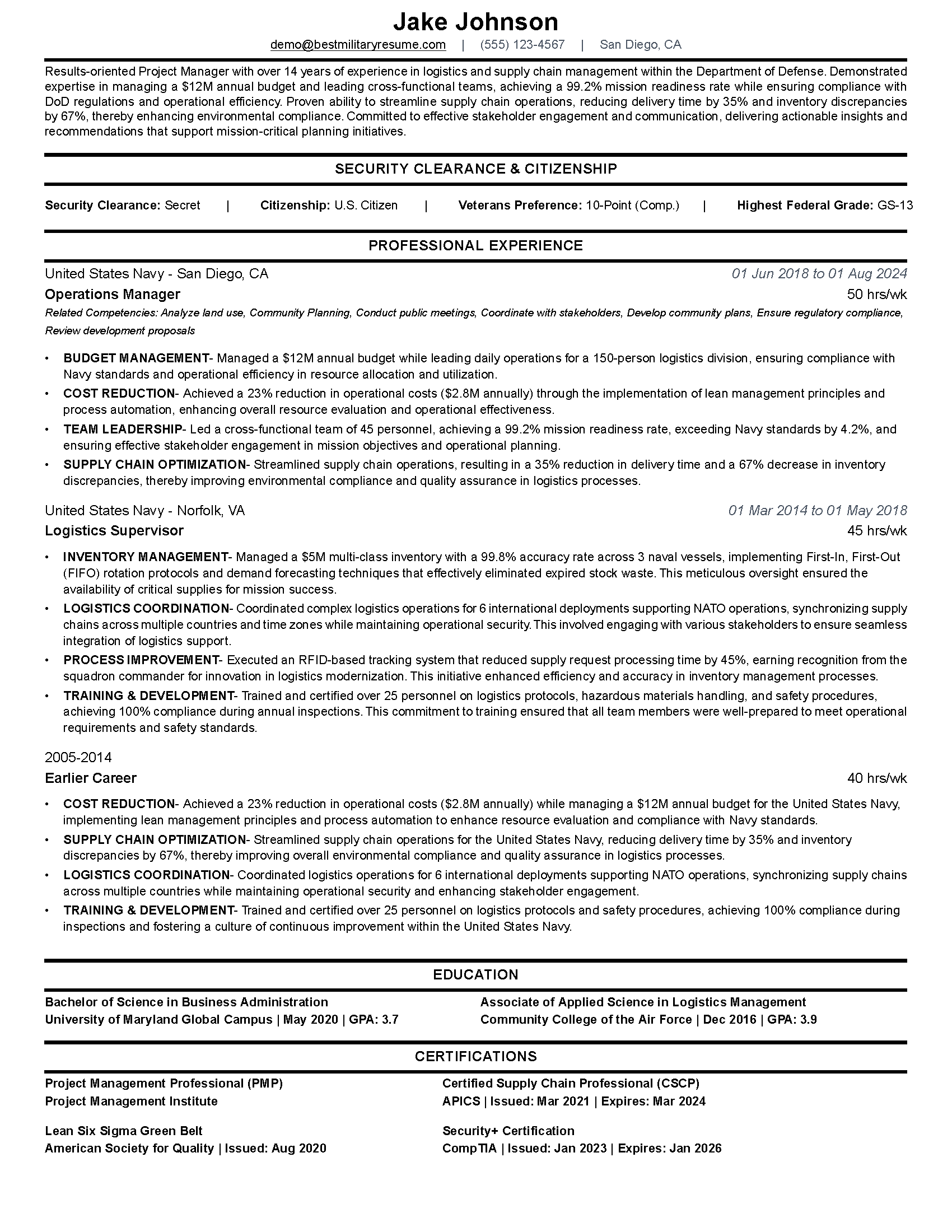
Start with the federal resume builder. When you tailor, BMR reads the posting and copies your resume. It rewrites three things in the posting's own words: your summary, your work bullets, and your skills. It does not add work you never did. A check runs after the artificial intelligence writes. It strips any sentence claiming the posting's job on a role that never did it. Your original resume stays untouched, and the job lands in your tracker. For federal, it grades you against the minimum qualification and says so when you don't meet it.
Frequently Asked Questions
Can I still get a within-grade step increase if my ladder promotion is on hold?
Does a hiring freeze affect a promotion I already accepted?
Can my supervisor promote me if I am rated below Fully Successful?
Where do I find my agency's merit promotion plan?
About the author
Brad Tachi is the CEO and founder of Best Military Resume and a 2025 Military Friendly Vetrepreneur of the Year award recipient for overseas excellence. A former U.S. Navy Diver with over 20 years of combined military, private sector, and federal government experience, Brad brings unparalleled expertise to help veterans and military service members successfully transition to rewarding civilian careers. Having personally navigated the military-to-civilian transition, Brad deeply understands the challenges veterans face and specializes in translating military experience into compelling resumes that capture the attention of civilian employers. Through Best Military Resume, Brad has helped thousands of service members land their dream jobs by providing expert resume writing, career coaching, and job search strategies tailored specifically for the veteran community.
