GS-2151 Dispatching Federal Resume for 88M and Military Police Vets
Christopher was selected for GS-13 on his first-ever USAJOBS application.
Christopher, E-7, Coast Guard, now writes policy for the work he did on active duty
The closed 04/27/2026 Joint Base Andrews Motor Vehicle Dispatcher GS-6 posting set its GS-6 bar this way: "at least one (1) year of specialized experience at the next lower grade GS-05, or equivalent in other pay systems." The same posting says: "This job does not have an education qualification requirement."
So a GS-2151 dispatching federal resume wins on your record, since no degree is required. This guide includes a military police (MP) and motor pool duty table and a job block to copy.
It covers Army 88M soldiers, motor pool dispatchers and MP desk or radio operators. Quotes come from five closed USAJOBS postings and the Department of the Interior (DOI) dispatcher page. Others come from Office of Personnel Management (OPM) two-page guidance and one DVIDS story.
Sort your dispatch desk into DOI's three specialty areas or motor vehicle dispatch
The DOI dispatcher careers page lists three kinds of work. They are "Fire Logistics Dispatcher," "Public Safety (Emergency Services) Dispatcher" and "Aircraft Dispatcher."
The Andrews posting adds a fourth kind: motor vehicle dispatch. Its specialized experience examples are about fleets and the rules for them. But its duties start with "emergency 911 call taking and dispatching services."
Best Military Resume (BMR) advice: match your lane to your record.
- You ran a motor pool dispatch desk: start with motor vehicle dispatch.
- You worked an MP desk or radio net: start with public safety dispatch.
- You worked a fire station or crash net: look at fire dispatch.
DOI's page splits the work into levels it labels "Entry 3-6" and "Mid 7-12." Entry duties include "Operating multi-channel radio and phone lines." Mid duties add "Coordinating with other dispatch organizations."
Fleet work that is more planning than dispatch may fit our transportation operations guide better.
The open-to line and hiring authority decide if you can apply
Each posting has a "This job is open to" line. It tells you if you can apply at all.
- Andrews GS-6 lists "Veterans" by name.
- So does the closed 06/17/2026 Bureau of Indian Affairs (BIA) Lead Dispatcher GS-7 posting.
- The closed 01/14/2026 Hanscom Firefighting Equipment Dispatcher GS-4 posting is open to "The public."
- The closed 09/30/2026 BIA Dispatcher GS-4 posting is open to the public and to Native Americans.
- The closed 04/28/2026 National Park Service (NPS) Public Safety Dispatcher GS-7 posting is open to the public.
The NPS job used a Field Unit Local Hiring Authority. It says: "Under this authority, veterans' preference and traditional rating and ranking procedures do not apply."
The BIA GS-4 posting works the other way. "Within each of these categories, applicants eligible for veteran's preference will receive selection priority over non-preference eligibles." Indian Preference also applies there, under the Indian Preference Act of 1934. See how category rating ranks veterans.
BMR advice: read the open-to line and the hiring authority first. They tell you if preference counts on that job.
GS-4 takes office work, GS-6 and GS-7 take a dispatch year
The two GS-4 postings ask for general work. The BIA GS-4 line reads:
"One year of general work experience that is progressively responsible clerical, office, or other work that demonstrates or reflects the ability to acquire the particular knowledge and skills needed to perform the duties of the position."
That BIA posting also takes "2 full academic years (60 semester hours or 90 quarter hours)" of college instead. Hanscom takes "education 2-years above high school level in any field."
GS-6 and GS-7 want specialized dispatch work. The BIA GS-7 line asks for a year at GS-06 doing three things:
- "serving as a senior operator to receive and transmit law enforcement communications on a multi-frequency radio network"
- "navigating the National Crime Information Center (NCIC) database"
- "maintaining records of radio transactions, law enforcement actions, and reports"
The NPS GS-7 says, "There is no substitution of education for experience." It wants a year like GS-2151-06, including "dispatching fire responders."
BMR advice: on these postings, GS-6 asked for a year at GS-05 and GS-7 a year at GS-06. Both years were dispatch work. Clerical or admin time with no dispatch fits the GS-4 general-work line. Write each BIA item as its own bullet if you did it.
See how raters credit specialized experience on a federal resume.
Driver's license and dispatch course lines, posting by posting
Each posting set its own rules. Plan for these.
- Andrews GS-6: keep "Public Telecommunicator Level I and II," HAZMAT Awareness, CPR, EMR and "Emergency Medical Dispatch certifications within one year of employment."
- NPS GS-7: "Public Safety Communications Officials (APCO) or International Academies of Emergency Dispatch (IAED) is required."
- Hanscom GS-4: meet all "certification levels" in "National Fire Protection Agency (NFPA) 1061" for Public Safety Tele-Communicator I and II. The deadline is "within one year of initial employment start date."
- BIA GS-4 and GS-7: "a valid driver's license, and have a safe driving record within the 4-year period" before "submittal of GSA Form 3607."
- NPS GS-7: "Please indicate in your application whether you possess a valid State driver's license."
BMR advice: list each dispatch course and card with its full name and the month you earned it. Put your license line under a certifications heading. On the NPS job, APCO or IAED was also a required document. It was due by the close date.
Say motor pool and MP desk work the way the postings say it
The Andrews GS-6 specialized experience examples use fleet words, though its listed duties are 911 dispatch. Here are two examples:
- "Knowledge of the characteristics and capacity of the transportation equipment being dispatched"
- "Knowledge of one or more automated transportation databases sufficient to input a range of standard information to maintain dispatch logs and records"
Army garrison motor pools do this work too. A 2025 DVIDS story profiles a transportation motor pool (TMP) dispatcher in Germany. The story calls him a "local national employee," not a soldier.
His team supports "over 180 vehicles." The duties include "issuing dispatches, calling in service and maintenance requests" and "overall TMP fleet management."
The table maps that work to the Andrews and BIA lines. The right column is BMR advice.
| Posting phrase | Where you did it | Write it as (BMR advice) |
|---|---|---|
| "standardized transportation regulations, procedures, operations" | Motor pool dispatch desk | Name the Army or base rules you dispatched under |
| "Knowledge of geographic area served" | Runs on and off post | Name the sites, routes and area size |
| "vehicle safety rules, regulations, and guidance" | License and maintenance checks before release | Say what you checked and how many |
| "contingency operations to real world/exercise emergency situations" | Field exercises, recalls, convoys | Name the exercise and vehicle count |
| "proper use of communications radios and procedures" | Convoy net or MP desk radio | Say which net and how many units |
| "receive and transmit law enforcement communications on a multi-frequency radio network" | MP desk or patrol dispatch | Name the radio system and shift |
| "navigating the National Crime Information Center (NCIC) database" | MP desk checks | Write it only if you ran NCIC checks yourself |
The O*NET crosswalk lists 15 relevant occupations for 88M if you want more job titles to search.
Fill every bracket with your own motor pool numbers
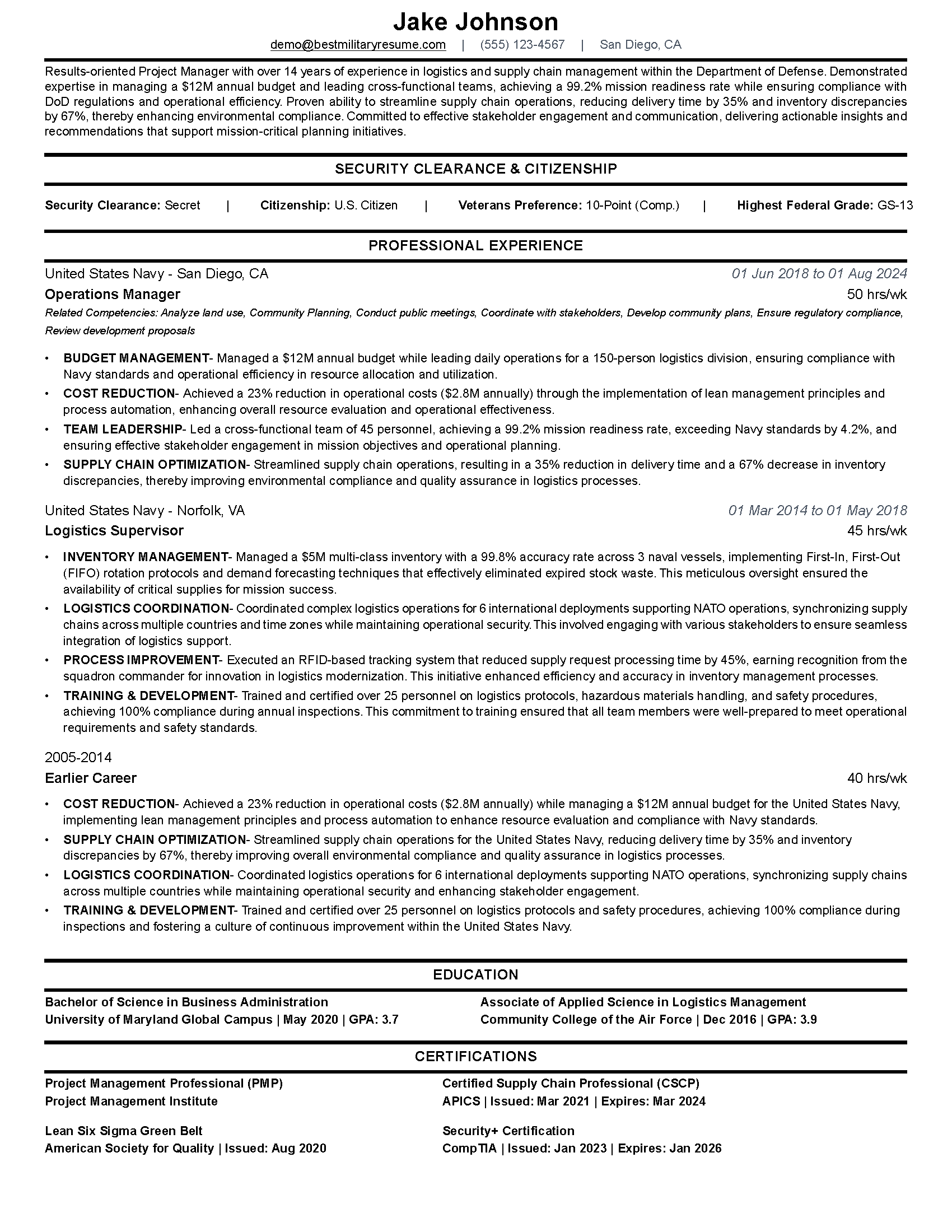
This is BMR's sample job block for a motor pool dispatch tour. It aims at the closed 04/27/2026 Andrews GS-6 posting. That job's qualification examples use fleet words, and its duties are 911 call taking. Swap every [00] and bracket for your own numbers. If you can't back a number, cut it.
[DUTY TITLE, such as MOTOR POOL DISPATCHER], U.S. Army (88M)
[Unit], [Installation, State]
MM/YYYY - MM/YYYY | [00] hours per week | [Rank]
- FLEET DISPATCH - Cut vehicle wait times by [00]% by dispatching [00] vehicles a day from a [00]-vehicle fleet under Army and installation transportation rules.
- LOAD AND ROUTE MATCHING - Reduced empty return trips by [00]% by matching [00] requests a week to vehicle type, payload and route across [00] sites.
- DISPATCH LOGS - Raised dispatch log accuracy to [00]% by entering [00] dispatches a month into [transportation system] and closing [00] trip records a week.
- OPERATOR AND VEHICLE SAFETY - Eliminated [00] unsafe vehicle releases over [00] months by checking [00] operator licenses and [00] maintenance records before release.
- RADIO AND EXERCISE SUPPORT - Improved convoy check-in rates to [00]% across [00] field exercises by tracking [00] vehicles on [00] radio nets each shift.
Which Andrews phrase each bullet answers, from its examples or its duties:
- Fleet dispatch: "a full range of dispatching duties" under "standardized transportation regulations."
- Load and route: "characteristics and capacity of the transportation equipment" and "geographic area served."
- Dispatch logs: "automated transportation databases" and the duty line's "automated activity log" of "vehicle movements."
- Safety: "vehicle safety rules, regulations, and guidance."
- Radio and exercises: "contingency operations" and the duty to monitor "radio and telephone communications" with field units.
BMR advice: the Andrews duties are 911 call taking and medical dispatch. If you took emergency calls on an MP desk, add a bullet for that work first.
Three small resume lines these dispatcher postings ask for
The NPS posting spells out the hours rule. "You will not receive any credit for experience that does not indicate exact hours per week or is listed as 'varies'."
Andrews wants "hours worked per week and dates of employment (i.e., month/year to month/year or month/year to present)." See how to list hours per week on a federal resume.
The NPS posting also says: "If military or civilian, please include your rank and/or grade."
BMR advice: put your rank on the date line, as the sample does.
OPM's guidance applies the two-page limit to "all competitive service and excepted service announcements under Title 5." Andrews says: "Your resume may NOT exceed two pages, and the font size should not be smaller than 10 pts."
Every posting checked here carried a two-page rule. Always check the announcement. The full rule is in our guide to the two-page federal resume limit.
Proving veterans' preference on a dispatch application
- Andrews GS-6: for VEOA, VRA or 30% disabled veteran, "Submit VOW certification memo or copy of the official DD Form 214."
- BIA GS-4: "For 10-point veterans' preference, you must submit a Standard Form (SF) 15."
- BIA GS-7: a "VA letter on VA letterhead stating your overall combined rating," plus "SF-15, DD-214 (Member 4 Copy Only)" showing an honorable discharge.
Andrews says: "The VOW Act requires federal agencies to treat an eligible active duty service member as a veteran" before "the effective release or discharge date."
BMR advice: still serving? Send the certification memo, since your DD-214 isn't out yet. For the DD-214 step, see using your DD-214 on a federal application.
Rules checked November 2026 against five closed USAJOBS dispatcher postings, DOI's dispatcher page and OPM's two-page guidance.
What to Do Next
Pick an open GS-2151 posting on USAJOBS. Read its open-to line, then match each bullet to its grade-line phrases.
Build it in the BMR federal resume builder and tailor it to the USAJOBS posting you picked. 79,061 resumes have been built on BMR.
Frequently Asked Questions
Does a GS-2151 dispatch center run around the clock?
Can I apply to an NPS local hiring authority dispatch job from another state?
What does essential employee mean on a BIA dispatcher posting?
About the author
Brad Tachi is the CEO and founder of Best Military Resume and a 2025 Military Friendly Vetrepreneur of the Year award recipient for overseas excellence. A former U.S. Navy Diver with over 20 years of combined military, private sector, and federal government experience, Brad brings unparalleled expertise to help veterans and military service members successfully transition to rewarding civilian careers. Having personally navigated the military-to-civilian transition, Brad deeply understands the challenges veterans face and specializes in translating military experience into compelling resumes that capture the attention of civilian employers. Through Best Military Resume, Brad has helped thousands of service members land their dream jobs by providing expert resume writing, career coaching, and job search strategies tailored specifically for the veteran community.
