GS Pay Scale 2027: Salary Table and Locality Pay Status
You found the federal GS pay. Would a rater credit your resume?
Free federal resume score in about a minute: hours per week, month-and-year dates, and every line a rater cannot credit as written.
You've got a federal job offer on the table, or you're close to one. It's November. So you search "GS pay scale 2027" to see what January will really pay. What you mostly find are guesses dressed up as charts.
This is where it stands as of early November 2026. OPM has not posted a 2027 GS table. The President's pay plan sets 0% for both base pay and locality pay in 2027. If that plan holds, the 2027 table will match the 2026 table, dollar for dollar.
Congress can still change that through a funding bill, and none has passed yet.
This guide covers the table, not the raise fight. You'll see how a GS salary is built and the official 2026 numbers. You'll also learn to find your locality area and run your offer math. The raise news, including military pay and COLA, lives in our 2027 federal pay raise update. For the full basics of grades and steps, start with the GS pay scale guide for veterans.
We'll update this page when OPM posts the 2027 tables.
Has OPM posted the GS pay scale for 2027 yet?
No. As of early November 2026, OPM's salaries and wages page shows 2026 as its newest year. There's no 2027 folder and no 2027 GS table.
What does exist is a plan. On August 26, 2026, the President sent Congress an alternative pay plan letter. It was printed as House Document 119-189. It says civilian base pay and locality pay "will not change from the 2026 rates." It sets the pay adjustment at zero.
A plan is not a final table, though. Congress can still set a different number in a funding bill. As of early November 2026, no bill like that has become law. The plan says flat, and nothing is final.
Law enforcement pay runs on a separate track. OPM plans a 3.8% increase through special rates. Its 2027 law enforcement special rates page says coverage isn't final yet. If you're weighing a law enforcement offer, read that page and our 2027 raise update.
Watch for fake 2027 charts.
Any 2027 GS table you see before OPM posts one is someone's estimate. Check the source. If it isn't opm.gov, treat it as a guess.
What will the 2027 GS pay table look like if the plan holds?
If the 0% plan holds, the 2027 table will look exactly like the 2026 table. Base pay and locality percentages would both stay put. So every cell keeps the same dollar figure.
That's the whole forecast, and we won't stretch it further. You'll see sites print a "projected 2027 GS table" with a raise baked in. Nobody can build that honestly right now. The plan says zero, and Congress hasn't acted.
Want to know what a GS-11 job in your area pays in January 2027? Look up the 2026 number. That's your best planning figure today. If Congress changes the plan, the 2027 table will move, and we'll show the new numbers here.
There's one more thing a flat table doesn't touch. Your own pay can still go up inside the table. Step increases come from time at your current step plus acceptable performance. The yearly table change doesn't drive them. Our guide on GS step increase timelines walks through how long each step takes.
How is a GS salary built?
Every GS salary has two parts. First comes base pay. Then a locality payment gets added on top. Your grade and step set the base. Your duty station sets the locality.
Part one: base pay
The base table is one national chart. It has 15 grades, from GS-1 to GS-15. Each grade has 10 steps. A new hire usually starts at step 1 of the grade in the offer. Some people start higher, and we'll cover how later.
For 2026, OPM raised the base table by 1.0% across the board. You can see that in the title of the official 2026 GS base table. It reads "Incorporating the 1% General Schedule Increase, Effective January 2026."
Part two: locality pay
Locality pay is a percentage added to base pay. It changes by where you work. Areas where private pay runs higher usually get a bigger percentage. U.S. locations outside any named area fall into "Rest of U.S."
For 2026, locality percentages stayed at their 2025 levels. That came from Executive Order 14368, signed December 18, 2025. So the 2026 raise came from the 1.0% base increase alone.
The math is simple. Multiply base pay by one plus the locality rate. A GS-12 step 1 base of $76,463 in Rest of U.S. (17.06%) comes to $89,508. That matches OPM's own 2026 Rest of U.S. table.
Our deep dive on how GS locality pay varies by location covers the history and the edge cases.
What are the official 2026 GS base pay numbers?
These are the base numbers from OPM's 2026 GS table. They don't include locality pay. Think of them as the floor before your area's percentage gets added. If the 0% plan holds, they're also what the 2027 base table would show.
2026 GS base pay, step 1 and step 10.
- GS-9: $52,727 to $68,549.
- GS-11: $63,795 to $82,938.
- GS-12: $76,463 to $99,404.
- GS-13: $90,925 to $118,204.
- GS-14: $107,446 to $139,684.
Source: OPM Salary Table 2026-GS, effective January 2026.
Each grade has its own set of steps. At GS-12, each step adds $2,549 to the base. At GS-13, each step adds $3,031. OPM prints that number in the last column of the table, called "within grade amounts."
If your offer is GS-12 or GS-13, we have grade guides with every step and city. See the GS-12 pay scale for 2026 and the GS-13 salary by location.
How do you find your locality pay area?
Your locality area comes from your duty station. That's where the job is, not where you live today. If you're moving from Camp Pendleton to a job in Houston, you use the Houston table.
OPM lists every area and the counties inside it on its 2026 locality pay area definitions page. Use it in five steps.
- Find the duty location on the job announcement. It's near the top, under "Location."
- Look up the county for that city.
- Search the definitions page for that county. The area it sits under is your locality area.
- If the county isn't listed, you're in Rest of U.S. That covers U.S. states and territories, not foreign countries.
- Open that area's 2026 salary table from OPM's 2026 General Schedule page.
What the same job pays in five places
This list shows one grade and step, GS-12 step 1, across five 2026 locality tables. The base is the same $76,463 in every one. Only the locality rate changes.
- Rest of U.S. (17.06%): $89,508.
- San Diego (33.72%): $102,246.
- Washington-Baltimore-Arlington (33.94%): $102,415.
- Houston (35.00%): $103,225.
- San Jose-San Francisco-Oakland (46.34%): $111,896.
That's a gap of more than $22,000 for the same grade and step. Locality is often the biggest single swing in a federal offer. So check it before you compare a federal job to a private one.
How do you read an OPM salary table without getting it wrong?
OPM tables look simple, but a few spots trip people up. Read these five things in order.
- The title line: It names the locality area and the percentage. Make sure it's your area, not the base table.
- The effective date: It says "Effective January 2026." A table with no year on it may be old.
- The rows: Each row is a grade. Find your grade on the left.
- The columns: Each column is a step, from 1 to 10. Your offer names the step.
- The last column: On the base table, it shows how much one step adds at that grade.
Then check your number against the job announcement. Every USAJOBS posting shows a salary range near the top. Say the posting covers one grade in one location. Then the range should match that grade's step 1 and step 10 in that area. If it doesn't, the job may use a special rate table. Some jobs, like certain law enforcement roles, have their own.
One more trap is the year. A search for "OPM pay scale 2027" today may turn up a 2025 table or a blog chart. The year sits in the title line of every OPM table. Read it first.
When will OPM post the 2027 GS tables?
Each year, the President usually signs a pay executive order in late December. OPM usually posts the new GS tables right after. That order sets the final numbers.
Last year's timeline is a good guide. Executive Order 14368 was signed December 18, 2025. It ran in the Federal Register on December 23, 2025. The 2026 tables then took effect in January 2026.
For 2027, expect something on a similar clock. Plan with the 2026 number until then.
We'll update this page when OPM posts the 2027 tables. Until then, any "official 2027 GS pay scale" you see is not official.
What numbers should you use for a federal offer right now?
Use the 2026 locality table for your duty station. Find your grade and step. That's what the job pays today. It's also your best planning number for 2027 while the 0% plan stands.
Then look at the part you can actually move. You can't change the table. But on a first federal job, the step may not be locked at 1.
Ask about a higher step
Agencies have a tool called the superior qualifications pay-setting authority. It's in 5 CFR 531.212. It lets an agency set pay above step 1 on a first federal civilian appointment. It also covers a return to federal civilian service after a break of at least 90 days. If this is your first federal civilian job, it can apply to you.
It's the agency's call, and it isn't automatic. Don't wait for the agency to offer it. Ask, and be ready to show why. That usually means proof of experience above what the grade calls for.
I've sat on federal hiring panels and picked from the cert as a selecting official. Pay usually came up after the pick, at the tentative offer stage. That's the window to ask. Our guide on tentative vs final federal offers explains where that stage falls.
Run the math with a real example
Say you have a tentative offer for a GS-12 job in San Diego. Step 1 on the 2026 San Diego table is $102,246. Step 5 is $115,880. That's $13,634 more a year if the agency approves step 5.
The step you start at also carries forward. Your step increases build from wherever you start. A step 5 start stays ahead of a step 1 start until both reach step 10.
For scripts and timing on the ask itself, read how to negotiate your GS level. To estimate other grades and areas, try the GS pay scale calculator guide.
Offer math checklist.
- Find your duty station's county and locality area.
- Open that area's 2026 OPM table.
- Read your grade and step from the offer.
- Check that the range matches the announcement.
- Decide if your experience supports a higher step, and ask before you accept.
What to Do Next
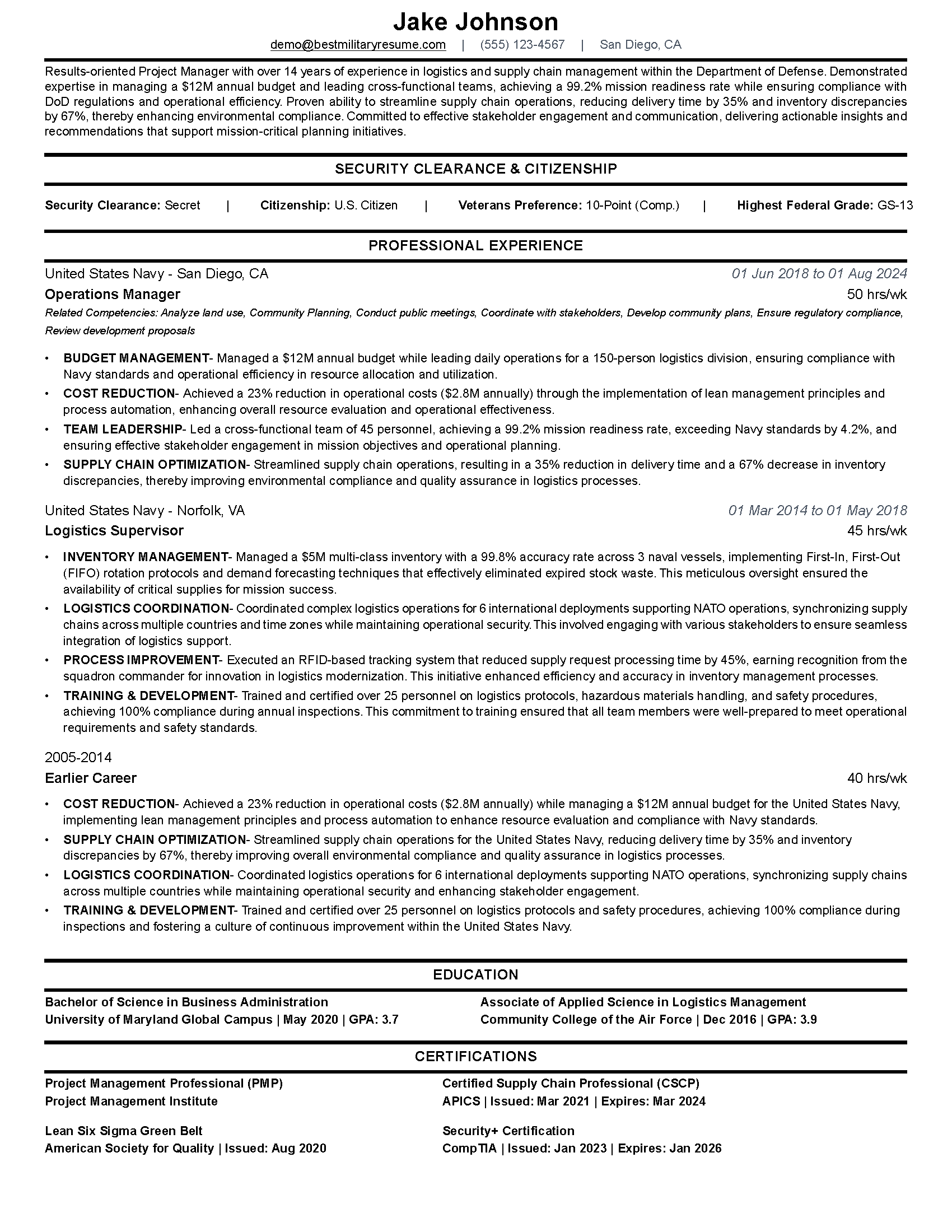
The 2027 table is out of your hands. Your resume isn't. It shows the work you've done, and it's your proof when you ask for a higher step.
Start with the job you want. Pull the specialized experience statement from the announcement. Then make sure your resume shows work that matches it. Add the scope that proves your level: how many people, how much gear, how much money.
Keep it tight, too. Federal resumes run two pages for most federal jobs. Always check the announcement, because some are exceptions. Our federal resume format guide covers what has to be on the page.
The BMR Federal Resume Builder matches your resume to the announcement for you. It builds the federal version from your base resume. It also grades you against the minimum qualification and tells you when you don't meet it. When a tailored resume runs long, it can condense it down to two pages. The free plan gives you one federal tailored resume and one private one.
Bookmark this page. When OPM posts the 2027 GS tables, we'll put the real numbers here.
Frequently Asked Questions
Will the 2027 GS pay scale be the same as 2026?
Has OPM released the 2027 GS pay tables?
What is the GS pay scale for 2027 with locality pay?
Is there a GS pay raise in 2027?
Do step increases still happen if the 2027 table is frozen?
Can I start above step 1 on my first federal job?
About the author
Brad Tachi is the CEO and founder of Best Military Resume and a 2025 Military Friendly Vetrepreneur of the Year award recipient for overseas excellence. A former U.S. Navy Diver with over 20 years of combined military, private sector, and federal government experience, Brad brings unparalleled expertise to help veterans and military service members successfully transition to rewarding civilian careers. Having personally navigated the military-to-civilian transition, Brad deeply understands the challenges veterans face and specializes in translating military experience into compelling resumes that capture the attention of civilian employers. Through Best Military Resume, Brad has helped thousands of service members land their dream jobs by providing expert resume writing, career coaching, and job search strategies tailored specifically for the veteran community.
