Merit Promotion vs DEU: Federal Jobs for Veterans
Christopher was selected for GS-13 on his first-ever USAJOBS application.
Christopher, E-7, Coast Guard, now writes policy for the work he did on active duty
Why Do Federal Job Announcements Have Different "Who May Apply" Sections?
If you've spent any time on USAJOBS, you've noticed that some job announcements say "Open to the public" while others say "Federal employees" or "Status candidates." These labels determine who can actually apply — and submitting to the wrong one wastes your time.
Federal agencies post jobs under different hiring authorities. The two most common are Delegated Examining Unit (DEU) announcements, which are open to everyone, and Merit Promotion announcements, which are typically reserved for current or former federal employees. Some postings combine both into a single announcement with two separate application paths.
For veterans, this gets interesting. You're not limited to just DEU announcements. Through the Veterans Employment Opportunities Act (VEOA), eligible veterans can also apply to Merit Promotion announcements — a path many veterans don't realize they have. Understanding these distinctions can double the number of federal positions you're eligible for.
I've been hired into six different federal career fields, from environmental management to contracting. Each time, knowing which announcements to target — and how to read the eligibility section — made a real difference in how efficiently I applied. This guide breaks down exactly what you need to know.
- •Open to all U.S. citizens
- •Competitive examining process
- •Veterans preference points apply
- •Larger applicant pools
- •Limited to status candidates
- •Internal promotion process
- •Veterans eligible via VEOA
- •Smaller, less competitive pools
What Is a DEU Announcement and How Does It Work?
DEU stands for Delegated Examining Unit. When an agency posts a DEU announcement, it means the position is open to all U.S. citizens — no prior federal experience required. This is the standard path for veterans entering federal service for the first time.
Under DEU, the agency uses a competitive examining process. Applicants are rated and ranked based on their qualifications, and veterans preference points are applied during this ranking. If you have a 5-point or 10-point preference, those points get added to your score after the initial qualification review. This is where veterans preference has its strongest impact.
On USAJOBS, DEU announcements typically show "Open to the public" with a small icon of people. The "Who May Apply" section will say something like "All U.S. Citizens" or "United States Citizens." These are the announcements where your veteran status gives you a scoring advantage over non-veteran applicants with similar qualifications.
One thing to understand: DEU announcements often attract large applicant pools. A GS-9 program analyst position open to the public might get 200-500 applications. Your federal resume needs to be tightly tailored to the specific announcement to rank well, even with preference points added.
What Is Merit Promotion and Can Veterans Apply?
Merit Promotion is the federal government's internal promotion and placement system. Normally, these announcements are limited to "status candidates" — people who currently hold or previously held a competitive service federal position. Think of it as the federal equivalent of an internal job posting at a private company.
But here's where VEOA changes the equation for veterans. The Veterans Employment Opportunities Act allows eligible veterans to apply to Merit Promotion announcements that are open to candidates outside the agency's own workforce. If the announcement says "All federal employees" or "Status candidates" (not just "Agency employees only"), VEOA-eligible veterans can compete.
Who Qualifies for VEOA?
To use VEOA, you need to meet one of these criteria: you're a preference-eligible veteran (meaning you have a service-connected disability, earned a campaign badge, or served during specific periods defined by law), OR you're a veteran who was separated from active duty under honorable conditions after completing a minimum of three years of continuous active service. If you meet either condition, Merit Promotion announcements become another avenue for you.
Why Merit Promotion Pools Are Worth Targeting
The applicant pools for Merit Promotion announcements are significantly smaller than DEU. Where a DEU posting might attract hundreds of applicants, the same position posted under Merit Promotion might get 20-50. Fewer applicants means your resume gets more attention and your odds improve. Many veterans skip these announcements entirely because they assume "federal employees only" means they can't apply. That assumption costs them opportunities.
"When I was applying for federal jobs, I only targeted DEU announcements for the first few months. Once I started applying to Merit Promotion postings through VEOA, the competition dropped dramatically. Same jobs, fewer applicants."
How Do You Read the "Who May Apply" Section on USAJOBS?
The "Who May Apply" section is the single most important part of a USAJOBS announcement to read before you invest time in an application. It tells you exactly which hiring authorities the agency is using and whether you're eligible. Here's how to decode it.
Look for These Key Phrases
"Open to the public" or "All U.S. Citizens" — This is a DEU announcement. Any veteran can apply, and veterans preference points will be applied to your score.
"Federal employees - Competitive service" or "Career transition (CTAP, ICTAP, RPL)" — This is Merit Promotion. Check for VEOA eligibility language. If the announcement lists "Veterans" as an eligible group or mentions VEOA in the "Who May Apply" details, you can apply under that authority.
"Veterans" listed as a separate eligibility group — The agency is explicitly accepting VEOA or VRA (Veterans Recruitment Appointment) candidates. Apply under this authority.
"Agency employees only" — This is an internal-only Merit Promotion. VEOA does not apply here. Only current employees of that specific agency can apply. Skip this one unless you already work there.
Dual Announcements: Two Paths, One Position
Many agencies post the same position as two separate announcement numbers — one DEU and one Merit Promotion. Sometimes they combine both into a single announcement with separate application instructions for each path. When you see a dual announcement, apply under both paths if you're eligible. This gives you two chances at the same job.
On the announcement page, scroll to the "This job is open to" section near the top. USAJOBS uses icons: a small group of people means "public," a building means "federal employees," and a medal means "veterans." Read the full text beneath each icon to confirm your eligibility category.
Don't Assume You're Ineligible
If an announcement lists multiple eligibility groups, read every one. Veterans often qualify under categories they didn't expect — VEOA, VRA, 30% disabled veteran, or Schedule A. When in doubt, apply and let HR make the determination.
What Application Strategy Should Veterans Use to Maximize Federal Job Opportunities?
Knowing the difference between DEU and Merit Promotion is only half the picture. The other half is building a strategy that puts your applications in front of as many hiring managers as possible without wasting effort on announcements where you don't qualify.
Cast a Wide Net on Eligibility
Set up your USAJOBS profile to reflect all your veteran eligibilities. In the "Hiring paths" section of your profile, select every category that applies: veterans, military spouses (if applicable), and open to the public. Enable email alerts for positions in your target series and grade levels. When an announcement drops, check the "Who May Apply" section first — if you qualify under any listed authority, apply.
Tailor Every Application
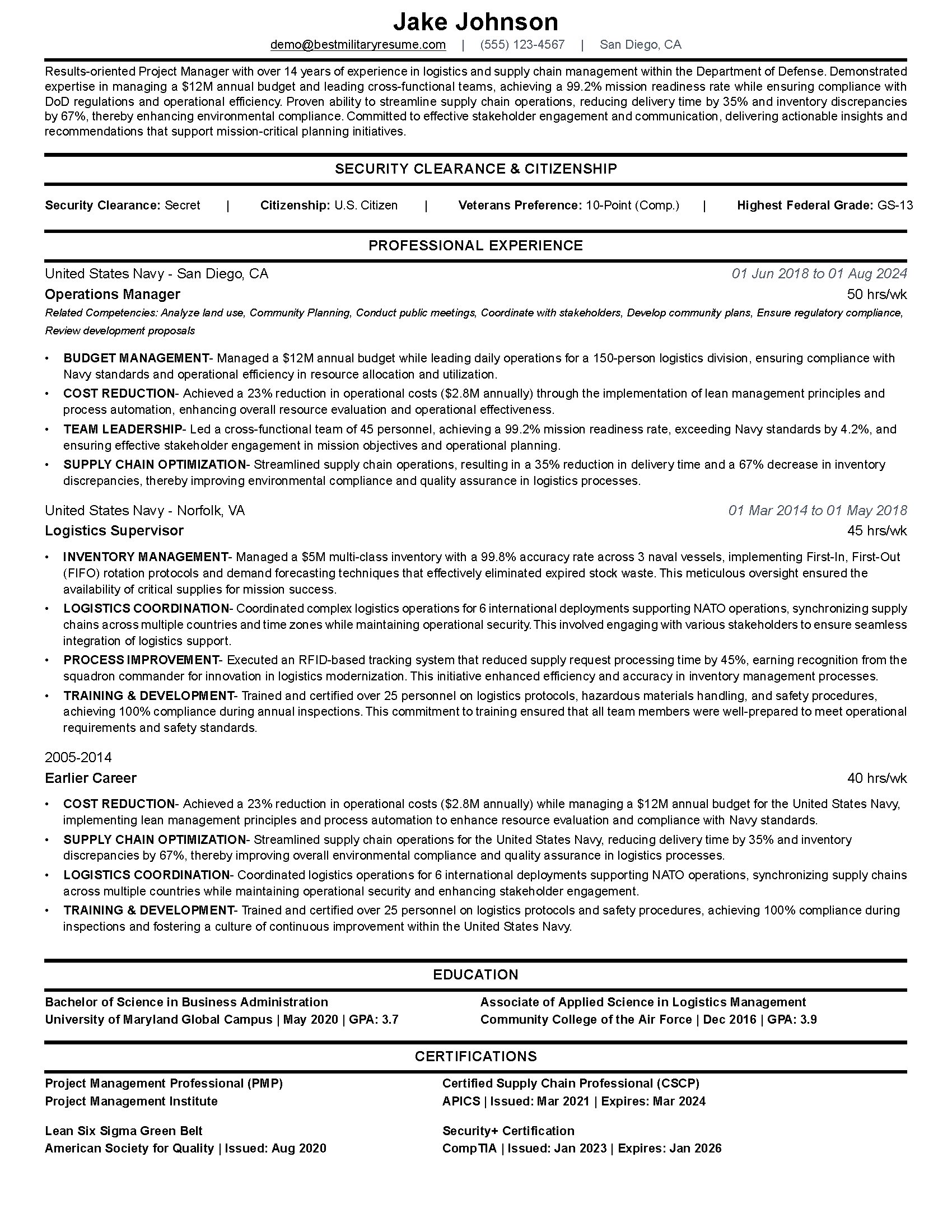
Whether you're applying under DEU or Merit Promotion, the resume requirements are the same. Your federal resume should be two pages, tailored to the specific announcement, and loaded with the exact terminology from the job posting. Mirror the language in the specialized experience section. If the announcement says "program management," your resume should say "program management" — not "project oversight" or "mission coordination."
Apply to Both Paths on Dual Announcements
When a position is posted under both DEU and Merit Promotion, submit two separate applications if they have different announcement numbers. You'll compete in two separate pools, and you could be referred from either one. This is one of the biggest advantages VEOA-eligible veterans have — two shots at the same job that most non-veteran external candidates only get one shot at.
BMR's Federal Resume Builder helps you tailor your resume to each specific announcement, making it practical to apply to both paths without spending hours rewriting from scratch.
1 Check Your VEOA Eligibility
2 Update Your USAJOBS Profile
3 Read "Who May Apply" Before Every Application
4 Apply Under Every Eligible Path
What Other Veteran Hiring Authorities Should You Know About?
DEU and Merit Promotion (via VEOA) are the two main paths, but they're not the only ones. Federal agencies have several other hiring authorities specifically designed for veterans, and knowing about them opens even more doors.
Veterans Recruitment Appointment (VRA): This allows agencies to hire eligible veterans without competition, up to the GS-11 grade level. VRA is a non-competitive appointment, meaning you don't go through the same rating-and-ranking process as DEU. The agency can hire you directly. VRA eligibility generally requires a campaign badge, service-connected disability, or separation within the last three years (extended for those with a service-connected disability). After two years on a VRA appointment, you convert to a career-conditional position in the competitive service.
30% or More Disabled Veteran: Veterans with a 30%+ service-connected disability rating can be appointed non-competitively to any position for which they qualify. This is a powerful authority that many veterans with VA disability ratings don't realize they can use.
Schedule A (Disability): If you have a severe physical or psychiatric disability documented by a VA letter or licensed medical professional, Schedule A provides another non-competitive hiring path. This is separate from the 30% disabled veteran authority.
When applying on USAJOBS, you'll often see a question asking which hiring authority applies to you. Select every authority you qualify under. Each one gives the agency a different legal mechanism to hire you, and some are faster than others.
Key Takeaway
Don't limit yourself to "Open to the public" announcements. Between VEOA, VRA, and the 30% disabled veteran authority, you likely have access to federal job postings that most civilian applicants can't touch. Check every announcement's full eligibility list before deciding whether to apply.
How Should You Prepare Your Federal Resume Differently for Each Announcement Type?
Your resume content doesn't change based on whether you're applying under DEU or Merit Promotion — the qualifications are the same, the specialized experience requirements are the same, and the career transition challenge is the same. What changes is how you document your eligibility and which supporting documents you attach.
For DEU applications, make sure your DD-214 (Member 4 copy) is uploaded to your USAJOBS account and attached to every application. If you're claiming veterans preference, include your SF-15 and any VA disability letters. The HR specialist reviewing your DEU application will use these documents to verify your preference points and apply them to your score.
For Merit Promotion applications under VEOA, the same DD-214 and preference documentation applies, but you also need to clearly indicate on the application questionnaire that you're applying under VEOA authority. Some announcements will ask you to select your eligibility category — choose "VEOA" or "Veterans Employment Opportunities Act" from the list. Missing this step can result in your application being screened out before a human ever sees your resume.
In both cases, your federal resume itself should be two pages, tailored specifically to the announcement's specialized experience requirements, and written in plain language that translates your military experience into terms a civilian HR specialist can evaluate. The announcement type determines your eligibility path — your resume determines whether you get referred to the hiring manager.
Start Applying Smarter, Not Just More
The federal hiring system isn't intuitive, but it does follow clear rules once you understand them. DEU announcements are your baseline — open to everyone, veterans preference applies. Merit Promotion announcements through VEOA are your competitive advantage — smaller pools, less competition, same positions. And non-competitive authorities like VRA and 30% disabled veteran can bypass the competition entirely.
After helping 15,000+ veterans through BMR, the pattern is consistent: the veterans who land federal jobs fastest are the ones who apply to every announcement they qualify for under every authority available to them. They don't guess at eligibility — they read the "Who May Apply" section, match it to their qualifications, and submit tailored applications through every open door.
Set up your USAJOBS alerts, confirm your VEOA eligibility, and start treating Merit Promotion announcements as part of your application strategy. The jobs are the same — you're just competing against fewer people to get them.
Related: How VA disability affects federal employment and best federal agencies for veterans in 2026.
Build yours: Create your federal resume with the free BMR Federal Resume Builder.
Explore positions: Browse 350+ federal job series matched to military experience.
Frequently Asked Questions
Can veterans apply to Merit Promotion announcements?
What is the difference between DEU and Merit Promotion?
How do I know if a USAJOBS announcement is DEU or Merit Promotion?
Should I apply to both DEU and Merit Promotion for the same job?
What is VEOA and who is eligible?
What is a Veterans Recruitment Appointment (VRA)?
Do veterans preference points apply to Merit Promotion announcements?
What documents do I need for a VEOA application?
About the Author
Brad Tachi is the CEO and founder of Best Military Resume and a 2025 Military Friendly Vetrepreneur of the Year award recipient for overseas excellence. A former U.S. Navy Diver with over 20 years of combined military, private sector, and federal government experience, Brad brings unparalleled expertise to help veterans and military service members successfully transition to rewarding civilian careers. Having personally navigated the military-to-civilian transition, Brad deeply understands the challenges veterans face and specializes in translating military experience into compelling resumes that capture the attention of civilian employers. Through Best Military Resume, Brad has helped thousands of service members land their dream jobs by providing expert resume writing, career coaching, and job search strategies tailored specifically for the veteran community.
