How VA Disability Affects Federal Employment
Tim is a Veteran Career Advisor. He used BMR himself and was hired.
Tim, E-8, Army, recommends BMR to the veterans he advises
Does VA Disability Help You Get a Federal Job?
Yes — and significantly. A VA disability rating is one of the strongest advantages you can bring to a federal job application. The federal government has multiple hiring authorities specifically designed to bring disabled veterans into the workforce, and your rating activates benefits that most civilian applicants cannot access.
Two hiring authorities matter most for disabled veterans: the 30% or More Disabled Veteran authority and Schedule A. Both allow federal agencies to hire you without competing through the standard USAJOBS announcement process. Understanding how each one works, and when to use which, can cut months off your federal job search.
Federal agencies also have legal obligations to recruit and hire people with disabilities under Section 501 of the Rehabilitation Act. Every agency has a Selective Placement Program Coordinator (SPPC) whose job is specifically to help qualified candidates with disabilities get placed into positions. Your VA disability rating is not a barrier to federal employment — it is an asset that opens doors most applicants never see.
Your Rating Is an Advantage
In federal hiring, a VA disability rating gives you access to non-competitive hiring authorities, veterans preference points, and priority consideration. This is the one hiring system where your disability works directly in your favor.
What Is the 30% or More Disabled Veteran Hiring Authority?
The 30% or More Disabled Veteran authority (sometimes called the 30% or More authority) allows federal agencies to appoint veterans with a 30% or higher service-connected disability rating directly into positions without going through the competitive examination process. This is a non-competitive hiring authority under 5 CFR 316.302(b)(5).
Here is how it works in practice. You find a position you want at a federal agency. Instead of applying through the standard USAJOBS competitive process — where your resume competes against hundreds of others — you contact the hiring manager or the agency Selective Placement Program Coordinator directly. You provide your VA disability documentation and your resume. If the hiring manager determines you are qualified for the position, they can hire you on the spot without posting the job publicly.
The appointment starts as a temporary position (up to 60 days) that can be converted to a permanent position at any time during that period. In practice, most agencies convert quickly. Once converted, you have the same rights and protections as any other federal employee.
What You Need to Apply
To use this authority, you need a VA disability rating letter showing 30% or more service-connected disability, your DD-214 showing honorable discharge, and a federal resume that demonstrates you meet the qualifications for the position. The resume is critical — even with a non-competitive hiring authority, you still need to show that your education and experience qualify you for the specific GS series and grade level.
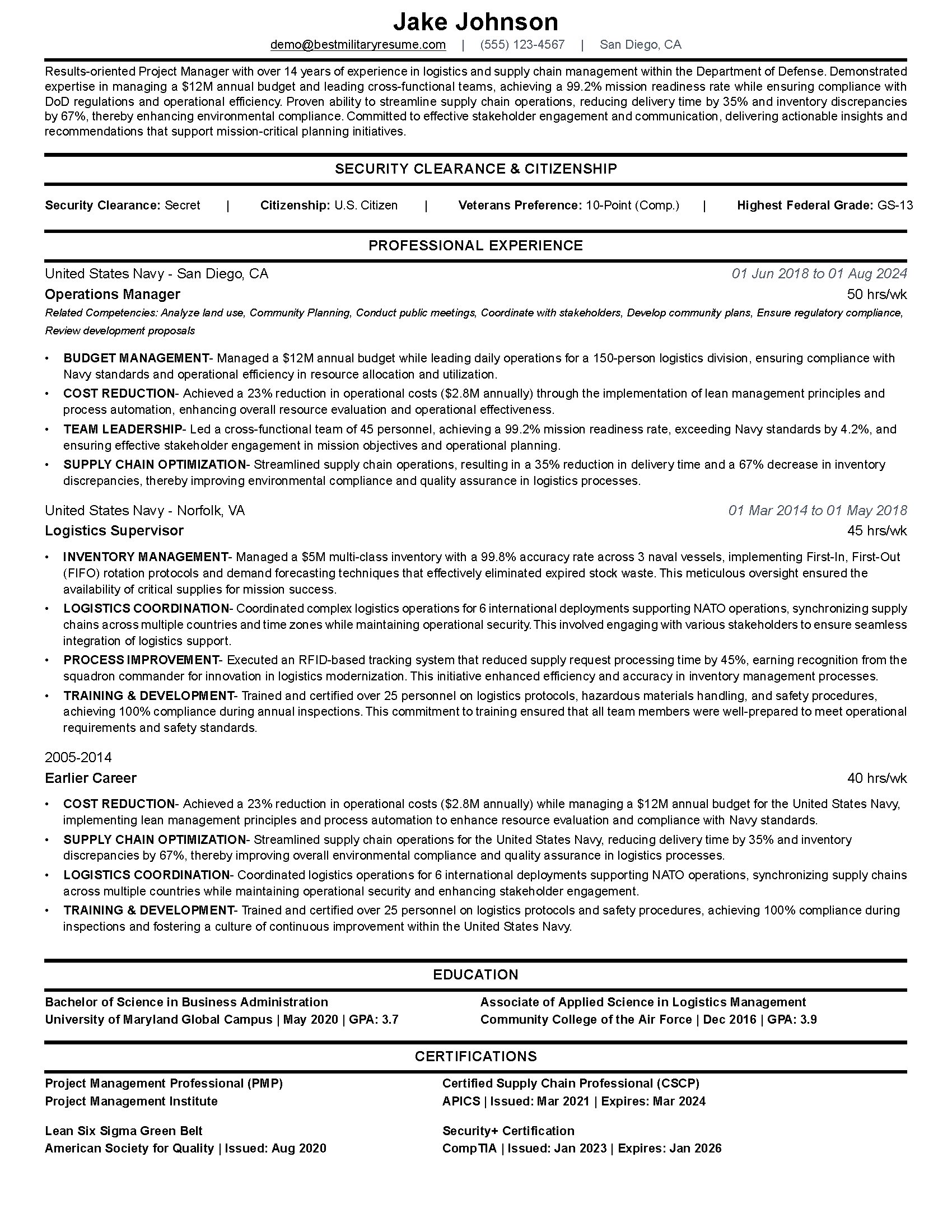
Your federal resume should be two pages max and tailored to the specific position you are targeting. Include your military experience translated into civilian terms, quantified accomplishments, and the specific knowledge, skills, and abilities (KSAs) listed in the position description. Non-competitive does not mean unqualified — the agency still needs to verify you meet the basic and specialized experience requirements.
- •Apply through public announcement
- •Compete against all qualified applicants
- •HR reviews and ranks all resumes
- •Process takes 2-6 months typically
- •Contact hiring manager or SPPC directly
- •No competition with other applicants
- •Manager verifies qualifications only
- •Can be hired in days or weeks
What Is Schedule A Hiring Authority?
Schedule A is a separate non-competitive hiring authority under 5 CFR 213.3102(u) that covers individuals with severe physical disabilities, psychiatric disabilities, or intellectual disabilities. Unlike the 30% or More authority, Schedule A is not limited to veterans — any person with a qualifying disability can use it. But for veterans with service-connected disabilities, it provides another path into federal employment.
To qualify for Schedule A, you need documentation from a licensed medical professional, a vocational rehabilitation counselor, or a VA or DOD authority confirming that you have a qualifying disability. A VA disability rating letter typically satisfies this requirement, especially for conditions like PTSD, TBI, hearing loss, or significant physical disabilities.
Schedule A works similarly to the 30% authority: you bypass the competitive process and can be hired directly by a manager who has an open position. The difference is that Schedule A appointments are initially excepted service positions, which means the conversion to competitive service (permanent federal employee status) happens after two years of satisfactory performance.
Which Authority Should You Use?
If you have a 30% or higher VA disability rating, the 30% or More authority is generally the better option because it leads to a faster conversion to permanent status. However, having both options available doubles your opportunities. Some positions or agencies may be more familiar with one authority than the other, and using whichever the hiring manager prefers can speed things up.
You can also apply through the competitive process on USAJOBS while simultaneously reaching out to agencies through non-competitive channels. There is no rule against pursuing multiple paths to the same job. In fact, doing both maximizes your chances — if the competitive process moves slowly, your non-competitive application might get you hired faster.
How Does Veterans Preference Work With a Disability Rating?
Veterans preference is separate from non-competitive hiring authorities, and it applies when you do go through the competitive USAJOBS process. Your disability rating determines how many preference points you receive.
Veterans with a service-connected disability of any percentage receive 10-point preference (CPS or CP). This is the highest preference available, and it means your application score gets 10 points added on top of your qualifications rating. In a competitive field, those 10 points can be the difference between landing on the best-qualified list and being screened out.
For a deep dive on how the point system works and how to claim your preference, check our full guide on veterans preference points. The key point here: your disability rating does not just qualify you for non-competitive hiring. It also gives you the maximum advantage in competitive hiring.
"I was hired into six different federal career fields — environmental management, supply, logistics, property management, engineering, and contracting. Every single time, my disability rating and veterans preference made the process faster. Federal hiring is the one system where being a disabled veteran is genuinely an advantage."
How Do You Find Federal Hiring Managers and SPPCs?
Non-competitive hiring authorities only work if you can connect with someone who has the authority to hire you. Here is how to find those people.
Selective Placement Program Coordinators (SPPCs): Every federal agency is required to have at least one SPPC. Their job is to recruit and place individuals with disabilities. You can find them by searching the agency website for "selective placement program coordinator" or "disability program manager." The Office of Personnel Management (OPM) also maintains a directory. Call or email the SPPC directly, explain that you are a disabled veteran interested in positions at their agency, and ask about current openings.
Hiring managers: For specific positions, identify the office or division where the job sits and try to find the supervisor. LinkedIn is useful for this. Federal employees often list their agency and division. A direct message explaining your background and your non-competitive eligibility can get your resume in front of the right person before a position is even posted publicly.
USAJOBS as research: Even when using non-competitive authorities, browse USAJOBS to understand what positions exist at your target agencies, what the qualification requirements are, and what GS levels are available. This research helps you target your outreach and ensures your resume matches what agencies are looking for.
VA Vocational Rehabilitation (VR&E): If you are enrolled in VR&E, your counselor can connect you with federal agencies that have partnerships with the VA. Some agencies actively recruit through VR&E, and your counselor can facilitate introductions. This combines two powerful programs — VR&E employment services and your non-competitive hiring eligibility.
What Accommodations Can You Request in a Federal Job?
Federal agencies are required to provide reasonable accommodations under both the Rehabilitation Act (Section 501) and the ADA. As a disabled veteran, you have strong legal protections that ensure your workplace accommodations are taken seriously.
Common accommodations for veterans include modified work schedules (for medical appointments or conditions that flare at certain times), telework arrangements, ergonomic equipment, assistive technology, reassignment of marginal job functions, and additional leave for treatment. The key word is "reasonable" — the accommodation must be effective for your needs without causing undue hardship to the agency.
To request an accommodation, submit a written request to your supervisor or your agency Reasonable Accommodation Coordinator. You do not need to use specific legal language — a clear statement that you have a disability and need a specific change to do your job is enough to start the process. Include documentation from your VA provider or private physician describing the functional limitation and the recommended accommodation.
Federal agencies generally have better accommodation processes than private employers because the legal requirements are more explicit and enforcement is stricter. The Equal Employment Opportunity Commission (EEOC) oversees federal sector complaints, and agencies take these complaints seriously. If your accommodation request is denied, you have the right to appeal through your agency EEO office.
1 Identify the Accommodation You Need
2 Get Medical Documentation
3 Submit a Written Request
4 Appeal if Denied
How Should Your Federal Resume Address Your Disability?
Your federal resume should focus on qualifications, experience, and accomplishments — not your disability. The resume itself is not the place to discuss your medical conditions or accommodations. That information belongs in separate documentation submitted alongside your application.
When applying through USAJOBS, you will be asked to self-identify as a person with a disability in the demographics section. This is where you indicate your veterans preference eligibility and disability status. Separately, you will upload your VA disability rating letter and DD-214 as supporting documents. These documents establish your eligibility for preference and non-competitive hiring authorities.
Your actual resume content should highlight what you bring to the job — your military experience translated into civilian terms, your education, your certifications, and your measurable accomplishments. Write your resume as if the hiring manager knows nothing about military structure or terminology. BMR's Federal Resume Builder handles this translation automatically, creating two-page federal resumes that match OPM formatting standards and include the required elements for federal applications.
One strategic tip: if a position description mentions the agency accepts applications through Schedule A or the 30% or More authority, include a brief cover letter or email stating your eligibility and the specific authority you are applying under. This signals to HR that your application should be routed through the non-competitive channel, which speeds up the process.
Key Takeaway
Your VA disability rating gives you access to non-competitive hiring authorities (30% or More and Schedule A), 10-point veterans preference in competitive hiring, and strong accommodation protections. Use all available channels simultaneously — competitive USAJOBS applications, direct outreach to SPPCs, and networking with hiring managers — to maximize your chances of landing a federal position.
What Mistakes Should Disabled Veterans Avoid in Federal Hiring?
After helping 15,000+ veterans build resumes through BMR, patterns emerge. Disabled veterans make specific mistakes in federal hiring that cost them positions they are qualified for. Here are the most common ones.
Only using USAJOBS. The competitive process is slow and crowded. If you have non-competitive eligibility through the 30% or More authority or Schedule A, use it. Applying only through USAJOBS and ignoring non-competitive channels leaves your strongest cards on the table. Contact SPPCs, email hiring managers, and pursue both paths simultaneously.
Submitting a generic resume. Federal resumes must be tailored to each position. The qualifications section of a USAJOBS announcement tells you exactly what the agency is looking for. Your resume needs to address each qualification point with specific examples from your experience. A generic military resume that works for one position will not work for another in a different series.
Forgetting to upload disability documentation. Veterans preference and non-competitive eligibility require proof. Upload your VA disability rating letter, your DD-214, and your SF-15 (Application for 10-Point Veteran Preference) with every competitive application. Missing documentation means HR cannot apply your preference points, and your application gets processed as if you are a standard civilian candidate.
Not understanding GS grade requirements. Each GS grade has specific education and experience requirements. A GS-9 position requires one year of specialized experience at the GS-7 level (or equivalent). Military experience counts, but you need to map your military responsibilities to the civilian equivalents clearly. Do not aim for a GS-13 position if your experience only qualifies you for a GS-9 — you will waste time on applications that HR will screen out regardless of your veteran status.
If you are preparing for a federal job search before separation, start learning the federal hiring system early. The learning curve is real, and understanding how to use your disability rating strategically gives you a head start that most transitioning service members miss.
Federal hiring authorities for veterans: disabled veteran hiring paths, merit promotion vs DEU, dual compensation rules, navigating hiring freezes, landing a GS-12 job, and choosing the right GS level.
Build yours: Create your federal resume with the free BMR Federal Resume Builder.
Explore positions: Browse 350+ federal job series matched to military experience.
Frequently Asked Questions
Does VA disability help you get a federal job?
What is the 30% or More Disabled Veteran hiring authority?
What is Schedule A hiring authority?
Can you use both Schedule A and the 30% authority?
How many veterans preference points does a disability rating give you?
Do you have to disclose your disability on a federal application?
What is a Selective Placement Program Coordinator?
What accommodations can federal employees with disabilities request?
About the Author
Brad Tachi is the CEO and founder of Best Military Resume and a 2025 Military Friendly Vetrepreneur of the Year award recipient for overseas excellence. A former U.S. Navy Diver with over 20 years of combined military, private sector, and federal government experience, Brad brings unparalleled expertise to help veterans and military service members successfully transition to rewarding civilian careers. Having personally navigated the military-to-civilian transition, Brad deeply understands the challenges veterans face and specializes in translating military experience into compelling resumes that capture the attention of civilian employers. Through Best Military Resume, Brad has helped thousands of service members land their dream jobs by providing expert resume writing, career coaching, and job search strategies tailored specifically for the veteran community.
