OPM Qualification Standards: Military to GS Grades
Christopher was selected for GS-13 on his first-ever USAJOBS application.
Christopher, E-7, Coast Guard, now writes policy for the work he did on active duty
Every federal job announcement on USAJOBS points back to OPM qualification standards. These standards are the gatekeepers. They determine whether your military experience counts as "specialized experience," whether your education can substitute for time on the job, and ultimately whether HR marks you as "qualified" or "not qualified" before a hiring manager ever sees your resume.
The problem? Most veterans read a job announcement, see language like "one year of specialized experience equivalent to the GS-9 level," and have no idea how to connect their military career to that requirement. I've been hired into six different federal career fields — environmental management, supply, logistics, property management, engineering, and contracting. Each time, OPM qualification standards determined what grade I could apply for and what experience counted. Once you understand how these standards work, you stop guessing and start applying with confidence.
This guide breaks down exactly how OPM qualification standards work, how your military experience maps to GS grades, and how to prove it all on your federal resume.
What Are OPM Qualification Standards and Why Do They Matter?
The Office of Personnel Management (OPM) publishes qualification standards for every federal job series. These standards define the minimum education, experience, or combination of both that applicants need to be eligible for a position at a specific GS grade level. HR specialists use these standards — not their personal judgment — to determine whether you meet the basic requirements.
There are two main types of OPM qualification standards. The General Schedule Qualification Standards apply to most white-collar GS positions and follow a consistent pattern across job series. Then there are Individual Occupational Requirements (IORs) for specific series that need additional qualifications — like a degree requirement for engineering positions or specific certifications for medical roles.
When you read a USAJOBS announcement, the "Qualifications" section is pulled directly from these OPM standards. The announcement might add agency-specific preferences, but the baseline requirements come from OPM. If you don't meet the OPM standard, HR cannot rate you as qualified — regardless of how impressive your military career was.
Key Takeaway
OPM qualification standards are not suggestions — they are hard requirements. HR specialists use them as a checklist. If your resume does not clearly demonstrate that you meet the standard, you will be screened out before a hiring manager reviews your application.
You can find OPM qualification standards at opm.gov/policy-data-oversight/classification-qualifications. Every veteran applying for federal jobs should bookmark that page and reference it before submitting any application.
How Does Military Experience Count as Specialized Experience?
OPM qualification standards typically require "one year of specialized experience equivalent to the next lower grade level." For a GS-11 position, that means you need one year of experience performing duties at the GS-9 level. The good news for veterans: military experience absolutely counts as specialized experience. The challenge is proving the equivalency on paper.
Specialized experience means you performed duties that are directly related to the position you are applying for. OPM does not require that the experience came from a federal job. Military, private sector, and volunteer experience all qualify — as long as the duties match.
Here is where veterans make mistakes. Your DD-214 lists your job title and dates of service, but it says nothing about the specific duties you performed. HR specialists need to see detailed descriptions of what you did, how you did it, and the scope of your responsibility. A military job title alone does not prove specialized experience.
"Managed supply operations for the unit. Responsible for all logistics and inventory management. Ensured mission readiness."
"Managed a $4.2M inventory of 2,800+ line items across 4 storage locations. Conducted cyclic inventories, reconciled discrepancies using GCSS-Army, and maintained 98.3% inventory accuracy. Supervised 6 supply specialists."
The second example works because it mirrors the language OPM uses in qualification standards for supply management positions: inventory control, property accountability, automated systems, and supervisory scope. When reviewing resumes for federal contracting positions, I looked for this level of specificity. Vague bullets got screened out because HR could not verify the specialized experience requirement was met.
Can Education Substitute for Experience on Federal Applications?
Yes — but only for certain grade levels and certain job series. OPM qualification standards include education substitution tables that spell out exactly when a degree can replace experience. This is especially relevant for veterans who used their GI Bill or completed a degree during or after service.
For most GS-5 positions, a bachelor's degree meets the qualification standard with no experience required. For GS-7, you can qualify with one full year of graduate education or a bachelor's degree with Superior Academic Achievement (a 3.0 GPA or higher, top third of your class, or membership in a national honor society). For GS-9, a master's degree or two full years of graduate education typically qualifies.
Above GS-9, education substitution gets limited. Most positions at GS-11 and above require specialized experience, and a degree alone will not meet the standard. Some professional series — like attorneys (GS-905), engineers (GS-800 series), and medical professionals — have their own education requirements that differ from the general schedule.
Education Substitution by GS Grade
GS-5
Bachelor's degree in any field (for most series)
GS-7
1 year graduate education OR bachelor's with Superior Academic Achievement
GS-9
Master's degree OR 2 full years of graduate education
GS-11
Ph.D. or equivalent doctoral degree (limited series only)
GS-12 and Above
Specialized experience required — education alone rarely qualifies
One thing veterans overlook: military training and Professional Military Education (PME) can sometimes count toward education requirements. Senior NCO academies, warrant officer courses, and officer professional development programs may qualify as post-secondary education. Check with the agency HR office if you are unsure whether your military education counts.
How Do You Combine Education and Experience to Meet OPM Standards?
OPM allows applicants to combine education and experience when neither alone meets the full qualification standard. This is called the "combination of education and experience" option, and it uses a percentage-based formula that trips up a lot of applicants.
The formula works like this: calculate what percentage of the required experience you have, then calculate what percentage of the required education you have. If the two percentages add up to 100% or more, you meet the standard. For example, if a GS-7 position requires one year of specialized experience at the GS-5 level OR one year of graduate education, and you have six months of qualifying experience (50%) plus 18 semester hours of graduate coursework out of the 36 required for a full year (50%), you hit 100% and qualify.
This combination option is a major advantage for veterans who started a degree but did not finish, or who have some qualifying experience but not a full year at the required level. Many veterans do not realize this option exists because the USAJOBS announcement language can be confusing.
Watch Your Math
When combining education and experience, only graduate education beyond the first year counts toward the combination formula for GS-9 positions. Undergraduate coursework does not count toward GS-7 and above combinations unless you have a completed bachelor's degree.
On your federal resume, be explicit about both your education and experience. List your semester hours, your GPA if it qualifies for Superior Academic Achievement, and the specific coursework that relates to the position. Do not assume HR will figure out the math — spell it out for them.
What Is the Best Way to Prove You Meet OPM Standards on Your Resume?
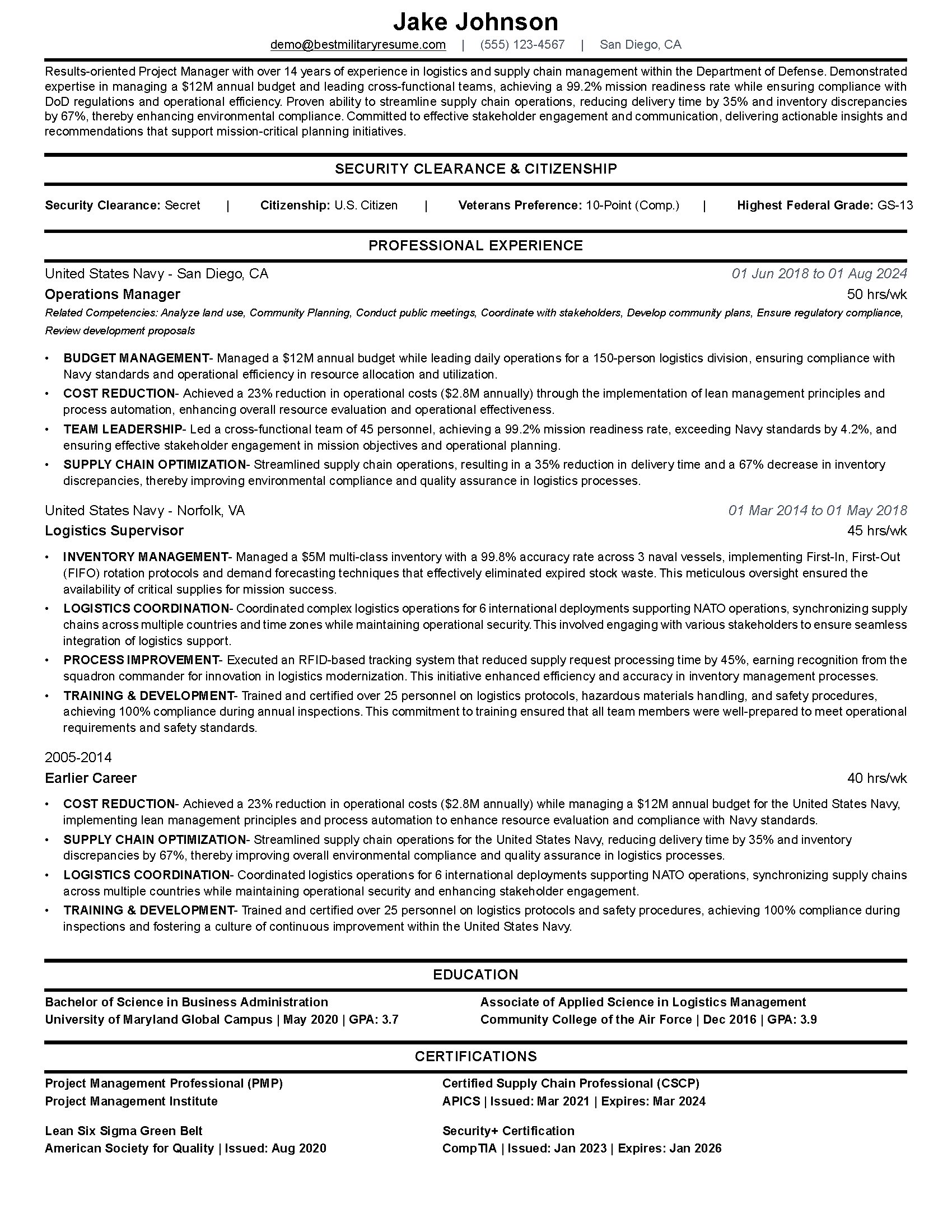
Your federal resume is the document HR uses to verify you meet OPM qualification standards. If your resume does not clearly demonstrate the required specialized experience or education, you will be rated "not qualified" — even if you actually have the experience. The resume is your proof.
Start by reading the qualification standard for the specific job series, not just the job announcement. The announcement summarizes the standard, but the full OPM standard on opm.gov gives you more detail about what counts as qualifying experience. Use that detail to frame your resume bullets.
For each position on your resume, include the job title, organization, dates of employment (month and year), and hours per week. Federal HR requires all four elements. Missing any one of them can result in your experience not being credited. Then write duty descriptions that mirror the language in the OPM qualification standard. If the standard says "experience in program management, budget formulation, and organizational analysis," your resume needs to use those exact terms — not military equivalents that HR might not recognize.
1 Read the Full OPM Standard
2 Map Your Military Duties
3 Include Required Details
4 Use Federal Language
BMR's Federal Resume Builder handles this translation automatically — it maps your military experience to federal job series language and formats everything to meet OPM requirements. But whether you use a tool or do it manually, the principle is the same: your resume must speak the language HR is trained to look for.
Which GS Grade Should Veterans Apply For?
This depends on your combination of education and military experience. OPM publishes a general experience and education chart that maps years of experience and education levels to GS grades. Here is a simplified breakdown for common veteran scenarios.
An E-5 with four to six years of service and no degree will typically qualify for GS-5 or GS-7 positions, depending on how closely their military duties match the specialized experience requirements. That same E-5 with a bachelor's degree could qualify for GS-7 or potentially GS-9 if their military experience includes supervisory duties or specialized technical work at the right level.
Senior NCOs (E-7 and above) with 10+ years of progressively responsible experience often qualify for GS-9 through GS-12, depending on the job series. Officers generally qualify for GS-9 and above, with field-grade officers targeting GS-12 through GS-14. But rank alone does not determine your GS grade — it is the specific duties you performed and how they align with the OPM standard for that series.
Do not apply exclusively at one grade level. If a position is posted as GS-9/11/12 (a ladder position), apply and show your strongest qualifications. HR will determine the highest grade you qualify for. Many veterans undersell themselves by targeting lower grades, while others aim too high and get screened out. Read the OPM standard for the specific series and honestly assess where your experience falls.
"I applied for GS positions in six different career fields across my federal career. Every time, I had to go back to the OPM qualification standard and rebuild my resume to match the specific series requirements. Same experience, different framing — that is what gets you qualified."
What Are Common Mistakes Veterans Make with OPM Standards?
After helping 15,000+ veterans through BMR, I see the same OPM-related mistakes repeatedly. The most common is not reading the qualification standard at all. Veterans read the job announcement, see duties they recognize, and assume they qualify. But the qualification standard might require specific types of experience — like "experience interpreting regulatory guidance" — that veterans have but fail to document on their resume.
Another frequent mistake is confusing GS grade equivalency with military rank. Your rank does not automatically translate to a specific GS level. An E-7 in a combat arms MOS might qualify for a different GS grade than an E-7 in a logistics MOS, even though they hold the same rank. It depends entirely on the duties performed and how those duties align with the specific job series standard.
Veterans also underestimate the importance of documenting hours per week. OPM requires that specialized experience be full-time (40 hours per week) or the equivalent. If you held a part-time position or a collateral duty that was not full-time, you need to specify the hours so HR can calculate whether you have a full year of qualifying experience. Military service is counted as full-time, but if you are combining military and civilian experience, accuracy matters.
Finally, many veterans apply for job series where their experience does not actually match the OPM standard, then get frustrated when they are rated "not qualified." Before applying, compare your actual duties — not your job title — against every requirement in the qualification standard. If there are gaps, consider whether education or the combination formula can fill them. If not, target a different series or a lower grade where your experience genuinely fits. Your KSA examples need to directly address the standard's requirements.
Understanding OPM qualification standards is not optional for federal job seekers — it is the foundation of every successful application. Read the standard before you write your resume, match your language to what HR is looking for, and document your experience with the detail and specificity that federal hiring requires. When you treat the OPM standard as your resume blueprint, you stop getting screened out and start getting referred to hiring managers. Veterans with veterans preference get an extra advantage — but only if they clear the qualification hurdle first.
Related: Military rank to GS level conversion chart and federal resume length 2026: the new 2-page limit.
Build yours: Create your federal resume with the free BMR Federal Resume Builder.
Explore positions: Browse 350+ federal job series matched to military experience.
Frequently Asked Questions
What are OPM qualification standards?
Does military experience count as specialized experience for federal jobs?
Can I use my degree instead of experience to qualify for a GS position?
How do I combine education and experience to meet OPM standards?
What GS grade should a veteran apply for?
Why was I rated not qualified for a federal job I am experienced in?
Does my DD-214 prove I meet OPM qualification standards?
Where can I find OPM qualification standards for a specific job series?
About the Author
Brad Tachi is the CEO and founder of Best Military Resume and a 2025 Military Friendly Vetrepreneur of the Year award recipient for overseas excellence. A former U.S. Navy Diver with over 20 years of combined military, private sector, and federal government experience, Brad brings unparalleled expertise to help veterans and military service members successfully transition to rewarding civilian careers. Having personally navigated the military-to-civilian transition, Brad deeply understands the challenges veterans face and specializes in translating military experience into compelling resumes that capture the attention of civilian employers. Through Best Military Resume, Brad has helped thousands of service members land their dream jobs by providing expert resume writing, career coaching, and job search strategies tailored specifically for the veteran community.
