WG-2610 Electronic Integrated Systems Mechanic Resume: Guide for Avionics Veterans
Christopher was selected for GS-13 on his first-ever USAJOBS application.
Christopher, E-7, Coast Guard, now writes policy for the work he did on active duty
OPM's job grading standard for WG-2610 describes work at WG-12 and WG-13, but allows other grades. The standard covers no helper or intermediate Electronic Integrated Systems Mechanic jobs. OPM says the work is not right for trainees (OPM standard TS-41, February 1981).
So most postings expect a working mechanic on day one. Many avionics vets look at that and ask, "Does my aircraft time even count here?" It can, if your resume shows the right things.
By the end, you'll have this trade's job element list and a work block for your resume. You'll also have sample bullets to shape to your records. This page covers WG-2610 only, not the general wage grade process. For pay and the job overview, see the WG-2610 career page.
What are the WG-2610 job elements?
Wage grade jobs are rated on OPM job elements. Some Guard postings add specialized experience too. OPM lists the elements for the whole 2600 family in its Job Qualification System for Trades and Labor. Here's that list, with what to show from your avionics work.
| Element (OPM number) | What to show from avionics work |
|---|---|
| Ability to do the work of the position without more than normal supervision (1, screen-out) | Jobs you signed off yourself, and the systems you were trusted to work alone |
| Knowledge of equipment assembly, installation, repair (2-E) | Installs, removals, mods and rewiring on named systems |
| Use of test equipment: electronics (60-A) | Test sets, scopes, ATE and meters, by name |
| Theory of electronics (62) | Tech school, signal tracing, and how you found faults on paper first |
| Ability to use hand and power tools: electronics (81-E) | Crimping, soldering, connector and harness repair |
| Trouble shooting: electronic equipment (96-C) | Faults you traced across more than one box, with the fix |
| Ingenuity: ability to suggest and apply new methods (104) | A better test step, a fix you wrote up, a tech data change you sent in |
One thing to watch. A posting can swap the screen-out element for lead, inspect, instruct or production support work. Those are elements 73, 77, 46 and 78 in the same OPM table. Read your posting to see which one it uses.
Is your avionics job the integrated systems kind?
This is the question that decides the whole resume. OPM's standard covers systems where several sensor parts feed one logic part. The result then changes how the whole system runs. Its examples include fire control, flight and landing control, and automatic test equipment. Flight simulators, bombing navigation and electronic warfare are on the list too.
The standard also sets a second test. You must use knowledge of the complete system in your daily work. If you only fixed one box, like a radio, OPM points that work to WG-2604 Electronics Mechanic instead.
So your resume has to show the links between parts. Say how a fault in one part showed up somewhere else. Then say how you proved the full system worked after the fix.
Military jobs that often feed WG-2610
BMR's crosswalk ties the Army and Air Force jobs below to WG-2610. Each page below covers that job's civilian and federal paths.
- Army: 15N Avionic Mechanic and 15Y AH-64D Armament/Electrical/Avionic Systems Repairer.
- Air Force: 2A3X5 Advanced Fighter Aircraft Integrated Avionics, 2A3X4 and 2A9X4 Heavy Aircraft Integrated Avionics.
Hold a code like 2A5X3 that is not on this list? Don't count yourself out. Use the title printed on your own records, then describe the systems you worked. The systems count more than the code.
How do you prove the screen-out element?
OPM's rule is plain. Applicants "must receive a minimum of two points on the screen-out element(s) to be deemed eligible for consideration." OPM adds that applicants who clearly fail it "can be rated ineligible without further review of their applications."
Two open postings show the wording. A U.S. Army Corps of Engineers job in Granite City, Illinois, was open on November 22, 2026. Its screen-out element asks you to do the work "without more than normal supervision" (posting CEDC-27-13118258-MP). An Air Force Reserve job at Andrews was open that day too. It asks for the same work "with little to no supervision" (posting 8Q-ARTE-13108386-460881-PW).
OPM's point scale tells you what to write. Two points means common tasks under close supervision. More points go to complete independence, or to complex and unusual problems you solved. So write what you did alone:
- Your sign-off: say which tasks you closed out on your own signature.
- Your systems: name each integrated system you worked without a lead watching.
- Your help to others: OPM's grade 12 text says these mechanics often help lower grade workers. If you trained or checked others, say so.
What goes in your WG-2610 work block?
Each military job gets its own block. Two pages for most federal jobs. Always check the announcement, because some are exceptions. The two-page federal resume guide shows how to fit it.
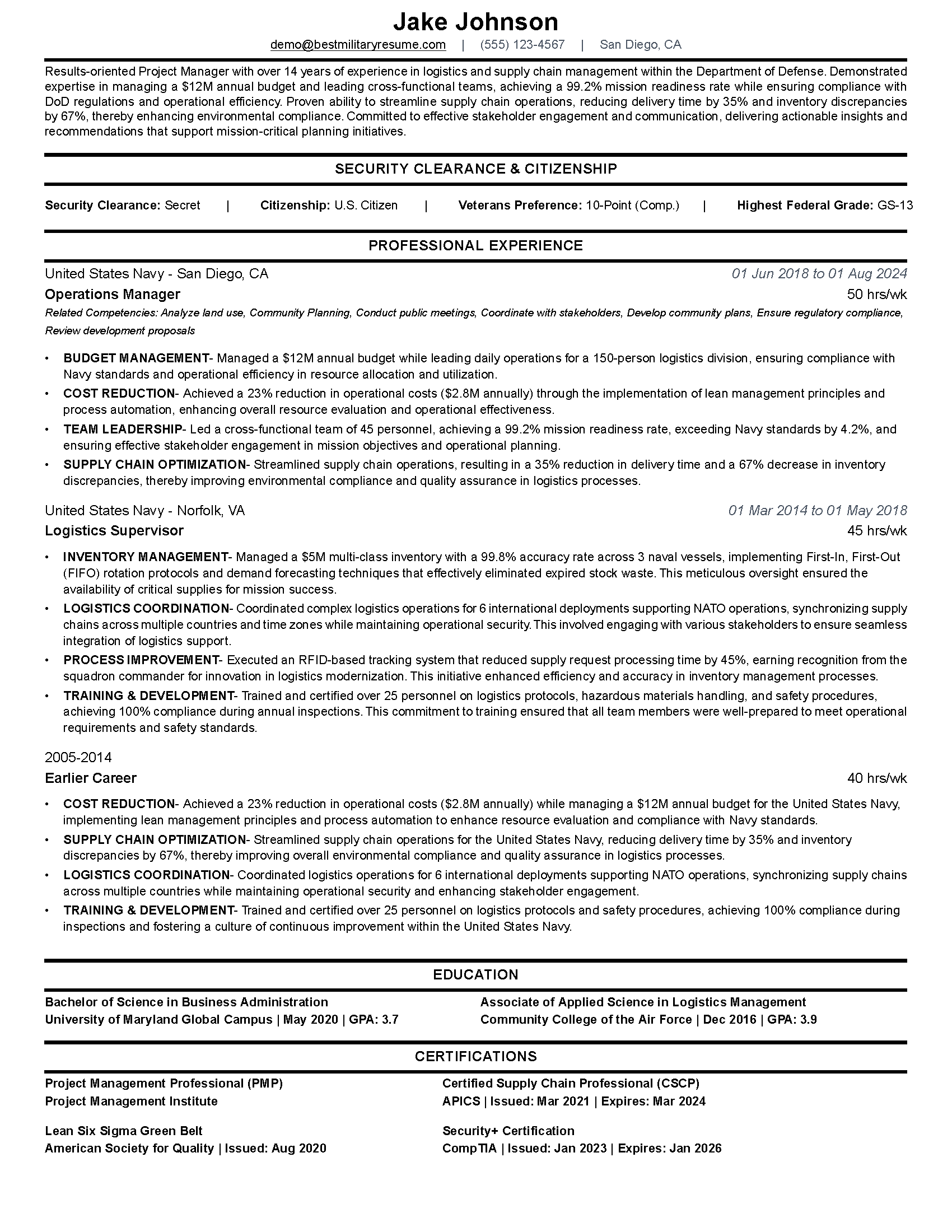
Here's a sample block. Swap in your own facts.
Example work block (all details illustrative):
- Title: Avionics Systems Technician (the job you held, in plain words)
- Employer: U.S. Army, [your unit], [your installation]
- Dates: 06/2021 to 08/2025
- Hours: 40 per week
- Systems: flight control, navigation and weapons systems on the AH-64D
- Test equipment: the test sets, scopes and meters you used, by name
- Bullets: three to five, in the format below
Write the systems and test gear by name. Those names match elements 60-A and 96-C in the table above.
What do strong WG-2610 bullets look like?
BMR writes federal bullets in one format. Each starts with a short header in capitals, then a dash. One or two sentences follow, 40 to 60 words, saying what you did, its scope and its result. Every specific word in the header appears in that bullet.
Example bullets (figures illustrative):
- NAVIGATION FAULT TRACING- Restored 6 AH-64D aircraft to flying status by tracing 14 repeat navigation faults to a failed signal path between the inertial unit and the flight computer, using the aircraft test set and a digital scope. Replaced the faulty harness and ran full system checks, with no repeat writeups in 90 days.
- AUTOMATIC TEST EQUIPMENT- Closed 38 test and alignment jobs on flight control and fire control components across 4 airframes, using automatic test equipment, oscilloscopes and signal generators. Logged each result against technical order limits and delivered every job under own signature by the shop's planned completion dates.
- TECHNICAL DATA CORRECTION- Eliminated a repeat 2-hour test error by finding a wrong wiring callout in the technical data for a weapons system test while tracing 3 failed checks. Submitted the correction with drawings attached and trained 5 junior technicians on the revised test steps, cutting repeat failures to 0.
Look at what each one does. It names the systems, the test gear and a result. It shows work done alone. Use your own numbers, and leave out any you cannot back up.
Should you apply at WG-12 or WG-13?
Pick the grade from the work, not your rank. OPM's standard draws the line this way.
- WG-12: you repair, align and troubleshoot one complete integrated system. Examples are inertial navigation, automatic flight control or fire control.
- WG-13: you work multisystem complexes, where several full systems feed data to each other. OPM's example is the full electronics package in a highly automated aircraft. Grade 13 mechanics may also build prototype or breadboard systems.
Read your own bullets back. If they show tracing faults between whole systems, WG-13 may fit. If they show one system, start at WG-12.
What changes on a National Guard technician posting?
Most series 2610 postings open on November 22, 2026 were National Guard jobs. Each of those Guard postings was a Title 32 technician job under 32 U.S.C. 709. You must belong to the Guard unit, or be willing to join. So these postings add military rules on top of OPM's elements.
One example is a Florida Air National Guard posting, open on November 22, 2026. It sets extra rules for its WG-13 jobs. It asks for a seven skill level AFSC from Air Force tech school. It also asks for at least one military education course. Rules like these differ by state, so read each posting.
Put your Guard membership, AFSC and skill level near the top of the job block. Then let the rest of the resume answer the elements, just like any other WG-2610 job. The WG-5803 mechanic guide shows the same element method for another trade.
What to Do Next
Here's your next step. Pick one open WG-2610 posting. Copy its screen-out line and its element list. Then write one bullet for each element, from your own records.
Kyle is a Navy Chief Petty Officer from aviation maintenance. About his first BMR resume, he wrote: "With the very first one I created... I was hired." The federal resume builder builds the work blocks in the format above. When you tailor, BMR reads the posting and rewrites your bullets in its words. It does not add work you never did. For federal jobs, it grades you against the minimum qualification and tells you when you don't meet it. With 3+ roles on a tailored resume, Condense to 2 Pages folds older ones into Earlier Career.
Postings quoted were open on November 22, 2026. OPM standard and Job Qualification System checked November 2026.
Frequently Asked Questions
Does PMEL or calibration work count toward WG-2610?
Is WG-2610 the same as GS-0856 Electronics Technician?
What about optical fire control or industrial control repair?
How many years of experience do I need for WG-2610?
What physical demands does a WG-2610 job list?
About the author
Brad Tachi is the CEO and founder of Best Military Resume and a 2025 Military Friendly Vetrepreneur of the Year award recipient for overseas excellence. A former U.S. Navy Diver with over 20 years of combined military, private sector, and federal government experience, Brad brings unparalleled expertise to help veterans and military service members successfully transition to rewarding civilian careers. Having personally navigated the military-to-civilian transition, Brad deeply understands the challenges veterans face and specializes in translating military experience into compelling resumes that capture the attention of civilian employers. Through Best Military Resume, Brad has helped thousands of service members land their dream jobs by providing expert resume writing, career coaching, and job search strategies tailored specifically for the veteran community.
