Military Veteran Resume: Complete Guide for 2026
Desiree landed a $135K hybrid senior financial consultant role.
Desiree, E-5, Army National Guard, the interviewer loved the resume from the top down
You served. You did real work. You led people, fixed equipment, managed budgets, and solved problems under pressure that most civilians will never face.
But now you need a resume. And the resume you got from TAP is not getting callbacks.
That is exactly where I was in 2015. I separated as a Navy Diver with years of high-stakes experience. I spent the next 18 months applying for jobs and hearing nothing. Zero interviews. Zero callbacks. My resume listed everything I did in the military, but nobody on the civilian side could figure out what I actually brought to the table.
The problem was not my experience. The problem was how I put it on paper. Once I fixed that, I got hired. Then I got hired again. And again. Six different career fields. That is what a good military veteran resume does. It takes what you already earned and puts it in a format that hiring managers actually read.
This guide covers how to build one that works. Not theory. Not a list of buzzwords. The actual structure, examples, and mistakes I see every week from the 24,538 veterans who use BMR.
What Makes a Military Veteran Resume Different?
A veteran resume is not a civilian resume with a military job title swapped in. The structure looks the same on the surface. Same sections. Same layout. But the content needs a full translation.
Civilian hiring managers do not know what an E-7 does. They do not know what a 68W is. They have never heard of an NCOER or a FITREP. And that is fine. Your resume needs to bridge that gap without dumbing down your experience.
Here is what makes a military veteran resume different from a standard civilian resume:
- Job titles need translation: "Fire Control Technician" becomes "Electronic Systems Technician" or "Weapons Systems Specialist" depending on the target role.
- Acronyms must be spelled out: COMSEC, PMS, CASREP, TMT. Your reader has never seen these. Write them out or replace them with plain language.
- Results need civilian context: "Managed a $2.4M equipment account with zero discrepancies" means something. "Maintained accountability of command assets" does not.
- Leadership should show scale: "Led 14 technicians across two shifts" tells a hiring manager exactly how much responsibility you had.
Supervised daily operations of the command's N4 division. Managed all facilities maintenance and coordinated with PWD for corrective work orders per NAVFAC guidelines.
Managed facilities maintenance for a 200-person organization. Oversaw 45 work orders monthly, reduced repair backlog by 30%, and managed a $180K annual maintenance budget.
The translated version has numbers, scope, and plain language. Any hiring manager can read it and understand the value. That is the goal with every bullet on your resume.
One more thing. If you are targeting federal jobs, the resume format is completely different. Federal resumes need hours per week, supervisor contact info, and more detail than a private sector resume. Check our USAJOBS federal resume requirements guide for that process. This article focuses on private sector and civilian resumes.
How Should You Structure a Military Veteran Resume?
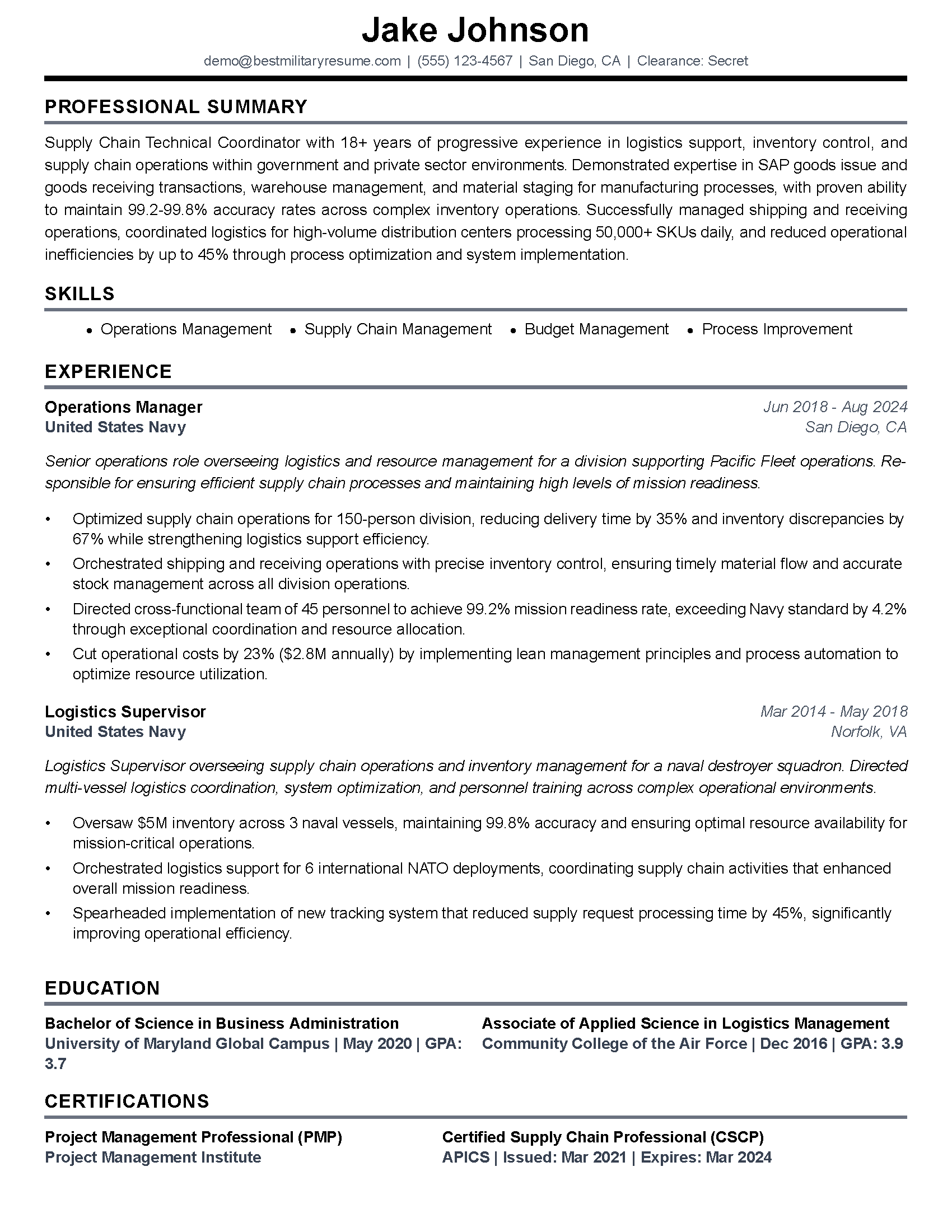
Keep it simple. Two pages max. Reverse chronological order. No fancy graphics, no columns, no icons. Clean format that is easy to scan.
Here is the structure that works:
Contact Header
Name, phone, email, city/state, LinkedIn URL. No military rank. No "veteran" in the header.
Professional Summary
Two to four sentences. State your years of experience, core skills, and the type of role you want. Tailor this for every job.
Work Experience
Each role gets a translated job title, dates, and four to six bullet points with measurable results. Most recent first.
Education and Certifications
Degrees, military schools that translate (like leadership courses), and relevant certifications. Skip classified or niche military courses.
Skills Section
Hard skills and software pulled directly from the job posting. Match their language exactly. Skip soft skills like "team player."
This structure works because it is what hiring managers expect. They scan from top to bottom. Summary first. Experience second. Education and skills at the end. Do not get creative with the order.
For more detail on how long your resume should be based on your target industry, read our veteran resume length guide.

How Do You Translate Military Experience for Civilian Jobs?
This is where most veteran resumes fall apart. You know what you did. You just do not know how to say it in a way that a civilian hiring manager gets.
The fix is simpler than you think. For every bullet on your resume, answer these four questions:
- What did you do? Use a plain English action verb. "Managed," "trained," "repaired," "coordinated."
- How many? People, dollars, equipment, projects. Put a number on it.
- What happened? The result. Faster, cheaper, safer, more accurate.
- Why does the employer care? Connect it to business value. Cost savings, efficiency, compliance, revenue.
An infantry squad leader does not just "lead a squad." They manage a team of 9 to 12 people. They plan and execute operations. They train and evaluate team members. They maintain equipment worth hundreds of thousands of dollars. Every one of those is a resume bullet.
Here are real translations by branch:
- Army 25B (IT Specialist): "Administered network infrastructure for 500+ users across two sites. Reduced system downtime by 40% through proactive monitoring."
- Navy MM (Machinist Mate): "Performed preventive and corrective maintenance on steam propulsion systems. Managed a $1.2M parts inventory with 99.8% accuracy."
- Air Force 3E5X1 (Engineering): "Managed construction projects valued at $3.5M. Supervised 8-person crews and delivered projects on schedule."
- Marine 0311 (Rifleman): "Supervised a 13-person team in high-pressure environments. Planned logistics for operations supporting 200+ personnel."
Notice the pattern. Numbers. Plain language. Results. No acronyms. No jargon. That is what gets your resume read.
For more examples broken out by branch, check our military experience examples for all 6 branches.
Key Takeaway
Every resume bullet needs a number. People managed, dollars saved, percentage improved, equipment maintained. If you cannot quantify it, rethink the bullet.
What Are the Biggest Military Veteran Resume Mistakes?
I see the same mistakes every week through BMR. Veterans are not doing anything wrong on purpose. They just do not know what civilian hiring managers look for. Here are the five most common ones.
Writing a Military Document, Not a Resume
Your resume is not a service record. It is a sales document. It should only include experience that is relevant to the job you want. If you were an aircraft mechanic applying for a project management role, lead with the project management parts of your job. The wrench-turning stays in the background.
Keeping Military Job Titles Without Translation
"Boatswain Mate First Class" tells a civilian nothing. Change it to something they can search for on LinkedIn. "Operations Supervisor" or "Marine Operations Specialist" works better. Keep the military title in parentheses if you want, but lead with the civilian version.
Listing Duties Instead of Results
Duties describe what you were supposed to do. Results describe what actually happened. "Responsible for supply chain operations" is a duty. "Managed supply chain for a 300-person unit. Reduced order fulfillment time from 14 days to 6 days" is a result. Hiring managers want results.
Using the Same Resume for Every Job
This is the biggest mistake. Your TAP resume was one version. But every job posting uses different keywords and asks for different skills. You need to tailor your resume for each job you apply to. Match the language in the posting. Use their words, not yours.
ATS software ranks resumes based on keyword matches. If the posting says "project management" and your resume says "mission planning," you rank lower. Same skill. Different words. The fix is matching their language.
Making It Too Long
Two pages. That is it. I do not care if you have 20 years of service. A hiring manager spends about 6 seconds on the first scan. If they cannot find what they need in two pages, they move on. Check our military to civilian resume sample rewrites to see how veterans with long careers fit everything into two pages.
Do Not Copy Your Evaluations
NCOERs, FITREPs, and EPRs are written in military language for a military audience. Copying bullets straight from your evaluations onto your resume is one of the fastest ways to lose a hiring manager. Translate every single bullet into plain English with numbers.
How Do You Write a Professional Summary as a Veteran?
The professional summary sits at the top of your resume. It is the first thing a hiring manager reads. You get two to four sentences to explain who you are and what you bring.
Here is the formula:
- Sentence 1: Years of experience + core expertise + the word "veteran" or "military" (for ATS matching).
- Sentence 2: Your top two to three skills that match the job posting.
- Sentence 3: A measurable result from your career that proves your value.
- Sentence 4 (optional): The type of role or industry you are targeting.
Here is an example for an Army logistics NCO targeting a supply chain analyst role:
"Supply chain and logistics professional with 12 years of military experience managing inventory and distribution for organizations of 500+ personnel. Skilled in demand forecasting, warehouse management systems, and vendor coordination. Reduced excess inventory by $1.8M while maintaining 98% fill rates across two deployments. Seeking a supply chain analyst position in manufacturing or defense contracting."
That summary works because it has numbers, it matches the job language, and it tells the reader exactly what you do. No fluff. No "hardworking team player" or "proven leader." Just facts.
Tailor this section for every single application. Pull two or three keywords from the job posting and work them in. If the posting says "data analysis," put "data analysis" in your summary. If it says "stakeholder management," use that exact phrase.
Should You Include Your Security Clearance?
Yes. If you have an active or recently expired clearance, put it on your resume. A security clearance saves an employer time and money. The investigation process can take 6 to 18 months and cost thousands of dollars. If you already have one, that is a real advantage.
Where to put it: in your professional summary or in a separate "Clearances" line right below your contact information.
How to list it:
- Active: "Active Top Secret/SCI Clearance (last investigated 2024)"
- Current but no longer active: "Top Secret Clearance (inactive, last investigated 2022)"
This matters most if you are targeting defense contractors, government consulting, or federal-adjacent roles. Companies like Booz Allen, Leidos, SAIC, and Northrop Grumman specifically look for cleared candidates.
If your clearance has been expired for more than two years, it is less valuable but still worth mentioning. It shows you can pass the investigation, which speeds up the process for a new one.
"I built BMR because my own transition was a disaster. 18 months, hundreds of applications, zero calls. The resume was the problem every time. Once I fixed the format and learned to speak civilian, everything changed."
How Does ATS Affect Your Military Veteran Resume?
ATS stands for Applicant Tracking System. Companies like Amazon, Lockheed Martin, and Deloitte use these systems to manage job applications. Every resume you submit online goes through one.
Here is what ATS actually does. It reads your resume, pulls out keywords, and ranks you against other applicants. Resumes with better keyword matches rank higher. Hiring managers start at the top of the list and work down. If your resume ranks low, nobody scrolls down to find you.
ATS does not reject resumes. It ranks them. Your goal is to rank near the top.
How to do that as a veteran:
- Use the exact words from the job posting. If they say "budget management," do not write "fiscal oversight." Match their language.
- Skip the graphics. ATS cannot read images, charts, or text boxes. Stick to plain text with standard headings.
- Use standard section headings. "Work Experience," "Education," "Skills." Not "Career Highlights" or "Professional Journey."
- Save as .docx or PDF. Both formats work fine. Do not stress about the file type.
- Do not stuff keywords. ATS systems are smart enough to catch keyword stuffing. Use keywords naturally in your bullet points and summary.
The biggest ATS mistake veterans make is using military terms when the job posting uses civilian terms. "COMSEC" and "communications security" mean the same thing, but only one matches the job posting keywords.
BMR's Resume Builder handles this translation automatically. You paste the job posting, and it matches your military experience to the right civilian keywords. Free for two tailored resumes.
What About Military Education and Training?
Military training is a goldmine for your resume. But you need to know what translates and what does not.
Training that translates well:
- Leadership courses (NCO Academy, Officer Leadership, Senior Enlisted Academy)
- Project management training
- Technical certifications (CompTIA, Cisco, AWS, welding certs)
- Safety and compliance training (OSHA 30, HAZMAT, First Aid/CPR)
- Instructor and train-the-trainer courses
Training that does not translate:
- Weapons qualifications (unless applying for law enforcement or security)
- Classified program training you cannot discuss
- Unit-specific SOPs or doctrine courses
- Physical fitness qualifications
For your education section, list your degree first if you have one. Then add military schools that have civilian value. Use the civilian name when possible. "Senior Enlisted Joint Professional Military Education" can become "Executive Leadership Development Program."
If you do not have a college degree, that is fine. Many veterans do not. Lead with your certifications and military training. A PMP certification, a Six Sigma belt, or a CompTIA Security+ can carry as much weight as a degree in the right industry.
You can use your GI Bill to add certifications that fill gaps in your resume. Check our Army resume examples by MOS to see how other veterans listed their training.
How Do You Handle Employment Gaps After Service?
Many veterans have a gap between their separation date and their first civilian job. This is normal. Hiring managers see it all the time from veteran candidates. Do not panic about it.
Here is how to handle it:
Short gap (under 6 months): You do not need to explain it. List your military service end date and your next job start date. Nobody questions a few months between jobs for a separating service member.
Longer gap (6+ months): Fill it with something real. Did you take classes? Get a certification? Volunteer? Do freelance work? Put it on the resume. Even "Completed PMP Certification and Project Management coursework" fills the gap and adds value.
Currently in the gap: Use your time wisely. Get a certification that matches your target industry. Take a free course through Coursera or a VA program. Volunteer with a veteran service organization. All of this goes on your resume.
What NOT to do: do not write "Career Transition Period" or "Sabbatical" on your resume. That tells the employer nothing. Fill the gap with something productive or leave it and let your experience speak for itself.
If you used SkillBridge during your last 180 days, that counts as experience. List it as an internship or fellowship with the company name, not the military command.
Do You Need a Different Resume for Each Job?
Yes. Every single application needs a tailored resume. I know that sounds like a lot of work. It is. But it is the difference between getting callbacks and hearing nothing for months.
Here is what tailoring actually means:
- Read the job posting word by word. Highlight the skills and qualifications they mention.
- Match your summary to their requirements. If they want "5+ years of logistics experience," your summary should say "12 years of logistics and supply chain experience."
- Reorder your bullets. Put the most relevant experience at the top of each job section.
- Mirror their keywords. If they say "cross-functional collaboration," use that phrase. Not "interagency coordination."
You do not need to rewrite the whole resume every time. Keep a master resume with all your experience. Then cut, rearrange, and adjust for each application. This takes about 20 to 30 minutes per job.
Or you can use a tool that does it for you. BMR's Resume Builder lets you paste any job posting and automatically tailors your resume to match. It pulls the right keywords, rearranges your experience, and formats everything. You get two free tailored resumes to start.
If you want to see what a fully rewritten resume looks like by rank and branch, check our military style resume guide for examples of what works and what does not.
Resume Tailoring Checklist
Read the full job posting
Highlight every skill, qualification, and keyword they mention
Rewrite your summary
Match their top requirements in your first two sentences
Swap your keywords
Replace military terms with the exact civilian phrases from the posting
Reorder your bullets
Most relevant experience goes first under each job title
Update skills section
Only list skills that appear in the job posting or are directly related
What Should You Do Next?
You have the structure. You have the examples. You know the mistakes to avoid. Now it is time to build your resume.
Start with your most recent military role. Translate every bullet using the four-question formula: what did you do, how many, what happened, why does the employer care? Get that one role right, then move to the next.
If you want help with the translation, BMR's Military Resume Builder was built for exactly this. Paste a job posting, upload your experience, and get a tailored resume in minutes. It was built by a veteran who spent 18 months learning this the hard way so you do not have to.
You can also explore your civilian career options with our military to civilian jobs tool. Enter your MOS, rating, or AFSC and see what civilian roles match your experience, along with salary ranges and federal positions.
Your experience is real. Your skills are valuable. The resume is just the wrapper. Get the wrapper right and the interviews follow.
Frequently Asked Questions
How long should a military veteran resume be?
Should I put my military rank on my resume?
What is the best resume format for veterans?
Do I need a different resume for every job application?
How do I translate military jargon for civilian employers?
Should I include my security clearance on my resume?
Can I use a PDF for my resume?
What if I have a gap between military service and my first civilian job?
About the Author
Brad Tachi is the CEO and founder of Best Military Resume and a 2025 Military Friendly Vetrepreneur of the Year award recipient for overseas excellence. A former U.S. Navy Diver with over 20 years of combined military, private sector, and federal government experience, Brad brings unparalleled expertise to help veterans and military service members successfully transition to rewarding civilian careers. Having personally navigated the military-to-civilian transition, Brad deeply understands the challenges veterans face and specializes in translating military experience into compelling resumes that capture the attention of civilian employers. Through Best Military Resume, Brad has helped thousands of service members land their dream jobs by providing expert resume writing, career coaching, and job search strategies tailored specifically for the veteran community.
