Home / Federal resume examples / Safety and Occupational Health Management
GS-0018 Safety and Occupational Health resume example (GS-11, 2 pages)
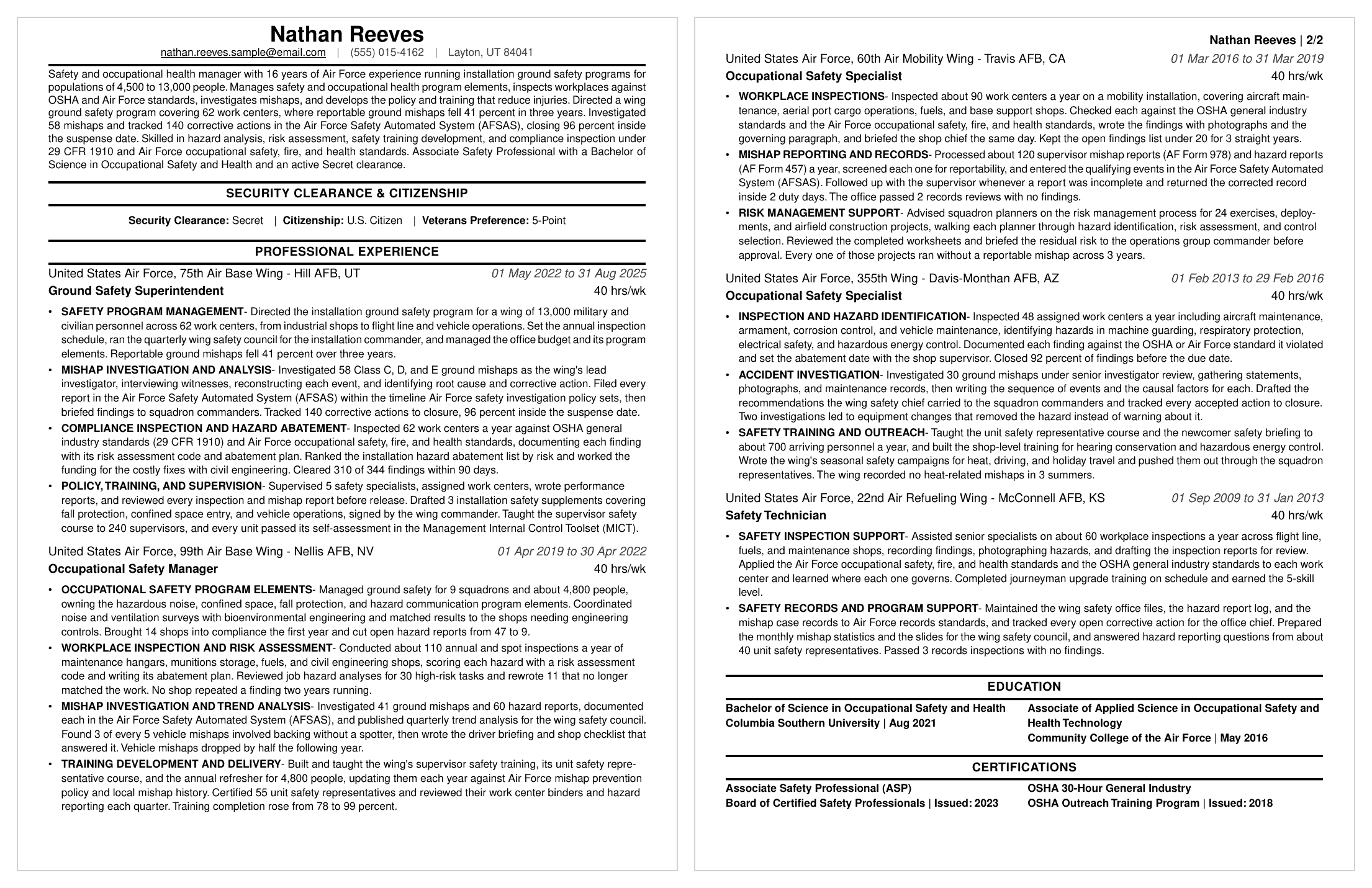
This is a two-page federal resume for a GS-0018 Safety and Occupational Health Management job at GS-11. It is written the way OPM now asks for. Nathan is a fictional Air Force safety NCO, a Master Sergeant with 16 years in. He spent the last three running a wing ground safety program. Did you inspect work centers, work mishaps, or run a safety shop in any branch? Then this is the format the rater expects. Under it: why each block is built the way it is, the words the job post uses, and a free score on your own resume.
The example
Fictional sample. The person, the units, and the numbers are illustrative. Rendered by BMR's Federal Traditional template, the same one a user's resume prints on.
Page 1 of 2
Safety and occupational health manager with 16 years of Air Force experience running installation ground safety programs for populations of 4,500 to 13,000 people. Manages safety and occupational health program elements, inspects workplaces against OSHA and Air Force standards, investigates mishaps, and develops the policy and training that reduce injuries. Directed a wing ground safety program covering 62 work centers, where reportable ground mishaps fell 41 percent in three years. Investigated 58 mishaps and tracked 140 corrective actions in the Air Force Safety Automated System (AFSAS), closing 96 percent inside the suspense date. Skilled in hazard analysis, risk assessment, safety training development, and compliance inspection under 29 CFR 1910 and Air Force occupational safety, fire, and health standards. Associate Safety Professional with a Bachelor of Science in Occupational Safety and Health and an active Secret clearance.
Security Clearance: Secret | Citizenship: U.S. Citizen | Veterans Preference: 5-Point
SAFETY PROGRAM MANAGEMENT- Directed the installation ground safety program for a wing of 13,000 military and civilian personnel across 62 work centers, from industrial shops to flight line and vehicle operations. Set the annual inspection schedule, ran the quarterly wing safety council for the installation commander, and managed the office budget and its program elements. Reportable ground mishaps fell 41 percent over three years.
MISHAP INVESTIGATION AND ANALYSIS- Investigated 58 Class C, D, and E ground mishaps as the wing's lead investigator, interviewing witnesses, reconstructing each event, and identifying root cause and corrective action. Filed every report in the Air Force Safety Automated System (AFSAS) within the timeline Air Force safety investigation policy sets, then briefed findings to squadron commanders. Tracked 140 corrective actions to closure, 96 percent inside the suspense date.
COMPLIANCE INSPECTION AND HAZARD ABATEMENT- Inspected 62 work centers a year against OSHA general industry standards (29 CFR 1910) and Air Force occupational safety, fire, and health standards, documenting each finding with its risk assessment code and abatement plan. Ranked the installation hazard abatement list by risk and worked the funding for the costly fixes with civil engineering. Cleared 310 of 344 findings within 90 days.
POLICY, TRAINING, AND SUPERVISION- Supervised 5 safety specialists, assigned work centers, wrote performance reports, and reviewed every inspection and mishap report before release. Drafted 3 installation safety supplements covering fall protection, confined space entry, and vehicle operations, signed by the wing commander. Taught the supervisor safety course to 240 supervisors, and every unit passed its self-assessment in the Management Internal Control Toolset (MICT).
OCCUPATIONAL SAFETY PROGRAM ELEMENTS- Managed ground safety for 9 squadrons and about 4,800 people, owning the hazardous noise, confined space, fall protection, and hazard communication program elements. Coordinated noise and ventilation surveys with bioenvironmental engineering and matched results to the shops needing engineering controls. Brought 14 shops into compliance the first year and cut open hazard reports from 47 to 9.
WORKPLACE INSPECTION AND RISK ASSESSMENT- Conducted about 110 annual and spot inspections a year of maintenance hangars, munitions storage, fuels, and civil engineering shops, scoring each hazard with a risk assessment code and writing its abatement plan. Reviewed job hazard analyses for 30 high-risk tasks and rewrote 11 that no longer matched the work. No shop repeated a finding two years running.
MISHAP INVESTIGATION AND TREND ANALYSIS- Investigated 41 ground mishaps and 60 hazard reports, documented each in the Air Force Safety Automated System (AFSAS), and published quarterly trend analysis for the wing safety council. Found 3 of every 5 vehicle mishaps involved backing without a spotter, then wrote the driver briefing and shop checklist that answered it. Vehicle mishaps dropped by half the following year.
TRAINING DEVELOPMENT AND DELIVERY- Built and taught the wing's supervisor safety training, its unit safety representative course, and the annual refresher for 4,800 people, updating them each year against Air Force mishap prevention policy and local mishap history. Certified 55 unit safety representatives and reviewed their work center binders and hazard reporting each quarter. Training completion rose from 78 to 99 percent.
Page 2 of 2
WORKPLACE INSPECTIONS- Inspected about 90 work centers a year on a mobility installation, covering aircraft maintenance, aerial port cargo operations, fuels, and base support shops. Checked each against the OSHA general industry standards and the Air Force occupational safety, fire, and health standards, wrote the findings with photographs and the governing paragraph, and briefed the shop chief the same day. Kept the open findings list under 20 for 3 straight years.
MISHAP REPORTING AND RECORDS- Processed about 120 supervisor mishap reports (AF Form 978) and hazard reports (AF Form 457) a year, screened each one for reportability, and entered the qualifying events in the Air Force Safety Automated System (AFSAS). Followed up with the supervisor whenever a report was incomplete and returned the corrected record inside 2 duty days. The office passed 2 records reviews with no findings.
RISK MANAGEMENT SUPPORT- Advised squadron planners on the risk management process for 24 exercises, deployments, and airfield construction projects, walking each planner through hazard identification, risk assessment, and control selection. Reviewed the completed worksheets and briefed the residual risk to the operations group commander before approval. Every one of those projects ran without a reportable mishap across 3 years.
INSPECTION AND HAZARD IDENTIFICATION- Inspected 48 assigned work centers a year including aircraft maintenance, armament, corrosion control, and vehicle maintenance, identifying hazards in machine guarding, respiratory protection, electrical safety, and hazardous energy control. Documented each finding against the OSHA or Air Force standard it violated and set the abatement date with the shop supervisor. Closed 92 percent of findings before the due date.
ACCIDENT INVESTIGATION- Investigated 30 ground mishaps under senior investigator review, gathering statements, photographs, and maintenance records, then writing the sequence of events and the causal factors for each. Drafted the recommendations the wing safety chief carried to the squadron commanders and tracked every accepted action to closure. Two investigations led to equipment changes that removed the hazard instead of warning about it.
SAFETY TRAINING AND OUTREACH- Taught the unit safety representative course and the newcomer safety briefing to about 700 arriving personnel a year, and built the shop-level training for hearing conservation and hazardous energy control. Wrote the wing's seasonal safety campaigns for heat, driving, and holiday travel and pushed them out through the squadron representatives. The wing recorded no heat-related mishaps in 3 summers.
SAFETY INSPECTION SUPPORT- Assisted senior specialists on about 60 workplace inspections a year across flight line, fuels, and maintenance shops, recording findings, photographing hazards, and drafting the inspection reports for review. Applied the Air Force occupational safety, fire, and health standards and the OSHA general industry standards to each work center and learned where each one governs. Completed journeyman upgrade training on schedule and earned the 5-skill level.
SAFETY RECORDS AND PROGRAM SUPPORT- Maintained the wing safety office files, the hazard report log, and the mishap case records to Air Force records standards, and tracked every open corrective action for the office chief. Prepared the monthly mishap statistics and the slides for the wing safety council, and answered hazard reporting questions from about 40 unit safety representatives. Passed 3 records inspections with no findings.
Bachelor of Science in Occupational Safety and HealthColumbia Southern University | Aug 2021
Associate of Applied Science in Occupational Safety and Health TechnologyCommunity College of the Air Force | May 2016
Associate Safety Professional (ASP)Board of Certified Safety Professionals | Issued: 2023
OSHA 30-Hour General IndustryOSHA Outreach Training Program | Issued: 2018
Open the PDF (2 pages, as the engine prints it).
Already have a resume? Get it graded straight.
Upload it and get a number in about a minute, plus the lines a federal rater cannot credit and the required fields you are missing. No account. Sign up and tailor it like they did.
Free. We keep it 30 days so you never upload it twice.
Why this example works
- The summary is one dense paragraph, not a headline.
Six sentences, the way BMR writes it. Who he is and how long. The size of the population he covered. The duties in the words the 0018 series uses: safety program management, workplace inspection, mishap investigation, training. Two results with numbers, the system, the credential, the clearance. It never says "applying for" and never names the job post. The HR specialist already knows which job you applied to. The summary's job is to prove you have done the work.
- Every job block carries the fields the rater needs to credit the time, and nothing else.
Employer, title, dates with month and year (the day is fine too), and hours per week. Leave off hours per week and the rater may not be able to count that job at all. No series or grade on a military job: those fields are for prior federal positions.
- Every bullet is a three-sentence paragraph, even on the oldest job.
Each one opens with a header in caps the rater can scan. Then a dash, then the paragraph: what he did, under which standard, in which system, at what scale, and what came of it. The 2009 technician job gets the same treatment as the 2025 superintendent job. A one-line bullet gives the rater nothing to grade. A thin old job makes the rater wonder what you did for four years.
- The headers are the series' own words.
"Safety program management." "Compliance inspection and hazard abatement." "Mishap investigation and analysis." "Training development and delivery." Those phrases come straight from the 0018 duties OPM lists. The rater matches your lines to the job post, so use the job post's words.
- This series has an extra gate, and the resume has to clear it.
Most series only use the group standard. This one adds a gate of its own on top. There are four ways through it. A degree in safety or occupational health. A degree in another field with 24 semester hours in related subjects. Specialized safety experience. Or a CSP, CIH, or CHP card. Nathan clears it two ways, with the degree and with 16 years of safety work. Have the years but not the degree? Then spell out what you managed, inspected, investigated, and taught.
- The top job proves the GS-11 requirement on its own.
GS-11 asks for one year of work at the GS-9 level. In safety that means you ran the program, not a checklist. The first bullet says he directed the ground safety program for 13,000 people across 62 work centers. It says he ran the wing safety council for the commander. Those words are there to answer that requirement.
- Standards and systems get named, and spelled out the first time.
"OSHA general industry standards (29 CFR 1910)." "The Air Force Safety Automated System (AFSAS)." A rater outside the Air Force has never seen AFSAS. One clause fixes that, and the acronym is still there for a search. Naming the standard also shows you worked to it, not around it.
- Older jobs get fewer bullets, not thinner ones.
The jobs before 2019 get three bullets or two instead of four, and each one is still a full paragraph with the standard, the volume, and the result. They stay dated and carry hours per week, so the rater can count all 16 years. What they give up is bullets, not detail.
- Nothing OPM leaves out is on the page.
No Social Security number, no photo, no age, no references, no KSA essays, no skills list, no supervisor line. Clearance, citizenship, and preference sit in one line. Preference is proven by the DD-214 under Required Documents, not by a paragraph in the resume.
The translation, military line to federal line
| How an EPR or a duty description says it | What the 0018 rater is looking for |
|---|---|
| NCOIC, Wing Ground Safety | Ground Safety Superintendent, installation safety office; 40 hrs/wk |
| Ran the wing ground safety program | Managed safety and occupational health program elements for 13,000 personnel across 62 work centers |
| Did annual and spot inspections | Inspected workplaces for compliance with OSHA and Air Force safety standards |
| Worked Class C mishaps | Investigated mishaps, determined root cause, and recommended corrective action |
| Filed the report in AFSAS | Documented investigations and hazards in the safety reporting system of record |
| Tracked the hazard abatement list | Managed hazard abatement, ranked findings by risk, and tracked actions to closure |
| Wrote the wing supplement | Developed safety policy and procedures; drafted 3 installation supplements that were signed |
| Taught supervisor safety training | Developed and delivered safety training to supervisors and unit representatives |
| Briefed the wing safety council | Analyzed safety data and briefed mishap trends to senior leadership each quarter |
| Ran ORM for the exercise | Applied risk management: hazard identification, risk assessment, and control selection |
The words the announcement uses
The words a 0018 job post uses, and what GS-11 requires.
Duties the job post lists
- Develop safety programs and policies
- Manage safety and occupational health program elements
- Conduct workplace inspections
- Investigate accidents and incidents
- Analyze safety data and identify trends
- Ensure OSHA compliance
- Develop standards and procedures to eliminate or control hazards
- Train employees, supervisors, and safety personnel
Competencies the questionnaire tends to rate
- Safety program management
- Hazard analysis and risk assessment
- Regulatory knowledge
- Accident investigation
- Training development
- Communication
What GS-11 requires (OPM, Group Coverage Qualification Standard for Administrative and Management Positions): one year of specialized experience equivalent to GS-9, OR a Ph.D. or equivalent doctoral degree, OR three full years of progressively higher-level graduate education, OR a combination. GS-9 moves that down to one year at GS-7, or a master's degree, or two years of graduate education. The 0018 series also carries an Individual Occupational Requirement on top of the group standard, met by a major in safety or occupational health, by a degree in another field with at least 24 semester hours in related subjects, by qualifying specialized safety experience, or by a CSP, CIH, or CHP certificate.
Sources: OPM, Individual Occupational Requirements for the Safety and Occupational Health Management Series 0018, https://www.opm.gov/policy-data-oversight/classification-qualifications/general-schedule-qualification-standards/0000/safety-and-occupational-health-management-series-0018/, used together with the Group Coverage Qualification Standard for Administrative and Management Positions; USAJOBS help, "What should I include in my federal resume?", https://help.usajobs.gov/faq/application/documents/resume/what-to-include, which states that federal agencies accept resumes up to two pages to comply with the Merit Hiring Plan. Both read 2026-09-09. Title 5 positions; Title 38 and hybrid Title 38 positions are exempt from the two-page limit.
Backgrounds that lead here
The 0018 series is named on 108 of BMR's military job guides. These are the direct matches; each guide shows the federal series, the civilian titles, and the pay for that code.
- Air Force 1S0X1 SafetyThis example
- Air Force 4B0X1 Bioenvironmental Engineering
- Air Force 3E7X1 Fire Protection
- Air Force 3E9X1 Emergency Management
- Army 74D CBRN Specialist
- Army 12M Firefighter
- Marine Corps 5711 CBRN Defense Specialist
- Navy DC Damage Controlman
Keep going
- GS-0018 Safety and Occupational Health ManagementThe series guide: grades, pay, how to qualify
- 2-page federal resume examples: OPM format, section by section
- Specialized experience on federal resumes
- Safety manager resume for veterans: the EHS career guideThe private-sector version of the same background
- Federal resume examples 2026: samples that work
- Contractor to federal employee: how veterans make the switch
Frequently asked questions
Do I need a safety degree to get a GS-0018 job?
No. There are four ways in. A degree with a major in safety, occupational health, or industrial hygiene. A degree in another field, backed by 24 semester hours in subjects like safety, public health, chemistry, or engineering. Specialized experience in safety work. Or a CSP, CIH, or CHP card. Years in a military safety shop count under the experience route. Your resume just has to spell that work out. What did you manage, inspect, investigate, and teach?
Can I qualify for GS-11 with military experience only?
Often, yes. GS-11 asks for one year of work at the GS-9 level, or a doctorate, or three years of grad school. In safety that means you owned the program, not a task list. A senior NCO who set the inspection schedule, worked mishaps, wrote the local supplement, and briefed the commander can usually show that year. The catch is the word "equivalent." Your resume has to show the work at that level. Use the job post's words. Give the hours per week and the dates the rater needs. That is what Nathan's top block does.
Do I have to list my supervisor and my salary?
No. USAJOBS requires the employer, the job title, start and end dates with month and year, and hours per week for each job. Series and grade are required only for past federal jobs. Supervisor name and phone are optional; some applicants add them for the most recent job, with "may contact" or "do not contact." Salary is not on OPM's list at all. This example leaves both off, and it leaves grade off too, because series and grade are for prior federal jobs, not military rank.
Build the federal version of yours
Upload your resume or your evals, pick a live USAJOBS opening, and BMR writes the two-page federal version for it: hours per week on every job, competency-header paragraphs, the job post's words. Free to start.