Loading...
Loading...
The civilian and federal jobs that hire Air Force Bioenvironmental Engineerings — with real salaries and the resume that gets callbacks.
Every 4B0X1 has more options than a Google search will tell you. Below: career paths, BLS salary data, federal GS series, certifications by target career, and how to translate your experience without losing what made you valuable to the Air Force in the first place.
Free · No credit card · Tailored resume in under 5 minutes
After the Navy I got hired into 6 federal career fields and tech sales, and sat on federal hiring panels along the way. I spent the last 2 years rebuilding everything I learned into BMR, tuned for how AI actually screens resumes today. This is the system I wish I'd had on day one.
I spent years in federal environmental and engineering work after the Navy, and the 4B0X1 skill set is one of the cleanest fits I have seen for that world. Bioenvironmental Engineering specialists run the occupational and environmental health (OEH) program on an Air Force installation. You sample air, water, soil, and noise. You build exposure assessments for flightline, paint shop, munitions, and fuel-systems operations. You manage the respiratory protection program, run the hearing conservation baseline, and tell a commander whether an operation is safe to continue. That is industrial hygiene, environmental compliance, and CBRN exposure analysis under one AFSC.
The training pipeline runs through the Bioenvironmental Engineering apprentice course at Joint Base San Antonio-Fort Sam Houston (the home of Air Force Medical Service training), where you learn instrument calibration, sampling methodology, toxicology basics, and the regulatory framework that OSHA, the EPA, and Air Force OEH directives all sit on. From there you work occupational health surveys, drinking-water surveillance, hazardous-material assessments, and radiological health monitoring at base public health and bioenvironmental flights worldwide. Some 4B0X1s also pick up CBRN response and deployable OEH assessment roles.
Civilian employers value this background because it is rare to find someone who can both pull a personal air sample correctly and explain the OSHA permissible exposure limit behind it to a plant manager. You already speak the language of regulatory compliance, sampling defensibility, and risk communication. If you are mapping out where this AFSC goes, start with the military-to-civilian career crosswalk, and look at adjacent Air Force health fields like 4E0X1 Public Health and 3E9X1 Emergency Management, both of which overlap on hazard assessment and response.
Bioenvironmental is the federal sleeper hit. Industrial hygiene, safety, and environmental protection are three full GS career fields, and a 4B0X1 has real surveys and exposure data to write specialized experience against. The clearance plus the sampling background is exactly what installation safety offices and the EPA look for. The resume just has to translate the survey work into civilian risk language. — Brad Tachi, Navy Diver veteran & BMR founder
The number that matters when you're deciding what's next: how does civilian pay compare to what you make now?
Military comp is approximate (varies by location/dependents). Civilian is BLS median. Federal includes locality pay. Your real number depends on duty station, family status, GS step, and overtime.
Bioenvironmental Engineering translates into several civilian fields that hire directly off this experience. The strongest is industrial hygiene and occupational health and safety. According to BLS OEWS (May 2024), occupational health and safety specialists earned a median of $83,910 annually, with the top 10 percent above $130,460. These roles sit in manufacturing, oil and gas, construction, healthcare systems, and consulting firms, and your sampling and exposure-assessment experience maps to them almost one for one.
Environmental compliance is the second lane. Environmental scientists and specialists earned a median of $80,060 (BLS OEWS, May 2024), and environmental engineers earned $104,170 if you carry or pursue an engineering degree. The work mirrors the air, water, and hazardous-material surveillance you already ran. Health and safety engineers, the design-and-systems end of the field, earned a median of $109,660 (BLS OEWS, May 2024) and typically require an engineering degree.
Be honest about the market: many of the best-paying industrial hygiene roles cluster around heavy industry, energy corridors (Gulf Coast, Permian Basin), and large metro healthcare systems. Consulting firms hire nationally but lean toward candidates with the Certified Industrial Hygienist (CIH) credential or a clear path to it. Entry-level technician roles pay less while you build the certification record that moves you into specialist and management pay bands.
Veterans from other branches reach these same civilian fields. If you came from a medical or environmental rating, see the Navy Hospital Corpsman and Coast Guard Marine Science Technician pages, which share the environmental-health and compliance paths. For the resume itself, our military resume builder is built to turn survey and sampling work into civilian bullets, or you can build your resume now.
| Civilian Job Title | Industry | BLS Median Salary | Outlook | Match |
|---|---|---|---|---|
Industrial Hygienist O*NET: 19-5011.00 | Occupational Health & Safety | $83,910 | 4% (As fast as average) | strong |
Occupational Health and Safety Specialist O*NET: 19-5011.00 | Occupational Health & Safety | $83,910 | 4% (As fast as average) | strong |
Environmental Scientist and Specialist O*NET: 19-2041.00 | Environmental Compliance | $80,060 | 7% (Faster than average) | strong |
Environmental Engineer O*NET: 17-2081.00 | Engineering | $104,170 | 7% (Faster than average) | moderate |
Health and Safety Engineer O*NET: 17-2111.00 | Engineering | $109,660 | 6% (Faster than average) | moderate |
Environmental Science and Protection Technician O*NET: 19-4042.00 | Environmental Compliance | $49,490 | 1% (Little or no change) | strong |
Health Physics Technician / Radiation Safety Specialist O*NET: 19-5011.00 | Radiological Health | $83,910 | 4% (As fast as average) | moderate |
BMR rewrites your 4B0X1 experience for any of the civilian roles above — keywords, achievements, and language hiring managers actually scan for.
Free · No credit card · 2 tailored resumes included
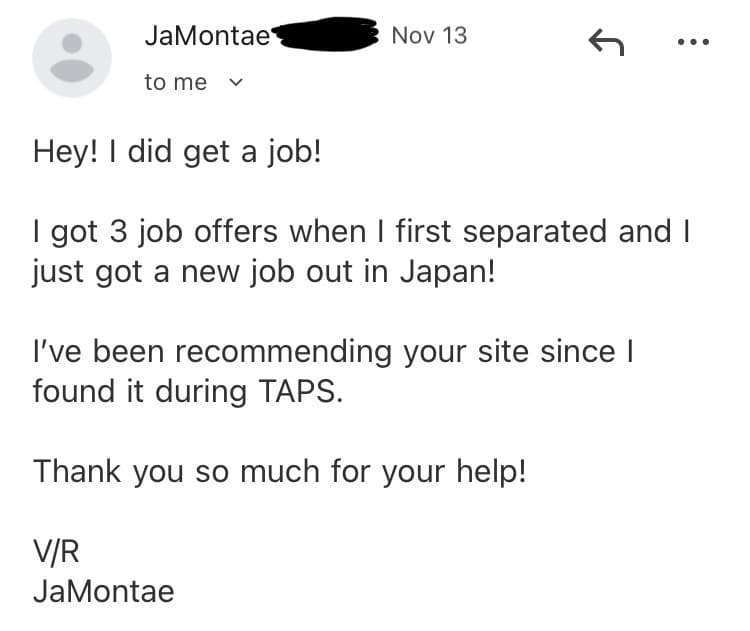
“Hey! I did get a job! I got 3 job offers when I first separated and I just got a new job out in Japan! I’ve been recommending your site since I found it during TAPS. Thank you so much for your help! V/R JaMontae ”
Federal service is where a 4B0X1 background is genuinely hard to beat, because three separate GS career fields exist for exactly this work. The GS-0690 Industrial Hygiene series is the closest match: installation safety offices, the VA, the EPA, OSHA, and every military service civilian workforce hire industrial hygienists to do the sampling and exposure assessment you already ran. Most veterans qualify at GS-7 or GS-9 entering, GS-11 with a degree plus your survey experience.
The GS-0018 Safety and Occupational Health Management series and GS-0803 Safety Engineering series cover the program-management and engineering ends of the same field. The GS-0819 Environmental Engineering and GS-0028 Environmental Protection Specialist series fit your air, water, and hazardous-waste compliance work. If your command put you on radiological health surveys, the GS-1306 Health Physics series is a direct line, and GS-0401 General Biological Science covers OEH roles that lean toward the science side.
Veterans Preference applies across all of these, and your specialized experience is the lever. The qualification standards reward documented program responsibility, so a survey you signed, an exposure assessment you authored, or a respiratory-protection program you managed becomes the specialized-experience statement that gets you referred. Read how specialized experience works on a federal resume and the 2026 OPM federal resume format before you apply. When you are ready, our federal resume builder handles the OPM structure, or you can start your federal resume directly.
| GS Series | Federal Job Title | Typical Grades | Match | Explore |
|---|---|---|---|---|
| GS-0018 | Safety and Occupational Health Management | GS-9, GS-11, GS-12 | View Details → | |
| GS-0690 | Industrial Hygiene | GS-7, GS-9, GS-11, GS-12 | View Details → | |
| GS-0482 | Fish Biology | GS-9, GS-11 | View Details → | |
| GS-0819 | Environmental Engineering | GS-9, GS-11, GS-12 | View Details → | |
| GS-0028 | Environmental Protection Specialist | GS-7, GS-9, GS-11 | View Details → | |
| GS-0401 | General Biological Science | GS-7, GS-9, GS-11 | View Details → | |
| GS-1306 | Health Physics | GS-9, GS-11 | View Details → | |
| GS-0803 | Safety Engineering | GS-9, GS-11, GS-12 | View Details → |
Federal hiring uses keyword-matching and structured experience. BMR builds federal-format resumes (USAJobs-ready) with the right keywords, hours/week, and supervisor info — for any GS series above.
Free · No credit card · Federal + civilian resume formats included
Not everyone wants to stay in a related field. These career paths leverage your transferable skills — leadership, risk management, logistics, project planning — in completely different industries.
Bioenvironmental sampling and contamination-control experience maps directly to food-safety hazard analysis (HACCP) and quality systems, just applied to a production line instead of a worksite.
The injury-prevention and physical-stressor side of bioenvironmental work is the foundation of ergonomics. You already evaluate how operations affect the human body and recommend controls.
ESG and sustainability reporting runs on the same environmental data, compliance frameworks, and audit discipline you used in OEH. The skill is measuring impact and reporting it defensibly.
Bioenvironmental exposure surveillance is applied environmental epidemiology. You already connect exposure data to health outcomes and report it to leadership.
Consumer-product and manufacturing safety teams need people who understand chemical exposure, testing, and regulatory limits. That is the toxicology side of your bioenvironmental training.
Your facility surveys, code enforcement against federal standards, and hazard documentation translate into building and fire-safety inspection, just under local code instead of OEH directives.
Your CBRN exposure-assessment and deployable OEH-response experience maps to civilian emergency management, especially hazmat and public-health response planning.
The skills that made you a good Marine, Sailor, Airman, or Soldier transfer further than you think. BMR rewrites your bullets for any of the pivot careers above — without making you sound like you've never done the work.
Free · No credit card · Try unlimited career angles
If you are staying in industrial hygiene, environmental health, or safety, your terminology already matches the industry. Civilian IH and EHS teams use the same OSHA, EPA, and ACGIH language you used in the bioenvironmental flight. This section is for 4B0X1s targeting careers OUTSIDE occupational and environmental health, where a hiring manager has never heard of an OEH survey.
The goal is to translate the work into outcomes a civilian recruiter understands: regulatory compliance, risk reduction, data-driven decisions, and program ownership. A few examples:
For more on translating military language, read 50 military terms translated to civilian language and the Air Force specific EPR/OPR to civilian resume guide. Our military resume builder applies this translation automatically.
BMR turns your 4B0X1 duties and accomplishments into civilian bullets that match the job you're applying for — no manual translation, no rewriting.
Free · No credit card · Tailored to each job posting
Which certifications you need depends on where you're headed. Find your target career path below.
The wrong placement can sink an otherwise strong application. BMR knows where each cert ranks, what to call it, and how to frame it for ATS keyword matching and hiring manager attention.
Free · No credit card · Built around your real certs and clearance
If you are continuing in the field, build toward the Certified Industrial Hygienist (CIH) from the Board for Global EHS Credentialing, the Certified Safety Professional (CSP) from BCSP, and OSHA 30-hour and HAZWOPER credentials. The American Industrial Hygiene Association (AIHA) and the American Society of Safety Professionals (ASSP) run local sections worth joining before you separate. SkillBridge placements with EHS departments at large manufacturers and energy firms are common, so start that conversation early with your command.
If you are leaving OEH entirely, lean on project management (PMP), quality and process credentials (Six Sigma), and the federal hiring pathways. Read Six Sigma for veterans for the quality-and-process pivot. American Corporate Partners (ACP) offers free veteran mentorship across industries, and the SFL-TAP transition resources cover the broader job-search mechanics.
Start with our military resume builder or federal resume builder, explore options on the career crosswalk, or build your resume now. See also: Air Force 4E0X1 Public Health, Coast Guard Marine Science Technician, and Navy Hospital Corpsman. For federal targeting, see 10 federal job series every veteran should search.
Most veterans do this backwards — they wait until terminal leave to start, then panic. Here's the actual sequence that works.
Print this. Tape it to your monitor. Veterans who treat the transition like a 90-day op get hired faster than the ones who treat it like an emergency.
Stop rewriting from scratch every time you apply. BMR turns your military experience into civilian and federal resumes — tailored to each job.