Home / Federal resume examples / Equipment Services
GS-1670 Equipment Services resume example (GS-9, 2 pages)
This is a two-page federal resume for a GS-1670 Equipment Services job at GS-9. It is written the way OPM now requires. Aaron is a fictional Air Force fleet manager, a Technical Sergeant with 13 years in, most of it spent on fleet records, parts, and repair data. If you ran a motor pool, a shop, or an equipment account in any branch, this is the format the rater wants. Under it: why each block is built the way it is, the words the job post uses, and a free score on your own federal resume.
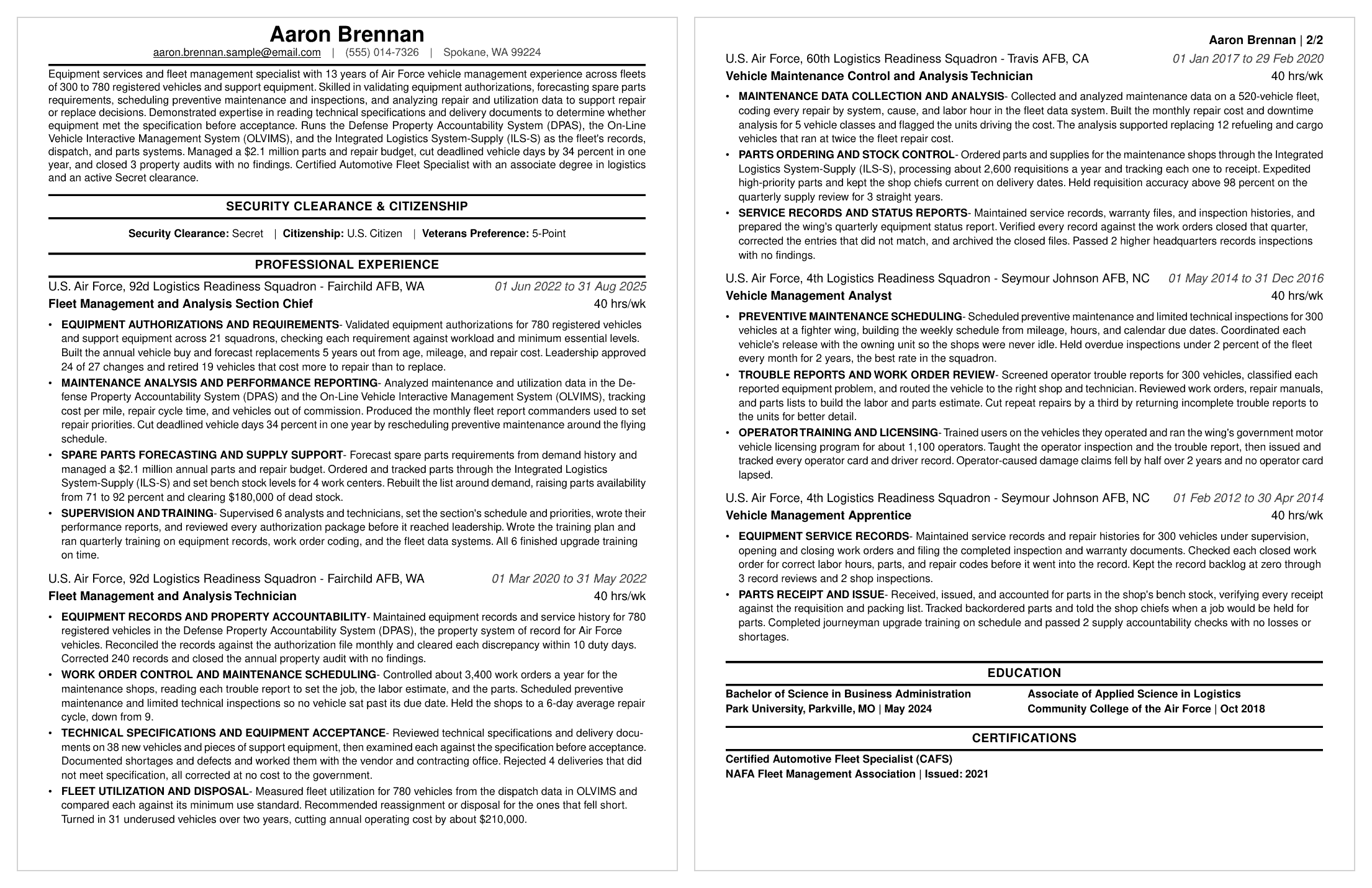
The example
Fictional sample. The person, the units, and the numbers are illustrative. Rendered by BMR's Federal Traditional template, the same one a user's resume prints on.
Page 1 of 2
Equipment services and fleet management specialist with 13 years of Air Force vehicle management experience across fleets of 300 to 780 registered vehicles and support equipment. Skilled in validating equipment authorizations, forecasting spare parts requirements, scheduling preventive maintenance and inspections, and analyzing repair and utilization data to support repair or replace decisions. Demonstrated expertise in reading technical specifications and delivery documents to determine whether equipment met the specification before acceptance. Runs the Defense Property Accountability System (DPAS), the On-Line Vehicle Interactive Management System (OLVIMS), and the Integrated Logistics System-Supply (ILS-S) as the fleet's records, dispatch, and parts systems. Managed a $2.1 million parts and repair budget, cut deadlined vehicle days by 34 percent in one year, and closed 3 property audits with no findings. Certified Automotive Fleet Specialist with an associate degree in logistics and an active Secret clearance.
Security Clearance: Secret | Citizenship: U.S. Citizen | Veterans Preference: 5-Point
EQUIPMENT AUTHORIZATIONS AND REQUIREMENTS- Validated equipment authorizations for 780 registered vehicles and support equipment across 21 squadrons, checking each requirement against workload and minimum essential levels. Built the annual vehicle buy and forecast replacements 5 years out from age, mileage, and repair cost. Leadership approved 24 of 27 changes and retired 19 vehicles that cost more to repair than to replace.
MAINTENANCE ANALYSIS AND PERFORMANCE REPORTING- Analyzed maintenance and utilization data in the Defense Property Accountability System (DPAS) and the On-Line Vehicle Interactive Management System (OLVIMS), tracking cost per mile, repair cycle time, and vehicles out of commission. Produced the monthly fleet report commanders used to set repair priorities. Cut deadlined vehicle days 34 percent in one year by rescheduling preventive maintenance around the flying schedule.
SPARE PARTS FORECASTING AND SUPPLY SUPPORT- Forecast spare parts requirements from demand history and managed a $2.1 million annual parts and repair budget. Ordered and tracked parts through the Integrated Logistics System-Supply (ILS-S) and set bench stock levels for 4 work centers. Rebuilt the list around demand, raising parts availability from 71 to 92 percent and clearing $180,000 of dead stock.
SUPERVISION AND TRAINING- Supervised 6 analysts and technicians, set the section's schedule and priorities, wrote their performance reports, and reviewed every authorization package before it reached leadership. Wrote the training plan and ran quarterly training on equipment records, work order coding, and the fleet data systems. All 6 finished upgrade training on time.
EQUIPMENT RECORDS AND PROPERTY ACCOUNTABILITY- Maintained equipment records and service history for 780 registered vehicles in the Defense Property Accountability System (DPAS), the property system of record for Air Force vehicles. Reconciled the records against the authorization file monthly and cleared each discrepancy within 10 duty days. Corrected 240 records and closed the annual property audit with no findings.
WORK ORDER CONTROL AND MAINTENANCE SCHEDULING- Controlled about 3,400 work orders a year for the maintenance shops, reading each trouble report to set the job, the labor estimate, and the parts. Scheduled preventive maintenance and limited technical inspections so no vehicle sat past its due date. Held the shops to a 6-day average repair cycle, down from 9.
TECHNICAL SPECIFICATIONS AND EQUIPMENT ACCEPTANCE- Reviewed technical specifications and delivery documents on 38 new vehicles and pieces of support equipment, then examined each against the specification before acceptance. Documented shortages and defects and worked them with the vendor and contracting office. Rejected 4 deliveries that did not meet specification, all corrected at no cost to the government.
FLEET UTILIZATION AND DISPOSAL- Measured fleet utilization for 780 vehicles from the dispatch data in OLVIMS and compared each against its minimum use standard. Recommended reassignment or disposal for the ones that fell short. Turned in 31 underused vehicles over two years, cutting annual operating cost by about $210,000.
Page 2 of 2
MAINTENANCE DATA COLLECTION AND ANALYSIS- Collected and analyzed maintenance data on a 520-vehicle fleet, coding every repair by system, cause, and labor hour in the fleet data system. Built the monthly repair cost and downtime analysis for 5 vehicle classes and flagged the units driving the cost. The analysis supported replacing 12 refueling and cargo vehicles that ran at twice the fleet repair cost.
PARTS ORDERING AND STOCK CONTROL- Ordered parts and supplies for the maintenance shops through the Integrated Logistics System-Supply (ILS-S), processing about 2,600 requisitions a year and tracking each one to receipt. Expedited high-priority parts and kept the shop chiefs current on delivery dates. Held requisition accuracy above 98 percent on the quarterly supply review for 3 straight years.
SERVICE RECORDS AND STATUS REPORTS- Maintained service records, warranty files, and inspection histories, and prepared the wing's quarterly equipment status report. Verified every record against the work orders closed that quarter, corrected the entries that did not match, and archived the closed files. Passed 2 higher headquarters records inspections with no findings.
PREVENTIVE MAINTENANCE SCHEDULING- Scheduled preventive maintenance and limited technical inspections for 300 vehicles at a fighter wing, building the weekly schedule from mileage, hours, and calendar due dates. Coordinated each vehicle's release with the owning unit so the shops were never idle. Held overdue inspections under 2 percent of the fleet every month for 2 years, the best rate in the squadron.
TROUBLE REPORTS AND WORK ORDER REVIEW- Screened operator trouble reports for 300 vehicles, classified each reported equipment problem, and routed the vehicle to the right shop and technician. Reviewed work orders, repair manuals, and parts lists to build the labor and parts estimate. Cut repeat repairs by a third by returning incomplete trouble reports to the units for better detail.
OPERATOR TRAINING AND LICENSING- Trained users on the vehicles they operated and ran the wing's government motor vehicle licensing program for about 1,100 operators. Taught the operator inspection and the trouble report, then issued and tracked every operator card and driver record. Operator-caused damage claims fell by half over 2 years and no operator card lapsed.
EQUIPMENT SERVICE RECORDS- Maintained service records and repair histories for 300 vehicles under supervision, opening and closing work orders and filing the completed inspection and warranty documents. Checked each closed work order for correct labor hours, parts, and repair codes before it went into the record. Kept the record backlog at zero through 3 record reviews and 2 shop inspections.
PARTS RECEIPT AND ISSUE- Received, issued, and accounted for parts in the shop's bench stock, verifying every receipt against the requisition and packing list. Tracked backordered parts and told the shop chiefs when a job would be held for parts. Completed journeyman upgrade training on schedule and passed 2 supply accountability checks with no losses or shortages.
Bachelor of Science in Business AdministrationPark University, Parkville, MO | May 2024
Associate of Applied Science in LogisticsCommunity College of the Air Force | Oct 2018
Certified Automotive Fleet Specialist (CAFS)NAFA Fleet Management Association | Issued: 2021
Open the PDF (2 pages, as the engine prints it).
Already have a resume? Get it graded straight.
Upload it and get a number in about a minute, plus the lines a federal rater cannot credit and the required fields you are missing. No account. Sign up and tailor it like they did.
Free. We keep it 30 days so you never upload it twice.
Why this example works
- The summary is one dense paragraph, not a headline.
Six sentences, the way BMR writes it. Who he is and how long. The size of the fleets he ran. The duties in the words the 1670 series uses: equipment authorizations, spare parts forecasting, preventive maintenance, technical specifications. Then two results with numbers, the systems, the credential, and the clearance. It never says "applying for" and never names the job post. The HR specialist already knows which job you applied to. The summary's job is to prove you have done the work.
- Every job block carries the fields the rater needs to credit the time, and nothing else.
Employer, title, dates with month and year (the day is fine too), and hours per week. Leave off hours per week and the rater may not be able to count that job at all. No series or grade on a military job: those fields are for prior federal positions.
- Every bullet is a three-sentence paragraph, even on the oldest job.
Each opens with a header in caps the rater can scan. Then a dash and the paragraph: what he did, how, in which system (DPAS, OLVIMS, ILS-S), at what scale, and what came of it. The 2012 apprentice job gets the same care as the 2025 section chief job. A one-line bullet gives the rater nothing to grade, and a thin old job makes the rater wonder what you did for two years.
- The headers are the series' own words.
"Spare parts." "Work orders." "Technical specs." "Preventive maintenance." OPM's own 1670 standard asks for people who track gear and plan the parts it needs, who read work orders, and who check new gear against the spec. Those are the words. The rater matches your lines to the job post, so use the job post's words.
- The top job proves the GS-9 requirement on its own.
GS-9 asks for one year at the GS-7 level. For 1670 that means you owned the calls, not just the paperwork. The first bullet says he validated authorizations for 780 vehicles and forecast replacements five years out, and that 24 of his 27 changes were approved. Those words are there to answer that requirement.
- Acronyms get spelled out the first time, then used.
DPAS becomes "the Defense Property Accountability System." It is where the Air Force keeps its vehicle records. A rater at the Forest Service or the VA has never seen it. One clause fixes that, and the short form is still there for a search.
- Nothing OPM leaves out is on the page.
No Social Security number, no photo, no age, no references, no KSA essays, no skills list, no supervisor line. Clearance, citizenship, and preference sit in one line. Preference is proven by the DD-214 under Required Documents, not by a paragraph in the resume.
The translation, military line to federal line
| How an EPR or a duty description says it | What the 1670 rater is looking for |
|---|---|
| NCOIC, Fleet Management and Analysis, 92 LRS | Fleet Management and Analysis Section Chief, wing vehicle fleet; 40 hrs/wk |
| Managed vehicle authorizations and allowances | Validated equipment authorizations against workload; recommended authorization changes |
| Built the annual vehicle buy and priority recall list | Forecast equipment replacement requirements from age, mileage, and repair cost |
| Ran OLVIMS retrievals for the fleet | Analyzed utilization and dispatch data; measured every vehicle against its use standard |
| Owned the vehicle account in DPAS | Maintained equipment records and property accountability in the system of record |
| Ordered parts through supply, managed bench stock | Forecast spare parts requirements; set stock levels; ordered and tracked requisitions |
| Scheduled PM and limited technical inspections | Scheduled preventive maintenance and inspections for a 780-item equipment fleet |
| Accepted new vehicles off the delivery | Examined equipment against technical specifications to determine if specifications were met |
| Screened AF Form 1800 trouble reports | Reviewed and interpreted work orders and trouble reports; built labor and parts estimates |
| Supervised 6 Airmen; wrote EPRs | Supervised and trained 6 analysts and technicians; wrote performance reports |
The words the announcement uses
The words a 1670 job post uses, and what GS-9 requires.
Duties the job post lists
- Analyze equipment and forecast spare parts requirements
- Read and interpret work orders, shop orders, and equipment requisitions
- Review and apply technical specifications and requirements
- Examine equipment against contract specifications
- Schedule preventive maintenance and inspections
- Maintain equipment service records and property accountability
- Analyze maintenance and repair operations to improve methods
- Train users on equipment
Competencies the questionnaire tends to rate
- Equipment management
- Maintenance coordination
- Asset tracking
- Procurement
- Budget management
- Problem solving
What GS-9 requires: the 1670 series has an Individual Occupational Requirement, so you must meet that and the group standard. The IOR asks for general experience that gave you a knowledge of the characteristics, uses, and properties of equipment for GS-5, and above GS-5 it asks for specialized experience such as work as a skilled mechanic or maintenance worker, a planner or estimator in a technical group, analyzing equipment and forecasting spare parts, reading work orders and change orders, or examining equipment against contract specifications. On top of that, GS-9 asks for one year equivalent to GS-7, or a master's degree, or two years of progressive graduate study. GS-11 moves that to one year at GS-9, or a doctorate, or three years of graduate study.
Sources, all read 2026-09-09: OPM qualification standard, Equipment Services Series 1670 (https://www.opm.gov/policy-data-oversight/classification-qualifications/general-schedule-qualification-standards/1600/equipment-services-series-1670/), which says to use the Group Coverage Qualification Standard for Administrative and Management Positions with the Individual Occupational Requirements below it; that group standard's GS-7, GS-9, and GS-11 lines (https://www.opm.gov/policy-data-oversight/classification-qualifications/general-schedule-qualification-standards/); USAJOBS help, what to include in a federal resume (https://help.usajobs.gov/faq/application/documents/resume/what-to-include); OPM Merit Hiring Plan resources, applicant guidance on the two-page resume limit, in force since September 27, 2025 (https://www.opm.gov/policy-data-oversight/hiring-information/merit-hiring-plan-resources/applicant-guidance-on-the-two-page-resume-limit/). Title 5 positions; Title 38 and hybrid Title 38 positions are exempt from the two-page limit.
Backgrounds that lead here
The 1670 series is named on 112 of BMR's military job guides. These are the direct matches; each guide shows the federal series, the civilian titles, and the pay for that code.
- Air Force 2T3X7 Fleet Management and AnalysisThis example
- Air Force 2T3X1 Mission Generation Vehicular Equipment Maintenance
- Air Force 2R2X1 Maintenance Management
- Army 91L Construction Equipment Repairer
- Army 91C Utilities Equipment Repairer
- Army 88M Motor Transport Operator
- Air Force 3E2X1 Pavements and Construction Equipment
- Marine Corps 0411 Maintenance Management Analyst
Keep going
- GS-1670 Equipment ServicesThe series guide: grades, pay, how to qualify
- 2-page federal resume examples: OPM format, section by section
- Federal resume for GS-7 to GS-9: how to qualify
- Specialized experience on federal resumes
- Wage grade federal resume: how to apply to trades jobs
- Facilities manager resume for veterans
Frequently asked questions
Can I qualify for GS-1670 with military experience only?
Usually, yes. The 1670 standard is written in a way that helps you. It names mechanic and maintenance work, planning and estimating, parts forecasting, and reading work orders. That is a motor pool, a shop, or an equipment account in any branch. The catch is the word "equivalent." For a GS-9 job your resume has to show the work at the GS-7 level, in the job post's words, with the hours per week and the dates the rater needs. That is what Aaron's top block does.
Should I apply for 1670 or a wage grade job?
It depends on whether you still want to turn wrenches. GS-1670 is the desk side of equipment: fleet size, parts, records, cost, and specs. The wage grade trades are the hands-on side, and they pay by the hour on a local scale. Plenty of veterans do both, starting in a WG job and moving to 1670 once they have run a shop's data. Read both job posts. Nothing stops you applying to each one.
Do I have to list my supervisor and my salary?
No. USAJOBS requires the employer, the job title, start and end dates with month and year, and hours per week for each job. Series and grade are required only for past federal jobs. Supervisor name and phone are optional; some applicants add them for the most recent job, with "may contact" or "do not contact." Salary is not on OPM's list at all. This example leaves both off, and it leaves grade off too, because series and grade are for prior federal jobs, not military rank.
Build the federal version of yours
Upload your resume or your evals, pick a live USAJOBS opening, and BMR writes the two-page federal version for it: hours per week on every job, competency-header paragraphs, the job post's words. Free to start.