Loading...
Loading...
The civilian and federal jobs that hire Air Force Pavements and Construction Equipments — with real salaries and the resume that gets callbacks.
Every 3E2X1 has more options than a Google search will tell you. Below: career paths, BLS salary data, federal GS series, certifications by target career, and how to translate your experience without losing what made you valuable to the Air Force in the first place.
Free · No credit card · Tailored resume in under 5 minutes
After the Navy I got hired into 6 federal career fields and tech sales, and sat on federal hiring panels along the way. I spent the last 2 years rebuilding everything I learned into BMR, tuned for how AI actually screens resumes today. This is the system I wish I'd had on day one.
If you held AFSC 3E2X1, you ran the heavy iron that keeps an air base operational. Graders, dozers, scrapers, front-end loaders, excavators, and rollers. You built and repaired concrete and asphalt runways, taxiways, aircraft parking aprons, and roads, then turned around and did rapid airfield damage repair (RADR) so jets could launch again on a cratered flightline. You cut grade, moved earth, ran rock crushers and concrete and asphalt batch plants, and cleared snow and ice off operating surfaces when weather shut everyone else down.
The training pipeline runs through the 69-day Pavements and Construction Equipment Operator course at Fort Leonard Wood, Missouri, where Airmen learn equipment operation, earthwork, and airfield construction alongside Army engineers. From there you went to a civil engineer squadron (CES) or a RED HORSE or Prime BEEF unit, and the work scaled from base maintenance to bare-base buildup in deployed locations.
Civilian employers value this background because airfield pavement work is unforgiving. A grade that is off by a fraction holds water, and water destroys pavement. You learned to read a site, hit tight tolerances, and produce finished surfaces under a deadline that did not move. That combination of equipment skill, site judgment, and accountability for the finished product is exactly what construction firms, departments of transportation, and federal engineering offices pay for. If you want to see how your AFSC maps to other roles, the military career crosswalk tool is a good place to start, and the related 3E5X1 Engineering and 3E0X1 Electrical Systems pages cover the rest of the civil engineer career field.
BMR has built more than 60,000 resumes across every branch and AFSC, and the 3E2X1s I see land offers fastest when the resume stops reading like a job description and starts proving the work. A line about "operated heavy equipment" gets skipped. A line that says you held grade to specification on a 9,000-foot runway repair on a fixed deadline gets a call back. The skill was never the problem. The translation is the work. — Brad Tachi, Navy Diver veteran & BMR founder
The number that matters when you're deciding what's next: how does civilian pay compare to what you make now?
Military comp is approximate (varies by location/dependents). Civilian is BLS median. Federal includes locality pay. Your real number depends on duty station, family status, GS step, and overtime.
The direct civilian path for a 3E2X1 is heavy construction, and the market is steady. Per BLS OEWS May 2024 data, Operating Engineers and Other Construction Equipment Operators (O*NET 47-2073.00) earn a median of $58,710 a year, with employment projected to grow about 4 percent through 2034. Demand follows infrastructure spending, so highway, airport, and utility work tends to hold up even when residential construction cools.
Your airfield experience makes you a strong fit for departments of transportation, airport authorities, and grading and paving contractors. Several roles pay above the operator median once you move up. First-Line Supervisors of Construction Trades (47-1011.00) earn a median of $78,900, Construction and Building Inspectors (47-4011.00) earn $72,120, Civil Engineering Technologists and Technicians (17-3022.00) earn $64,200, and Construction Managers (11-9021.00) earn $106,980 (all BLS OEWS May 2024). If you ran convoys of equipment and hauled materials, Heavy and Tractor-Trailer Truck Drivers (53-3032.00) earn a median of $57,440.
Be honest with yourself about geography. Heavy construction work concentrates where projects are funded, so the highest-paying markets are not always where you want to live. Union operating engineer locals control a lot of the best-paid work in the Northeast, Midwest, and West Coast, and getting into a local can take patience. If you are weighing a trade path, the military to construction management guide and the Helmets to Hardhats apprenticeship guide both lay out realistic entry points. Marines and sailors who ran the same iron land in these jobs too, so the Navy Equipment Operator (EO) and Marine Corps 1345 Engineer Equipment Operator pages are worth a look. When you are ready to put it on paper, the military resume builder turns your AFSC into civilian-readable bullets, or you can build your resume now.
| Civilian Job Title | Industry | BLS Median Salary | Outlook | Match |
|---|---|---|---|---|
Operating Engineer / Construction Equipment Operator O*NET: 47-2073.00 | Heavy Construction | $58,710 | 4% (As fast as average, 2024-2034) | strong |
First-Line Supervisor of Construction Trades O*NET: 47-1011.00 | Construction Management | $78,900 | 7% (Faster than average) | strong |
Construction and Building Inspector O*NET: 47-4011.00 | Inspection & Compliance | $72,120 | -2% (Little or no change) | strong |
Civil Engineering Technician O*NET: 17-3022.00 | Engineering Support | $64,200 | 4% (As fast as average) | moderate |
Construction Manager O*NET: 11-9021.00 | Construction Management | $106,980 | 9% (Faster than average) | moderate |
Heavy and Tractor-Trailer Truck Driver O*NET: 53-3032.00 | Transportation | $57,440 | 5% (Faster than average) | moderate |
Surveying and Mapping Technician O*NET: 17-3031.00 | Engineering Support | $51,940 | 2% (Little or no change) | moderate |
BMR rewrites your 3E2X1 experience for any of the civilian roles above — keywords, achievements, and language hiring managers actually scan for.
Free · No credit card · 2 tailored resumes included
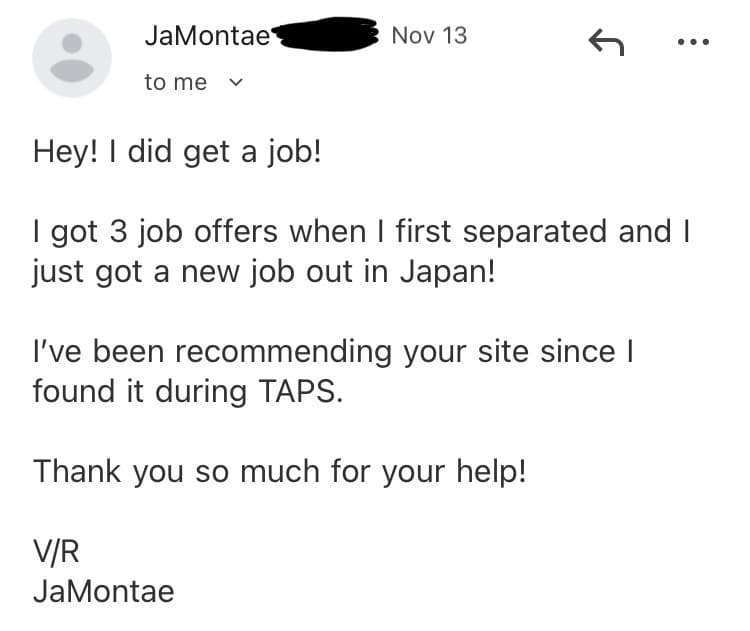
“Hey! I did get a job! I got 3 job offers when I first separated and I just got a new job out in Japan! I’ve been recommending your site since I found it during TAPS. Thank you so much for your help! V/R JaMontae ”
Federal service is one of the cleanest landing spots for a 3E2X1, because the work you did has a direct equivalent in the federal trades and engineering-technician series. The Corps of Engineers, the Air Force and Army installation civil engineer offices, the Bureau of Reclamation, the National Park Service, and the Federal Highway Administration all run heavy equipment and maintain pavements with federal employees.
The closest wage-grade match is WG-5716 Engineering Equipment Operating, which covers graders, dozers, loaders, and scrapers. Adjacent operator series include WG-5705 Tractor Operating and WG-5703 Motor Vehicle Operating if you hauled materials. On the salaried side, look at GS-0802 Engineering Technician and GS-0809 Construction Control Technician for inspection and quality-assurance roles, GS-0810 Civil Engineering for degreed paths, and GS-1670 Equipment Services for fleet and equipment management. Quarry and batch-plant experience can open GS-1601 General Facilities and Equipment work, and supervisory or program tracks run through GS-0340 Program Management and GS-0018 Safety and Occupational Health.
Veterans' Preference adds 5 or 10 points to your rated score, and the VEOA and VRA hiring authorities let you compete for or be directly appointed to many of these positions. Wage-grade jobs in particular reward demonstrated equipment hours, so document your operating time and the specific machines you ran. The specialized experience guide shows how to phrase that so a federal HR specialist can rate it, and the federal job series guide helps you search USAJOBS efficiently. The Navy Seabee Equipment Operator and Army 12N Horizontal Construction Engineer pages target the same WG-5716 and GS-0802 jobs. To assemble the package, the federal resume builder handles the OPM format, or you can start your federal resume here.
| GS Series | Federal Job Title | Typical Grades | Match | Explore |
|---|---|---|---|---|
| GS-5716 | Engineering Equipment Operating | WG-8, WG-9, WG-10 | View Details → | |
| GS-0802 | Engineering Technician | GS-7, GS-9, GS-11 | View Details → | |
| GS-5705 | Tractor Operating | WG-6, WG-7, WG-8 | View Details → | |
| GS-0809 | Construction Control | GS-7, GS-9, GS-11 | View Details → | |
| GS-5703 | Motor Vehicle Operating | WG-5, WG-6, WG-7 | View Details → | |
| GS-1670 | Equipment Services | GS-7, GS-9, GS-11 | View Details → | |
| GS-1601 | General Facilities and Equipment | GS-7, GS-9, GS-11 | View Details → |
Federal hiring uses keyword-matching and structured experience. BMR builds federal-format resumes (USAJobs-ready) with the right keywords, hours/week, and supervisor info — for any GS series above.
Free · No credit card · Federal + civilian resume formats included
Not everyone wants to stay in a related field. These career paths leverage your transferable skills — leadership, risk management, logistics, project planning — in completely different industries.
Running quarry and aggregate operations gives you a working feel for soils, rock, and material behavior that geological technicians apply in mining and exploration.
Site-prep and excavation skill plus comfort working to strict procedures transfers cleanly into remediation, where earthmoving and containment are core tasks.
Coordinating crews and equipment on a flightline under launch deadlines is the same tempo cargo handling supervisors manage at airports and freight terminals.
Years of knowing how long a grading or paving task actually takes and what it consumes makes you credible at building accurate estimates and bids.
Running heavy equipment with a zero-incident standard means you already think in hazards and controls, which is the daily work of a safety technician.
Keeping a job site supplied with the right equipment, fuel, and materials at the right time is logistics, and deployment experience proves you can do it under pressure.
The skills that made you a good Marine, Sailor, Airman, or Soldier transfer further than you think. BMR rewrites your bullets for any of the pivot careers above — without making you sound like you've never done the work.
Free · No credit card · Try unlimited career angles
If you are staying in heavy construction, your terminology already translates. A grading contractor or a DOT knows what a motor grader, a finished subgrade, and a compaction test are. This section is for 3E2X1s targeting careers outside the construction trades, where hiring managers have never heard your AFSC language and will skip a resume that reads like a deployment brief.
The fix is to convert military shorthand into outcomes a civilian recruiter can score. Lead with the result, then the scale, then the constraint you worked under.
For more conversions, the 50 military terms translated to civilian language glossary and the Air-Force-specific EPR/OPR to civilian resume guide are the two most useful starting points. The military resume builder does this conversion automatically, or you can get started here.
BMR turns your 3E2X1 duties and accomplishments into civilian bullets that match the job you're applying for — no manual translation, no rewriting.
Free · No credit card · Tailored to each job posting
Which certifications you need depends on where you're headed. Find your target career path below.
The wrong placement can sink an otherwise strong application. BMR knows where each cert ranks, what to call it, and how to frame it for ATS keyword matching and hiring manager attention.
Free · No credit card · Built around your real certs and clearance
Here is where to point your energy, split by whether you are staying in the field or leaving it.
See also: the Navy Steelworker (SW), Army 12W Carpentry and Masonry Specialist, and Marine Corps 1371 Combat Engineer career paths. To build the resume, use the military resume builder, explore options in the career crosswalk, or build your resume now.
Most veterans do this backwards — they wait until terminal leave to start, then panic. Here's the actual sequence that works.
Print this. Tape it to your monitor. Veterans who treat the transition like a 90-day op get hired faster than the ones who treat it like an emergency.
Stop rewriting from scratch every time you apply. BMR turns your military experience into civilian and federal resumes — tailored to each job.