Loading...
Loading...
The civilian and federal jobs that hire Navy Steelworkers — with real salaries and the resume that gets callbacks.
Every SW has more options than a Google search will tell you. Below: career paths, BLS salary data, federal GS series, certifications by target career, and how to translate your experience without losing what made you valuable to the Navy in the first place.
Free · No credit card · Tailored resume in under 5 minutes
After the Navy I got hired into 6 federal career fields and tech sales, and sat on federal hiring panels along the way. I spent the last 2 years rebuilding everything I learned into BMR, tuned for how AI actually screens resumes today. This is the system I wish I'd had on day one.
As a Navy Steelworker you ran the structural backbone of Seabee construction. You fabricated and erected pre-engineered metal buildings, set and tied reinforcing steel for concrete pours, rigged and hoisted structural members into position, and ran arc, MIG, and oxy-acetylene welding and cutting on everything from waterfront structures to expeditionary camps. SW work sits inside the Naval Construction Force, so your projects were rarely a quiet shop floor. They were contingency airfields, port facilities, base camps, and disaster-recovery sites where the steel had to go up correctly the first time.
The "A" school pipeline runs roughly 11 weeks at the Naval Construction Training Center in Gulfport, Mississippi, where Steelworkers learn structural drawings and blueprints, welding processes and weld symbols, rigging and crane signaling, reinforcing-steel placement, and pre-engineered building assembly. From there you deployed with a Naval Mobile Construction Battalion or a unit like an Underwater Construction Team, often building under tight schedules in austere or contested environments. That mix of trade skill and project discipline is exactly why employers value the background.
Here is what civilian hiring managers actually respond to once it is translated. You read structural plans and shop drawings, you hold tight tolerances on weld quality and steel placement, you work to code and inspection standards, and you do it on a schedule with real safety consequences. Those are the same competencies a structural steel contractor, a federal facilities engineer, or a quality inspector is hiring for. If you want to see how your rating maps across the civilian and federal job market, start with our military-to-civilian career crosswalk, and compare notes with the related Seabee trades like the Builder (BU) and Equipment Operator (EO) ratings.
I spent years in federal engineering, construction, and environmental work after the Navy, and Steelworkers translate into that world more cleanly than almost any rating I have seen. The federal facilities and engineering shops at NAVFAC, USACE, and GSA run on people who can read a structural drawing, judge a weld, and keep a job on code and on schedule. That is your day-one resume. The work is already there. The only thing standing between you and the GS pay table is describing it in language a federal HR specialist scores. — Brad Tachi, Navy Diver veteran & BMR founder
The number that matters when you're deciding what's next: how does civilian pay compare to what you make now?
Military comp is approximate (varies by location/dependents). Civilian is BLS median. Federal includes locality pay. Your real number depends on duty station, family status, GS step, and overtime.
The most direct civilian path keeps you in structural steel and metal trades. Structural iron and steel workers earned a median of $61,540 per year (BLS OEWS, May 2024), and the field is cyclical. It tracks commercial and infrastructure construction spending, so demand is strong in growth metros and softer when projects pause. Reinforcing iron and rebar workers and welders, cutters, solderers, and brazers are adjacent trades where your "A" school and deployment experience map almost one-to-one. Welders earned a median of $50,460 (BLS OEWS, May 2024), with certified structural and pipe welders at the top of that range.
Beyond the field itself, the supervisory and inspection side pays well and rewards your blueprint and code fluency. Construction and building inspectors earned a median of $67,700 and first-line supervisors of construction trades earned a median of $76,760 (BLS OEWS, May 2024). These roles want someone who can look at structural steel, reinforcing placement, and welds and know whether the work meets spec. That is the exact judgment you exercised on every Seabee project. For a deeper look at how trade experience scales into running projects, our military to construction management guide walks through the jump from craft to management.
Geography matters more in this field than in most. Shipyards and heavy-fabrication shops cluster on the coasts, structural steel erection follows commercial construction into major metros, and bridge and infrastructure work moves with state and federal funding cycles. Companies that build the same kinds of structures you did in uniform, including shipbuilders, steel fabricators, and heavy-civil contractors, are the fastest hires because they already speak your language. You can see how the same trade lines up in other branches on the Army 12B Combat Engineer and Marine 1371 Combat Engineer pages. When you are ready to put this on paper, build your resume now.
| Civilian Job Title | Industry | BLS Median Salary | Outlook | Match |
|---|---|---|---|---|
Structural Iron and Steel Worker O*NET: 47-2221.00 | Construction | $61,540 | 3% (As fast as average) | strong |
Reinforcing Iron and Rebar Worker O*NET: 47-2171.00 | Construction | $58,210 | 3% (As fast as average) | strong |
Welder, Cutter, Solderer, and Brazer O*NET: 51-4121.00 | Manufacturing | $50,460 | 2% (Slower than average) | strong |
Construction and Building Inspector O*NET: 47-4011.00 | Construction | $67,700 | 0% (Little or no change) | strong |
First-Line Supervisor of Construction Trades O*NET: 47-1011.00 | Construction | $76,760 | 5% (Faster than average) | strong |
Sheet Metal Worker O*NET: 47-2211.00 | Construction | $58,780 | 1% (Little or no change) | moderate |
Crane and Tower Operator O*NET: 53-7021.00 | Construction | $64,690 | 4% (As fast as average) | moderate |
BMR rewrites your SW experience for any of the civilian roles above — keywords, achievements, and language hiring managers actually scan for.
Free · No credit card · 2 tailored resumes included
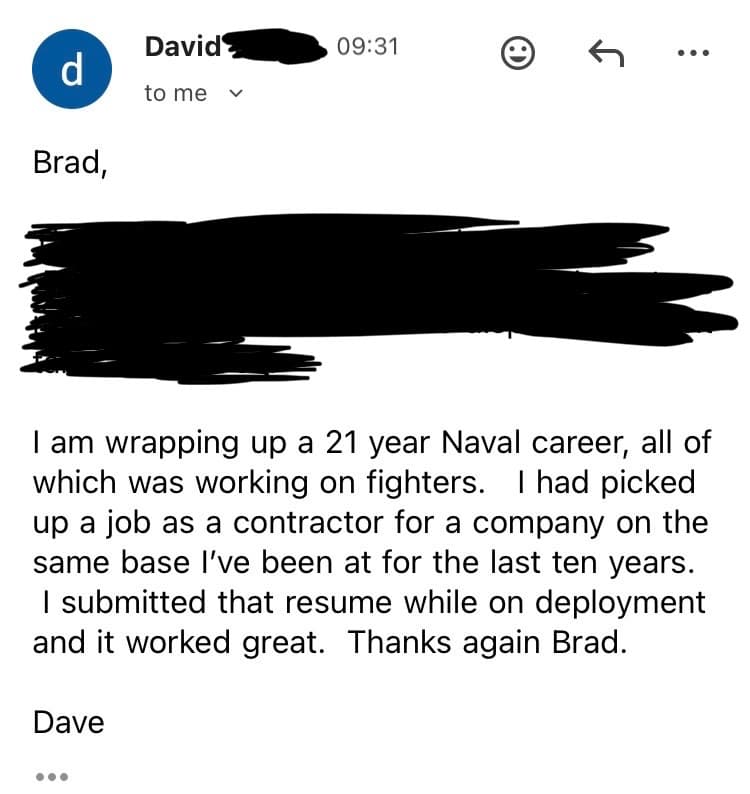
“I am wrapping up a 21 year Naval career, all of which was working on fighters. I had picked up a job as a contractor for a company on the same base I’ve been at for the last ten years. I submitted that resume while on deployment and it worked great. Thanks again Brad. Dave ”
Federal facilities and construction shops are one of the strongest landing zones for a Steelworker, and the agencies are exactly the ones you may already know: NAVFAC, the Army Corps of Engineers (USACE), GSA's Public Buildings Service, the Department of Veterans Affairs construction offices, and the National Park Service. They hire and contract for the structural and metal trades constantly, and your Seabee record reads as direct specialized experience.
On the wage-grade (WG) trades side, the cleanest matches are the Welding family (GS-3703), Sheet Metal Mechanic (GS-3806), Metal Forging (GS-3802), and Rigging (GS-5210). These are the federal job series your daily SW work maps onto, and a qualified journeyman steelworker often slots in without a degree because the standard is demonstrated trade skill. As you move toward inspection and oversight, Construction Control (GS-0809) and Engineering Technician (GS-0802) value the blueprint reading and quality judgment you built in the rating. Safety-minded veterans should look at Safety and Occupational Health Management (GS-0018) and Safety Engineering (GS-0803), since construction safety experience transfers directly.
Veterans' Preference adds 5 or 10 points to your assessed score on competitive federal jobs, and many trades positions hire through the Veterans Recruitment Appointment (VRA), which lets agencies bring you on without competing the announcement. The number that trips up most trades veterans is grade level. Read the qualification standard and the specialized-experience paragraph in the announcement carefully, because a year of journeyman-level SW work usually satisfies more than people assume. Our guide to matching your MOS to a federal job series and the 2026 federal resume format guide cover the formatting that federal HR specialists score. When you are ready, start your federal resume.
| GS Series | Federal Job Title | Typical Grades | Match | Explore |
|---|---|---|---|---|
| GS-3703 | Welding | WG-10, WG-11, WG-12 | View Details → | |
| GS-5210 | Rigging | WG-8, WG-10, WG-11 | View Details → | |
| GS-3802 | Metal Forging | WG-8, WG-10 | View Details → | |
| GS-3806 | Sheet Metal Mechanic | WG-9, WG-10, WG-11 | View Details → | |
| GS-0809 | Construction Control | GS-7, GS-9, GS-11 | View Details → | |
| GS-1670 | Equipment Services | GS-5, GS-6 | View Details → | |
| GS-0802 | Engineering Technician | GS-6, GS-7, GS-9 | View Details → | |
| GS-1601 | General Facilities and Equipment | GS-7, GS-9, GS-11 | View Details → | |
| GS-0018 | Safety and Occupational Health Management | GS-7, GS-9, GS-11 | View Details → |
Federal hiring uses keyword-matching and structured experience. BMR builds federal-format resumes (USAJobs-ready) with the right keywords, hours/week, and supervisor info — for any GS series above.
Free · No credit card · Federal + civilian resume formats included
Not everyone wants to stay in a related field. These career paths leverage your transferable skills — leadership, risk management, logistics, project planning — in completely different industries.
Steelworkers already read structural plans and judge whether work meets code. Fire inspection applies that same plan-reading and standards-enforcement mindset to occupancy, egress, and fire systems.
SW work demands holding structural members and welds to tight tolerances verified by inspection. Calibration rewards that same precision and specification discipline applied to instruments and gauges.
A Steelworker knows what can actually be fabricated and how metal behaves. That manufacturability instinct is rare and valuable on a design team that has to make a concept buildable.
You already read structural prints and weld symbols daily. Drafting turns that fluency around so you produce the drawings, and your shop-floor knowledge makes your details buildable.
SW selection emphasizes manual dexterity and detailed, repetitive precision work. Dental lab work is metal and material fabrication at a fine scale, rewarding the same hands-on accuracy.
Cutting, joining, and finishing metal with torch heat control is core SW skill. Jewelry and precious-metal work is that craft at a miniature scale, prizing the same hand control and material sense.
Seabee construction runs on controlling risk during rigging, welding, and steel erection. That hands-on safety judgment is the foundation a health and safety engineer builds an engineering credential on top of.
The skills that made you a good Marine, Sailor, Airman, or Soldier transfer further than you think. BMR rewrites your bullets for any of the pivot careers above — without making you sound like you've never done the work.
Free · No credit card · Try unlimited career angles
If you are staying in structural steel, welding, or the metal trades, your terminology already translates. A steel fabricator, a shipyard, or a federal welding shop knows what a Seabee did and uses the same words you do. This section is for Steelworkers targeting careers OUTSIDE the trades, where a hiring manager has never read a Seabee evaluation and needs your experience in plain business language.
The trap is writing your resume in rating shorthand. A civilian recruiter outside construction does not know what an NMCB is, what "tabbing rebar" means, or why pre-engineered building experience is impressive. Translate the function, not the jargon. Here are before-and-after examples aimed at non-trade roles like operations, project coordination, and quality.
Notice what each rewrite keeps: the scope, the standard, and the outcome. That is what a hiring manager scores. For more on this, see 50 military terms translated to civilian language, then run your own bullets through our military resume builder to tighten them.
BMR turns your SW duties and accomplishments into civilian bullets that match the job you're applying for — no manual translation, no rewriting.
Free · No credit card · Tailored to each job posting
Which certifications you need depends on where you're headed. Find your target career path below.
The wrong placement can sink an otherwise strong application. BMR knows where each cert ranks, what to call it, and how to frame it for ATS keyword matching and hiring manager attention.
Free · No credit card · Built around your real certs and clearance
SkillBridge Programs: Steel fabricators, shipyards, and heavy-civil contractors participate in DOD SkillBridge, letting you work a civilian trades job during your final 180 days. Search the SkillBridge database and start with our SkillBridge guide for 2026.
AWS Welding Credentials: The American Welding Society (AWS) Certified Welder and Certified Welding Inspector (CWI) credentials are the industry standard. Many SW veterans can test directly against a procedure rather than retraining from scratch. Verify current testing locations and fees through AWS before paying for a course.
Ironworker Apprenticeships: The International Association of Bridge, Structural, Ornamental and Reinforcing Iron Workers runs registered apprenticeships, and many honor military experience toward advanced standing. Bring your training records and dive logs of documented hours when you apply.
Construction Management: Pair OSHA 30-Hour Construction with project-management training and you become a strong candidate to run the work instead of doing it. The Construction Management Association of America (CMAA) offers the CCM credential and a hiring network. Our military to construction management guide maps the path.
Federal Employment (USAJobs): Create your USAJobs profile now and filter for "Veterans." Target NAVFAC, USACE, GSA, and VA construction offices for trades and inspection roles. Read the 2026 federal resume format guide first, then build a federal resume.
Veteran Networking: American Corporate Partners (ACP) pairs you with a corporate mentor in your target field, free for veterans.
Process Improvement: A Six Sigma credential signals you can run quality and throughput, which plays well for veterans moving from craft into operations and quality roles. See Six Sigma for veterans.
Next Steps: Explore other ratings and MOSs on the career crosswalk, use the SFL-TAP transition resources, and when you are ready, build your resume now. See also: Builder (BU) and Air Force 3E5X1 Engineering career paths.
Most veterans do this backwards — they wait until terminal leave to start, then panic. Here's the actual sequence that works.
Print this. Tape it to your monitor. Veterans who treat the transition like a 90-day op get hired faster than the ones who treat it like an emergency.
Stop rewriting from scratch every time you apply. BMR turns your military experience into civilian and federal resumes — tailored to each job.