Loading...
Loading...
The civilian and federal jobs that hire Navy Builders — with real salaries and the resume that gets callbacks.
Every BU has more options than a Google search will tell you. Below: career paths, BLS salary data, federal GS series, certifications by target career, and how to translate your experience without losing what made you valuable to the Navy in the first place.
Free · No credit card · Tailored resume in under 5 minutes
After the Navy I got hired into 6 federal career fields and tech sales, and sat on federal hiring panels along the way. I spent the last 2 years rebuilding everything I learned into BMR, tuned for how AI actually screens resumes today. This is the system I wish I'd had on day one.
As a Navy Builder (BU) you were the Seabees' general construction trade. You framed and finished structures, poured and formed concrete, set masonry, hung drywall, ran roofing and waterproofing, and built everything from advanced base camps and SEA huts to permanent barracks, galleys, and aircraft hangars. BUs work inside the Naval Construction Force alongside Equipment Operators (EO), Utilitiesmen (UT), and Construction Mechanics (CM) in Naval Mobile Construction Battalions (NMCBs). If you deployed, you likely ran timberwork and concrete in austere conditions, read prints, and finished a project to a punch list with a calendar and a tasking that did not move.
The training pipeline runs through Naval Construction Training Center Gulfport, Mississippi, or Port Hueneme, California, after boot camp at Great Lakes. "A" school covered blueprint reading, carpentry, concrete and masonry, plastering, roofing, and light steel. From there you learned the rest where it actually matters, on a project site, under a crew leader, building to spec. Many BUs cross-trained into Steelworker (SW) tasks, scaffolding, and rigging depending on the battalion and the deployment.
Civilian employers value this background because the Seabee model is the civilian construction model run under deadline and accountability. You estimated material, sequenced trades, kept a job moving, and answered for quality and safety. That is the daily work of a superintendent, a foreman, an estimator, and a project engineer. You can explore how your rating maps to civilian roles using the military career crosswalk, and if you want the corporate-construction route specifically, our guide on moving from military to construction management walks the full path.
I spent years in federal environmental and engineering work after the Navy, and the Builder background lands cleaner than almost any rating I have seen. The skill that wins is not "I can swing a hammer." It is "I ran a project to a print, a budget, and a safety standard." Write the resume around the projects you delivered and the trades you coordinated, and a hiring manager reads a superintendent, not a laborer. — Brad Tachi, Navy Diver veteran & BMR founder
The number that matters when you're deciding what's next: how does civilian pay compare to what you make now?
Military comp is approximate (varies by location/dependents). Civilian is BLS median. Federal includes locality pay. Your real number depends on duty station, family status, GS step, and overtime.
Construction is cyclical and regional. Private nonresidential and infrastructure work has been steady, but residential swings with interest rates, and pay varies sharply by metro and by union density. The figures below are national medians from the BLS Occupational Employment and Wage Statistics survey (OEWS, May 2024); your local market may run well above or below them.
Construction Manager / Superintendent is the highest-leverage target for a senior BU who ran crews. BLS reports a median wage of $106,980 for construction managers (OEWS, May 2024), and the work, sequencing trades, holding a schedule, managing a punch list, is what you already did in an NMCB. Cost Estimator ($77,070 median, OEWS May 2024) suits BUs who tracked material takeoffs and labor hours. Construction and Building Inspector ($72,120 median, OEWS May 2024) rewards your eye for code-compliant work and finished quality.
If you want to stay in the trade rather than move into the trailer, Carpenter ($59,310 median, OEWS May 2024) and Brickmason / Blockmason / Cement Mason work (masonry workers median $56,600, OEWS May 2024) translate directly, and a First-Line Supervisor of Construction Trades role is the natural next rung for a former crew leader. These trades are unionized in many metros, which raises pay and adds benefits beyond the national median.
BUs who held NEC-level structural or QC roles also compete for Construction Surveying and Mapping Technician work ($51,940 median, OEWS May 2024) and for facilities roles with large institutional owners. The same trade-coordination skill set appears across branches, so it is worth comparing how the Army's 12W Carpentry and Masonry Specialist and 12N Horizontal Construction Engineer, and the Marine Corps 1371 Combat Engineer, present the same civilian paths. When you are ready to put your project history on paper, the military resume builder structures it for civilian recruiters, or you can build your resume now.
| Civilian Job Title | Industry | BLS Median Salary | Outlook | Match |
|---|---|---|---|---|
Construction Manager / Superintendent O*NET: 11-9021.00 | Construction | $106,980 | 9% (Faster than average) | strong |
Cost Estimator O*NET: 13-1051.00 | Construction | $77,070 | 5% (Faster than average) | strong |
Construction and Building Inspector O*NET: 47-4011.00 | Construction | $72,120 | 2% (Slower than average) | strong |
First-Line Supervisor of Construction Trades O*NET: 47-1011.00 | Construction | $79,940 | 5% (Faster than average) | strong |
Carpenter O*NET: 47-2031.00 | Construction | $59,310 | 4% (As fast as average) | strong |
Cement Mason / Brickmason O*NET: 47-2021.00 | Construction | $56,600 | Little or no change | moderate |
Construction Surveying and Mapping Technician O*NET: 17-3031.00 | Construction | $51,940 | 5% (Faster than average) | moderate |
Construction Laborer (entry, rapid advancement) O*NET: 47-2061.00 | Construction | $46,050 | 7% (Faster than average) | moderate |
BMR rewrites your BU experience for any of the civilian roles above — keywords, achievements, and language hiring managers actually scan for.
Free · No credit card · 2 tailored resumes included
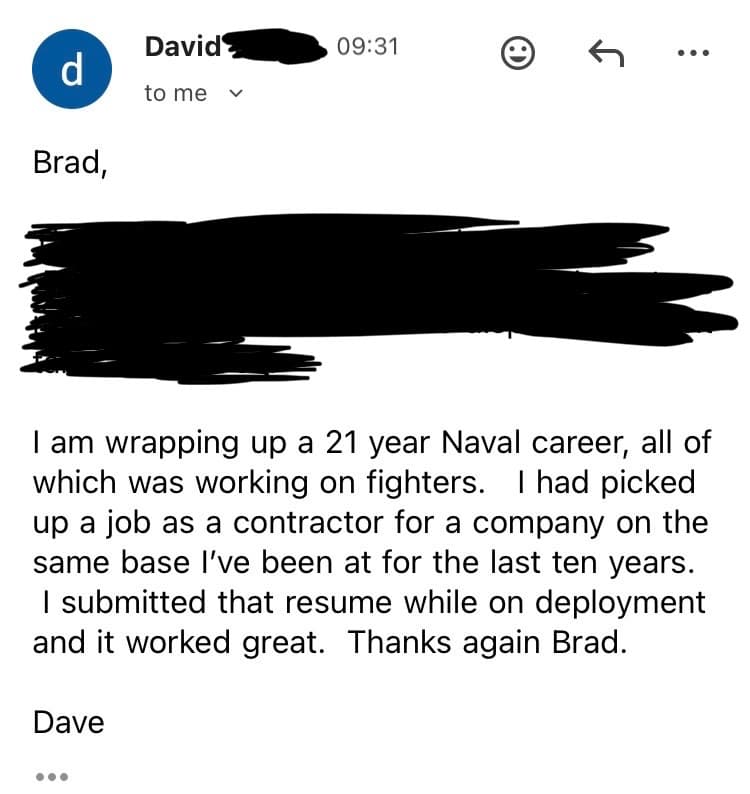
“I am wrapping up a 21 year Naval career, all of which was working on fighters. I had picked up a job as a contractor for a company on the same base I’ve been at for the last ten years. I submitted that resume while on deployment and it worked great. Thanks again Brad. Dave ”
Federal construction and facilities work is one of the strongest landing zones for a BU, because the government builds and maintains its own infrastructure through the Naval Facilities Engineering Systems Command (NAVFAC), the Army Corps of Engineers, the GSA, the VA, and the National Park Service. These agencies hire both white-collar GS series and blue-collar Wage Grade (WG) trades, so you have two doors.
On the GS side, GS-0809 Construction Control Technician is the most direct fit, inspecting and overseeing contractor construction for the government, and BUs commonly qualify at the GS-7 through GS-11 range based on hands-on construction experience. GS-0810 Civil Engineering Technician and GS-0808 Architecture support design and project delivery. GS-1601 General Facilities and Equipment and the GS-0018 Safety and Occupational Health Management series fit BUs who ran site safety. Project-leadership experience supports GS-0340 Program Management at higher grades. On the trades side, Wage Grade jobs in Carpentry, Masonry (WG-3603), and Maintenance Mechanic (WG-4749) hire directly off your hands-on rate.
Veterans' Preference adds 5 or 10 points to your competitive rating, and the qualification game on USAJOBS is about specialized experience written in OPM language, not how the work felt. Our guide to the specialized-experience paragraph shows exactly what that looks like, and the MOS-to-federal-series crosswalk helps you pick the right announcements. A federal resume runs long and detailed by design; the federal resume builder handles the format, or you can start your federal resume directly. BUs and Utilitiesmen often target the same NAVFAC announcements, so it is worth reading both rating pages.
| GS Series | Federal Job Title | Typical Grades | Match | Explore |
|---|---|---|---|---|
| GS-0809 | Construction Control | GS-7, GS-9, GS-11 | View Details → | |
| GS-3502 | Laboring | WG-7, WG-8, WG-9 | View Details → | |
| GS-0810 | Civil Engineering | GS-7, GS-9, GS-11 | View Details → | |
| GS-1601 | General Facilities and Equipment | GS-7, GS-9, GS-11 | View Details → | |
| GS-0340 | Program Management | GS-11, GS-12, GS-13 | View Details → | |
| GS-1640 | Facility Operations Services | GS-5, GS-6, GS-7 | View Details → | |
| GS-0018 | Safety and Occupational Health Management | GS-9, GS-11, GS-12 | View Details → | |
| GS-0802 | Engineering Technician | GS-5, GS-7 | View Details → | |
| GS-0808 | Architecture | GS-7, GS-9, GS-11 | View Details → |
Federal hiring uses keyword-matching and structured experience. BMR builds federal-format resumes (USAJobs-ready) with the right keywords, hours/week, and supervisor info — for any GS series above.
Free · No credit card · Federal + civilian resume formats included
Not everyone wants to stay in a related field. These career paths leverage your transferable skills — leadership, risk management, logistics, project planning — in completely different industries.
A BU who served as project QC already reads prints and verifies work to spec; manufacturing QC applies the same acceptance discipline to parts and assemblies rather than structures.
BUs who ran tailgate briefs and high-risk lift safety already work the hazard-control mindset; the pivot is formalizing it across industries beyond construction.
The comfort working at height, on structures, and to a precise build sequence transfers cleanly; turbine techs assemble, inspect, and repair rather than build from the ground up.
A BU is used to operating and maintaining systems to a standard and documenting it; treatment-plant operation rewards the same disciplined, accountable handling of critical infrastructure.
Rooftop work, structural mounting, and precise layout are daily BU skills; PV installation is a fast-growing, different industry that values that hands-on accuracy.
Running a Seabee project, sequencing trades against a deadline, is the same coordination a plant floor needs; the pivot moves the skill from a job site to a production line.
A BU who knows materials and how they go together sells building products to contractors with real jobsite credibility most reps never earn; the work is sales, a different field, not construction.
The skills that made you a good Marine, Sailor, Airman, or Soldier transfer further than you think. BMR rewrites your bullets for any of the pivot careers above — without making you sound like you've never done the work.
Free · No credit card · Try unlimited career angles
If you are applying to a construction company, a NAVFAC contractor, or a trades union, your terminology already translates. Estimators and superintendents know what forming, screeding, and a punch list are. This section is for BUs targeting careers OUTSIDE hands-on construction, where a hiring manager has never set foot on a job site and needs the work described in business language.
"Crew leader / LPO on an NMCB project" becomes "site supervisor accountable for a multi-trade crew, schedule, and deliverables." "Material takeoff and BCM/COMSEC paperwork" becomes "quantity estimating, procurement coordination, and project documentation." "Built to print and punch list" becomes "executed to engineered specifications and a defined quality-acceptance standard." "Stood up an advanced base camp on deployment" becomes "delivered turnkey facility infrastructure on a fixed timeline in an austere, resource-constrained environment."
A resume bullet like "Led a 6-Seabee crew building two 20-by-48 SEA huts in 9 days" reads to a project-management or operations recruiter as "Supervised a 6-person team delivering two structures two days ahead of schedule under deployed conditions." Same facts, civilian frame. For more of these conversions, see 50 military terms translated to civilian language and our guide to translating military leadership for a civilian resume. The military resume builder applies this translation automatically, or get started here.
BMR turns your BU duties and accomplishments into civilian bullets that match the job you're applying for — no manual translation, no rewriting.
Free · No credit card · Tailored to each job posting
Which certifications you need depends on where you're headed. Find your target career path below.
The wrong placement can sink an otherwise strong application. BMR knows where each cert ranks, what to call it, and how to frame it for ATS keyword matching and hiring manager attention.
Free · No credit card · Built around your real certs and clearance
Staying in construction and the trades. SkillBridge is the fastest on-ramp into a civilian construction company before you separate; our military-to-construction-management guide and the 2026 SkillBridge companies list are the place to start. Industry credentials worth chasing include the OSHA 30-Hour Construction card, the NCCER carpentry and masonry credentials, and the CMAA / AGC project-management certificates. Union apprenticeship locals (Carpenters, Bricklayers) will often credit your Seabee experience toward journeyman status.
Careers outside construction. For the federal route, read the military-to-federal transition roadmap and the 10 federal job series every veteran should search. The PMP (Project Management Professional) and a Six Sigma belt open operations and management roles well beyond the job site, see Six Sigma for veterans. For mentorship and networking, American Corporate Partners (ACP) pairs transitioning veterans with corporate mentors, and the SFL-TAP transition resources cover the administrative side.
Build the resume. Start with the military resume builder for private-sector roles or the federal resume builder for USAJOBS, explore options on the career crosswalk, or build your resume now. See also the related Seabee ratings: EO Equipment Operator, CM Construction Mechanic, and the Army 12B Combat Engineer.
Most veterans do this backwards — they wait until terminal leave to start, then panic. Here's the actual sequence that works.
Print this. Tape it to your monitor. Veterans who treat the transition like a 90-day op get hired faster than the ones who treat it like an emergency.
Stop rewriting from scratch every time you apply. BMR turns your military experience into civilian and federal resumes — tailored to each job.