Aircrew Survival Equipmentman
The civilian and federal jobs that hire Navy Aircrew Survival Equipmentmans — with real salaries and the resume that gets callbacks.
Every PR has more options than a Google search will tell you. Below: career paths, BLS salary data, federal GS series, certifications by target career, and how to translate your experience without losing what made you valuable to the Navy in the first place.
Free to start · Tailored resume in under 5 minutes
After the Navy I got hired into 6 federal career fields and tech sales, and sat on federal hiring panels along the way. I spent the last 2 years rebuilding everything I learned into BMR, tuned for how AI actually screens resumes today. This is the system I wish I'd had on day one.
Get a free PR Aircrew Survival Equipmentman sample resume
One page, built in our template, with your military experience translated into civilian terms hiring managers and ATS systems read. Use it as a reference for your own. Drop your email and we'll send you the download link.
Free. We'll also send occasional job-search tips. Unsubscribe anytime.
Military Role Overview
If you held the PR rating, you were the reason aircrew came home. Aircrew Survival Equipmentman is the modern name for what the Navy used to call the parachute rigger (the rating title changed in 1965), and the job covers far more than canopies. You inspected, packed, and repaired personnel and drogue parachutes, then signed your name to the log certifying the pack was airworthy. You maintained survival kits, life rafts, anti-exposure suits, g-suits, flight clothing, and aircrew oxygen systems including liquid oxygen converters and CO2 transfer and recharge equipment. You ran heavy-duty sewing machines to fabricate and repair load-bearing assemblies, and you trained aircrew on how to use the gear when a bad day got worse.
The pipeline runs through the PR "A" school at Naval Air Station Pensacola, roughly twelve weeks built around common-core, organizational-level, and intermediate-level skill blocks. From there PRs work in paraloft and AIMD spaces at air stations and aboard carriers and amphibs, splitting time between O-level squadron support and I-level component repair. The work is governed by hard inspection intervals, signed maintenance records, and a zero-defect standard. A miss-packed canopy or a bad oxygen regulator is not a paperwork problem. It is a fatality.
Civilian employers value this background because it is the rare military job that combines precision textile fabrication, life-support equipment maintenance, and documented quality inspection under a regulatory standard. That is the exact profile a manufacturing quality department, an FAA-certificated rigging loft, or a safety-equipment maker is short on. If you are mapping where the rating goes next, start with the military-to-civilian career crosswalk, and compare related Navy aviation ratings like the Aviation Structural Mechanic (AM) and the Aviation Support Equipment Technician (AS).
I was a Navy Diver, not a rigger, but I have watched how this rating lands across the more than 60,000 resumes BMR has built. PRs lose interviews for one reason: they list "parachute rigger" and stop, when the real story is certified quality inspection and life-support maintenance under a federal-grade standard. The skill set is rarer than you think. The resume has to say so. — Brad Tachi, Navy Diver veteran & BMR founder
Pay Reality Check
The number that matters when you're deciding what's next: how does civilian pay compare to what you make now?
Military comp is approximate (varies by location/dependents). Civilian is BLS median. Federal includes locality pay. Your real number depends on duty station, family status, GS step, and overtime.
Private Sector Career Paths
The most direct civilian matches sit in three buckets: quality inspection, technical sewing and textile fabrication, and FAA-certificated rigging. Per BLS OEWS May 2024, Inspectors, Testers, Sorters, Samplers, and Weighers earned a median of $47,460 a year, and that occupation hires heavily across aerospace and defense manufacturing where your documented-inspection habit is the whole point. Sewing Machine Operators sat at a $36,000 median and Fabric and Apparel Patternmakers at $67,670, but the load-bearing and technical-textile end of that market (parachutes, harnesses, tactical gear, inflatable life rafts) pays above the floor and competes hard for people who can actually run an industrial machine to spec.
If you want to stay closest to the rating, the FAA Senior and Master Parachute Rigger certificates (FAR Part 65) let you inspect and pack civilian parachutes at jump operations, gear manufacturers, and military contractors. That is a small, geographically clustered market, so be honest with yourself about relocating. The broader and more stable path is manufacturing quality: a Quality Inspector or Manufacturing QC Technician role at an aerospace or safety-equipment plant, then up to Quality Control Systems Manager (BLS OEWS May 2024 median $121,440 for that management line) or First-Line Supervisor of Production and Operating Workers ($71,190). Aircraft mechanics and maintainers face a similar translation problem, and the patterns in our aircraft mechanic civilian careers guide apply directly to PRs.
Cross-branch, your closest counterparts run into the same employers: the Army 92R Parachute Rigger and the survival-equipment side of the Air Force 1T0X1 SERE Specialist. When you are ready to put this on paper, the military resume builder translates the rating into civilian quality and manufacturing language, or you can build your resume now.
Civilian Job Title Translations
| Civilian Job Title | Industry | BLS Median Salary | Outlook | Match |
|---|---|---|---|---|
Quality Inspector (Aerospace/Safety Equipment) O*NET: 51-9061.00 | Manufacturing Quality | $47,460 | Little or no change | strong |
FAA Parachute Rigger O*NET: 51-9061.00 | Aviation / Rigging | $47,460 | Little or no change | strong |
Industrial Sewing / Technical Fabrication Supervisor O*NET: 51-1011.00 | Textile & Technical Products | $71,190 | 3% (As fast as average) | strong |
Manufacturing QC Technician O*NET: 51-9061.00 | Manufacturing | $47,460 | Little or no change | strong |
Safety Equipment Technician O*NET: 51-9061.00 | Safety & Survival Equipment | $47,460 | Little or no change | moderate |
Production Supervisor O*NET: 51-1011.00 | Manufacturing | $71,190 | 3% (As fast as average) | moderate |
Technical Patternmaker O*NET: 51-6092.00 | Technical Textiles | $67,670 | Decline | moderate |
Quality Control Systems Manager O*NET: 11-3051.01 | Aerospace & Defense Manufacturing | $121,440 | 6% (Faster than average) | moderate |
Companies That Hire This Background
See a salary you want? Build a resume targeting it.
BMR rewrites your PR experience for any of the civilian roles above — keywords, achievements, and language hiring managers actually scan for.
Free to start · 2 tailored resumes included
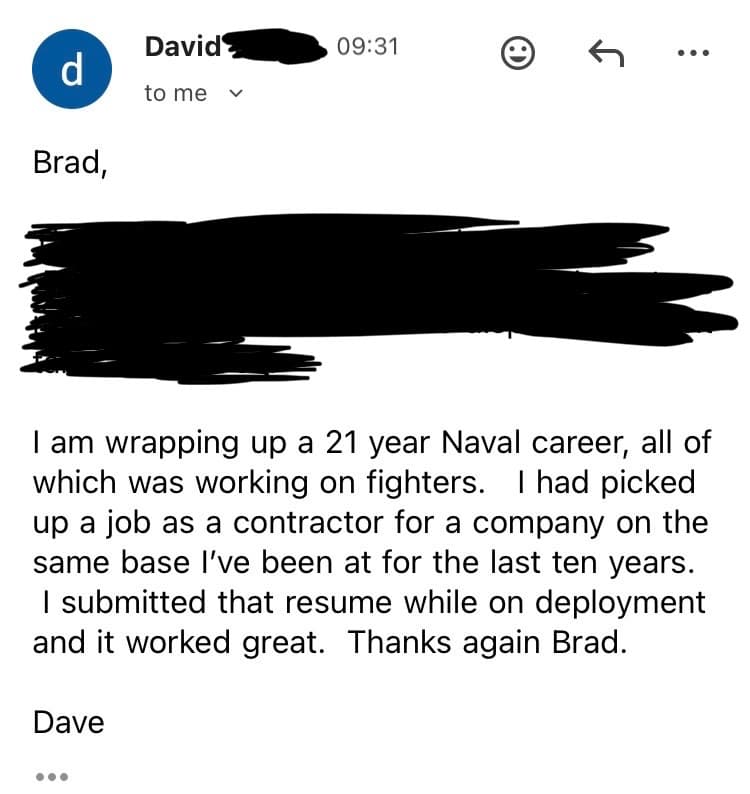
“I am wrapping up a 21 year Naval career, all of which was working on fighters. I had picked up a job as a contractor for a company on the same base I’ve been at for the last ten years. I submitted that resume while on deployment and it worked great. Thanks again Brad. Dave ”
Federal Career Paths
Federal trades and quality work is where the PR skill set converts almost without friction, because the government runs the same gear under the same documentation discipline. The federal wage-grade and GS series that line up:
- WG-3105 Fabric Working and WG-3111 Sewing Machine Operating. The direct trade match. DoD depots, the Defense Logistics Agency, and military airlift and special-operations support units employ fabric workers to fabricate and repair parachutes, slings, covers, and survival assemblies. Your packing and machine experience qualifies you at journeyman wage-grade levels.
- GS-1910 Quality Assurance Specialist. Your signed-inspection background is exactly what this series wants. Grades commonly run GS-7 through GS-11 entering, with supervisory QA reaching GS-12 and above at depots and contract-management activities.
- WG-1670 Equipment Specialist / Equipment Services. Survival and life-support equipment servicing, including oxygen-system and recharge-equipment work, maps here at aviation maintenance commands.
- GS-0346 Logistics Management Specialist. Managing the lifecycle, configuration, and supply of survival and aircrew equipment fleets. Typically GS-9 through GS-12.
- GS-0301 Miscellaneous Administration and Program. Program and maintenance-administration roles for the same equipment portfolios, useful when a slot is classified by program rather than trade.
Veterans' Preference adds 5 or 10 points to your rated federal score, and for trade (wage-grade) jobs it can move you ahead of non-preference applicants outright. The mechanics of claiming it, and which series to chase first, are laid out in our guide to federal job series for veterans. Federal resumes are their own format with hours-per-week and month-year detail, which the federal resume builder handles, and the tactics in our federal resume tips raise your odds of getting referred. The AM rating chases several of these same series.
GS Series & Position Matches
| GS Series | Federal Job Title | Typical Grades | Match | Explore |
|---|---|---|---|---|
| GS-3111 | Sewing Machine Operating | WG-7, WG-8, WG-9 | View Details → | |
| GS-1910 | Quality Assurance | GS-7, GS-9, GS-11 | View Details → | |
| GS-3105 | Fabric Working | WG-8, WG-9, WG-10 | View Details → | |
| GS-1670 | Equipment Services | WG-8, WG-9, WG-10 | View Details → | |
| GS-0802 | Engineering Technician | GS-5, GS-7, GS-9 | View Details → | |
| GS-0019 | Safety Technician | GS-7, GS-9 | View Details → | |
| GS-0346 | Logistics Management | GS-9, GS-11, GS-12 | View Details → | |
| GS-0301 | Miscellaneous Administration and Program | GS-7, GS-9, GS-11 | View Details → |
Federal resumes follow different rules. We know them.
Federal hiring uses keyword-matching and structured experience. BMR builds federal-format resumes (USAJobs-ready) with the right keywords, hours/week, and supervisor info — for any GS series above.
Free to start · Federal + civilian resume formats included
Want to Change Careers Entirely?
Not everyone wants to stay in a related field. These career paths leverage your transferable skills — leadership, risk management, logistics, project planning — in completely different industries.
Respiratory Therapist
Your aircrew oxygen and life-support background is the closest civilian analog to delivering and managing medical gases and respiratory equipment under pressure.
Medical Equipment Repairer
You already maintained, tested, and certified life-critical equipment to a standard. Biomedical devices reward exactly that discipline in a different industry.
Industrial Engineering Technologist and Technician
Your habit of inspecting against spec and chasing defects is the core of industrial-engineering support work in plants far outside the textile world.
Sales Representative, Technical and Scientific Products
You can sell safety, medical, or technical-textile equipment because you have actually used and maintained it, which is the credibility technical buyers respond to.
Wind Turbine Service Technician
High-consequence, procedure-driven work at height in a fast-growing field rewards the risk discipline and precision you built around life-critical gear.
Transportation, Storage, and Distribution Manager
Managing the inspection cycle, configuration, and supply of a survival-equipment fleet is the same accountability backbone distribution operations run on.
Pivoting industries? You don't need to start from scratch.
The skills that made you a good Marine, Sailor, Airman, or Soldier transfer further than you think. BMR rewrites your bullets for any of the pivot careers above — without making you sound like you've never done the work.
Free to start · Try as many career angles as you want
Skills Translation Guide
If you are applying to a rigging loft, a parachute manufacturer, or an aerospace quality shop, the people reading your resume already speak your language. Pack jobs, FAR Part 65, and AIMD mean something to them. This section is for the careers outside the survival-equipment world, where a civilian hiring manager has never heard of a paraloft and will skip a resume that reads like a maintenance log.
The fix is to translate the function, not the jargon. A few that matter for PRs:
- "Inspected and certified parachutes per NAVAIR 13-1-6 intervals" becomes "Performed documented quality inspections on life-critical equipment against published technical standards, certifying airworthiness with signed records."
- "Packed personnel and drogue chutes in the paraloft" becomes "Assembled and final-inspected high-reliability safety assemblies in a controlled production environment under a zero-defect standard."
- "Ran heavy-duty sewing machines to repair load-bearing gear" becomes "Operated industrial sewing equipment to fabricate and repair load-rated textile assemblies to engineering specification."
- "Maintained aircrew oxygen and LOX converter systems" becomes "Serviced and tested compressed-gas and life-support systems, including charging and pressure equipment, to manufacturer and safety standards."
Lead with the inspection-and-certification angle whenever the target job is quality, manufacturing, or safety. That single reframe is what separates a callback from a pass. For a full reference, our glossary of 50 military terms and civilian equivalents covers the common offenders, and the military resume builder applies these rewrites automatically. When the resume is close, you can get started here.
Resume Bullet Examples
Get bullets like these auto-generated for your resume.
BMR turns your PR duties and accomplishments into civilian bullets that match the job you're applying for — no manual translation, no rewriting.
Free to start · Tailored to each job posting
Certifications by Career Path
Which certifications you need depends on where you're headed. Find your target career path below.
Aviation Maintenance
Federal Employment
Logistics & Supply Chain
Manufacturing
Quality Assurance
Safety & EHS
Got a cert? Don't bury it. List it the right way.
The wrong placement can sink an otherwise strong application. BMR knows where each cert ranks, what to call it, and how to frame it for ATS keyword matching and hiring manager attention.
Free to start · Built around your real certs and clearance
Transition Resources
Staying in survival equipment, rigging, and quality
The Parachute Industry Association (PIA) is the trade body for civilian rigging and gear manufacturing and is the place to track FAA Part 65 rigger certification, manufacturer hiring, and industry events. For the manufacturing-quality path, the American Society for Quality (ASQ) owns the certifications employers actually ask for (Certified Quality Inspector, Certified Quality Technician). SkillBridge can place you with an aerospace or safety-equipment manufacturer before you separate. Our SkillBridge program guide walks the eligibility and command-approval steps.
Careers outside the field
If you are leaving the specialty entirely, the leverage is your inspection discipline, your life-support and compressed-gas knowledge, and your comfort in hazardous, high-consequence work. ASQ and OSHA credentials open quality and safety roles in any industry. For federal trade and QA jobs, lean on Veterans' Preference and the wage-grade path. American Corporate Partners (ACP) offers free one-on-one veteran mentorship for figuring out the pivot. Interview prep matters here, because you will be explaining unfamiliar work to a civilian panel. Our guide on structured federal interview tips and the SFL-TAP resources at SFL-TAP transition support are good starting points. A strong cover letter helps for non-field roles; see our military-to-civilian cover letter template.
Next steps
Explore adjacent paths through the career crosswalk. See also the Aviation Machinist's Mate (AD) and Aviation Electrician's Mate (AE) ratings for related Navy aviation paths. When you are ready, build your resume now with the military resume builder or the federal resume builder for USAJobs.
Your 30 / 60 / 90-Day Transition Plan
Most people do this backwards. They wait until terminal leave to start, then panic. Here's the sequence that works. Already out? Same plan, start at day one today.
Set the foundation
- Pull your DD-214 (request from Milconnect if separated)
- List your top 3 civilian roles AND top 3 GS series
- Build your tailored PR resume — BMR does it free
- Write 1 strong LinkedIn headline (not "veteran seeking opportunities")
- Pull together your evals/performance reports for accomplishments
Apply with intent
- Apply to 5–10 jobs/week — quality over quantity
- Tailor every resume to the job description (BMR auto-tailors)
- Connect with 5 people/week on LinkedIn (not a spray)
- Set up a USAJobs profile and a saved-search alert for your GS series
- Practice translating your military bullets out loud — explain to a civilian friend
Close the offer
- Track every application — date, status, contact, notes
- Follow up 7–10 days after each application
- Prep for behavioral interviews using the STAR method
- Negotiate salary — don't take the first offer (BLS median is your floor)
- Stay applying even after one offer — leverage = options
Print this. Tape it to your monitor. Veterans who treat the job search like a 90-day op get hired faster than the ones who treat it like an emergency.
Frequently Asked Questions
What civilian jobs hire former Navy PRs?
How much can I earn after the PR rating?
Can I become an FAA parachute rigger as a civilian?
What if I want to leave the survival-equipment field entirely?
Which federal job series fit a PR?
How does Veterans' Preference help me?
Is my clearance worth anything as a civilian?
Should I use my GI Bill, and on what?
Where are the jobs concentrated geographically?
Can I start applying before I separate?
Translate your PR Aircrew Survival Equipmentman experience into a resume that gets callbacks
Stop rewriting from scratch every time you apply. BMR turns your military experience into civilian and federal resumes — tailored to each job.