Air ForceAFSC: 1T0X1

SERE Specialist

The civilian and federal jobs that hire Air Force SERE Specialists — with real salaries and the resume that gets callbacks.

Every 1T0X1 has more options than a Google search will tell you. Below: career paths, BLS salary data, federal GS series, certifications by target career, and how to translate your experience without losing what made you valuable to the Air Force in the first place.

Free to start · Tailored resume in under 5 minutes

$58K–$125K
Salary Range
BLS-verified median salaries
14
Career Paths
12
Companies Hiring
10
Resume Examples
10
Federal GS Series
6
Certification Paths
10
FAQs Answered
BT
Brad Tachi
Navy Diver · BMR Founder

After the Navy I got hired into 6 federal career fields and tech sales, and sat on federal hiring panels along the way. I spent the last 2 years rebuilding everything I learned into BMR, tuned for how AI actually screens resumes today. This is the system I wish I'd had on day one.

65,000+ resumes built·Success stories every week
Free Sample · Emailed to You

Get a free 1T0X1 SERE Specialist sample resume

One page, built in our template, with your military experience translated into civilian terms hiring managers and ATS systems read. Use it as a reference for your own. Drop your email and we'll send you the download link.

Free. We'll also send occasional job-search tips. Unsubscribe anytime.

Military Role Overview

SERE (Survival, Evasion, Resistance, and Escape) Specialists (1T0X1) are among the most elite non-flying career fields in the Air Force. They design, develop, and conduct training programs that prepare aircrew and other high-risk-of-capture personnel to survive in hostile environments, evade enemy forces, resist exploitation if captured, and escape captivity. SERE Specialists are the instructors, not the students — they are the subject matter experts who build and execute the training.

The pipeline is one of the most demanding in the Air Force. It begins at the SERE Specialist Training course at Fairchild AFB, WA (366th Training Squadron), encompassing survival skills, resistance training laboratory instruction, and fieldcraft. Graduates are assigned to SERE schools and squadrons at Fairchild AFB, survival training at JBSA-Lackland, or operational units supporting special operations and combat rescue. Advanced SERE Specialists may serve as course directors, curriculum developers, or deploy as Personnel Recovery specialists with combat search and rescue forces.

What makes SERE Specialists valuable in the civilian world is not just the survival expertise — it is the instructional design capability, the ability to manage high-stress training environments safely, and deep experience in risk management where the consequence of failure is catastrophic. These are professionals who design curricula, assess trainee performance under extreme duress, and maintain safety standards in inherently dangerous training scenarios.

SERE Specialists have one of the most difficult civilian transitions because the work is so specialized — survival, evasion, resistance, escape doesn't have an obvious civilian analog. After 18 months of no callbacks myself, I learned the resume problem dominates these specialty backgrounds. SEREs land in federal LE, corporate security, defense contracting, and outdoor education when the resume reframes the work. — Brad Tachi, Navy Diver veteran & BMR founder

Security ClearanceSecret (minimum)
ASVAB RequirementG-55, M-55
TrainingSERE Specialist Training (SST) course at Fairchild AFB, WA — one of the most demanding courses in the Air Force (~12 months including all phases). Covers survival techniques, evasion, resistance to exploitation, escape methodology, instructional technique, and water survival. Graduates are SERE instructors from day one at their operational unit.
Certs Earned in ServiceSERE Instructor Qualification, Wilderness survival certifications (military-specific), Water survival instructor, Resistance Training Laboratory instructor, EMT-Basic or Tactical Combat Casualty Care (varies), First Aid/CPR/AED

Pay Reality Check

The number that matters when you're deciding what's next: how does civilian pay compare to what you make now?

Air Force mid-career
$58K–$82K
E-5 to E-7 total comp (base + BAH + BAS + tax advantage)
Civilian SERE Specialist
$64K–$125K
BLS median across direct-match civilian roles
Federal (GS-9 to GS-13)
$58K–$120K
10 matching GS series + locality pay + step increases
+12% on average
Civilian roles for SERE Specialists pay ~$9K more than mid-career enlisted total comp.

Military comp is approximate (varies by location/dependents). Civilian is BLS median. Federal includes locality pay. Your real number depends on duty station, family status, GS step, and overtime.

Private Sector Career Paths

SERE Specialists have a unique skill set that applies to several civilian sectors, though the path is less linear than some other AFSCs. The outdoor recreation and adventure training industry, corporate leadership development, and security consulting sectors are the most direct matches.

According to the Bureau of Labor Statistics, Training and Development Specialists earn a median of $64,340 (May 2024, O*NET 13-1151.00) with 6% projected growth. Training and Development Managers earn $125,040 (O*NET 11-3131.00). Emergency Management Directors earn $86,130 (O*NET 11-9161.00). These roles align with the curriculum development, instruction, and risk management components of SERE experience.

The security consulting industry — executive protection firms, corporate risk advisory companies, and travel security providers — hires former SERE specialists for their expertise in hostile environment awareness, personnel recovery planning, and resistance-to-exploitation training. Companies like Global Guardian, International SOS, and Crisis24 provide security services to corporations operating in high-risk regions.

Civilian Job Title Translations

Training and Development Manager
Multiple Industries
strong
$125,040median
About as fast as average (6%)
O*NET: 11-3131.00
Training and Development Specialist
Multiple Industries
strong
$64,340median
About as fast as average (6%)
O*NET: 13-1151.00
Emergency Management Director
Government / Healthcare / Education
moderate
$86,130median
About as fast as average
O*NET: 11-9161.00
Security Management Specialist
Government / Corporate / Defense
moderate
$65,080median
Faster than average (6%)
O*NET: 33-9032.00
Instructional Coordinator
Education / Government / Corporate
moderate
$74,620median
About as fast as average (2%)
O*NET: 25-9031.00
Outdoor Education Instructor
Education / Recreation / Nonprofit
strong
$64,340median
About as fast as average
O*NET: 13-1151.00
Occupational Health & Safety Specialist
Government / Manufacturing / Construction
moderate
$83,910median
Faster than average (12%)
O*NET: 19-5011.00
Executive Protection Specialist
Security / Corporate / Government
moderate
$65,080median
Faster than average
O*NET: 33-9032.00

Companies That Hire This Background

Supports DOD survival training programs as a contractor. SERE instructor and curriculum development positions at multiple locations.
Provides training solutions and live/virtual/constructive simulation. Supports military training programs including personnel recovery exercises.
Executive protection, travel security, and hostile environment awareness training for corporate clients operating in high-risk regions.
Global security and medical risk management. Hostile environment training, travel security assessments, and crisis response for multinational corporations.
Corporate risk intelligence, executive protection, and security consulting. Former SERE specialists valued for hostile environment awareness expertise.
Premier wilderness education organization. Instructor positions teaching backcountry skills, leadership, and risk management. Multiple locations worldwide.
Experiential education programs in wilderness settings. Instructor positions leveraging survival skills, leadership development, and risk management.
Emergency management specialist (GS-0089) positions. Risk assessment, disaster preparedness, and crisis coordination. Regional offices nationwide.
Park ranger (GS-0025) positions combining law enforcement, search and rescue, and wilderness management. Outdoor expertise and physical fitness valued.
Border Patrol Agent positions in remote and austere environments. Survival, navigation, and tracking skills directly applicable. Physical fitness and field expertise valued.
Special operations and personnel recovery consulting. Training program development and assessment roles supporting AFSOC and SOCOM.
Supports DOD training and simulation programs including personnel recovery and survival training. Curriculum development and instruction roles.

See a salary you want? Build a resume targeting it.

BMR rewrites your 1T0X1 experience for any of the civilian roles above — keywords, achievements, and language hiring managers actually scan for.

Free to start · 2 tailored resumes included

Build My Resume Free
Real Air Force success story
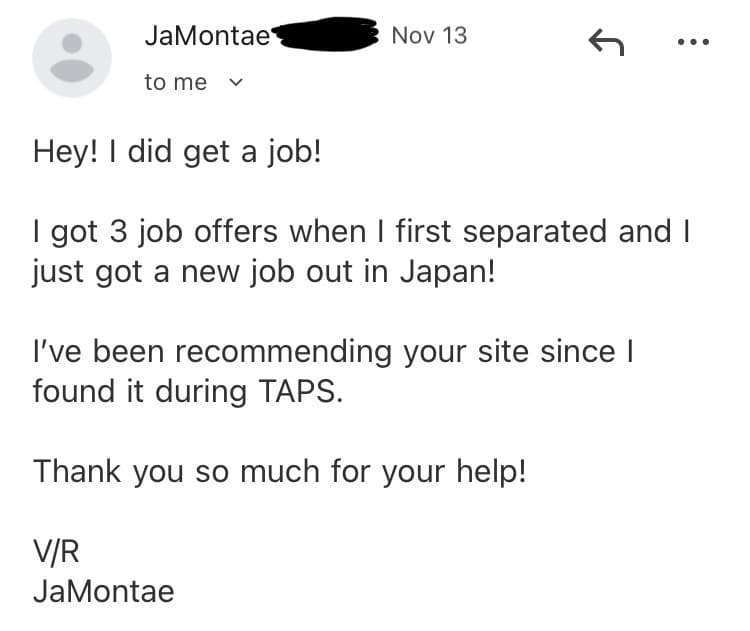
Hey! I did get a job! I got 3 job offers when I first separated and I just got a new job out in Japan! I’ve been recommending your site since I found it during TAPS. Thank you so much for your help! V/R JaMontae
JaMontae· Staff Sergeant (E-5)· Air Force
Information Technology and Computer Science
Read the full story

Federal Career Paths

The federal government values SERE expertise across several agencies, though the positions are more specialized than in some other career fields. The largest federal employer of former SERE Specialists is the DOD itself — as GS civilians continuing to support survival training programs.

GS-1712 (Training Instruction) is the most direct series match. These positions exist at SERE schools, Combat Aircrew Training Squadrons, and joint personnel recovery training centers. GS-0301 (Miscellaneous Administration) and GS-0340 (Program Management) cover training program management and curriculum development roles at MAJCOM and HAF levels.

GS-0089 (Emergency Management Specialist) positions at FEMA, DOD installations, and state emergency management agencies leverage the risk assessment and crisis management expertise SERE Specialists develop. GS-0080 (Security Administration) positions at military installations and federal facilities cover physical security, force protection, and anti-terrorism programs — all areas where SERE experience is relevant.

GS-1801 (General Inspection, Investigation, Enforcement) positions and GS-1811 (Criminal Investigation) apply to SERE Specialists pivoting toward federal law enforcement, particularly agencies like the U.S. Marshals Service, Border Patrol, and federal protective services where field survival and evasion skills have practical application. GS-0025 (Park Ranger) positions at the National Park Service combine outdoor expertise with law enforcement and public safety.

GS Series & Position Matches

GS-1712
Training Instruction
Typical grades: GS-9, GS-11, GS-12
View Details
GS-0080
Security Administration
Typical grades: GS-7, GS-9, GS-11, GS-12
View Details
GS-0089
Emergency Management
Typical grades: GS-9, GS-11, GS-12
View Details
GS-0343
Management and Program Analyst
Typical grades: GS-9, GS-11, GS-12
View Details
GS-0391
Telecommunications
Typical grades: GS-7, GS-9, GS-11
View Details
GS-1801
General Inspection, Investigation, Enforcement
Typical grades: GS-7, GS-9, GS-11
View Details
GS-0018
Safety and Occupational Health Management
Typical grades: GS-9, GS-11, GS-12
View Details
GS-1910
Quality Assurance
Typical grades: GS-9, GS-11, GS-12
View Details
GS-0301
Miscellaneous Administration and Program
Typical grades: GS-7, GS-9, GS-11
View Details
GS-0340
Program Management
Typical grades: GS-11, GS-12, GS-13
View Details

Federal resumes follow different rules. We know them.

Federal hiring uses keyword-matching and structured experience. BMR builds federal-format resumes (USAJobs-ready) with the right keywords, hours/week, and supervisor info — for any GS series above.

Free to start · Federal + civilian resume formats included

Build My Federal Resume Free

Want to Change Careers Entirely?

Not everyone wants to stay in a related field. These career paths leverage your transferable skills — leadership, risk management, logistics, project planning — in completely different industries.

Substance Abuse, Behavioral Disorder, and Mental Health Counselor

$59,190
Behavioral Healthcare(O*NET: 21-1018.00)BLS OEWS May 202417% (Much faster than average)
Coaching people through psychological duressStress-inoculation and resilience instructionReading behavior under pressureBuilding trust with people in crisis

The core of SERE is preparing people to keep their head together under captivity and extreme stress, and recognizing when someone is breaking down. That is the same human-resilience work a behavioral-health counselor does, applied to addiction and trauma instead of survival.

How to get there: Requires a master's degree and state licensure (LPC / LADC) for clinical roles, though entry-level peer-support and counselor-tech positions accept a bachelor's plus certification. Veterans often use the GI Bill for the graduate path.

Recreational Therapist

$60,280
Healthcare(O*NET: 29-1125.00)BLS OEWS May 20243% (As fast as average)
Wilderness and outdoor program designUsing physical challenge to build resilienceAdapting activities to people in recoveryBehavioral observation and progress tracking

SERE specialists run people through the outdoors to build confidence and grit. Recreational therapists use wilderness, adventure, and physical activity as the treatment itself, helping patients rebuild function and resilience after injury or trauma.

How to get there: Requires a bachelor's degree in recreational therapy and the CTRS certification. Veterans with outdoor-instruction backgrounds are competitive for entry roles, often in VA hospitals and rehabilitation centers.

Health Education Specialist

$63,000
Public Health(O*NET: 21-1091.00)BLS OEWS May 20244% (As fast as average)
Curriculum design for high-stress topicsTeaching adults to change behaviorTranslating doctrine into clear instructionAssessing learner comprehension and retention

A SERE instructor builds a curriculum that has to stick when a student is exhausted and afraid, then proves they learned it. Health education specialists build and deliver behavior-change programs the same way, for hospitals, public-health agencies, and nonprofits.

How to get there: Requires a bachelor's degree in health education or public health, and the CHES credential strengthens hiring. Veterans with formal-instructor experience qualify for entry program-coordinator roles.

Athletic Trainer

$60,250
Sports Medicine(O*NET: 29-9091.00)BLS OEWS May 202411% (Much faster than average)
Conditioning people for extreme physical demandInjury prevention in austere conditionsField assessment and first responseCoaching physical and mental endurance

SERE work centers on getting people physically and mentally ready to endure, and managing injuries far from help. Athletic trainers do the parallel job for athletes, preventing injury, responding on the field, and conditioning bodies for sustained stress.

How to get there: Requires a master's degree in athletic training and BOC certification plus state licensure. Veterans typically use the GI Bill for the accredited program.

Paramedic

$58,410
Emergency Medical Services(O*NET: 29-2043.00)BLS OEWS May 20245% (Faster than average)
Field medicine in austere environmentsDecision-making under extreme stressTrauma assessment and stabilizationStaying calm and directing others in crisis

SERE training already covers field medicine, improvisation, and functioning when everything is going wrong. Paramedics live in that exact zone, making life-or-death calls in the field with limited resources.

How to get there: Requires an accredited paramedic program (roughly 1,200 to 1,800 hours) and NREMT certification plus state licensure. Veterans with combat or field-medical exposure often test out of EMT-Basic and move straight toward paramedic training.

Emergency Management Director

$86,130
Government and Public Safety(O*NET: 11-9161.00)BLS OEWS May 20244% (As fast as average)
Planning for low-probability high-consequence eventsCoordinating response under pressureTraining and exercising teams for crisisRisk and contingency planning

SERE is built around preparing for the worst case and rehearsing the response until it is automatic. Emergency management directors build, exercise, and execute the same kind of contingency plans for cities, hospitals, and agencies.

How to get there: Often requires a bachelor's degree in emergency management or a related field. Veterans frequently enter via FEMA training tracks and certifications, then move into county or state emergency-operations roles.

Pivoting industries? You don't need to start from scratch.

The skills that made you a good Marine, Sailor, Airman, or Soldier transfer further than you think. BMR rewrites your bullets for any of the pivot careers above — without making you sound like you've never done the work.

Free to start · Try as many career angles as you want

Tailor My Resume to a New Career

Skills Translation Guide

If you are applying to DOD civilian SERE positions, defense contractor survival training programs, or special operations support companies, your terminology is understood. They know what resistance training means, they understand the SERE mission, and they recognize operational qualifications. This section is not for those applications.

This section is for SERE Specialists targeting careers outside of military training and defense — corporate training, emergency management, outdoor education, security consulting, or any role where the hiring manager has no frame of reference for what "conduct resistance training laboratory" means. The translations below reframe your experience for non-defense employers.

Resume Bullet Examples

Before (Military)
Served as primary SERE instructor for 12 classes annually, training 300+ aircrew and special operations personnel in resistance, evasion, and survival techniques
After (Civilian)
Designed and facilitated 12 immersive training programs annually for 300+ professionals, developing curriculum focused on decision-making under extreme stress, situational awareness, and resilience
Before (Military)
Conducted resistance training laboratory exercises, evaluating student performance under simulated captivity conditions and adjusting pressure based on individual psychological response
After (Civilian)
Conducted scenario-based behavioral assessments, evaluating individual performance under high-pressure simulations and calibrating exercise intensity based on real-time psychological observation
Before (Military)
Planned and executed 72-hour field training exercises for 40-person classes across 50,000+ acres, coordinating safety personnel, logistics, and real-time scenario adjustments
After (Civilian)
Planned and executed multi-day experiential training programs for groups of 40+ across remote sites, managing logistics, safety teams, and real-time program adjustments over 50,000+ acres
Before (Military)
Developed personnel recovery plans for deploying units, establishing communication protocols, evasion corridors, and recovery asset coordination procedures
After (Civilian)
Developed comprehensive crisis response and personnel accountability plans, establishing communication protocols, contingency procedures, and coordination frameworks for multi-agency response operations
Before (Military)
Provided survival medicine instruction including improvised wound care, environmental injury treatment, and water procurement in austere environments across multiple climate zones
After (Civilian)
Delivered emergency medical training covering trauma response, environmental injury prevention, and resource-limited healthcare protocols for remote-site operations across diverse environments
Before (Military)
Instructed advanced land navigation and evasion techniques using terrain association, celestial navigation, and GPS-denied movement across mountainous and jungle environments
After (Civilian)
Developed and delivered advanced navigation and environmental awareness training programs, teaching terrain analysis, route planning, and GPS-independent wayfinding across challenging landscapes
Before (Military)
Applied stress inoculation training methodology to prepare personnel for high-stress operational environments, gradually increasing psychological pressure while building coping mechanisms
After (Civilian)
Designed and delivered resilience and performance-under-pressure training programs, using graduated stress exposure methodology to build coping strategies and sustained decision-making capability
Before (Military)
Conducted water survival training for pre-deployment personnel, including underwater egress, open-water survival techniques, and signaling procedures
After (Civilian)
Managed aquatic safety training programs covering emergency water egress, open-water survival protocols, and rescue signaling, maintaining zero safety incidents across all training evolutions
Before (Military)
Facilitated after action reviews following each SERE training evolution, identifying performance gaps, documenting lessons learned, and updating training protocols based on student feedback
After (Civilian)
Facilitated post-exercise performance reviews, identifying improvement areas, documenting lessons learned, and updating program protocols based on participant feedback and observed outcomes
Before (Military)
Coordinated with JPRA and service-level SERE schools to standardize training protocols, align curriculum updates, and share lessons learned across DoD personnel recovery community
After (Civilian)
Coordinated across multiple organizational divisions and partner agencies to standardize program protocols, align curriculum updates, and establish shared performance benchmarks

Get bullets like these auto-generated for your resume.

BMR turns your 1T0X1 duties and accomplishments into civilian bullets that match the job you're applying for — no manual translation, no rewriting.

Free to start · Tailored to each job posting

Generate My Resume Bullets

Certifications by Career Path

Which certifications you need depends on where you're headed. Find your target career path below.

Emergency Management

Certified Emergency Manager (CEM)
Recommended
IAEM
Cost: $300 - $500Time: 3-6 months preparationGI Bill Eligible
SERE training includes evasion, survival, and recovery planning — all elements of emergency management. CEM credential opens state, local, and federal EM positions.
FEMA Professional Development Series (PDS)
Beneficial
FEMA Emergency Management Institute
Cost: $0 (free online)Time: 2-4 months
Free online courses through FEMA. Completing the PDS demonstrates emergency management knowledge and is often listed on federal EM job announcements.

Federal Employment

Security Clearance (Maintain Active)
Required
DoD / OPM
Cost: $0Time: Maintain during transition
Active clearance is critical for federal positions in DoD training commands, intelligence agencies, and DHS. Costs agencies thousands to sponsor new clearances.
Certified Protection Professional (CPP)
Beneficial
ASIS International
Cost: $400 - $600Time: 3-6 months studyGI Bill Eligible
For SERE Specialists targeting personnel recovery, force protection, or security management roles in federal agencies or defense contractors.

Healthcare

Licensed Professional Counselor (LPC) prerequisites
Recommended
State licensing boards
Cost: $30,000 - $60,000 (degree)Time: 2-3 years (master's)GI Bill Eligible
For SERE Specialists drawn to the psychological resilience side of SERE. Requires a master's degree. GI Bill covers many counseling programs.
Certified Resilience Trainer
Beneficial
Various (APA-aligned programs)
Cost: $500 - $2,000Time: 1-4 weeks
SERE Specialists with Code of Conduct and resistance training experience can leverage this in corporate resilience and stress inoculation programs.

Project Management

Project Management Professional (PMP)
Beneficial
PMI
Cost: $400 - $600Time: 3-6 months studyGI Bill Eligible
For SERE Specialists targeting training program management or operations roles. SERE course development and field training exercise planning count toward PMP project hours.
Certified Professional in Training Management (CPTM)
Beneficial
Training Industry
Cost: $1,500 - $2,500Time: 3-6 months
SERE Specialists are experienced curriculum developers and instructors. CPTM formalizes training management skills for corporate L&D and government training roles.

Safety & EHS

OSHA 30-Hour General Industry
Recommended
OSHA
Cost: $150 - $300Time: 4 days
Baseline safety certification for industrial and corporate safety roles. SERE risk management experience translates well to workplace safety programs.
Certified Safety Professional (CSP)
Recommended
BCSP
Cost: $300 - $500Time: 4-6 months studyGI Bill Eligible
Gold standard for safety professionals. SERE experience with hazard identification and risk mitigation in extreme environments is a strong foundation for the exam.
Associate Safety Professional (ASP)
Beneficial
BCSP
Cost: $250 - $400Time: 2-3 months studyGI Bill Eligible
Stepping stone to CSP. SERE Specialists without a safety-specific degree can use this to enter the EHS field while building toward full CSP.

Training & Development

Wilderness First Responder (WFR)
Recommended
NOLS Wilderness Medicine / SOLO
Cost: $600 - $900Time: 8-10 daysGI Bill Eligible
Some SERE Specialists may hold this or equivalent through military survival medicine training. Industry standard for outdoor education programs and guiding companies.
AMGA Certified Rock/Alpine Guide
Beneficial
American Mountain Guides Association
Cost: $3,000 - $8,000 (full program)Time: 6-18 monthsGI Bill Eligible
For SERE Specialists targeting professional guiding careers. SERE field experience provides a strong foundation but AMGA certification requires specific technical assessments.
Leave No Trace Master Educator
Beneficial
Leave No Trace Center
Cost: $200 - $400Time: 5 days
Required by many outdoor education organizations and land management agencies. Demonstrates environmental stewardship alongside technical skills.

Got a cert? Don't bury it. List it the right way.

The wrong placement can sink an otherwise strong application. BMR knows where each cert ranks, what to call it, and how to frame it for ATS keyword matching and hiring manager attention.

Free to start · Built around your real certs and clearance

Build My Resume the Right Way

Transition Resources

For Staying in Survival Training & Personnel Recovery

DOD Civilian SERE Positions: SERE schools at Fairchild AFB, JBSA-Lackland, NAS North Island, and Camp Mackall hire GS civilian SERE instructors. Check USAJobs for GS-1712 positions at these locations.

Defense Contractor Training: Companies like SAIC, Engility (now part of SAIC), and Cubic support DOD survival training programs. These positions maintain your connection to the SERE mission as a contractor. Search their career pages directly.

Special Operations Support: Contractor positions supporting AFSOC, JSOC, and SOCOM personnel recovery operations are available through companies like CACI, L3Harris, and Booz Allen Hamilton.

For Careers Outside SERE & Defense

Corporate Training & L&D: Your instructional design and training delivery experience translates directly. ATD (Association for Talent Development) membership and their CPTD certification formalize your training expertise for corporate employers. GI Bill covers many instructional design degree programs.

Emergency Management: The IAEM CEM (Certified Emergency Manager) certification is the industry standard. FEMA courses (free online) build credentials. Your risk assessment and crisis management experience transfers directly. State and local governments are the primary employers.

Outdoor Education & Adventure Training: Organizations like NOLS, Outward Bound, and university outdoor programs hire experienced wilderness instructors. WFR (Wilderness First Responder) certification and AMGA credentials open doors. Your field experience is the primary qualification.

Security Consulting: Companies like Global Guardian, International SOS, and Crisis24 hire for hostile environment awareness training and executive protection. Your SERE background is a direct qualifier. ASIS CPP certification adds civilian credibility.

Federal Employment (USAJobs): Create your USAJobs profile early. Key agencies: FEMA, NPS, CBP, USMS, and DOD civilian positions. Federal resumes are 2 pages max. Build yours here.

Veteran Networking: American Corporate Partners (ACP) provides free mentorship from corporate executives. Completely free for veterans.

Education Benefits: Use the GI Bill Comparison Tool to verify programs. Instructional design, emergency management, exercise science, and organizational leadership degrees align well with SERE experience.

BMR Career Resources

Air Force Resume Guide: AFSC Translation | Complete Military Resume Guide | Top Companies Hiring Veterans | Build Your Resume Free
Your 30 / 60 / 90-Day Transition Plan

Most people do this backwards. They wait until terminal leave to start, then panic. Here's the sequence that works. Already out? Same plan, start at day one today.

1Days 0–30

Set the foundation

  • Pull your DD-214 (request from Milconnect if separated)
  • List your top 3 civilian roles AND top 3 GS series
  • Build your tailored 1T0X1 resume — BMR does it free
  • Write 1 strong LinkedIn headline (not "veteran seeking opportunities")
  • Pull together your evals/performance reports for accomplishments
Build my resume free
2Days 30–60

Apply with intent

  • Apply to 5–10 jobs/week — quality over quantity
  • Tailor every resume to the job description (BMR auto-tailors)
  • Connect with 5 people/week on LinkedIn (not a spray)
  • Set up a USAJobs profile and a saved-search alert for your GS series
  • Practice translating your military bullets out loud — explain to a civilian friend
Tailor my next resume
3Days 60–90

Close the offer

  • Track every application — date, status, contact, notes
  • Follow up 7–10 days after each application
  • Prep for behavioral interviews using the STAR method
  • Negotiate salary — don't take the first offer (BLS median is your floor)
  • Stay applying even after one offer — leverage = options
Track my applications

Print this. Tape it to your monitor. Veterans who treat the job search like a 90-day op get hired faster than the ones who treat it like an emergency.

Frequently Asked Questions

What is the median salary for careers that match SERE experience?
It depends on the path. According to BLS May 2024 data, Training and Development Managers earn a median of $125,040 (O*NET 11-3131.00). Training and Development Specialists earn $64,340 (O*NET 13-1151.00). Emergency Management Directors earn $86,130 (O*NET 11-9161.00). Security Management Specialists earn $65,080 (O*NET 33-9032.00). DOD civilian SERE instructor GS-1712 positions vary by grade level and locality.
Can I continue teaching SERE as a civilian?
Yes. DOD hires GS civilian SERE instructors (GS-1712 series) at SERE schools at Fairchild AFB, JBSA-Lackland, NAS North Island, and other locations. Defense contractors like SAIC and Cubic also support survival training programs. These are the most direct civilian transitions — same mission, similar work, federal benefits or competitive contractor salaries.
What if I want to leave survival training entirely?
Many SERE Specialists pivot into corporate training and development, emergency management, security consulting, outdoor education, or federal law enforcement. The curriculum design, training delivery, and risk management skills apply across industries. See the Career Change Paths and Skills Translation sections for specific salary data and entry paths.
Is my security clearance valuable?
If you hold a Secret or TS clearance, yes. Defense contractors and federal agencies value cleared candidates, particularly for positions supporting special operations and personnel recovery. ClearanceJobs.com lists positions requiring active clearances. Your clearance stays active for up to 24 months after separation. However, unlike intelligence career fields, many SERE career pivot paths do not require clearances.
How does Veterans Preference work for federal jobs?
Veterans' Preference gives you 5 or 10 extra points on federal hiring assessments depending on disability rating. FEMA, NPS, CBP, and DOD civilian positions all apply Veterans' Preference. GS-1712 training instructor positions are the most direct match. Start your federal resume at bestmilitaryresume.com.
Should I use my GI Bill for a degree or certifications?
For training and development careers, an instructional design or organizational leadership degree opens doors to senior L&D positions. For emergency management, a bachelor's in emergency management qualifies you for higher GS grades. For immediate employability, certifications like CEM, WFR, or CPTD provide fast ROI. Many SERE Specialists combine certs for quick employment while pursuing a degree part-time.
What certifications should I get before separating?
For training careers: ATD CPTD (Certified Professional in Talent Development). For emergency management: start FEMA IS courses (free online) and prep for CEM. For outdoor education: Wilderness First Responder (WFR). For security consulting: ASIS CPP or PSP. For federal jobs: USAJobs profile 6 months out. Universal: keep EMT/First Responder certs current.
Where are the best job markets for former SERE Specialists?
For DOD SERE positions: Fairchild AFB (WA), JBSA-Lackland (TX), NAS North Island (CA), Camp Mackall (NC). For emergency management: any state capital or FEMA regional office — demand is growing nationwide. For security consulting: DC Metro, Houston, and international. For outdoor education: mountain and coastal regions (Colorado, Washington, North Carolina, California). Corporate training roles are increasingly remote.
How competitive is the outdoor education market?
Competitive but achievable. Organizations like NOLS and Outward Bound value your field experience highly, but compensation is typically lower than defense or corporate paths. University outdoor programs offer better salary and benefits. The key differentiator is combining your survival expertise with formal certifications (WFR, AMGA, Leave No Trace Trainer). Your instructional experience managing high-risk training is a significant advantage over civilian-trained outdoor educators.
Can I start job searching while still on active duty?
Yes — start 12 months before separation. At 180 days out, you may qualify for DOD SkillBridge with a defense contractor or outdoor education organization. ATD conferences and IAEM annual conferences are good networking opportunities. Set up USAJobs early, update LinkedIn, and start applying to federal positions 6 months out. Terminal leave is your transition runway.
Free for every veteran

Translate your 1T0X1 SERE Specialist experience into a resume that gets callbacks

Stop rewriting from scratch every time you apply. BMR turns your military experience into civilian and federal resumes — tailored to each job.

What you get — all free:
2
Tailored resumes
AI-rewritten for each job posting
2
Cover letters
Matched to the role
LinkedIn optimization
Profile rewrite for civilian recruiters
Elevator pitch generator
For interviews and networking
2
Company research reports
Know who you're applying to
Job tracker
Manage every application in one place
Start My Free Resume
Free to start · 90 seconds to sign upBuilt by a Navy Diver veteran. More than 65,000 resumes built for the military community.