Loading...
Loading...
The civilian and federal jobs that hire Air Force Tactical Aircraft Maintenance (5th Generation)s — with real salaries and the resume that gets callbacks.
Every 2A3X7 has more options than a Google search will tell you. Below: career paths, BLS salary data, federal GS series, certifications by target career, and how to translate your experience without losing what made you valuable to the Air Force in the first place.
Free · No credit card · Tailored resume in under 5 minutes
After the Navy I got hired into 6 federal career fields and tech sales, and sat on federal hiring panels along the way. I spent the last 2 years rebuilding everything I learned into BMR, tuned for how AI actually screens resumes today. This is the system I wish I'd had on day one.
BMR has built more than 60,000 resumes across every branch, and the maintainers who came out of the 5th-generation flight line carry a profile civilian employers rarely see twice. If you held Air Force AFSC 2A3X7, you were the dedicated crew chief on an F-22 Raptor or F-35 Lightning II. You owned the jet as an integrated weapon system, not one subsystem of it. Hydraulics, landing gear, engine, fuel, environmental, flight controls, and the low-observable skin that makes the airframe stealthy all lived under your sign-off before that aircraft left the ground.
The work that sets 2A3X7 apart from older fighter maintenance is the low-observable (LO) discipline. On a 5th-gen airframe, every panel you open and close, every fastener you torque, and every coating or gap you restore changes the aircraft's signature. You learned to inspect and repair radar-absorbent materials, manage panel-to-panel seams, and document LO health so the jet's stealth profile stayed inside spec. A misapplied coating or an out-of-tolerance gap is a mission-affecting defect, so the standard for surface and structural integrity on these aircraft is tighter than anything in legacy fighter maintenance.
Day to day you ran launch and recovery under a clock, cleared red-ball faults before a sortie slipped, executed phase and isochronal inspections, and worked the integrated diagnostics that 5th-gen jets generate instead of the manual troubleshooting older fighters relied on. The F-35 in particular feeds maintenance through its health-management and information systems, so you were reading system-generated fault data and confirming it against the airframe rather than chasing every symptom by hand. Training started with 7.5 weeks of Basic Military Training, then aircraft-maintenance technical training at Sheppard AFB in Wichita Falls, Texas, before you certified on your specific 5th-gen platform at your first duty station. At the senior level, 2A3X7 merges into the 2A390 maintenance superintendent track.
Civilian aviation, advanced manufacturing, and federal depots all want this background because it is rare: a technician who integrates multiple aircraft systems, works to a stealth-grade precision standard, and signs for airworthiness under time pressure. The one thing standing between that experience and a civilian offer is translation. Air Force LO and integrated-systems language does not read on a civilian resume without rework, which is the entire reason this guide exists. Start with the military career crosswalk tool, and compare your scope against the 2A3X4 Fighter Aircraft Integrated Avionics path if your time leaned more toward the electronics side.
The 5th-gen crew chiefs we see at BMR sell themselves short because they describe the airframe instead of the standard they held it to. Low-observable work is precision surface engineering under a deadline, and that translates to advanced manufacturing and depot QA far better than most maintainers realize. Name the standard, not the jet. — Brad Tachi, Navy Diver veteran & BMR founder
The number that matters when you're deciding what's next: how does civilian pay compare to what you make now?
Military comp is approximate (varies by location/dependents). Civilian is BLS median. Federal includes locality pay. Your real number depends on duty station, family status, GS step, and overtime.
Civilian aviation maintenance is the most direct landing zone for a 5th-generation crew chief, and the market is steady rather than booming. The Bureau of Labor Statistics (OEWS, May 2024) reports a median annual wage of $78,680 for aircraft mechanics and service technicians (O*NET 49-3011.00), with overall employment for aircraft and avionics equipment mechanics projected to grow 5 percent from 2023 to 2033, about as fast as average, and roughly 13,400 openings a year over the decade. The fastest route to the higher end of that range is an FAA Airframe and Powerplant (A&P) certificate, which many separating maintainers pursue using a Joint Service Aviation Maintenance Technician Certification Council (JSAMTCC) authorization to test on military experience.
Stealth experience is a differentiator the airlines cannot offer you, so the strongest first move is often a 5th-gen original-equipment manufacturer or sustainment line rather than a commercial carrier. Lockheed Martin runs F-35 final assembly and sustainment, and Northrop Grumman and Pratt & Whitney sit across the 5th-gen supply and propulsion base. Field Service Representative roles with these primes put you back on a military flight line as a civilian, supporting the exact airframe you maintained. For those who want out of aviation entirely, the low-observable skill set maps cleanly onto advanced-composites manufacturing, which is covered in the career-change section below.
Avionics-adjacent technicians earn a BLS median of $81,390 (O*NET 49-2091.00), a reasonable target if your 5th-gen time leaned into integrated diagnostics and fault-data work. Quality inspection is another natural path: inspectors, testers, sorters, samplers, and weighers earn a median of $47,460 (O*NET 51-9061.00) at entry, but in aerospace manufacturing and MRO settings the LO and airworthiness-inspection background pushes you toward the senior end and into supervisory inspection quickly. Be honest with yourself about geography here, because 5th-gen sustainment work clusters around Fort Worth, Marietta, Ogden, and a handful of other sites. If you want to stay in this niche, you may need to move to it. Veterans coming from other branches' aircraft programs, such as Navy Aviation Machinist's Mate (AD) and Army 15B Aircraft Powerplant Repairer, compete for the same civilian roles, so a resume that names the stealth-grade standard is what separates you. The civilian aviation careers guide for military maintainers breaks down the A&P route, and you can build your resume now when you are ready to translate it.
| Civilian Job Title | Industry | BLS Median Salary | Outlook | Match |
|---|---|---|---|---|
Aircraft Mechanic and Service Technician O*NET: 49-3011.00 | Aviation Maintenance | $78,680 | 5% (As fast as average) | strong |
Avionics Technician O*NET: 49-2091.00 | Aviation Maintenance | $81,390 | 5% (As fast as average) | strong |
Field Service Representative (Defense Aviation) O*NET: 49-2091.00 | Defense Sustainment | $81,390 | 5% (As fast as average) | strong |
Aerospace Quality Inspector O*NET: 51-9061.00 | Aerospace Manufacturing | $47,460 | (Little change) | strong |
MRO Maintenance Technician O*NET: 49-3011.00 | Aviation Maintenance, Repair & Overhaul | $78,680 | 5% (As fast as average) | moderate |
Composite Repair Technician (Aerospace) O*NET: 49-3011.00 | Aerospace Manufacturing | $78,680 | 5% (As fast as average) | moderate |
First-Line Maintenance Supervisor (Aviation) O*NET: 49-1011.00 | Aviation Maintenance | $81,390 | 5% (As fast as average) | moderate |
BMR rewrites your 2A3X7 experience for any of the civilian roles above — keywords, achievements, and language hiring managers actually scan for.
Free · No credit card · 2 tailored resumes included
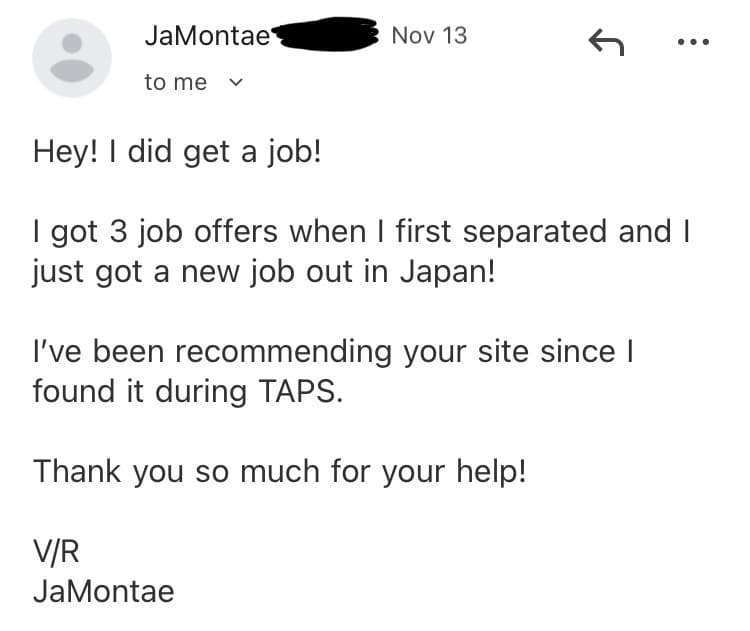
“Hey! I did get a job! I got 3 job offers when I first separated and I just got a new job out in Japan! I’ve been recommending your site since I found it during TAPS. Thank you so much for your help! V/R JaMontae ”
Federal aviation maintenance hires through both the Wage Grade (WG) trade system and the General Schedule (GS), and Veterans' Preference carries real weight in both. The most direct match is the Aircraft Mechanic series, WG-8852, staffed across the Air Logistics Complexes at Hill, Tinker, and Robins, plus Navy and Army depots. These positions perform the same scheduled and unscheduled airframe maintenance you did in uniform, and a number of them now support 5th-gen depot work directly, where your LO and integrated-systems experience is a qualifying advantage rather than a nice-to-have.
For the precision-systems side of your background, the Pneudraulic Systems Mechanic series (WG-8255) covers depot-level hydraulic and pneumatic component overhaul, which lines up with the landing-gear, flight-control, and utility-hydraulic work that fills a crew chief's day. If you spent time on flightline quality, the Quality Assurance series (GS-1910) at depots and at the Defense Contract Management Agency hires former maintainers to oversee contractor airworthiness, and your sign-off authority and LO inspection record map onto the qualification standard.
Two engineering-adjacent series reward maintainers with strong technical-troubleshooting documentation: Engineering Technician (GS-0802) for those who supported modification, test, or analysis work, and Mechanical Engineering (GS-0830) if you completed a relevant degree and want to move toward design and sustainment engineering rather than hands-on repair. Aviation Safety (GS-1825) is the FAA and DoD path for maintainers who ran flightline safety, FOD prevention, or tool-control programs, though the inspector roles generally expect an A&P plus civilian time. Equipment Services (WG-1670) and Miscellaneous Administration and Program (GS-0301) round out the options for those who managed servicing operations, supply coordination, or maintenance production. Build the application in the federal resume builder, learn how preference actually scores in our Veterans' Preference points guide, and use the OPM federal resume format guide so the document clears the qualifications screen. Other branches' depot maintainers, including Coast Guard Aviation Maintenance Technician (AMT), target these same WG and GS series.
| GS Series | Federal Job Title | Typical Grades | Match | Explore |
|---|---|---|---|---|
| GS-8852 | Aircraft Mechanic | WG-8, WG-10, WG-11 | View Details → | |
| GS-1910 | Quality Assurance | GS-9, GS-11, GS-12 | View Details → | |
| GS-8255 | Pneudraulic Systems Mechanic | WG-9, WG-10, WG-11 | View Details → | |
| GS-0802 | Engineering Technician | GS-7, GS-9, GS-11 | View Details → | |
| GS-1825 | Aviation Safety | GS-9, GS-11, GS-12 | View Details → | |
| GS-0830 | Mechanical Engineering | GS-7, GS-9, GS-11 | View Details → | |
| GS-1670 | Equipment Services | GS-7, GS-9, GS-11 | View Details → |
Federal hiring uses keyword-matching and structured experience. BMR builds federal-format resumes (USAJobs-ready) with the right keywords, hours/week, and supervisor info — for any GS series above.
Free · No credit card · Federal + civilian resume formats included
Not everyone wants to stay in a related field. These career paths leverage your transferable skills — leadership, risk management, logistics, project planning — in completely different industries.
Factories running automated and robotic lines need technicians who can troubleshoot integrated hydraulic, pneumatic, and electrical systems the way a 5th-gen crew chief does across an airframe.
Heavy commercial and electric-vehicle fleets need maintainers comfortable with high-voltage and integrated diagnostics, which is exactly the systems-troubleshooting discipline a crew chief uses on the flight line.
Mechatronics work blends the electrical, mechanical, and software-driven diagnostics that define 5th-gen maintenance, making it a natural step for maintainers who worked health-management systems.
Calibration is precision measurement to an exact tolerance with full traceability, which mirrors the signature-spec conformance work a low-observable maintainer performs every shift.
Hands-on low-observable and aerostructures repair gives a designer rare insight into how composite parts actually fail and assemble, which is valuable in product and tooling design.
Lab work rewards the same disciplined adherence to controlled procedure and zero-error documentation a crew chief lives by, just applied to specimens and instruments instead of airframes.
The skills that made you a good Marine, Sailor, Airman, or Soldier transfer further than you think. BMR rewrites your bullets for any of the pivot careers above — without making you sound like you've never done the work.
Free · No credit card · Try unlimited career angles
If you are applying to a 5th-gen sustainment line, an MRO shop, or a defense prime, the hiring manager already speaks your language. They know what a crew chief does, what low-observable maintenance means, and why a red-ball is a big deal. You do not need to translate for them. This section is for the maintainer targeting a career outside aviation, where "restored LO coating to signature spec" means nothing until you reframe it.
The translation that matters most for a 5th-gen maintainer is turning stealth-grade precision and integrated-systems work into the language of advanced manufacturing, quality, and process control. These are not word swaps. They restructure what you did into outcomes a civilian hiring manager in a non-aviation industry can measure. The military terms glossary covers the common vocabulary, and the EPR/OPR translation guide is built specifically for pulling civilian bullets out of your Air Force evaluations. When the language is ready, build your resume now and let the tool structure the bullets for you.
BMR turns your 2A3X7 duties and accomplishments into civilian bullets that match the job you're applying for — no manual translation, no rewriting.
Free · No credit card · Tailored to each job posting
Which certifications you need depends on where you're headed. Find your target career path below.
The wrong placement can sink an otherwise strong application. BMR knows where each cert ranks, what to call it, and how to frame it for ATS keyword matching and hiring manager attention.
Free · No credit card · Built around your real certs and clearance
The resources below split into staying on the aircraft and leaving it. Pick the column that matches where you are headed, not where you have been.
Pursue the FAA Airframe and Powerplant (A&P) certificate first, testing on your military experience through the Joint Service Aviation Maintenance Technician Certification Council (JSAMTCC) authorization. SkillBridge is the cleanest on-ramp to a 5th-gen sustainment employer before you separate, and our SkillBridge guide walks through command approval and placement. The Professional Aviation Maintenance Association (PAMA) is the industry body worth joining for networking and continuing education. For related airframe paths in other branches, see Navy Aviation Structural Mechanic (AM) and Marine Corps Helicopter Crew Chief (6173).
For non-aviation moves, target a recognized quality or process credential: ASQ Certified Quality Inspector or Certified Quality Technician for inspection roles, or a Lean Six Sigma Green Belt for process and operations work, covered in our Six Sigma for veterans guide. Use American Corporate Partners (ACP) for one-on-one mentorship from a civilian in your target industry, and lean on your clearance and GI Bill as leverage rather than afterthoughts. When you are ready to apply, get started here, explore adjacent jobs in the career crosswalk, and pull your transition timeline together through SFL-TAP resources. See also 2A7X3 Aircraft Structural Maintenance if your strength was the structures and low-observable surface side.
Most veterans do this backwards — they wait until terminal leave to start, then panic. Here's the actual sequence that works.
Print this. Tape it to your monitor. Veterans who treat the transition like a 90-day op get hired faster than the ones who treat it like an emergency.
Stop rewriting from scratch every time you apply. BMR turns your military experience into civilian and federal resumes — tailored to each job.