Loading...
Loading...
The civilian and federal jobs that hire Air Force Missile and Space Facilitiess — with real salaries and the resume that gets callbacks.
Every 2M0X3 has more options than a Google search will tell you. Below: career paths, BLS salary data, federal GS series, certifications by target career, and how to translate your experience without losing what made you valuable to the Air Force in the first place.
Free · No credit card · Tailored resume in under 5 minutes
After the Navy I got hired into 6 federal career fields and tech sales, and sat on federal hiring panels along the way. I spent the last 2 years rebuilding everything I learned into BMR, tuned for how AI actually screens resumes today. This is the system I wish I'd had on day one.
My federal background ran through supply, logistics, property, and facilities work, so I have real respect for the airmen who keep a hardened launch complex alive when the power grid is gone and the weather outside does not care. A 2M0X3 is the reason an intercontinental ballistic missile sits ready in a climate it can survive. You own the diesel generators, the automatic switching units, the brine chillers, the guidance-and-control conditioning units, and the HVAC and refrigeration that hold a launch facility and its launch control center inside tight environmental limits, day and night, through commercial power loss. Civilian recruiters rarely understand that on first read. The systems are critical and the words are the wall.
As a Missile and Space Facilities specialist you install, operate, service, troubleshoot, and repair the power generation and distribution systems and the environmental control systems that support missile, spacelift, and research and development facilities. That means diesel generators, automatic and manual switching gear, distribution and control panels, portable auxiliary power units, battery systems, and power processors on the power side. On the environmental side it means brine chillers, guidance-and-control chillers, HVAC and refrigerant systems, and the conditioning units that keep sensitive components inside specification. You analyze a facility or equipment malfunction to judge operational readiness, then you fix it to exacting technical-data standards inside a nuclear surety program where the margin for error does not exist. Your sibling specialties, 2M0X1 Missile and Space Systems Electronic Maintenance and 2M0X2 Missile and Space Systems Maintenance, own the guidance electronics and the mechanical guts of the weapon itself. Your lane is the facility infrastructure that keeps the whole site survivable.
Initial skills training runs through the technical school at Vandenberg, where the course covers power generation and distribution, environmental control and refrigeration systems, and the safety discipline that high-consequence facility work demands, before you reach the missile fields at Malmstrom, Minot, and F.E. Warren. The work sits behind a high-trust clearance, which opens federal and cleared-contractor doors most veterans never reach. Civilian employers value this background because it proves something you cannot fake on a resume. You can keep mission-critical power and cooling online with no acceptable downtime, you can troubleshoot redundant backup systems under real consequence, and you hold a standard of accuracy where one mistake is one too many.
If you are mapping your options, start with the military career crosswalk tool to see where facilities and power skills land. Veterans from the Navy UT Utilitiesman rating run into the same translation wall from the seabee side.
I spent years in federal facilities and property work after the Navy, and the people who ran the building systems were the ones the whole mission quietly depended on. That is exactly what a 2M0X3 does, except the resume buries it under brine chillers and launch-facility jargon no hiring manager decodes. Write it as mission-critical power and environmental systems with zero acceptable downtime, and a data center or hospital sees the engineer they have been hunting for. The skill was never the problem. — Brad Tachi, Navy Diver veteran & BMR founder
The number that matters when you're deciding what's next: how does civilian pay compare to what you make now?
Military comp is approximate (varies by location/dependents). Civilian is BLS median. Federal includes locality pay. Your real number depends on duty station, family status, GS step, and overtime.
The most direct civilian lane for a 2M0X3 is commercial and industrial facilities maintenance, where your power and environmental-systems experience transfers with little friction. The Bureau of Labor Statistics (BLS OEWS, May 2024) reports a median annual wage of $75,190 for stationary engineers and boiler operators (51-8021), the people who run the central plant of a large building, and $59,810 for heating, air conditioning, and refrigeration mechanics and installers (49-9021). Industrial machinery mechanics and the broader machinery-maintenance group (49-9041) carry a median of $63,510. BLS projects much-faster-than-average growth for HVAC and refrigeration mechanics through 2034, driven by more complex commercial systems that need technicians who can troubleshoot them, while stationary-engineer demand grows more slowly.
Power generation is the second clean lane, and it pays. Power plant operators (51-8013) earned a median of $95,990 and electrical power-line installers and repairers (49-9051) a median of $92,560 (BLS OEWS, May 2024). Your standby-generator, switchgear, and distribution-panel experience reads directly onto the operations and maintenance side of utilities and on-site generation, where employers need people who can bring backup power online cleanly and keep it there. A live high-trust clearance adds a real premium in the cleared-utility and critical-infrastructure market on top of these figures.
Be honest with yourself about geography and shift. Central-plant and HVAC work clusters in metro areas with dense commercial real estate, hospitals, and campuses, while utility-generation jobs follow the plants and the grid. Pay scales up with night-shift differentials, on-call premiums, and overtime, so the BLS median understates what a strong technician willing to carry a pager and work odd hours can clear. The most demanding and best-paid version of this work, keeping power and cooling online where downtime is not an option, is covered in the career-change section below.
Veterans coming out of this field also look at the Army 91C Utilities Equipment Repairer and 91D Power Generation Equipment Repairer pages, which hit the same civilian-translation challenge from the Army side. If you want a plain-language map of how facility terms become resume bullets, our guide to 50 military terms translated to civilian language is a good start. For the resume itself, the military resume builder turns launch-facility systems into language a hiring manager reads in seconds, or you can build your resume now.
| Civilian Job Title | Industry | BLS Median Salary | Outlook | Match |
|---|---|---|---|---|
Stationary Engineer / Boiler Operator O*NET: 51-8021.00 | Facilities Operations | $75,190 | 2% (Slower than average) | strong |
HVAC and Refrigeration Mechanic O*NET: 49-9021.00 | Facilities Maintenance | $59,810 | 9% (Much faster than average) | strong |
Industrial Machinery Mechanic O*NET: 49-9041.00 | Industrial Maintenance | $63,510 | 12% (Much faster than average) | strong |
Power Plant Operator O*NET: 51-8013.00 | Utilities | $95,990 | Little or no change | strong |
Standby Power / Generator Service Technician O*NET: 49-9041.00 | Power Systems | $63,510 | 12% (Much faster than average) | strong |
Building Maintenance Engineer O*NET: 49-9071.00 | Commercial Real Estate | $48,620 | 5% (Faster than average) | moderate |
Electrical Power-Line Installer and Repairer O*NET: 49-9051.00 | Utilities | $92,560 | 8% (Faster than average) | moderate |
BMR rewrites your 2M0X3 experience for any of the civilian roles above — keywords, achievements, and language hiring managers actually scan for.
Free · No credit card · 2 tailored resumes included
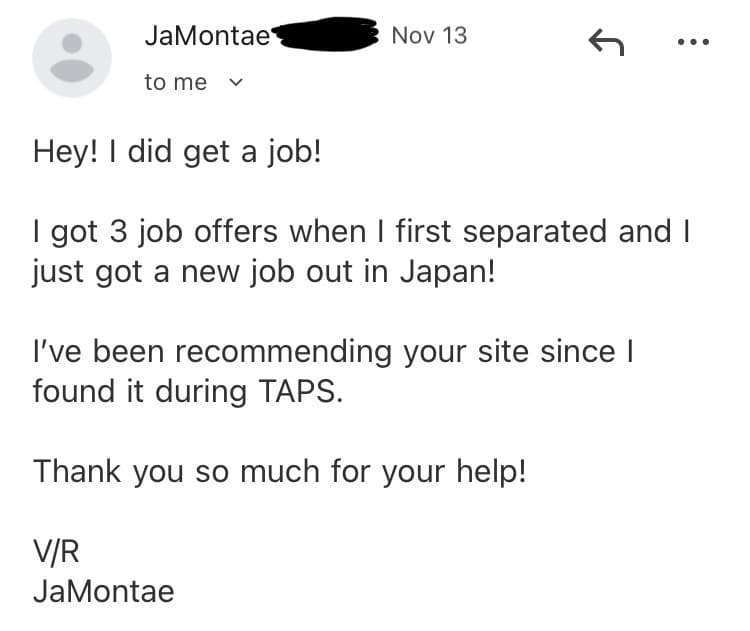
“Hey! I did get a job! I got 3 job offers when I first separated and I just got a new job out in Japan! I’ve been recommending your site since I found it during TAPS. Thank you so much for your help! V/R JaMontae ”
Federal service is one of the strongest moves a 2M0X3 can make, and the facility and power experience is what carries it. Your work maps onto a mix of Wage Grade trades occupations and General Schedule series that the Department of Defense, NASA, the Department of Energy, and the Department of Veterans Affairs hire for on a rolling basis to run their own buildings and plants.
On the trades side, the WG-5306 Air Conditioning Equipment Mechanic and WG-5309 Heating and Boiler Plant Equipment Mechanic occupations are direct matches for your HVAC, chiller, and central-plant experience, and WG-4742 Utility Systems Repair and Operating fits the broader facility-systems work. WG-5352 Industrial Equipment Mechanic suits the rotating-equipment and machinery side of the job. These Wage Grade jobs pay on a locality wage schedule rather than the GS table, and your hands-on technical-data record is exactly what their qualification standards ask for.
On the General Schedule side, GS-1601 General Facilities and Equipment covers facility operations and the technician-to-management track that supervisors move into, and GS-1670 Equipment Services fits support-equipment management. GS-0802 Engineering Technician suits anyone moving toward engineering-support and project roles, GS-1910 Quality Assurance fits the surety-minded technician who lived inspection and configuration control, and GS-0018 Safety and Occupational Health Management or GS-0803 Safety Engineering fit those who leaned into the system-safety side of nuclear surety. Read each qualification standard on USAJOBS against your own record before you apply, because the minimum-experience language differs by series. Our guide on moving from contractor to federal employee and the breakdown of Tier 3 versus Tier 5 clearance levels are both worth reading before you file. When you are ready to write the document, the federal resume builder handles the length and format USAJOBS expects, or you can start your federal resume here.
| GS Series | Federal Job Title | Typical Grades | Match | Explore |
|---|---|---|---|---|
| GS-5306 | Air Conditioning Equipment Mechanic | WG-08, WG-10, WG-11 | View Details → | |
| GS-5309 | Heating and Boiler Plant Equipment Mechanic | WG-08, WG-10, WG-11 | View Details → | |
| GS-4742 | Utility Systems Repair and Operating | WG-08, WG-10 | View Details → | |
| GS-0802 | Engineering Technician | GS-9, GS-11 | View Details → | |
| GS-1601 | General Facilities and Equipment | GS-7, GS-9, GS-11 | View Details → | |
| GS-1910 | Quality Assurance | GS-7, GS-9 | View Details → | |
| GS-1670 | Equipment Services | GS-7, GS-9 | View Details → | |
| GS-0018 | Safety and Occupational Health Management | GS-7, GS-9, GS-11 | View Details → |
Federal hiring uses keyword-matching and structured experience. BMR builds federal-format resumes (USAJobs-ready) with the right keywords, hours/week, and supervisor info — for any GS series above.
Free · No credit card · Federal + civilian resume formats included
Not everyone wants to stay in a related field. These career paths leverage your transferable skills — leadership, risk management, logistics, project planning — in completely different industries.
An elevator is a safety-critical electromechanical system tied to controls, power, and a paper trail where a missed inspection has real consequences. That is the surety mindset you already lived, pointed at a building instead of a launch facility.
Hospitals need technicians who treat a failure as a life-safety event and document every action. That mindset is exactly what nuclear surety built into you, applied to medical equipment instead of missile facilities.
A treatment plant is a continuous-process facility that cannot go offline, run to strict regulatory standards. The plant-operations and compliance discipline from a launch complex carries directly into municipal utilities.
Building automation runs the same chillers, transfer switches, and environmental setpoints you managed, now tied together by a control system. Your systems-level view of how power and cooling interact is the hard part to teach.
Commercial launch providers need people who understand ground-support facility systems and high-consequence procedures. You already worked the facility side of a space and missile mission, which most candidates have never seen.
Aviation maintenance runs on the same documented, inspected, zero-defect discipline you lived under surety. The precision and the paper trail transfer; the airframe systems are what you learn on the job.
Carriers and tower companies run distributed, unattended equipment sites that depend on backup power and tight environmental control, the same remote-facility problem you owned in the missile fields. Keeping electronic systems online at a site nobody visits for weeks is exactly the discipline you built.
The skills that made you a good Marine, Sailor, Airman, or Soldier transfer further than you think. BMR rewrites your bullets for any of the pivot careers above — without making you sound like you've never done the work.
Free · No credit card · Try unlimited career angles
If you are staying in facilities, power, or HVAC work, your terminology already translates. Plant operators and facility-engineering managers know what a chiller plant and a transfer switch are, so you do not need to reword those. This section is for 2M0X3 veterans targeting careers OUTSIDE facility maintenance, where a hiring manager has never set foot in a launch complex and reads launch-facility jargon as noise.
The goal is to keep the scale and the consequence while dropping the acronyms. A civilian reader does not know what a brine chiller or a guidance-and-control conditioning unit is, but every reader understands "mission-critical cooling system with zero acceptable downtime." Lead with the outcome you protected, not the equipment nomenclature.
| Military Term | Civilian Translation |
|---|---|
| Brine chiller / guidance-and-control conditioning unit | Precision environmental control system / process cooling system |
| Automatic switching unit / transfer switch | Automatic power-transfer and backup-power system |
| Diesel generator set / portable auxiliary power unit | Standby and emergency power generation |
| Technical data / tech order compliance | Standard operating procedures and documented maintenance standards |
| Nuclear surety program | Safety-critical reliability and compliance program |
Here is how that looks on the page. Before: "Performed PMIs on launch-facility brine chillers and diesel gensets per applicable tech data under the nuclear surety program." After: "Maintained mission-critical cooling and standby power systems for a hardened facility under documented reliability standards, sustaining continuous uptime with zero unplanned outages." The second version is what a data center hiring manager or a hospital facilities director actually reads. For more before-and-after examples built from evaluations rather than discharge paperwork, see how to convert an EPR, NCOER, or FITREP into resume bullets. The military resume builder does this translation for you, or you can build your resume now.
BMR turns your 2M0X3 duties and accomplishments into civilian bullets that match the job you're applying for — no manual translation, no rewriting.
Free · No credit card · Tailored to each job posting
Which certifications you need depends on where you're headed. Find your target career path below.
The wrong placement can sink an otherwise strong application. BMR knows where each cert ranks, what to call it, and how to frame it for ATS keyword matching and hiring manager attention.
Free · No credit card · Built around your real certs and clearance
Below are two tracks. The first is for staying in facilities, power, and HVAC work. The second is for moving into a different industry entirely.
Stack a recognized trade credential on top of your military experience so a civilian employer can place you fast. EPA Section 608 certification is effectively required to handle refrigerants, and most central-plant employers want it before day one. The SkillBridge program can place you with a facilities or critical-infrastructure employer in your last months of service, and the top SkillBridge companies list includes data center and building-systems operators. Industry associations worth knowing are ASHRAE for HVAC and building systems, RETA for industrial refrigeration, and the 7x24 Exchange for mission-critical facilities.
If you want out of the field entirely, your value is the discipline, not the equipment. A live clearance is worth real money, so read what a clearance is worth in salary and how to check your clearance status after separation before you let it lapse. American Corporate Partners (ACP) runs a free year-long veteran mentorship program that is genuinely useful for figuring out a pivot. When you are ready to put it on paper, the military resume builder translates the facility-systems work for you.
See also the Coast Guard MK Machinery Technician and Navy MM Machinist's Mate pages, which share the mechanical-systems DNA, and explore the full military-to-civilian career crosswalk. When you are ready, the federal resume builder handles USAJOBS formatting, or you can get started here.
Most veterans do this backwards — they wait until terminal leave to start, then panic. Here's the actual sequence that works.
Print this. Tape it to your monitor. Veterans who treat the transition like a 90-day op get hired faster than the ones who treat it like an emergency.
Stop rewriting from scratch every time you apply. BMR turns your military experience into civilian and federal resumes — tailored to each job.