Loading...
Loading...
The civilian and federal jobs that hire Air Force Ground Transportations — with real salaries and the resume that gets callbacks.
Every 2T1X1 has more options than a Google search will tell you. Below: career paths, BLS salary data, federal GS series, certifications by target career, and how to translate your experience without losing what made you valuable to the Air Force in the first place.
Free · No credit card · Tailored resume in under 5 minutes
After the Navy I got hired into 6 federal career fields and tech sales, and sat on federal hiring panels along the way. I spent the last 2 years rebuilding everything I learned into BMR, tuned for how AI actually screens resumes today. This is the system I wish I'd had on day one.
If you held the 2T1X1 AFSC, you ran the fleet that kept an installation moving. Ground Transportation Airmen operate and dispatch the full spread of base vehicles: 44-passenger buses on the installation shuttle, tractor-trailer combinations hauling outsized cargo, 10K and larger forklifts on the flightline, and wrecker and recovery vehicles when something breaks down on the apron. The work runs from passenger movement and bus operations to vehicle dispatch, deployment distribution, and the convoy and cargo movements that get an expeditionary force to where it needs to be.
Beyond driving, 2T1X1s carry the administrative weight that civilian fleets pay managers to handle. You administered the DoD Official Use program, examined and licensed installation motor vehicle operators under AFI 24-301, managed the pooled vehicle fleet, and ran preventative maintenance scheduling on that pool. That is dispatch, compliance, licensing, and fleet accountability in one career field. Training started with 8.5 weeks of Basic Military Training, then the Ground Transportation Apprentice Course taught by the 368th Training Squadron at Fort Leonard Wood, Missouri, where the AFSC requires you to meet the Mechanical line score on the ASVAB and qualify on government vehicles before award.
Civilian employers value this background because it is rare to find a candidate who has both driven the equipment and managed the program around it. A commercial fleet wants someone who can pass a DOT audit, schedule preventative maintenance, and dispatch drivers without a missed run. You did all three on active duty. If you are weighing where the skill set points, the military-to-civilian career explorer maps it out, and the closely related 2T3X1 Vehicle Maintenance and 2S0X1 Materiel Management pages cover the maintenance and supply sides of the same logistics enterprise.
When I separated from the Navy I spent 18 months sending out applications and getting almost no callbacks. The work I had done was solid. The problem was that nobody reading my resume could tell. A 2T1X1 hits the same wall: "drove buses and trucks" buries the dispatch program, the DOT-style compliance, and the fleet you were accountable for. The translation is what wins the interview, not the years you put in. — Brad Tachi, Navy Diver veteran & BMR founder
The number that matters when you're deciding what's next: how does civilian pay compare to what you make now?
Military comp is approximate (varies by location/dependents). Civilian is BLS median. Federal includes locality pay. Your real number depends on duty station, family status, GS step, and overtime.
The most direct civilian path is commercial driving, and the numbers are honest about it. Heavy and Tractor-Trailer Truck Drivers earned a median of $57,440 per year in May 2024 per the BLS Occupational Employment and Wage Statistics, and Transit and Intercity Bus Drivers landed at the same $57,440 median. School Bus Drivers sit lower at $47,040, and Light Truck Drivers at $44,140. Pay in trucking is mileage- and region-driven, freight markets are cyclical, and the long-haul side carries time away from home that not everyone wants. A 2T1X1 who already holds or can quickly convert to a CDL skips the most expensive part of the on-ramp.
The higher-ceiling moves use the program side of your AFSC rather than the steering wheel. Transportation, Storage, and Distribution Managers earned a median of $102,010 in May 2024 (BLS OEWS), and Logisticians earned $80,880. Dispatching and routing experience transfers into fleet operations and transportation coordination roles at carriers and distribution networks. If you ran the pooled-vehicle PM schedule, the maintenance side is open too: Automotive Service Technicians earned a median of $49,670 and Bus and Truck Mechanics and Diesel Engine Specialists earned $60,640 (BLS OEWS May 2024).
Geography matters. Distribution and warehousing hubs cluster around Memphis, Louisville, the Inland Empire in California, and the Dallas and Chicago corridors, so management and logistics roles concentrate there. For a deeper read on this field, see veterans in logistics and supply chain careers and moving from military logistics into management. Veterans coming from the Army side share these exact paths, which is why the Army 88M Motor Transport Operator and Navy LS Logistics Specialist guides line up with this one. When your resume is ready, the military resume builder turns dispatch logs into hiring-manager language.
| Civilian Job Title | Industry | BLS Median Salary | Outlook | Match |
|---|---|---|---|---|
Heavy and Tractor-Trailer Truck Driver O*NET: 53-3032.00 | Transportation | $57,440 | 5% (As fast as average) | strong |
Transit and Intercity Bus Driver O*NET: 53-3052.00 | Transportation | $57,440 | 8% (Faster than average) | strong |
Transportation, Storage, and Distribution Manager O*NET: 11-3071.00 | Logistics | $102,010 | 8% (Faster than average) | strong |
Dispatcher (Transportation) O*NET: 43-5032.00 | Transportation | — | 1% (Little or no change) | strong |
Logistician O*NET: 13-1081.00 | Logistics | $80,880 | 19% (Much faster than average) | strong |
Bus and Truck Mechanic / Diesel Engine Specialist O*NET: 49-3031.00 | Maintenance | $60,640 | 4% (As fast as average) | moderate |
Light Truck Driver O*NET: 53-3033.00 | Transportation | $44,140 | 5% (As fast as average) | moderate |
Automotive Service Technician O*NET: 49-3023.00 | Maintenance | $49,670 | 3% (As fast as average) | moderate |
School Bus Driver O*NET: 53-3051.00 | Transportation | $47,040 | 2% (Slower than average) | moderate |
BMR rewrites your 2T1X1 experience for any of the civilian roles above — keywords, achievements, and language hiring managers actually scan for.
Free · No credit card · 2 tailored resumes included
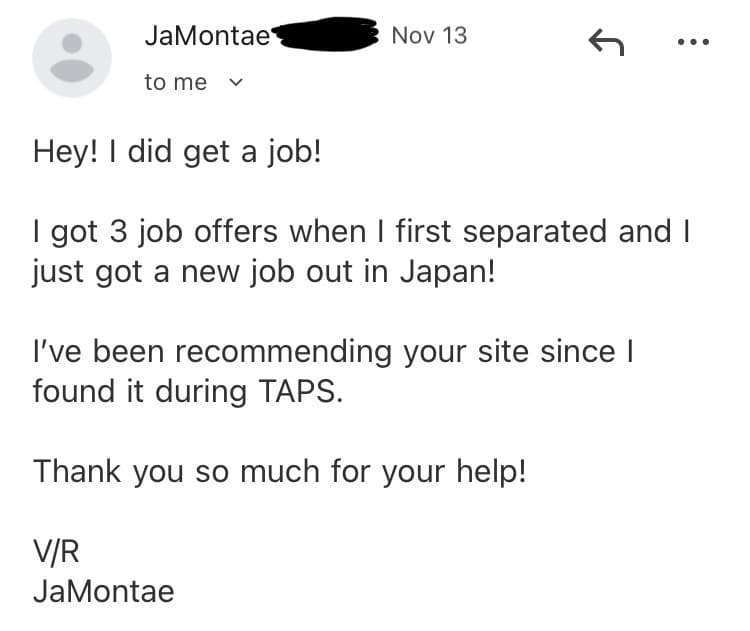
“Hey! I did get a job! I got 3 job offers when I first separated and I just got a new job out in Japan! I’ve been recommending your site since I found it during TAPS. Thank you so much for your help! V/R JaMontae ”
Federal transportation work is one of the cleaner crosswalks out of the 2T1X1 field, because the government classifies the exact functions you performed. The GS-2150 Transportation Operations series covers fleet dispatch, movement coordination, and transportation program management, and your bus and convoy operations experience maps to it directly, commonly at the GS-7 through GS-11 range as you document scope. The wage-grade WG-5703 Motor Vehicle Operator series is the hands-on driving equivalent, and WG-5704 Forklift Operating and WG-5705 Tractor Operating cover the equipment you ran on the flightline.
The program functions point higher. GS-2130 Traffic Management fits the routing and shipment-coordination side, GS-2030 Distribution Facilities and Storage Management fits if you handled deployment distribution, and GS-0346 Logistics Management is the broad path for the dispatch-and-accountability profile most 2T1X1s build. The fleet maintenance management you did on the pooled vehicles supports the GS-1670 Equipment Services series. Veterans' Preference adds 5 or 10 points to your rated score and, on many announcements, lets you compete on referral lists you would otherwise miss, which is why an honest accounting of your scope matters more than a job title.
To set qualifying experience up correctly, read how specialized experience works on a federal resume and matching your AFSC to a federal job series. The federal logistics path overlaps with the 2S0X1 Materiel Management field, so its GS targets are worth reviewing alongside these. The federal resume builder handles the page-count and hours-per-week formatting USAJOBS expects.
| GS Series | Federal Job Title | Typical Grades | Match | Explore |
|---|---|---|---|---|
| GS-5703 | Motor Vehicle Operating | WG-5, WG-6, WG-7 | View Details → | |
| GS-2150 | Transportation Operations | GS-7, GS-9, GS-11 | View Details → | |
| GS-2130 | Traffic Management | GS-7, GS-9, GS-11 | View Details → | |
| GS-2101 | Transportation Specialist | GS-5, GS-7, GS-9 | View Details → | |
| GS-0346 | Logistics Management | GS-9, GS-11, GS-12 | View Details → | |
| GS-2030 | Distribution Facilities and Storage Management | GS-7, GS-9 | View Details → | |
| GS-1670 | Equipment Services | GS-7, GS-9 | View Details → |
Federal hiring uses keyword-matching and structured experience. BMR builds federal-format resumes (USAJobs-ready) with the right keywords, hours/week, and supervisor info — for any GS series above.
Free · No credit card · Federal + civilian resume formats included
Not everyone wants to stay in a related field. These career paths leverage your transferable skills — leadership, risk management, logistics, project planning — in completely different industries.
Running a vehicle-safety and licensing program is the core of an OHS role. You already managed compliance, investigated incidents, and enforced standards across an operation.
Daily vehicle inspections trained you to find defects against a standard and document them defensibly. Inspection work rewards exactly that habit applied to code and structures.
You ran a regulatory program end to end: authorizing use, documenting it, and surviving audits. That is the day-to-day of corporate and government compliance work.
Your understanding of vehicle risk, liability, and safety translates naturally to property, casualty, and commercial-auto insurance. The discipline to work a pipeline solo comes from running daily operations.
Fleet, parts, and equipment manufacturers want reps who actually understand the product. You operated and maintained the gear, which gives you instant credibility selling into transportation and industrial accounts.
Real estate rewards self-starters who can run their own schedule, juggle several deals at once, and keep transactions moving to closing. That is the operational rhythm you already lived.
The skills that made you a good Marine, Sailor, Airman, or Soldier transfer further than you think. BMR rewrites your bullets for any of the pivot careers above — without making you sound like you've never done the work.
Free · No credit card · Try unlimited career angles
If you are staying in transportation, fleet operations, or logistics, your terminology already translates. Carriers, distribution centers, and bus systems use the same words you used, so do not waste resume space defining them. This section is for 2T1X1s targeting careers OUTSIDE transportation, where a hiring manager has never heard of an AFSC and reads "ground transportation" as "drove a truck." The fix is to surface the program, the compliance, and the accountability underneath the driving.
Translate the function, not the jargon. "Dispatch" becomes operations scheduling and resource coordination. "DoD Official Use program administration" becomes policy compliance and audit-ready recordkeeping. "Pooled vehicle fleet management" becomes asset accountability and lifecycle scheduling. "Operator examination and licensing" becomes training, certification, and qualification management. Each one is a civilian competency a non-transportation employer already hires for.
For more patterns, see 50 military terms translated to civilian language, the Air Force-specific guide to translating your EPR or OPR, and how to explain military experience in a civilian interview. The military resume builder does this translation pass for you against the job you are targeting.
BMR turns your 2T1X1 duties and accomplishments into civilian bullets that match the job you're applying for — no manual translation, no rewriting.
Free · No credit card · Tailored to each job posting
Which certifications you need depends on where you're headed. Find your target career path below.
The wrong placement can sink an otherwise strong application. BMR knows where each cert ranks, what to call it, and how to frame it for ATS keyword matching and hiring manager attention.
Free · No credit card · Built around your real certs and clearance
If you are keeping the field, the fastest moves protect your existing experience. A SkillBridge fellowship before separation can land you inside a carrier or distribution operation, and several logistics-heavy programs are listed in the SkillBridge programs by industry guide. If you do not already hold a CDL, the military-to-CDL free training guide covers the conversion routes. Professional bodies worth knowing: the American Trucking Associations, NAFA Fleet Management Association, and APICS/ASCM for the supply-chain credential track.
If you are done with the field entirely, look at the Want to Change Careers Entirely section below for skill-driven pivots, and lean on the broad transition credentials: a Project Management Professional or Six Sigma certification reframes your dispatch and fleet experience as operations management. American Corporate Partners (ACP) offers free one-on-one veteran mentorship to map a non-transportation path. For the federal route, SFL-TAP resources and the 10 federal job series every veteran should search are good starting points.
Related career fields with overlapping civilian paths: Army 88N Transportation Management Coordinator, Marine Corps 3531 Motor Vehicle Operator, and Air Force 2F0X1 Fuels. When you are ready to apply, the cleanest next step is to build your resume now.
Most veterans do this backwards — they wait until terminal leave to start, then panic. Here's the actual sequence that works.
Print this. Tape it to your monitor. Veterans who treat the transition like a 90-day op get hired faster than the ones who treat it like an emergency.
Stop rewriting from scratch every time you apply. BMR turns your military experience into civilian and federal resumes — tailored to each job.