Loading...
Loading...
The civilian and federal jobs that hire Air Force Electrical Power Productions — with real salaries and the resume that gets callbacks.
Every 3E0X2 has more options than a Google search will tell you. Below: career paths, BLS salary data, federal GS series, certifications by target career, and how to translate your experience without losing what made you valuable to the Air Force in the first place.
Free · No credit card · Tailored resume in under 5 minutes
After the Navy I got hired into 6 federal career fields and tech sales, and sat on federal hiring panels along the way. I spent the last 2 years rebuilding everything I learned into BMR, tuned for how AI actually screens resumes today. This is the system I wish I'd had on day one.
One page, built in our template, with your military experience translated into civilian terms hiring managers and ATS systems read. Use it as a reference for your own. Drop your email and we'll send you the download link.
Free. We'll also send occasional job-search tips. Unsubscribe anytime.
If you held the 3E0X2 AFSC, you kept the power on when the grid could not. Electrical Power Production specialists install, operate, troubleshoot, and overhaul the standby and prime power that runs an installation when commercial utility power drops. That means diesel and gas-turbine mobile electric power (MEP) generators from 3 kW to 100 kW and larger deployable power plants, automatic transfer switches that cut a flight line over to backup power in seconds, high and low-voltage switchgear and circuit breakers, paralleling controls, and the aircraft arresting systems (BAK-12 and BAK-14) that stop a fighter on an emergency landing. You read electrical wiring diagrams, interpret maintenance-malfunction data, and diagnose a prime mover down to the injector or the voltage regulator.
The training pipeline starts with 8.5 weeks of Basic Military Training, then technical training at Sheppard AFB, Texas, where you learn power generation principles, generation, conversion, transformation, and distribution, and the repair of aircraft arresting systems. From there you are a civil engineer Airman who deploys: bare-base power plants, contingency generators, and mission-critical uptime where a dropped load is not an inconvenience but a grounded sortie. Color vision is required because generator wiring is color-coded, and the work runs from the switchboard to the engine block.
Civilian employers value this background because the work is genuinely scarce. Most electricians have never paralleled two generators, commissioned an automatic transfer switch, or load-banked a 100 kW prime mover. You combine the electrical side and the mechanical side in one person, which is exactly what data centers, hospitals, and utilities pay a premium for. If you want to see how your AFSC maps across the civilian and federal job market, start with the military-to-civilian career crosswalk. Civil engineer Airmen in adjacent fields like 3E0X1 Electrical Systems and 3E5X1 Engineering share many of the same employers and federal series.
I spent years in federal environmental and engineering work after the Navy, and power-production backgrounds were some of the easiest to place because the skill is provable and rare. Anyone can claim they "worked on generators." You commissioned transfer switches, paralleled prime movers, and kept arresting systems mission-capable. Put that on paper in plain language and the interview comes to you. — Brad Tachi, Navy Diver veteran & BMR founder
The number that matters when you're deciding what's next: how does civilian pay compare to what you make now?
Military comp is approximate (varies by location/dependents). Civilian is BLS median. Federal includes locality pay. Your real number depends on duty station, family status, GS step, and overtime.
The civilian market for standby and prime power skills is strong, and it is concentrated in places that cannot tolerate downtime. Below are direct career matches with U.S. Bureau of Labor Statistics (BLS) Occupational Employment and Wage Statistics (OEWS) salary data, May 2024.
Two forces drive hiring: aging utility infrastructure and the build-out of facilities that run 24/7. Data centers, hospitals, water treatment plants, and telecom hubs all carry banks of generators and automatic transfer switches that need someone who can test, parallel, and overhaul them. The work is geographically broad but clusters around metro areas with heavy data-center and healthcare density. It is not cyclical the way construction electrical work can be. A standby plant has to be maintained whether the economy is up or down.
If you are staying in power and electrical work, your resume needs to name the equipment specifically. "Maintained generators" loses to "commissioned and load-banked 100 kW diesel prime movers and paralleling switchgear." A focused military resume builder turns AFSC tasks into civilian language a hiring manager scans in six seconds. When you are ready, build your resume now.
Cross-branch peers chase the same employers. See Navy Electrician's Mate (EM), Navy Construction Electrician (CE), and Army 91D Power Generation Equipment Repairer. For the broader move out of the trade, our Six Sigma for veterans guide is a useful next read.
| Civilian Job Title | Industry | BLS Median Salary | Outlook | Match |
|---|---|---|---|---|
Generator / Power Generation Technician O*NET: 49-2094.00 | Critical Facilities | $71,270 | Growth on par with average (BLS, installer/repairer group) | strong |
Electrical & Electronics Repairer, Commercial & Industrial Equipment O*NET: 49-2094.00 | Industrial | $71,270 | About as fast as average | strong |
Powerhouse, Substation & Relay Repairer O*NET: 49-2095.00 | Utilities | $71,270 | Stable utility demand | strong |
Electrical Power-Line Installer & Repairer O*NET: 49-9051.00 | Utilities | $92,560 | Faster than average | moderate |
Power Plant Operator / Distributor / Dispatcher O*NET: 51-8013.00 | Utilities | $103,600 | Little or no change | moderate |
Stationary Engineer & Boiler Operator O*NET: 51-8021.00 | Facilities | $75,190 | Little or no change | moderate |
Industrial Machinery Mechanic O*NET: 49-9041.00 | Manufacturing | $63,510 | Faster than average | moderate |
BMR rewrites your 3E0X2 experience for any of the civilian roles above — keywords, achievements, and language hiring managers actually scan for.
Free · No credit card · 2 tailored resumes included
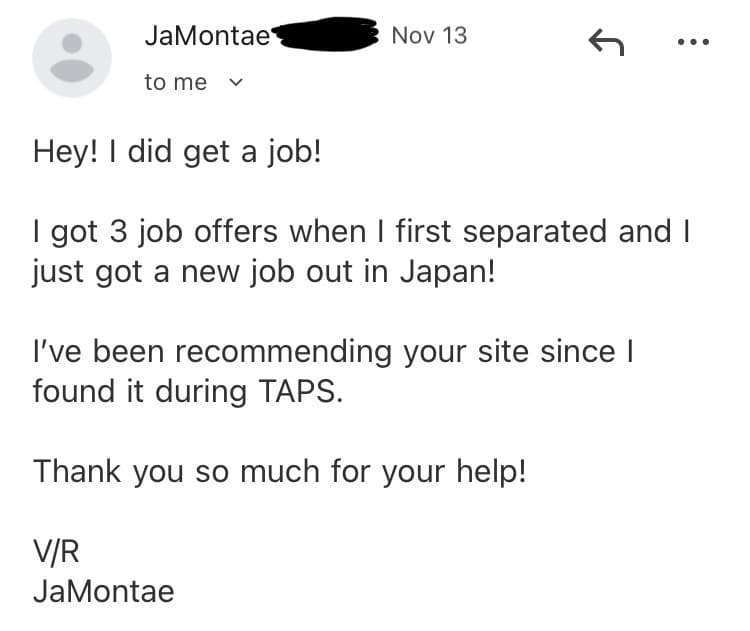
“Hey! I did get a job! I got 3 job offers when I first separated and I just got a new job out in Japan! I’ve been recommending your site since I found it during TAPS. Thank you so much for your help! V/R JaMontae ”
Federal service is one of the strongest landing zones for a power-production background, and not only at the obvious bases. The Department of Veterans Affairs runs central energy plants at every major medical center. The Army Corps of Engineers, Bureau of Reclamation, and TVA operate hydropower and generation. GSA, the National Park Service, and federal prisons all run standby power. Your AFSC maps to both Wage Grade (WG) trade jobs and General Schedule (GS) technical and engineering series.
Veterans' Preference adds 5 or 10 points to your federal application score, and many of these positions accept the WG trade route without a degree. The federal resume is its own format, longer and more detailed than a private-sector resume, with month-and-year dates and hours per week. Our federal resume tips and the GS pay scale guide walk through both. Build it with the federal resume builder, or start your federal resume here. Army 91C Utilities Equipment Repairers target many of these same WG series.
| GS Series | Federal Job Title | Typical Grades | Match | Explore |
|---|---|---|---|---|
| GS-2805 | Electrician | WG-8, WG-10 | View Details → | |
| GS-5378 | Powered Support Systems Mechanic | WG-8, WG-10 | View Details → | |
| GS-0802 | Engineering Technician | GS-7, GS-9, GS-11 | View Details → | |
| GS-0850 | Electrical Engineering | GS-7, GS-9, GS-11 | View Details → | |
| GS-0018 | Safety and Occupational Health Management | GS-7, GS-9, GS-11 | View Details → | |
| GS-1601 | General Facilities and Equipment | GS-7, GS-9 | View Details → |
Federal hiring uses keyword-matching and structured experience. BMR builds federal-format resumes (USAJobs-ready) with the right keywords, hours/week, and supervisor info — for any GS series above.
Free · No credit card · Federal + civilian resume formats included
Not everyone wants to stay in a related field. These career paths leverage your transferable skills — leadership, risk management, logistics, project planning — in completely different industries.
Hospital biomedical equipment demands the same electromechanical troubleshooting and zero-failure standard you applied to arresting systems and standby power, but on patient-care devices.
Offshore platforms and vessels run on the same generators, switchgear, and prime-mover diagnostics you handled, just at sea. Your austere-environment reliability experience is directly relevant.
Building management systems integrate power, HVAC, and life-safety controls. Your switchgear-control and transfer-switch commissioning experience maps onto the controls and sequencing side of BAS work.
Grid-scale battery and microgrid projects need technicians who understand power-electronics commissioning and switchgear integration. Your generator-paralleling and load-test experience transfers to inverter and storage commissioning.
HVAC blends the electrical and mechanical skills you already pair daily. Critical-facilities employers value technicians who can cover both power and cooling.
Running standby power across a base is small-scale facilities management. The uptime planning and maintenance coordination scale up to managing an entire building portfolio.
Manufacturing plants need planners who think in uptime and failure modes. Your reliability discipline on mission-critical power is exactly the mindset reliability planning rewards.
The skills that made you a good Marine, Sailor, Airman, or Soldier transfer further than you think. BMR rewrites your bullets for any of the pivot careers above — without making you sound like you've never done the work.
Free · No credit card · Try unlimited career angles
If you are staying in power generation, electrical, or facilities work, your terminology already translates. Utility and critical-facilities employers know what a transfer switch and a prime mover are. This section is for 3E0X2 veterans targeting careers OUTSIDE power production, where a hiring manager has never heard your AFSC.
Before: "Operated and maintained MEP generators and arresting gear at deployed locations."
After (operations / project role): "Sustained 99 percent uptime on mission-critical power systems across austere sites, coordinating maintenance schedules, parts logistics, and emergency response under deadline pressure."
Before: "Troubleshot generator faults and replaced components."
After (quality / reliability role): "Diagnosed root-cause failures on electromechanical systems and implemented corrective maintenance that reduced repeat faults, documenting findings to engineering standards."
The pattern is to lead with the outcome and the scale, then name the transferable skill. Our 50 military terms translated to civilian language glossary and how to explain military experience in an interview go deeper. The resume builder applies this translation automatically, or you can get started here.
BMR turns your 3E0X2 duties and accomplishments into civilian bullets that match the job you're applying for — no manual translation, no rewriting.
Free · No credit card · Tailored to each job posting
Which certifications you need depends on where you're headed. Find your target career path below.
The wrong placement can sink an otherwise strong application. BMR knows where each cert ranks, what to call it, and how to frame it for ATS keyword matching and hiring manager attention.
Free · No credit card · Built around your real certs and clearance
Start with the military resume builder or the federal resume builder, explore the full military-to-civilian jobs crosswalk, and review your transition timeline through SFL-TAP resources. When you are ready to apply, build your resume now.
See also: Navy Electrician's Mate, Marine Corps 1141 Electrician, and Coast Guard Electrician's Mate.
Most veterans do this backwards — they wait until terminal leave to start, then panic. Here's the actual sequence that works.
Print this. Tape it to your monitor. Veterans who treat the transition like a 90-day op get hired faster than the ones who treat it like an emergency.
Stop rewriting from scratch every time you apply. BMR turns your military experience into civilian and federal resumes — tailored to each job.