Loading...
Loading...
The civilian and federal jobs that hire Navy Construction Electricians — with real salaries and the resume that gets callbacks.
Every CE has more options than a Google search will tell you. Below: career paths, BLS salary data, federal GS series, certifications by target career, and how to translate your experience without losing what made you valuable to the Navy in the first place.
Free · No credit card · Tailored resume in under 5 minutes
After the Navy I got hired into 6 federal career fields and tech sales, and sat on federal hiring panels along the way. I spent the last 2 years rebuilding everything I learned into BMR, tuned for how AI actually screens resumes today. This is the system I wish I'd had on day one.
Navy Construction Electricians (CEs) are the Seabees who power everything the Naval Construction Force builds. If you held this rating, you ran power distribution and generation for forward operating bases, wired structures from rough-in to final trim, installed transformers and switchgear, set up and maintained prime power and tactical generators, pulled and terminated cable, and kept airfield lighting, communications power, and pole lines energized in austere conditions. You worked off the National Electrical Code in the field, troubleshot three-phase systems with a multimeter and your own judgment, and did it without a supply house down the street.
The training pipeline runs through Recruit Training Command, then CE "A" School at Naval Construction Training Center Gulfport, Mississippi, where you learned interior and exterior wiring, generator theory and operation, motor controls, and power distribution. From there you reported to a Naval Mobile Construction Battalion (NMCB), a Construction Battalion Maintenance Unit, or a Naval Construction Group. Many CEs deploy on rotations supporting humanitarian construction, base build-outs, and disaster response. Some advance into prime power, switchgear, and high-voltage work depending on their billet.
Civilian employers value this background because you bring code-based electrical work plus generator and power-distribution depth that most apprentices never touch. You read prints, you troubleshoot live systems, and you have a documented safety record. The Seabee rating sits next to other construction ratings: see the Navy UT Utilitiesman and Navy BU Builder paths if your work crossed trades, and use the military career crosswalk to compare every option side by side. If you want the licensing roadmap, the military to electrician licensing guide walks through how your hours count toward a journeyman card.
I spent years in federal environmental and engineering work after the Navy, and the thing I kept seeing is that electrical trades plus federal facilities is one of the cleanest matches there is. A CE who can document code-based wiring, generator maintenance, and power distribution is exactly who staffs base public works and federal facility shops. The work is real. What costs people interviews is a resume that buries the prime-power and switchgear experience under Navy shorthand. — Brad Tachi, Navy Diver veteran & BMR founder
The number that matters when you're deciding what's next: how does civilian pay compare to what you make now?
Military comp is approximate (varies by location/dependents). Civilian is BLS median. Federal includes locality pay. Your real number depends on duty station, family status, GS step, and overtime.
The civilian electrical trade is one of the most direct landings a Seabee can make. Per BLS OEWS (May 2024), electricians earn a median of $61,590 per year (O*NET 47-2111.00), with the top 10 percent above $104,000. Demand is steady. BLS projects electrician employment to grow about 11 percent through 2033, faster than the average for all occupations, driven by building construction, grid modernization, and electric-vehicle infrastructure.
Where you land depends on the work you want. Inside wiremen and commercial electricians do exactly what you did at rough-in and trim. If you ran pole lines, transformers, and high-voltage distribution, electrical power-line installers and repairers (O*NET 49-9051.00) earn a median of $85,420 and the work overlaps heavily with prime power. CEs who handled motor controls and switchgear often move into industrial electrician roles inside manufacturing plants, where uptime is the whole job. If you held a leadership billet, first-line supervisors of construction trades (O*NET 47-1011.00) earn a median of $76,760, and a CE crew leader's experience running a wiring crew on deployment translates cleanly.
Be honest about the market. Electrical work is cyclical and tied to construction starts. Union locals (IBEW) control a lot of the higher-wage commercial and industrial work, and getting in often means an apprenticeship interview where your military hours can shave time off the program. Solar PV installation (O*NET 47-2231.00, median $48,800) is growing fast but pays less at entry. Building inspection (O*NET 47-4011.00, median $64,480) rewards your code knowledge without the physical wear. Cross-branch, the same civilian paths open for the Air Force 3E0X1 Electrical Systems and Marine Corps 1141 Electrician career fields, so those pages are worth comparing if you are weighing where to apply. For the full apprenticeship-and-license picture, read the military to trade careers guide, then build your resume now to get your bullets translating before you apply.
| Civilian Job Title | Industry | BLS Median Salary | Outlook | Match |
|---|---|---|---|---|
Electrician O*NET: 47-2111.00 | Construction & Electrical Trades | $61,590 | 11% (Faster than average) | strong |
Electrical Power-Line Installer and Repairer O*NET: 49-9051.00 | Utilities | $85,420 | 8% (Faster than average) | strong |
Industrial Electrician O*NET: 47-2111.00 | Manufacturing | $61,590 | 11% (Faster than average) | strong |
First-Line Supervisor of Construction Trades O*NET: 47-1011.00 | Construction | $76,760 | 4% (Average) | strong |
Construction and Building Inspector O*NET: 47-4011.00 | Government & Construction | $64,480 | 0% (Little or no change) | moderate |
Solar Photovoltaic Installer O*NET: 47-2231.00 | Renewable Energy | $48,800 | 48% (Much faster than average) | moderate |
Electrical Inspector O*NET: 47-4011.00 | Government | $64,480 | 0% (Little or no change) | moderate |
Wind Turbine Service Technician O*NET: 49-9081.00 | Renewable Energy | $62,580 | 60% (Much faster than average) | emerging |
BMR rewrites your CE experience for any of the civilian roles above — keywords, achievements, and language hiring managers actually scan for.
Free · No credit card · 2 tailored resumes included
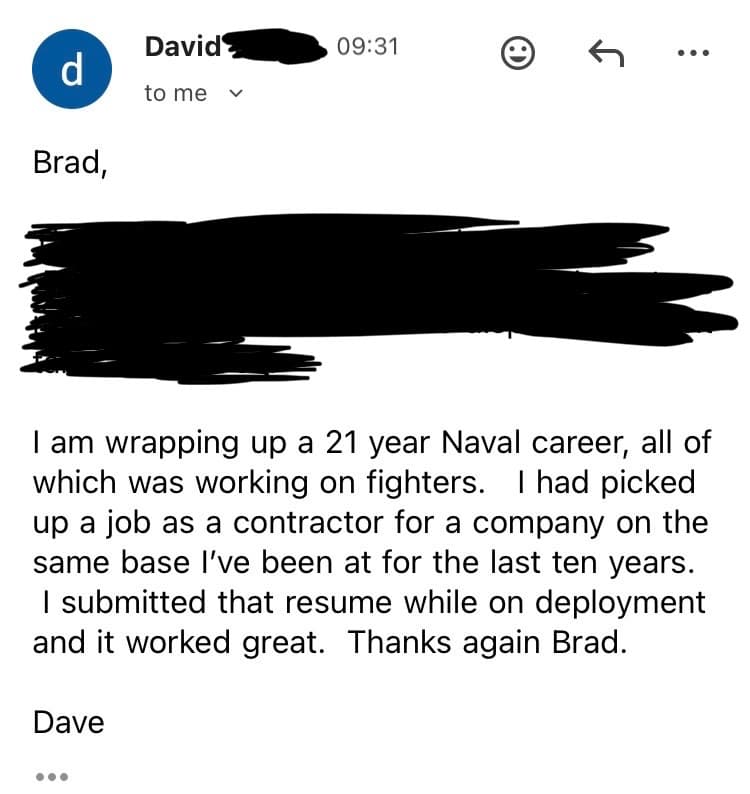
“I am wrapping up a 21 year Naval career, all of which was working on fighters. I had picked up a job as a contractor for a company on the same base I’ve been at for the last ten years. I submitted that resume while on deployment and it worked great. Thanks again Brad. Dave ”
Federal facilities run on electricians, and your Seabee record maps to the federal wage-grade and General Schedule systems with very little friction. The most direct match is the WG-2805 Electrician series, the federal trade classification for interior and exterior wiring, motor controls, and power distribution. WG-2805 positions sit on base public works departments, at NAVFAC, on Army and Air Force installations, in the VA, and across GSA-managed buildings. Your NEC-based field work and documented qualifications are the exact evidence these jobs ask for.
Beyond the trade series, your background opens technical and oversight roles. The GS-0809 Construction Control series covers inspectors who verify electrical and structural work against specifications. GS-1601 General Facilities and Equipment covers facilities management and shop supervision, where a former CE leading-petty-officer makes a natural fit. If you pursued an engineering degree on the GI Bill, GS-0850 Electrical Engineering and the GS-0802 Engineering Technician series sit one credential away. GS-1601 and GS-5306 Air Conditioning Equipment Mechanic round out the facilities-trade options if your billet crossed into building systems.
Veterans' Preference applies on USAJOBS, and wage-grade trade jobs are often easier to qualify for than GS professional series because they score your hands-on experience directly. Read 10 federal job series every veteran should search to map your options, and 15 federal resume tips that get veterans referred before you submit. A federal resume reads nothing like a civilian one, so our federal resume builder handles the format. The Army 12W Carpentry and Masonry Specialist page shares several of these same trade series if you are comparing construction-rate paths.
| GS Series | Federal Job Title | Typical Grades | Match | Explore |
|---|---|---|---|---|
| GS-2805 | Electrician | WG-10, WG-11, WG-12 | View Details → | |
| GS-1601 | General Facilities and Equipment | GS-7, GS-9, GS-11 | View Details → | |
| GS-0850 | Electrical Engineering | GS-7, GS-9, GS-11 | View Details → | |
| GS-0809 | Construction Control | GS-7, GS-9, GS-11 | View Details → | |
| GS-5306 | Air Conditioning Equipment Mechanic | WG-8, WG-10 | View Details → | |
| GS-0856 | Electronics Technician | GS-7, GS-9 | View Details → | |
| GS-1640 | Facility Operations Services | GS-5, GS-6, GS-7 | View Details → | |
| GS-0802 | Engineering Technician | GS-7, GS-9 | View Details → |
Federal hiring uses keyword-matching and structured experience. BMR builds federal-format resumes (USAJobs-ready) with the right keywords, hours/week, and supervisor info — for any GS series above.
Free · No credit card · Federal + civilian resume formats included
Not everyone wants to stay in a related field. These career paths leverage your transferable skills — leadership, risk management, logistics, project planning — in completely different industries.
CEs who kept generators and distribution running on deployment already manage uptime, crews, and safety on a plant floor that runs on the same priorities.
A CE can walk a buyer through generator sizing, switchgear, and distribution because they installed and ran it. That technical credibility is what separates a top industrial sales rep from a catalog reader.
CEs run electrical safety programs daily, controlling the most dangerous hazards on a jobsite. That experience is exactly what employers need in a safety specialist.
Seabees deploy for disaster response and stand up power and infrastructure when systems fail. That mission is the core of emergency management.
CEs who worked energized systems by the book bring the procedural discipline and risk judgment that flight training builds on.
Treatment plants run on the same pumps, motor controls, and continuous-operation mindset CEs already manage, with regulatory logging on top.
CEs who trained junior Seabees already teach the trade. Vocational programs need instructors with real field credibility.
The skills that made you a good Marine, Sailor, Airman, or Soldier transfer further than you think. BMR rewrites your bullets for any of the pivot careers above — without making you sound like you've never done the work.
Free · No credit card · Try unlimited career angles
If you are staying in the electrical trade, your terminology already translates. IBEW locals, industrial plants, and electrical contractors use the same language you used in the battalion, so do not water it down for them. This section is for CEs targeting careers OUTSIDE hands-on electrical work, where a hiring manager has never heard of an NMCB and needs your experience in business language.
The pattern that costs callbacks is leaving Navy shorthand on the page. A civilian recruiter reading "CE2, NMCB" learns nothing. The fix is naming the system, the scope, and the outcome.
For a CE moving into project coordination, operations, or facilities management, lead with the planning and accountability, not the wire. The 50 military terms translated to civilian language glossary covers the rest of your vocabulary, and how to explain military experience in a civilian interview handles the verbal version. Our military resume builder does this translation for you, or you can start your resume now and see your bullets rewritten in plain civilian terms.
BMR turns your CE duties and accomplishments into civilian bullets that match the job you're applying for — no manual translation, no rewriting.
Free · No credit card · Tailored to each job posting
Which certifications you need depends on where you're headed. Find your target career path below.
The wrong placement can sink an otherwise strong application. BMR knows where each cert ranks, what to call it, and how to frame it for ATS keyword matching and hiring manager attention.
Free · No credit card · Built around your real certs and clearance
Your fastest path to higher wages is a journeyman license, and your Navy hours count. Most states let you apply documented military electrical experience toward the on-the-job-training hours a journeyman card requires, though you still sit for the state or local exam. Start with your IBEW local or a state-approved apprenticeship. The military to electrician licensing guide breaks down hour requirements state by state. SkillBridge can place you with an electrical contractor or utility before you separate. The SkillBridge programs by industry guide lists trade partners, and how to get SkillBridge command approval covers the paperwork. Industry associations worth joining: IBEW, the Independent Electrical Contractors (IEC), and the National Electrical Contractors Association (NECA).
If you are leaving hands-on electrical work, your leadership and project experience carry weight. American Corporate Partners (ACP) pairs transitioning veterans with corporate mentors at no cost. For federal facilities and inspection roles, your security background and trade record are assets. Explore options in the military career crosswalk, and if construction management interests you, read the military to construction management guide. For broader transition resources and TAP support, see SFL-TAP resources.
Whatever direction you pick, the resume is the bottleneck. Use the military resume builder for private-sector roles or the federal resume builder for USAJOBS, then get started here. See also: Navy EO Equipment Operator and Navy CM Construction Mechanic career paths.
Most veterans do this backwards — they wait until terminal leave to start, then panic. Here's the actual sequence that works.
Print this. Tape it to your monitor. Veterans who treat the transition like a 90-day op get hired faster than the ones who treat it like an emergency.
Stop rewriting from scratch every time you apply. BMR turns your military experience into civilian and federal resumes — tailored to each job.