Loading...
Loading...
The civilian and federal jobs that hire Air Force Biomedical Equipments — with real salaries and the resume that gets callbacks.
Every 4A2X1 has more options than a Google search will tell you. Below: career paths, BLS salary data, federal GS series, certifications by target career, and how to translate your experience without losing what made you valuable to the Air Force in the first place.
Free · No credit card · Tailored resume in under 5 minutes
After the Navy I got hired into 6 federal career fields and tech sales, and sat on federal hiring panels along the way. I spent the last 2 years rebuilding everything I learned into BMR, tuned for how AI actually screens resumes today. This is the system I wish I'd had on day one.
One page, built in our template, with your military experience translated into civilian terms hiring managers and ATS systems read. Use it as a reference for your own. Drop your email and we'll send you the download link.
Free. We'll also send occasional job-search tips. Unsubscribe anytime.
As a 4A2X1 Biomedical Equipment Technician you kept the machines that keep people alive working. Ventilators, patient monitors, infusion pumps, anesthesia units, defibrillators, dialysis machines, surgical lasers, and diagnostic imaging systems all passed through your hands for installation, calibration, scheduled inspection, and repair. When a monitor in the ICU threw a fault at 0300, you were the one tracing it to a board, a sensor, or a power supply and getting it back in service before a clinician needed it. That is regulated, life-safety electronics work, and it is rare.
The training pipeline is one of the longest in the medical field. After Basic, you completed the tri-service Biomedical Equipment Technician course at the Medical Education and Training Campus (METC) on Fort Sam Houston, roughly 41 weeks covering electronics fundamentals, anatomy and physiology, medical device theory, and hands-on troubleshooting across device families. Entry requires an ASVAB Electronics composite of 70 and a Mechanical composite of 60, which screens for exactly the analytical and electromechanical aptitude civilian employers pay for. Many technicians later pursue Certified Biomedical Equipment Technician (CBET) credentialing, and some hold A+, Network plus, or Security plus from working networked medical devices.
Civilian employers value this background because medical and scientific equipment failures carry consequences, and because the work sits at the intersection of electronics, mechanics, software, and federal regulation. You already document to a standard. You already work inside FDA and Joint Commission expectations. You already calibrate to traceable references. That combination is the reason a 4A2X1 resume can open doors well beyond a hospital biomed shop, from calibration labs to aerospace test floors. For a wider view of where a technical AFSC can lead, the military to civilian career crosswalk is a good starting point, and the closely related 4R0X1 Diagnostic Imaging and 2A0X1 Avionics Test Station pages share parts of your skill set.
I spent years in federal environmental and engineering work after the Navy, and the thing that surprised me was how much hiring managers respect a technician who can prove they work to a regulated standard. A 4A2X1 already does that every single day. The calibration records, the inspection intervals, the device documentation. The challenge is never the skill. It is writing it so a civilian or federal manager sees a precision engineering professional, not just an equipment repairer. — Brad Tachi, Navy Diver veteran & BMR founder
The number that matters when you're deciding what's next: how does civilian pay compare to what you make now?
Military comp is approximate (varies by location/dependents). Civilian is BLS median. Federal includes locality pay. Your real number depends on duty station, family status, GS step, and overtime.
The most direct civilian path is medical equipment repair, and the market is strong. According to BLS Occupational Employment and Wage Statistics (May 2024), Medical Equipment Repairers (O*NET 49-9062.00) earned a median annual wage of $62,630, with employment projected to grow 13 percent from 2024 to 2034, much faster than average, driven by aging diagnostic and life-support fleets. Hospital systems, independent service organizations, and original equipment manufacturers all hire biomedical equipment technicians directly, and your METC training maps to the work with almost no gap.
Your calibration and test discipline opens a second lane. Calibration Technologists and Technicians (O*NET 17-3028.00) earned a median of $65,040 (BLS, May 2024), and Electrical and Electronic Engineering Technologists and Technicians (O*NET 17-3023.00) earned a median of $77,180. Both reward someone who can work to traceable standards and document results, which is exactly what biomedical inspection records demand. Industrial Machinery Mechanics (O*NET 49-9041.00, median $63,510, 13 percent growth) and Quality Control Inspectors (O*NET 51-9061.00, median $47,460) round out the field for technicians who want to apply the electromechanical and inspection side of the job in manufacturing settings.
Geography matters. Hospital biomed roles cluster around large metro health systems and Veterans Affairs medical centers, while calibration and test work concentrates near manufacturing and defense hubs. Independent service organizations travel, so field service roles can mean regional territory coverage. Many technicians who have worked networked devices also lean toward the medical software and integration side as imaging and monitoring move onto hospital networks. Veterans coming from the Navy or Coast Guard electronics world land in similar civilian roles, which is why the Navy ET Electronics Technician and Coast Guard ET paths overlap heavily with yours. To turn this experience into interviews, our military resume builder structures device-family and calibration experience the way technical hiring managers read it, or you can build your resume now.
| Civilian Job Title | Industry | BLS Median Salary | Outlook | Match |
|---|---|---|---|---|
Medical Equipment Repairer O*NET: 49-9062.00 | Healthcare | $62,630 | 13% (Much faster than average) | strong |
Calibration Technologist and Technician O*NET: 17-3028.00 | Manufacturing | $65,040 | 5% (Faster than average) | strong |
Electrical and Electronic Engineering Technologist and Technician O*NET: 17-3023.00 | Engineering | $77,180 | Average | strong |
Electro-Mechanical and Mechatronics Technologist and Technician O*NET: 17-3024.00 | Manufacturing | $70,760 | 1% (Little or no change) | moderate |
Industrial Machinery Mechanic O*NET: 49-9041.00 | Manufacturing | $63,510 | 13% (Much faster than average) | moderate |
Quality Control Inspector O*NET: 51-9061.00 | Manufacturing | $47,460 | Average | moderate |
BMR rewrites your 4A2X1 experience for any of the civilian roles above — keywords, achievements, and language hiring managers actually scan for.
Free · No credit card · 2 tailored resumes included
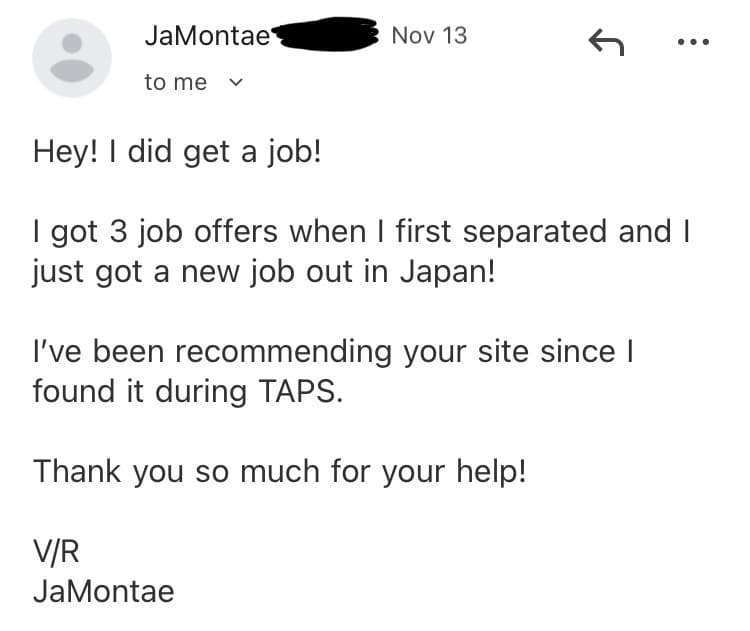
“Hey! I did get a job! I got 3 job offers when I first separated and I just got a new job out in Japan! I’ve been recommending your site since I found it during TAPS. Thank you so much for your help! V/R JaMontae ”
Federal service rewards a 4A2X1 background more than most veterans realize, because the government runs enormous medical, scientific, and engineering equipment fleets that need people who can maintain and certify them. The Department of Veterans Affairs is the single largest employer of biomedical equipment technicians in the country, and the Defense Health Agency, military treatment facilities, NIH, and federal research labs all staff these roles civilian-side.
The closest classification fit is the GS-0856 Electronics Technician series, which covers the install, calibrate, troubleshoot, and repair work you already do. Strong adjacent series include GS-0802 Engineering Technician for broader technical support roles, GS-1910 Quality Assurance for inspection and compliance work, and GS-0644 Medical Technologist or GS-0640 Health Aid and Technician where the role sits closer to clinical equipment support. Technicians who move toward design, project oversight, or test engineering can target GS-0855 Electronics Engineering or GS-0801 General Engineering as they add education. Equipment fleet and accountability roles map to GS-1670 Equipment Services and GS-0346 Logistics Management.
Most technicians qualify at the GS-7 to GS-9 range entering federal service, with GS-11 and above reachable as specialized experience accumulates. Veterans Preference adds points to your competitive rating and, through programs like VRA and VEOA, can route you to positions outside the standard competitive process. The federal resume is its own document with hours per week, supervisor details, and explicit duty narratives. Our federal resume builder is built for OPM format, and the specialized experience guide and MOS to GS series guide walk through the qualification standards. When you are ready, you can start your federal resume.
| GS Series | Federal Job Title | Typical Grades | Match | Explore |
|---|---|---|---|---|
| GS-0856 | Electronics Technician | GS-9, GS-11, GS-12 | View Details → | |
| GS-0802 | Engineering Technician | GS-7, GS-9, GS-11 | View Details → | |
| GS-1910 | Quality Assurance | GS-7, GS-9, GS-11 | View Details → | |
| GS-0640 | Health Aid and Technician | GS-5, GS-7, GS-9 | View Details → | |
| GS-1670 | Equipment Services | GS-7, GS-9, GS-11 | View Details → | |
| GS-0855 | Electronics Engineering | GS-9, GS-11, GS-12 | View Details → | |
| GS-0644 | Medical Technologist | GS-7, GS-9 | View Details → | |
| GS-0801 | General Engineering | GS-9, GS-11 | View Details → |
Federal hiring uses keyword-matching and structured experience. BMR builds federal-format resumes (USAJobs-ready) with the right keywords, hours/week, and supervisor info — for any GS series above.
Free · No credit card · Federal + civilian resume formats included
Not everyone wants to stay in a related field. These career paths leverage your transferable skills — leadership, risk management, logistics, project planning — in completely different industries.
Avionics work mirrors biomed troubleshooting and inspection, but on aircraft systems under FAA rather than FDA regulation. The fault-isolation and documentation discipline transfers directly.
Aerospace test floors need technicians who can run precision instrumentation and document results to a standard, which is exactly the calibration and inspection rigor a biomed tech brings.
Semiconductor fabs run on precision process equipment and strict cleanroom discipline. A biomed tech already works to tight tolerances in controlled, documented environments.
Biomedical devices integrate electronics, mechanics, and software exactly like robotic and automated systems. Field service on automation equipment rewards that combined skill set.
Solar and renewable energy controls work draws on the same electrical testing, commissioning, and safety discipline a biomed tech uses, in one of the fastest-growing fields tracked by BLS.
Broadcast and live-production environments need technicians who can keep complex electronic systems running under time pressure, the same calm under failure a biomed tech brings to a clinical setting.
The skills that made you a good Marine, Sailor, Airman, or Soldier transfer further than you think. BMR rewrites your bullets for any of the pivot careers above — without making you sound like you've never done the work.
Free · No credit card · Try unlimited career angles
If you are staying in biomedical or calibration work, your terminology already matches the industry and you can skip most of this section. Hospital biomed shops and calibration labs use the same device names, the same standards, and the same acronyms you used in service. This section is for technicians targeting careers outside the medical equipment specialty, where a hiring manager has never heard your AFSC or your shop language.
The goal is to translate regulated technical work into plain business and engineering language. Lead with the standard you worked to, the scope of equipment you owned, and the measurable reliability you delivered. Our 50 military terms translated to civilian language glossary and the translate EPR to civilian resume guide both help, and the military resume builder applies these patterns automatically.
A few examples. A military bullet of "Performed scheduled preventive maintenance inspections on 400-plus medical devices per Joint Commission standards" reads outside healthcare as "Managed preventive maintenance program for 400-plus regulated electronic assets, sustaining 98 percent uptime against compliance and inspection standards." A bullet of "Calibrated patient monitoring equipment to NIST-traceable references" becomes "Calibrated precision electronic instrumentation to traceable national standards, documenting results for audit and quality control." The work does not change. The framing moves it from a hospital shop to any engineering, manufacturing, or quality organization.
BMR turns your 4A2X1 duties and accomplishments into civilian bullets that match the job you're applying for — no manual translation, no rewriting.
Free · No credit card · Tailored to each job posting
Which certifications you need depends on where you're headed. Find your target career path below.
The wrong placement can sink an otherwise strong application. BMR knows where each cert ranks, what to call it, and how to frame it for ATS keyword matching and hiring manager attention.
Free · No credit card · Built around your real certs and clearance
Pursue the Certified Biomedical Equipment Technician (CBET) credential through the AAMI Credentials Institute, which is the recognized standard for hospital and ISO biomed roles. The Association for the Advancement of Medical Instrumentation (AAMI) publishes the standards your field runs on and is worth following. For calibration-focused paths, the American Society for Quality (ASQ) and NCSL International cover metrology and quality. SkillBridge can place you with hospital systems and independent service organizations during terminal leave, and the SkillBridge to federal career guide explains how to line one up.
For aerospace, semiconductor, robotics, or renewable energy paths, the certifications and entry routes differ by field and are covered in the certifications section below. American Corporate Partners (ACP) offers free veteran mentorship that helps when you are switching industries and need someone who has made the jump. For federal roles, Veterans Preference and the qualification standards in the specialized experience guide are your leverage.
Start with the military resume builder for private-sector roles or the federal resume builder for GS positions, and when you know your target, build your resume now. Explore adjacent roles through the career crosswalk, and use SFL-TAP resources for the broader transition. See also the Army 68A Biomedical Equipment Specialist, Air Force 4T0X1 Medical Laboratory, and 3E0X1 Electrical Systems pages for related career paths.
Most veterans do this backwards — they wait until terminal leave to start, then panic. Here's the actual sequence that works.
Print this. Tape it to your monitor. Veterans who treat the transition like a 90-day op get hired faster than the ones who treat it like an emergency.
Stop rewriting from scratch every time you apply. BMR turns your military experience into civilian and federal resumes — tailored to each job.