Loading...
Loading...
The civilian and federal jobs that hire Air Force Medical Laboratory Specialists — with real salaries and the resume that gets callbacks.
Every 4T0X1 has more options than a Google search will tell you. Below: career paths, BLS salary data, federal GS series, certifications by target career, and how to translate your experience without losing what made you valuable to the Air Force in the first place.
Free · No credit card · Tailored resume in under 5 minutes
After the Navy I got hired into 6 federal career fields and tech sales, and sat on federal hiring panels along the way. I spent the last 2 years rebuilding everything I learned into BMR, tuned for how AI actually screens resumes today. This is the system I wish I'd had on day one.
One page, built in our template, with your military experience translated into civilian terms hiring managers and ATS systems read. Use it as a reference for your own. Drop your email and we'll send you the download link.
Free. We'll also send occasional job-search tips. Unsubscribe anytime.
As a 4T0X1 Medical Laboratory Specialist, you ran the bench that the rest of the Air Force Medical Service quietly depended on. Hematology cell counts and differentials, microbiology cultures and sensitivities, clinical chemistry panels, urinalysis, and the blood bank where a single mislabeled unit is never an option. You worked under CLIA-regulated protocols, logged quality control on every analyzer before a single patient sample ran, and signed your name to results that physicians treated as fact. That is a level of analytical precision and regulated-process discipline most civilian hiring managers rarely see in one candidate.
Your pipeline backs that up. Initial skills training in the Medical Laboratory Apprentice course at the Medical Education and Training Campus (METC) at Fort Sam Houston results in an Associate in Applied Science in Medical Laboratory Technology, and the program satisfies the technical-education requirements toward a CCAF degree. From the 3-skill apprentice level through the 7-skill craftsman and the 9-skill superintendent roles, you moved from running assays to managing laboratory services, validating instruments, and supervising other technicians. Many 4T0X1 personnel also test for national certification through the ASCP Board of Certification, which is the credential that carries the most weight on the civilian side.
Civilian employers value this background because clinical laboratory science does not forgive guesswork. Hospitals, reference labs, pharmaceutical QC departments, and public-health labs need people who can operate analytical instrumentation, troubleshoot a failed control, document chain of custody, and follow a regulated protocol exactly the same way every shift. At BMR we have built more than 60,000 resumes across every branch and specialty, and the 4T0X1 background is one of the cleaner translations we see, provided the resume names the methods and the certification instead of burying them under a job title nobody outside the AFMS recognizes. If you want to see where your specialty maps, start with our military-to-civilian career crosswalk, and compare notes with the 4N0X1 Aerospace Medical Technician path if you cross-trained on patient care, or 4E0X1 Public Health if you leaned toward epidemiology and surveillance.
I have watched lab techs lose interviews because their resume said "performed laboratory testing" instead of "ran hematology, microbiology, and blood-bank assays under CLIA on automated analyzers, ASCP-certified." Same person, same skill, completely different callback rate. The work is rigorous. Make the resume say so. — Brad Tachi, Navy Diver veteran & BMR founder
The number that matters when you're deciding what's next: how does civilian pay compare to what you make now?
Military comp is approximate (varies by location/dependents). Civilian is BLS median. Federal includes locality pay. Your real number depends on duty station, family status, GS step, and overtime.
The most direct civilian path is the one you already know: the clinical laboratory. BLS groups Medical and Clinical Laboratory Technologists and Technicians together, and reports a median wage of $61,890 (BLS OEWS, May 2024), with the field projected to grow about 5% through 2033. Technologist-level roles (the MLS scope) sit at the upper end of that range, while technician-level roles (MLT scope) sit lower. The dividing line on the civilian side is usually your ASCP certification category and whether you hold or can finish a bachelor's degree, so confirm which credential a posting requires before you apply.
Within the lab, the work splits into the same departments you ran in service. Hematology, clinical chemistry, microbiology, immunohematology (blood bank), and molecular diagnostics each hire separately at large reference labs like Quest Diagnostics and Labcorp, and a 4T0X1 who can name a specific bench depth (for example, gram stains and culture work-ups in micro, or antibody screens and crossmatches in blood bank) reads as a specialist rather than a generalist. Hospital labs, in contrast, often want generalists who can cover multiple benches on an overnight shift, which is exactly how most Air Force labs operate.
Be honest about the market. Clinical lab work is stable but not high-growth, and pay varies sharply by region and by employer type (hospital systems and academic medical centers tend to pay more than standalone draw stations). Night and weekend differentials are real money in this field. If you are open to a higher ceiling, the same analytical skill set moves into pharmaceutical and biotech quality control, where a QC analyst running assays under GMP can out-earn a hospital bench tech. That is covered in the career-change section below. For the resume itself, our military resume builder is built to translate bench-level detail into language a civilian lab manager scans for, and you can build your resume now if you already know which bench you are targeting. If you served alongside Army lab techs, the Army 68K Medical Laboratory Specialist page covers the same civilian landscape from the Army side.
| Civilian Job Title | Industry | BLS Median Salary | Outlook | Match |
|---|---|---|---|---|
Medical Laboratory Scientist (MLS) O*NET: 29-2011.00 | Healthcare | $61,890 | 5% (As fast as average) | strong |
Medical Laboratory Technician (MLT) O*NET: 29-2012.00 | Healthcare | $61,890 | 5% (As fast as average) | strong |
Clinical Chemistry Technologist O*NET: 29-2011.00 | Healthcare | $61,890 | 5% (As fast as average) | strong |
Microbiology Technologist O*NET: 29-2011.00 | Healthcare | $61,890 | 5% (As fast as average) | strong |
Blood Bank / Immunohematology Technologist O*NET: 29-2011.00 | Healthcare | $61,890 | 5% (As fast as average) | strong |
Histotechnician O*NET: 29-2011.00 | Healthcare | $61,890 | 5% (As fast as average) | moderate |
Phlebotomist O*NET: 31-9097.00 | Healthcare | $43,660 | 8% (Faster than average) | moderate |
Laboratory Supervisor / Lead Technologist O*NET: 29-2011.00 | Healthcare | $61,890 | 5% (As fast as average) | strong |
BMR rewrites your 4T0X1 experience for any of the civilian roles above — keywords, achievements, and language hiring managers actually scan for.
Free · No credit card · 2 tailored resumes included
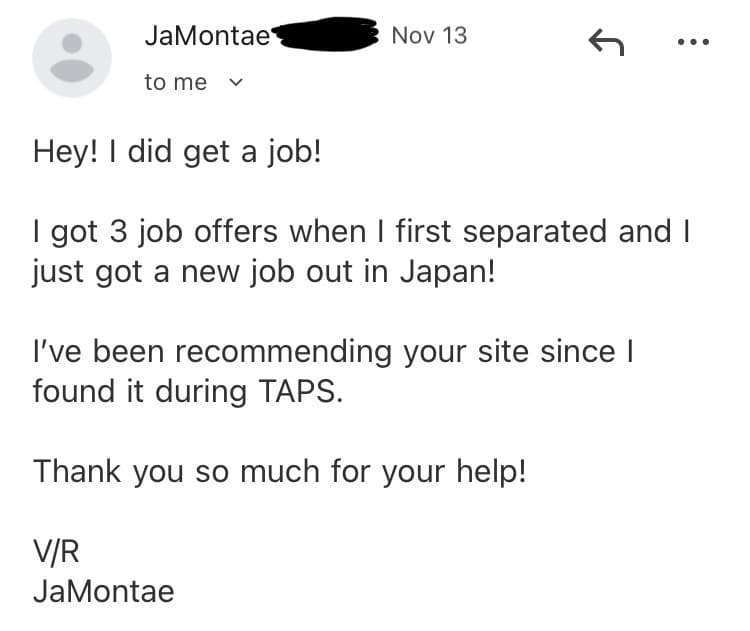
“Hey! I did get a job! I got 3 job offers when I first separated and I just got a new job out in Japan! I’ve been recommending your site since I found it during TAPS. Thank you so much for your help! V/R JaMontae ”
Federal labs are one of the strongest landing spots for a 4T0X1, because the work is nearly identical and the qualification standards already recognize your training. The Department of Veterans Affairs runs the largest integrated health-care lab system in the country, and the Defense Health Agency, military treatment facilities, the CDC, FDA, and Indian Health Service all staff clinical and research laboratories. Veterans' Preference applies to these positions, and your time in an AFMS lab counts as qualifying specialized experience, not just a checkbox.
The core series is GS-0644 Medical Technologist, which covers technologist-level bench and supervisory work and typically runs GS-7 through GS-12 depending on certification and degree. GS-0645 Medical Technician covers technician-level laboratory roles at GS-4 through GS-9. GS-0640 Health Aid and Technician picks up phlebotomy and specimen-processing roles. If you want to move toward the analytical chemistry side, GS-1320 Chemistry and GS-1306 Health Physics open up at research and environmental labs, and GS-0601 General Health Science is the catch-all for hybrid lab and program roles. The blood bank and transfusion specialists among you should look hard at GS-0644 positions tied to VA transfusion services, where immunohematology experience is specifically sought.
Grade placement turns on your ASCP certification and education. A certified MLS with a bachelor's degree qualifies for higher GS-0644 grades than a technician without the four-year degree, so list the certification category and the degree explicitly on a federal resume. The federal format is its own discipline. Our federal resume builder handles the USAJobs length and keyword requirements, the GI Bill certifications guide covers funding the ASCP credential if you still need it, and you can start your federal resume when you are ready. Coast Guard health-services veterans pursuing the same VA-lab path will find the HS Health Services Technician page useful for the shared federal series.
| GS Series | Federal Job Title | Typical Grades | Match | Explore |
|---|---|---|---|---|
| GS-0644 | Medical Technologist | GS-7, GS-9, GS-11 | View Details → | |
| GS-0645 | Medical Technician | GS-4, GS-5, GS-7, GS-9 | View Details → | |
| GS-0640 | Health Aid and Technician | GS-4, GS-5, GS-6 | View Details → | |
| GS-0601 | General Health Science | GS-7, GS-9, GS-11 | View Details → | |
| GS-1306 | Health Physics | GS-7, GS-9, GS-11 | View Details → | |
| GS-1320 | Chemistry | GS-7, GS-9, GS-11 | View Details → |
Federal hiring uses keyword-matching and structured experience. BMR builds federal-format resumes (USAJobs-ready) with the right keywords, hours/week, and supervisor info — for any GS series above.
Free · No credit card · Federal + civilian resume formats included
Not everyone wants to stay in a related field. These career paths leverage your transferable skills — leadership, risk management, logistics, project planning — in completely different industries.
Pharma QC runs the same assay-validation and quality-control discipline as a clinical chemistry bench, just under GMP instead of CLIA. The instrument and documentation habits transfer directly.
Food-safety labs test for pathogens using the same plating, culturing, and identification skills you used on the micro bench. The setting is a plant, not a hospital, but the science is the same.
Crime-lab work lives and dies on chain of custody and analytical precision, which is the exact discipline a blood-bank or chemistry tech already practices on every sample. The handling rigor transfers cleanly.
Environmental labs test water, soil, and air samples on analytical instruments under EPA methods, mirroring the regulated, controlled testing a clinical lab tech runs daily. The QC mindset is identical.
Breweries and fermentation producers run microbiology and chemistry QC on every batch to catch contamination and hold specs, which is the same bench work you did in a clinical micro lab applied to a different product.
CRAs monitor clinical trials for protocol compliance and data integrity. A lab tech understands specimen handling and regulated documentation from the bench side, which makes the trial-monitoring side faster to learn.
7- and 9-skill-level techs who ran lab quality systems and supervised benches already manage QC programs, audits, and corrective action. That is the core of a civilian QA management role.
The skills that made you a good Marine, Sailor, Airman, or Soldier transfer further than you think. BMR rewrites your bullets for any of the pivot careers above — without making you sound like you've never done the work.
Free · No credit card · Try unlimited career angles
If you are staying in clinical laboratory science, your terminology already matches the job posting. Lab managers know what a CBC with differential, a type and screen, and a culture and sensitivity are, so do not water those terms down. This section is for the 4T0X1 who wants to leave the clinical bench for a different industry, where "blood bank" and "AFMS" mean nothing to the hiring manager and your value has to be spelled out in their language.
The move is to translate the underlying skill, not the medical context. Running quality control on an analyzer becomes instrument calibration and statistical process control. Following CLIA becomes regulated-protocol compliance and audit readiness. Chain of custody on a specimen becomes documented sample integrity and traceability. Those are the phrases a pharmaceutical QC manager, a food-safety lab, or a forensic lab scans for. Our military terms glossary covers the broader translation patterns, and the interview guide for explaining military experience without jargon helps you carry the translation into the room. When you are ready to rebuild the bullets, the resume builder structures them for you, and the table below shows the before-and-after pattern for non-lab roles.
BMR turns your 4T0X1 duties and accomplishments into civilian bullets that match the job you're applying for — no manual translation, no rewriting.
Free · No credit card · Tailored to each job posting
Which certifications you need depends on where you're headed. Find your target career path below.
The wrong placement can sink an otherwise strong application. BMR knows where each cert ranks, what to call it, and how to frame it for ATS keyword matching and hiring manager attention.
Free · No credit card · Built around your real certs and clearance
SkillBridge can place you in a hospital system or reference lab before you separate. Quest Diagnostics and Labcorp both run veteran hiring pipelines, and large hospital networks recruit lab staff continuously. Keep your ASCP Board of Certification current, since it is the single credential that opens the most civilian lab doors, and verify whether your target state requires separate clinical-laboratory personnel licensure (California, New York, Florida, and a handful of others do). The American Society for Clinical Pathology (ASCP) and the American Society for Clinical Laboratory Science (ASCLS) are the professional bodies worth joining for continuing education and job boards. See the SkillBridge guide for timing and command approval.
If you are pivoting into pharmaceutical QC, food safety, environmental testing, or forensics, lean on American Corporate Partners (ACP) for veteran mentorship in those industries, and use your GI Bill strategically toward a relevant credential rather than a second degree you may not need. The GI Bill certifications list shows what your benefit covers, and SFL-TAP resources can structure your timeline. To compare specialties, the career crosswalk tool maps options side by side.
Whatever direction you choose, the resume is the gate. Our military resume builder and federal resume builder are built for exactly this translation, and you can get started here in a few minutes.
See also: Army 68K Medical Laboratory Specialist, Navy HM Hospital Corpsman, and Air Force 4N0X1 Aerospace Medical Technician career paths.
Most veterans do this backwards — they wait until terminal leave to start, then panic. Here's the actual sequence that works.
Print this. Tape it to your monitor. Veterans who treat the transition like a 90-day op get hired faster than the ones who treat it like an emergency.
Stop rewriting from scratch every time you apply. BMR turns your military experience into civilian and federal resumes — tailored to each job.