Loading...
Loading...
Civilian Career Paths & Job Guide
Everything you need to translate your HS experience into a civilian career — salary data, companies hiring, resume examples, and certifications by career path.
Coast Guard Health Services Technicians (HS) are the primary healthcare providers for Coast Guard personnel. Unlike medical roles in larger branches, an HS often works as the only medical professional on a cutter or at a remote shore unit. That level of independence sets this rating apart from every other military medical job.
Training starts with a 22-week A-school at USCG Training Center Petaluma, California. The curriculum covers anatomy, physiology, clinical lab work, nursing fundamentals, pharmacy, wound care, and medical administration. After A-school, HSs can earn advanced qualifications in X-ray technology, pharmacy, behavioral health, and independent duty certification. Many HSs also earn their NREMT-EMT credential during training.
Day to day, an HS runs sick call, provides emergency medical care, assists medical and dental officers, performs lab tests and X-rays, manages pharmacy operations, gives immunizations, and handles medical records. On cutters and at small units, an HS handles all of this alone. That means making clinical decisions without a doctor down the hall. It means stabilizing a patient on a pitching deck in the middle of a patrol and coordinating a medevac. Few civilian healthcare workers get that kind of autonomy this early in their career.
The civilian healthcare industry values this experience. Hospitals, clinics, VA medical centers, and public health agencies need people who can assess patients, make decisions under pressure, and manage a clinical operation. Whether you stay in healthcare or pivot to something new, the clinical skills and independent judgment you built as an HS transfer directly. If you are exploring how other military medical ratings compare, check out the Navy Hospital Corpsman (HM) and Army 68W Combat Medic pages. You can also explore all military-to-civilian career matches on our career crosswalk tool.
Healthcare is one of the strongest job markets in the country. The Bureau of Labor Statistics projects healthcare occupations will grow much faster than average through 2032. As a separating HS, you have clinical experience that many entry-level civilian candidates lack. The key is matching your experience to the right role and getting the right certifications.
This is the fastest path to a paycheck after separation. Many HSs already hold NREMT-EMT certification from A-school. EMTs earn a median of $41,340 per year (BLS May 2024). Paramedics, who complete additional training, earn a median of $58,410. Fire departments, private ambulance companies, and hospitals all hire EMTs. Your experience running sick call and handling emergencies on cutters gives you a real edge over candidates who only trained in a classroom.
Medical assistants work in clinics and physician offices. They take vitals, draw blood, give injections, handle patient intake, and manage medical records. This is close to what you did every day as an HS. Median pay is $44,200 (BLS May 2024). Many states do not require formal certification, though the CMA (AAMA) or CCMA (NHA) credentials help you stand out. This role is a solid stepping stone while you pursue nursing or other advanced credentials.
LPN programs typically take 12 months and build directly on what you learned as an HS. Many community colleges and vocational schools offer accelerated tracks for veterans with military medical experience. LPNs earn a median of $62,340 (BLS May 2024). LPNs work in hospitals, long-term care facilities, home health, and clinics. Your clinical hours from Coast Guard service may count toward program prerequisites at some schools. The Army 68C Practical Nursing Specialist page covers this career path in detail.
Nursing is the highest-demand healthcare career in America. RNs earn a median of $93,600 (BLS May 2024). Getting there requires either an Associate Degree in Nursing (ADN, 2 years) or a Bachelor of Science in Nursing (BSN, 4 years). Many nursing programs give credit for military medical training and clinical hours. The GI Bill covers both ADN and BSN programs. Some universities offer LPN-to-RN or military medic-to-RN bridge programs that shorten the timeline. This is a serious investment, but the payoff is real.
If you spent time managing medical records, patient data, and healthcare documentation as an HS, health information technology is a natural fit. These roles involve managing electronic health records (EHR), coding medical procedures, and ensuring data accuracy. Median pay is $67,310 (BLS May 2024). The RHIT credential from AHIMA is the standard certification. This path works well for HSs who prefer working with data over direct patient care.
HSs who managed pharmacy operations on cutters or at clinics already have hands-on pharmacy experience. Civilian pharmacy technicians earn a median of $43,460 (BLS May 2024). The PTCB (Pharmacy Technician Certification Board) exam is the industry standard. Retail pharmacies, hospitals, and mail-order pharmacies all hire pharmacy techs. Your military pharmacy training gives you a head start on the certification exam.
Many HSs assisted dental officers as part of their duties. Dental assistants earn a median of $47,300 (BLS May 2024). Some states require certification (CDA from DANB), while others allow on-the-job training. Dental offices, clinics, and community health centers hire dental assistants. Your experience working chairside with dental officers translates directly.
HSs who handled preventive medicine, environmental health inspections, or workplace safety programs can pivot to occupational health. These specialists earn a median of $83,910 (BLS May 2024) with 12% projected job growth. The CSP (Certified Safety Professional) credential from BCSP is the gold standard. Your preventive medicine and environmental health training maps well to OSHA compliance and workplace safety programs. See how the Air Force 4N0X1 Aerospace Medical Technician page covers similar crossover paths.
For HSs willing to invest in education, the PA path offers a median salary of $133,260 (BLS May 2024). PA programs require a bachelor's degree plus prerequisite courses and patient care hours. Your military clinical hours count toward the patient care requirement at many PA schools. This is a 6-8 year path from separation to practicing, but the GI Bill covers most of the cost. Some PA programs specifically recruit military medics.
For help translating your HS experience into a civilian resume, build your resume with our military resume builder. It is free to start and built specifically for veterans.
| Civilian Job Title | Industry | BLS Median Salary | Outlook | Match |
|---|---|---|---|---|
Emergency Medical Technician O*NET: 29-2042.00 | Emergency Medical Services | $41,340 | About as fast as average (5%) | strong |
Medical Assistant O*NET: 31-9092.00 | Healthcare / Clinics | $44,200 | Much faster than average (15%) | strong |
Licensed Practical Nurse (LPN) O*NET: 29-2061.00 | Healthcare / Hospitals / Long-term Care | $62,340 | About as fast as average (5%) | strong |
Registered Nurse (RN) O*NET: 29-1141.00 | Healthcare / Hospitals | $93,600 | Faster than average (6%) | strong |
Health Information Technologist O*NET: 29-9021.00 | Healthcare / Health IT | $67,310 | Faster than average (16%) | moderate |
Pharmacy Technician O*NET: 29-2052.00 | Pharmacy / Retail / Hospital | $43,460 | About as fast as average (6%) | strong |
Dental Assistant O*NET: 31-9091.00 | Dental / Healthcare | $47,300 | Much faster than average (11%) | moderate |
Occupational Health and Safety Specialist O*NET: 19-5011.00 | Government / Manufacturing / Healthcare | $83,910 | Faster than average (12%) | moderate |
Paramedic O*NET: 29-2043.00 | Emergency Medical Services / Fire Departments | $58,410 | About as fast as average (5%) | strong |
Physician Assistant O*NET: 29-1071.00 | Healthcare / Hospitals / Clinics | $133,260 | Much faster than average (27%) | moderate |
The federal government is one of the largest healthcare employers in the country. VA medical centers, Indian Health Service (IHS) facilities, USCG civilian clinics, and DHS all hire people with your exact background. As a Coast Guard veteran, you already understand how federal healthcare works from the inside. Build your federal resume here to get started on USAJobs applications.
GS-0640 Health Aid and Technician: The most direct match for separating HSs. These positions perform clinical support tasks at VA hospitals, military treatment facilities, and federal clinics. Patient care, vital signs, specimen collection, and clinical documentation. GS-4 through GS-7 entry range depending on experience.
GS-0645 Medical Technician: Lab-focused positions for HSs with clinical laboratory training. Blood draws, specimen processing, and diagnostic testing at VA and DoD labs.
GS-0620 Practical Nurse: If you earn your LPN license, this series covers federal LPN positions at VA hospitals and IHS clinics. VA is the largest employer of LPNs in the country.
GS-0610 Nurse: For HSs who earn their RN license. VA nurses earn competitive salaries with federal benefits, loan repayment programs, and guaranteed pension. The VA has special hiring authorities for nurses that can speed up the process.
GS-0681 Dental Assistant: Federal dental assistant positions at military dental clinics and VA facilities. Your experience assisting dental officers transfers directly.
GS-0660 Pharmacist / GS-0661 Pharmacy Technician: For HSs with pharmacy experience. VA pharmacies and military treatment facility pharmacies hire technicians with your background.
GS-0679 Medical Support Assistance: Front desk, scheduling, patient intake, and medical records management at VA and DoD healthcare facilities. A strong match for HSs who handled medical administration.
GS-0675 Medical Records Technician: Health information management positions. Coding, records maintenance, and data quality at federal healthcare facilities.
GS-0301 Miscellaneous Administration: Broad administrative series that covers healthcare administration roles at VA, DHS, and other agencies. Your medical office management experience applies.
GS-0343 Management and Program Analyst: For senior HSs with program management experience. Healthcare program analysis, policy review, and operational improvement roles.
GS-0018 Safety and Occupational Health: Workplace safety positions across all federal agencies. Your preventive medicine and environmental health training maps directly to OSHA compliance roles. Growing demand across DoD, VA, and DHS.
GS-0690 Industrial Hygiene: Environmental and occupational exposure monitoring. HSs with environmental health inspection experience are well qualified.
GS-0601 General Health Science: Broad public health and health science positions. Epidemiology support, health education, and disease prevention roles at CDC, IHS, and VA.
GS-0030 Sports Specialist / GS-0637 Manual Arts Therapist: Niche roles at VA rehabilitation centers that value hands-on clinical backgrounds.
VA Medical Centers: The Veterans Health Administration runs 171 medical centers and over 1,100 outpatient clinics. They actively recruit veterans for healthcare positions and offer Veterans Preference. Many VA positions do not require civilian certifications for entry-level roles.
USCG Civilian Health Services: The Coast Guard employs civilian healthcare workers at clinics and bases. As a former HS, you already know the system, the patients, and the mission. This is an often-overlooked option.
Indian Health Service (IHS): IHS operates hospitals and clinics on tribal lands, often in remote locations. HSs who served independent duty at remote stations understand this environment well. IHS offers loan repayment and recruitment bonuses for healthcare workers.
DHS / FEMA: Disaster medical response teams, port health screening, and immigration health services. Your Coast Guard medical experience with search and rescue and disaster response is directly relevant.
Federal resumes are 2 pages max. They need specific details like hours per week, supervisor name and phone, and detailed duty descriptions. Read our guide to writing a federal resume with no civilian experience for step-by-step instructions. Also see why hours per week matter on a federal resume.
| GS Series | Federal Job Title | Typical Grades | Match | Explore |
|---|---|---|---|---|
| GS-0640 | Health Aid and Technician | GS-5, GS-6, GS-7, GS-8 | View Details → | |
| GS-0645 | Medical Technician | GS-5, GS-6, GS-7 | View Details → | |
| GS-0647 | Diagnostic Radiologic Technologist | GS-5, GS-7 | View Details → | |
| GS-0671 | Health System Specialist | GS-7, GS-9, GS-11 | View Details → | |
| GS-0675 | Medical Records Technician | GS-5, GS-7, GS-9 | View Details → |
Not everyone wants to stay in a related field. These career paths leverage your transferable skills — leadership, risk management, logistics, project planning — in completely different industries.
HSs manage clinical operations, supply chains, personnel scheduling, and quality standards. Senior HSs run entire clinic operations at remote stations. This is operations management in a healthcare setting and the skills apply to any industry.
Every medical readiness inspection, clinic setup, and mass immunization event is a project. HSs plan scope, coordinate resources, manage timelines, and deliver results. PMP certification formalizes what you already do.
HSs train junior medical staff, teach CPR and first aid classes, and maintain training records. Senior HSs develop training programs and evaluate competency. This teaching and curriculum development experience transfers to corporate training roles.
HSs manage pharmaceutical inventories, medical supply chains, and equipment maintenance schedules. On cutters, you tracked every piece of medical equipment and medication. This inventory and logistics discipline translates to civilian supply chain roles.
Your preventive medicine training, environmental health inspections, and workplace safety experience map directly to OSHA compliance and EHS programs. You already know how to identify hazards, implement controls, and document compliance.
If you are applying to hospitals, clinics, or healthcare employers, your clinical terminology is mostly understood. Doctors and nurses know what vitals, injections, and wound care mean. This section is for HSs targeting careers outside of healthcare: project management, operations, safety, administrative roles, or corporate positions where the hiring manager has never heard of a sick call or independent duty.
Which certifications you need depends on where you're headed. Find your target career path below.
NREMT Certification: If your NREMT-EMT certification is still current, you can work as an EMT immediately. If it lapsed, the recertification process is faster than starting from scratch. Visit NREMT.org for requirements.
Nursing Bridge Programs: Many nursing schools offer accelerated tracks for military medics. Check with your local community college ADN program about credit for military training. The GI Bill Comparison Tool shows approved nursing programs near you.
VA Healthcare Careers: The VA actively recruits veterans for healthcare positions. Apply at USAJobs and filter for VA medical center positions. Many VA roles offer loan repayment and recruitment bonuses.
CG COOL: The Coast Guard COOL program can fund civilian certifications like CMA, PTCB, and NREMT while you are still on active duty. Use this before you separate.
SkillBridge: Coast Guard members can use SkillBridge to intern at hospitals, clinics, or healthcare companies during their last 180 days of service. Search the SkillBridge database for healthcare openings. Read our SkillBridge guide for tips on getting approved.
Project Management: Your experience managing clinical operations, supply chains, and medical readiness translates to project management. The PMP certification (PMI) is the standard credential. Your military management experience counts toward the experience requirement.
Safety and Compliance: Preventive medicine and environmental health training maps to occupational safety roles. Start with OSHA 30-Hour General Industry and work toward the CSP (Certified Safety Professional).
Federal Employment: Create your USAJobs profile and target GS-0640, GS-0679, GS-0018, and GS-0301 positions. Federal resumes are different from civilian resumes. Build your federal resume here.
TAP Resources: Take advantage of every Transition Assistance Program workshop available. The career counseling and resume review sessions are worth your time.
Navy Hospital Corpsman Career Guide | Army 68W Combat Medic Career Guide | Army 68K Medical Lab Specialist | Hidden Military Skills Civilians Value | Jobs for Veterans by MOS | Career Crosswalk Tool
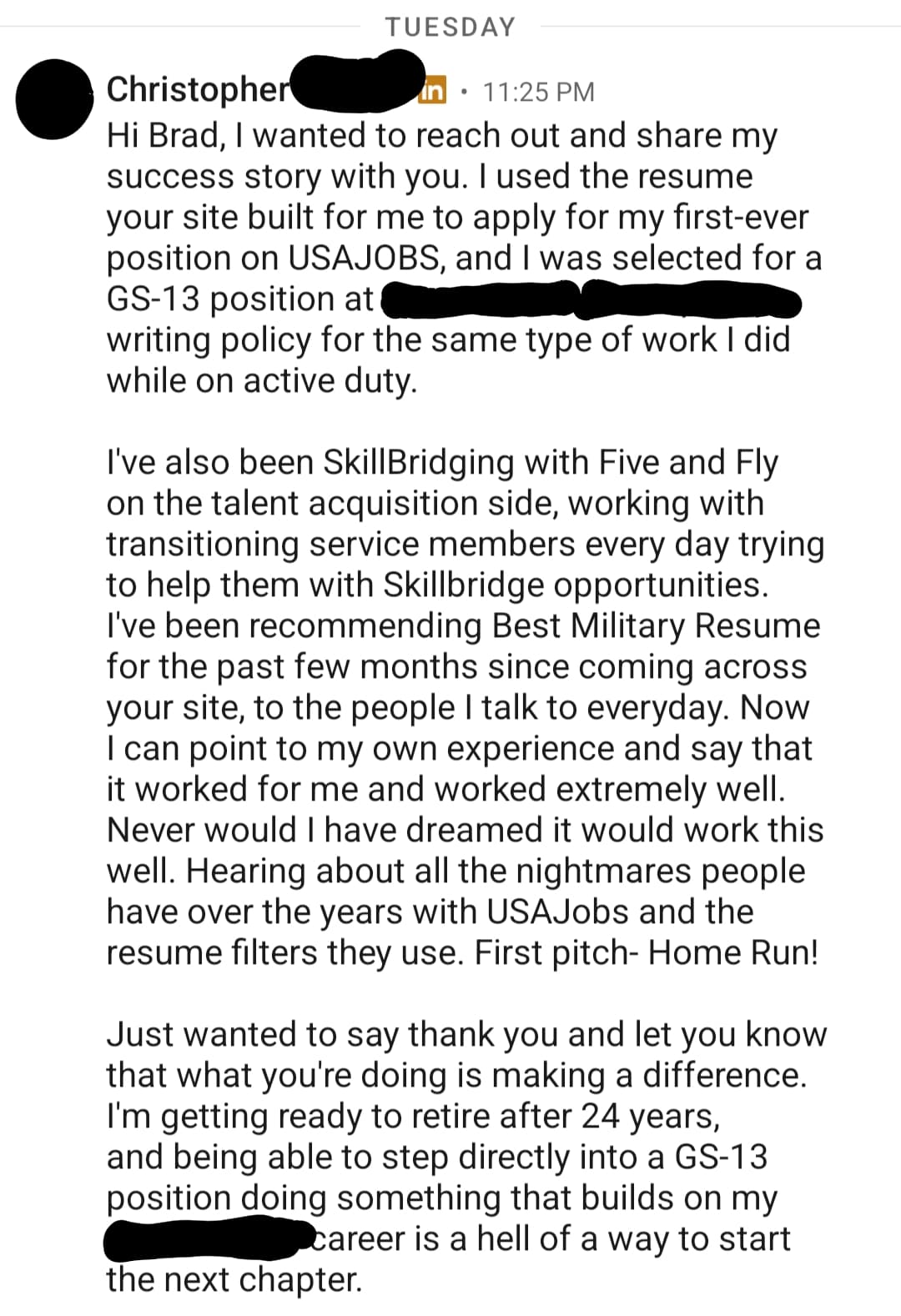
Ready to build your resume? Start for free at Best Military Resume. Our tool is built by a Navy Diver veteran who spent 1.5 years figuring out the transition process the hard way.
Translate your HS Health Services Technician experience into a resume that gets interviews.
Build Your Resume →