Loading...
Loading...
The civilian and federal jobs that hire Air Force Special Investigationss — with real salaries and the resume that gets callbacks.
Every 7S0X1 has more options than a Google search will tell you. Below: career paths, BLS salary data, federal GS series, certifications by target career, and how to translate your experience without losing what made you valuable to the Air Force in the first place.
Free · No credit card · Tailored resume in under 5 minutes
After the Navy I got hired into 6 federal career fields and tech sales, and sat on federal hiring panels along the way. I spent the last 2 years rebuilding everything I learned into BMR, tuned for how AI actually screens resumes today. This is the system I wish I'd had on day one.
One page, built in our template, with your military experience translated into civilian terms hiring managers and ATS systems read. Use it as a reference for your own. Drop your email and we'll send you the download link.
Free. We'll also send occasional job-search tips. Unsubscribe anytime.
BMR has built more than 60,000 resumes across every branch and specialty, and 7S0X1 special agents are one of the rarer backgrounds we see come through. There is a reason for that. You cannot enlist straight into Special Investigations. The Air Force Office of Special Investigations (AFOSI, now OSI) only takes Airmen who already proved themselves in another career field, passed one of the most thorough background investigations the military runs, and earned a slot at the Special Investigators Course at the Federal Law Enforcement Training Centers (FLETC) in Glynco, Georgia. That selectivity is exactly why the credential carries weight on the outside, but only if the resume actually translates the work.
As a 7S0X1 you ran felony-level criminal investigations, economic crime and fraud cases, and counterintelligence and counter-threat operations protecting Air Force and Space Force people, weapons systems, and technology. The day-to-day is interviews and interrogations conducted to a legal standard, evidence collection and chain-of-custody management, case files that hold up to prosecutorial review under the UCMJ and in federal court, source development, surveillance, and protective service operations for senior leaders and distinguished visitors. Many agents also work alongside forensic-science consultants and digital-crime specialists, and some carry credentials in technical or computer-crime investigations depending on assignment.
Civilian employers value this background because it is rare and it is verifiable. You hold a clearance, you have documented experience building cases that withstand legal scrutiny, and you have interviewed hostile and cooperative subjects under pressure. That combination maps cleanly onto the federal 1811 Criminal Investigator path and onto corporate roles in fraud, compliance, security, and cyber that most applicants reach without ever having worked a real case. If you want to see how your skills line up against other fields, the military career crosswalk tool is a good starting point, and agents leaving adjacent Air Force career fields often compare paths with Security Forces (3P0X1).
The 7S0X1 credential is one of the strongest investigative backgrounds in the military, but I see agents undersell it constantly. They write "conducted investigations" and stop there. The federal 1811 path and the corporate fraud and compliance world want to see the case volume, the conviction or adjudication outcomes, and the clearance stated plainly. Translate the work, not the title. — Brad Tachi, Navy Diver veteran & BMR founder
The number that matters when you're deciding what's next: how does civilian pay compare to what you make now?
Military comp is approximate (varies by location/dependents). Civilian is BLS median. Federal includes locality pay. Your real number depends on duty station, family status, GS step, and overtime.
The most direct civilian path for a 7S0X1 is federal criminal investigation, and the broader detective and investigator market is healthy. According to BLS OEWS (May 2024), Detectives and Criminal Investigators (33-3021) earned a median annual wage of $93,580. That category includes the federal special-agent roles at agencies like the FBI, DEA, ATF, HSI, and the inspector general offices, which is the most natural landing spot for an OSI background.
Private-sector investigation pays less on average but hires steadily. BLS OEWS (May 2024) reports Private Detectives and Investigators (33-9021) at a median of $52,370, though corporate investigations, financial-crime units at banks, and fraud teams at insurers pay well above that floor for candidates who bring federal-quality case experience and a clearance. Forensic Science Technicians (19-4092) earned a median of $67,440 per BLS OEWS (May 2024) for agents who worked closely with crime-scene and lab functions.
The fraud and financial-crime corner of the market is where investigation experience converts to higher pay. Compliance Officers (13-1041) earned a median of $78,420 and Claims Adjusters, Examiners, and Investigators (13-1031) earned $76,790, both per BLS OEWS (May 2024). Banks, payment processors, and insurers staff large special-investigation units that specifically want people who can build a documented case. Be honest about geography: the strongest federal and corporate investigation markets cluster around Washington DC, Northern Virginia, and major financial hubs. If you are open to fields beyond investigation, agents share civilian paths with Army Counterintelligence Agents (35L) and Coast Guard Investigators (IV). To get the resume itself right, our military resume builder is built for exactly this translation, and you can build your resume now when you are ready.
| Civilian Job Title | Industry | BLS Median Salary | Outlook | Match |
|---|---|---|---|---|
Federal Special Agent (Criminal Investigator) O*NET: 33-3021.00 | Federal Law Enforcement | $93,580 | 4% (As fast as average) | strong |
Corporate Investigator O*NET: 33-9021.00 | Corporate Security | $52,370 | 5% (Faster than average) | strong |
Fraud Investigator (Financial Crime Unit) O*NET: 13-1031.00 | Banking & Financial Services | $76,790 | 6% (Faster than average) | strong |
Insurance Special Investigations Unit (SIU) Investigator O*NET: 13-1031.00 | Insurance | $76,790 | 6% (Faster than average) | strong |
Compliance Officer O*NET: 13-1041.00 | Compliance & Regulatory | $78,420 | 4% (As fast as average) | strong |
Background Investigator O*NET: 33-9021.00 | Federal Security | $52,370 | 5% (Faster than average) | strong |
Forensic Science Technician O*NET: 19-4092.00 | Forensics | $67,440 | 14% (Much faster than average) | moderate |
Corporate Security Manager O*NET: 13-1041.00 | Corporate Security | $78,420 | 4% (As fast as average) | moderate |
BMR rewrites your 7S0X1 experience for any of the civilian roles above — keywords, achievements, and language hiring managers actually scan for.
Free · No credit card · 2 tailored resumes included
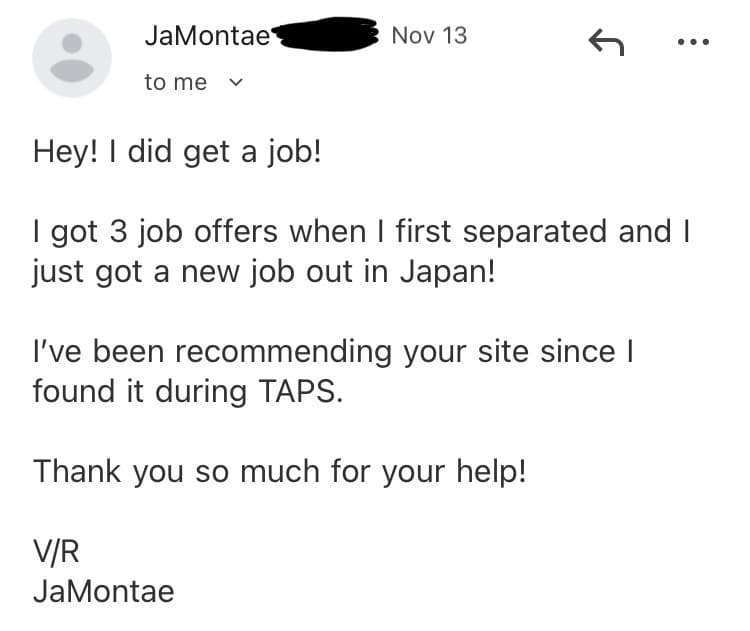
“Hey! I did get a job! I got 3 job offers when I first separated and I just got a new job out in Japan! I’ve been recommending your site since I found it during TAPS. Thank you so much for your help! V/R JaMontae ”
For a 7S0X1, the federal 1811 Criminal Investigator series is the marquee target and the closest one-to-one match in government. The GS-1811 series is the classification for armed federal special agents, and OSI agents qualify on the strength of documented case work, interview and interrogation experience, and an existing background investigation. Entry typically lands at GS-7 or GS-9 for agents with a degree and investigative experience, with journeyman special-agent work sitting at GS-11 through GS-13. The 1811 path runs through the FBI, DEA, ATF, HSI, the US Marshals, the Secret Service, and the dozens of agency inspector general and office of investigations components that hire continuously.
Beyond 1811, several series reward this background. GS-1810 General Investigating covers non-criminal administrative and suitability investigations, including the background-investigation work done by the Defense Counterintelligence and Security Agency. GS-0132 Intelligence fits agents who spent time in counterintelligence and counter-threat analysis. GS-0080 Security Administration and GS-0086 Security Clerical and Assistance cover personnel-security and information-security program roles. GS-1801 General Inspection, Investigation, Enforcement, and Compliance is the umbrella series for regulatory and program-integrity investigators across agencies. GS-0083 Police roles exist for agents who want a uniformed federal protective path.
Veterans preference applies across all of these, and the clearance plus a completed background investigation removes one of the slowest, most expensive steps an agency would otherwise have to fund. That is real leverage on a USAJobs application. Federal resumes follow their own rules on length, detail, and keyword alignment to the qualification standard, so our federal resume builder handles that structure, and agents targeting the same 1811 and 0132 series often cross-reference Marine Corps Counterintelligence/HUMINT (0211). When your federal resume is ready, you can start your federal resume here.
| GS Series | Federal Job Title | Typical Grades | Match | Explore |
|---|---|---|---|---|
| GS-1811 | Criminal Investigator | GS-9, GS-11, GS-12, GS-13 | View Details → | |
| GS-0132 | Intelligence | GS-11, GS-12, GS-13 | View Details → | |
| GS-1810 | General Investigating | GS-7, GS-9, GS-11 | View Details → | |
| GS-0080 | Security Administration | GS-7, GS-9, GS-11 | View Details → | |
| GS-1801 | General Inspection, Investigation, Enforcement | GS-7, GS-9, GS-11 | View Details → | |
| GS-0083 | Police | GS-5, GS-7, GS-8 | View Details → | |
| GS-0086 | Security Clerical and Assistance | GS-5, GS-6, GS-7 | View Details → |
Federal hiring uses keyword-matching and structured experience. BMR builds federal-format resumes (USAJobs-ready) with the right keywords, hours/week, and supervisor info — for any GS series above.
Free · No credit card · Federal + civilian resume formats included
Not everyone wants to stay in a related field. These career paths leverage your transferable skills — leadership, risk management, logistics, project planning — in completely different industries.
Incident response is investigation applied to digital intrusions. The discipline of preserving evidence, reconstructing a timeline, and writing a defensible report is the same work you did on a criminal case, just on systems and logs instead of people.
The core of OSI interviewing is getting accurate information from people who may not want to give it, then turning it into a defensible conclusion. Market research runs on the same skill: structured questioning, synthesis, and a written finding leadership can act on.
You spent years writing case files and reports that had to be precise enough to survive legal scrutiny. Technical writing is the same instinct applied to product, policy, and procedure documentation, where accuracy and clarity are the whole job.
UX research is professional interviewing for product teams. The skill of getting past what someone says to what they actually mean, and reporting it without bias, is exactly what made you effective in an interrogation room.
Auditing is investigation with a ledger. Economic-crime case work already taught you to follow money, spot what does not reconcile, and document it. The audit and forensic-accounting world wants exactly that mindset.
Corporate HR runs internal investigations into misconduct, harassment, and policy violations, and those teams need people who can conduct a neutral interview and document a finding that holds up. That is your core skill in a civilian setting.
The skills that made you a good Marine, Sailor, Airman, or Soldier transfer further than you think. BMR rewrites your bullets for any of the pivot careers above — without making you sound like you've never done the work.
Free · No credit card · Try unlimited career angles
If you are staying in investigations, your terminology already translates. Federal agencies and corporate investigation units know what a case agent, a chain of custody, and a record of interview are. This section is for agents targeting careers OUTSIDE the investigation field, where OSI language reads as jargon and needs to be rewritten in business terms.
The skill that travels furthest is structured information-gathering: you interview people, reconcile conflicting accounts, document findings to an evidentiary standard, and present conclusions that hold up under challenge. In a corporate or technical setting that is the language of research, compliance, and risk. Here is how a few of the core terms convert for non-field roles.
| OSI / Military Term | Civilian Business Term |
|---|---|
| Record of Interview (ROI) | Documented stakeholder interview and findings report |
| Chain of custody | Audit trail and evidence integrity controls |
| Counter-threat operation | Risk assessment and threat-mitigation program |
| Case disposition | Case resolution and outcome reporting |
A before-and-after shows why this matters. Before: "Served as case agent on 40-plus felony investigations and authored ROIs for SJA review." After (for a corporate compliance or research role): "Led 40-plus complex investigations end to end, conducting stakeholder interviews, reconciling conflicting evidence, and producing documented findings reports that withstood legal review." The work is identical. The second version is legible to a hiring manager who has never heard of an SJA. For more on rewriting military language, see our guide to translating military terms, and the military resume builder applies this automatically. When you want to draft it yourself, get started here.
BMR turns your 7S0X1 duties and accomplishments into civilian bullets that match the job you're applying for — no manual translation, no rewriting.
Free · No credit card · Tailored to each job posting
Which certifications you need depends on where you're headed. Find your target career path below.
The wrong placement can sink an otherwise strong application. BMR knows where each cert ranks, what to call it, and how to frame it for ATS keyword matching and hiring manager attention.
Free · No credit card · Built around your real certs and clearance
The federal special-agent path is the most natural next step. Build your USAJobs profile early and set saved searches for the 1811, 1810, and 0132 series. SkillBridge can place transitioning agents with law-enforcement and corporate-security organizations during your final months, so ask your base SkillBridge office which investigation-adjacent partners are currently authorized. For mentorship, American Corporate Partners (ACP) pairs transitioning service members with corporate mentors at no cost, which is useful if you are aiming at a private-sector fraud or security team. Start your federal documents with our federal resume builder and review the broader SFL-TAP transition resources.
If you are leaving investigation work behind, lead with the transferable signature: structured interviewing, evidence-grade documentation, risk analysis, and clearance. The career crosswalk at military-to-civilian jobs maps these into fields you may not have considered. When you are ready to write, you can build your resume now with the military resume builder.
Most veterans do this backwards — they wait until terminal leave to start, then panic. Here's the actual sequence that works.
Print this. Tape it to your monitor. Veterans who treat the transition like a 90-day op get hired faster than the ones who treat it like an emergency.
Stop rewriting from scratch every time you apply. BMR turns your military experience into civilian and federal resumes — tailored to each job.