Loading...
Loading...
The civilian and federal jobs that hire Navy Cryptologic Technician Maintenances — with real salaries and the resume that gets callbacks.
Every CTM has more options than a Google search will tell you. Below: career paths, BLS salary data, federal GS series, certifications by target career, and how to translate your experience without losing what made you valuable to the Navy in the first place.
Free · No credit card · Tailored resume in under 5 minutes
After the Navy I got hired into 6 federal career fields and tech sales, and sat on federal hiring panels along the way. I spent the last 2 years rebuilding everything I learned into BMR, tuned for how AI actually screens resumes today. This is the system I wish I'd had on day one.
If you served as a Cryptologic Technician Maintenance (CTM), you were the Sailor who kept sophisticated cryptologic, electronic, and communications systems running when they could not be allowed to fail. CTMs perform preventive and corrective maintenance on electronic cryptologic and ancillary systems used for communications, monitoring, tracking, recognition, electronic attack, and physical security. You installed, tested, troubleshot, repaired, and replaced cryptologic networks, antennas, personal computers, digital and optical interfaces, and data systems aboard surface ships, submarines, and shore sites. You fabricated and terminated radio-frequency and fiber-optic cable, isolated faults down to the component level with test equipment and technical manuals, and configured the switches and routers that carry secure traffic. This is the electronics-engineering and maintenance track of the Navy's Information Warfare community, and it sits apart from the collection, analysis, and language ratings beside it.
The training pipeline runs through Information Warfare technical schools, where CTMs build a foundation in electronics theory, digital systems, networking, and the specific cryptologic and physical-security equipment they will sustain in the fleet. Most CTMs hold a Top Secret/SCI clearance with counterintelligence-scope polygraph eligibility, because the systems you maintained carried national and fleet tasking. Sea-shore rotation is built into the rating, and roughly half of a CTM's career is spent at sea supporting surface and submarine cryptologic operations. The work is documented to inspection standard: logged maintenance actions, parts tracking, tag-out compliance, and readiness reporting that holds up under audit.
Civilian employers value this background because it is rare. You are not a generalist who took a soldering class. You diagnosed and restored complex electronic systems under operational pressure, on a deployed platform, where a wrong move had consequences and the next technician was a thousand miles away. That combination of hands-on electronics depth, disciplined documentation, and a high-level clearance is exactly what defense electronics firms, federal engineering organizations, and technical employers look for. To see how your skills map to specific roles and salaries, start with the military-to-civilian career crosswalk. CTMs sit alongside the other Navy cryptologic ratings, and you can compare paths with CTT Cryptologic Technician Technical and CTN Cryptologic Technician Networks, but CTM is the one built around fixing the hardware, not collecting or analyzing the signal.
I spent years in federal environmental and engineering work after the Navy, and the CTM background lines up with that world better than most ratings I see. You already think like an electronics engineer's right hand. You read schematics, isolate faults, and restore systems to spec under documentation that has to survive an inspection. That is the GS-0856 and GS-0855 skill set, and the clearance you carried is the part civilians cannot replicate. The translation is the only thing standing between your maintenance log and a federal electronics offer. — Brad Tachi, Navy Diver veteran & BMR founder
The number that matters when you're deciding what's next: how does civilian pay compare to what you make now?
Military comp is approximate (varies by location/dependents). Civilian is BLS median. Federal includes locality pay. Your real number depends on duty station, family status, GS step, and overtime.
The strongest direct civilian matches for a CTM are in electronics maintenance, repair, and technician work, where your fault-isolation and systems-restoration experience transfers with almost no retraining. The U.S. Bureau of Labor Statistics (BLS, May 2024) reports a median annual wage of $71,270 for electrical and electronics installers and repairers as a group, with the highest 10 percent earning more than $109,300. Within that group, avionics technicians earned a median of $81,390 and telecommunications equipment installers and repairers earned $64,310. Electrical and electronic engineering technologists and technicians, a common next step for CTMs who pair their experience with an associate degree, earned a median of $77,180.
Defense electronics is the most natural landing zone. Contractors that build and sustain the cryptologic, SIGINT, and secure-communications systems you maintained hire CTMs specifically because you already know the equipment and you already hold the clearance. The market here is steady rather than cyclical, and it concentrates around fleet concentration areas and major SIGINT sites: Hampton Roads, San Diego, Maryland's Fort Meade corridor, Hawaii, and Georgia. Commercial electronics maintenance, broadband and telecom infrastructure, and industrial controls are broader but more geographically distributed, so geography is worth weighing against the role you want.
Cleared electronics roles command a premium that uncleared candidates cannot match, which is why a CTM who keeps the clearance current is in a different hiring lane than a civilian-trained technician. For a sense of how that clearance translates to pay, our blog breaks down what a security clearance is worth by level. CTMs share civilian destinations with electronics maintainers in other branches, including the Coast Guard's ET Electronics Technician and the Air Force's 2A0X1 Avionics Test Station and Components. When you are ready to put this on paper, the military resume builder turns maintenance-log language into the accomplishment statements hiring managers read, or you can build your resume now.
| Civilian Job Title | Industry | BLS Median Salary | Outlook | Match |
|---|---|---|---|---|
Electronics Technician (Commercial and Industrial Equipment) O*NET: 49-2094.00 | Electronics Maintenance | $71,270 | Little or no change (BLS 2024-2034) | strong |
Avionics Technician O*NET: 49-2091.00 | Aviation Electronics | $81,390 | 4% (As fast as average) | strong |
Electrical and Electronic Engineering Technician O*NET: 17-3023.00 | Engineering Support | $77,180 | 2% (Slower than average) | strong |
Telecommunications Equipment Installer and Repairer O*NET: 49-2022.00 | Telecommunications | $64,310 | -7% (Decline) | strong |
Calibration Technologist and Technician O*NET: 17-3028.00 | Test and Measurement | $65,040 | 5% (Faster than average) | moderate |
Computer Network Support Specialist O*NET: 15-1231.00 | IT Infrastructure | $73,340 | 4% (As fast as average) | moderate |
Electro-mechanical and Mechatronics Technician O*NET: 17-3024.00 | Industrial Automation | $70,760 | 2% (Slower than average) | moderate |
Electronics Engineer (with degree) O*NET: 17-2072.00 | Defense Electronics | $127,590 | 5% (Faster than average) | emerging |
BMR rewrites your CTM experience for any of the civilian roles above — keywords, achievements, and language hiring managers actually scan for.
Free · No credit card · 2 tailored resumes included
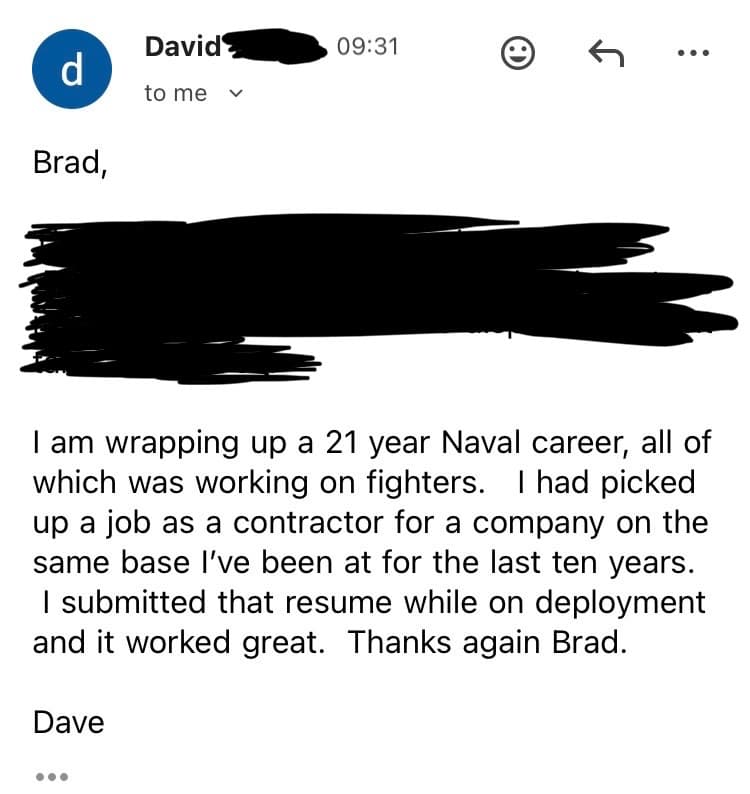
“I am wrapping up a 21 year Naval career, all of which was working on fighters. I had picked up a job as a contractor for a company on the same base I’ve been at for the last ten years. I submitted that resume while on deployment and it worked great. Thanks again Brad. Dave ”
Federal service is where a CTM's electronics background and clearance combine most cleanly, and the qualifying series are specific. The crosswalk tool shows the full mapping, but the anchors are GS-0856 Electronics Technician and GS-0855 Electronics Engineering. The GS-0856 series is the closest one-to-one match for hands-on CTM work: installing, calibrating, troubleshooting, and repairing complex electronic systems. With a journeyman maintenance record, many CTMs qualify at the GS-7 to GS-11 range, and senior CTMs with lead or installation-activity experience can compete higher. GS-0855 Electronics Engineering opens up when you add an engineering degree or strong technical coursework, and it is the series to aim at if you want the design and systems-engineering side rather than bench repair.
Beyond those two, GS-0802 Engineering Technician covers broader technical support across engineering organizations, and GS-0854 Computer Engineering fits CTMs who leaned into the networking, switch, and router side of the rating. GS-0391 Telecommunications and GS-0392 General Telecommunications map to the antenna, RF, and secure-communications hardware you sustained. Agencies that hire heavily into these series include NAVWAR, NAVSEA warfare centers, the Naval Information Warfare Centers in San Diego and Charleston, the Army's communications-electronics commands, and the broader Intelligence Community where cleared electronics technicians are continuously in demand.
Veterans preference applies on USAJOBS, and a CTM separating with a current TS/SCI is an unusually competitive candidate because the hiring organization avoids the cost and delay of sponsoring a new investigation. The federal resume is its own format with its own rules, longer and more detailed than a private-sector resume, and getting it right is what separates referral from rejection. Our guide on the 2026 OPM federal resume format walks through the requirements, and CTMs targeting the same series as Air Force maintainers can compare paths with 3D1X2 Cyber Transport Systems. When you are ready, the federal resume builder is built around the OPM format, or you can start your federal resume here.
| GS Series | Federal Job Title | Typical Grades | Match | Explore |
|---|---|---|---|---|
| GS-0855 | Electronics Engineering | GS-7, GS-9, GS-11, GS-12 | View Details → | |
| GS-0856 | Electronics Technician | GS-7, GS-9, GS-11 | View Details → | |
| GS-0802 | Engineering Technician | GS-7, GS-9, GS-11 | View Details → | |
| GS-0854 | Computer Engineering | GS-9, GS-11, GS-12 | View Details → | |
| GS-0391 | Telecommunications | GS-7, GS-9, GS-11 | View Details → | |
| GS-0392 | General Telecommunications | GS-6, GS-7, GS-9 | View Details → |
Federal hiring uses keyword-matching and structured experience. BMR builds federal-format resumes (USAJobs-ready) with the right keywords, hours/week, and supervisor info — for any GS series above.
Free · No credit card · Federal + civilian resume formats included
Not everyone wants to stay in a related field. These career paths leverage your transferable skills — leadership, risk management, logistics, project planning — in completely different industries.
CTMs are used to keeping mission-critical electronic life-or-mission systems running under pressure. Respiratory therapists run ventilators and monitoring equipment where the same calm, procedural precision is the job.
CTMs already respect powerful energy fields and complex electronic instrumentation. MRI work rewards exactly that mix of electronic familiarity and strict safety discipline around a high-energy environment.
CTMs work fluently with complex instrumentation and respect hazardous environments. Nuclear technicians operate monitoring and control instrumentation under the same culture of procedure and zero tolerance for error.
CTMs are comfortable on watch with control and monitoring systems where a missed indication has consequences. Power plant operators run that same kind of continuous, instrumentation-driven watch over generation systems.
CTMs install and wire electronic systems and read schematics as second nature. Solar installation is the same hands-on electrical work applied to a fast-growing renewable field, with strong projected demand.
CTMs maintain RF and signal-transmission systems under live operational conditions. Broadcast engineering is the civilian version of that work, keeping transmission and production equipment running on air without a second take.
CTMs plan for failure, keep critical systems ready, and stay composed when things break. Emergency management applies that readiness-and-response mindset to coordinating people and resources across an incident.
The skills that made you a good Marine, Sailor, Airman, or Soldier transfer further than you think. BMR rewrites your bullets for any of the pivot careers above — without making you sound like you've never done the work.
Free · No credit card · Try unlimited career angles
If you are staying in electronics maintenance, RF, or defense systems, your terminology already translates. Employers in those fields use the same language you used in the fleet, and you do not need to dilute it. This section is for CTMs targeting careers outside cryptologic and electronics maintenance, where a hiring manager has never seen a Navy maintenance log and needs the civilian equivalent spelled out.
The pattern that costs callbacks is leaving Navy acronyms and equipment names on the page where a recruiter cannot parse them. The translation is not dumbing it down. It is restating the same work in the business and engineering language the reader already uses. Our blog post on 50 military terms translated to civilian language covers the common ones, and the military resume builder handles the rewrite automatically, or you can build your resume now.
Before: "Performed organizational-level corrective maintenance on cryptologic and IW systems, isolating faults to LRU level using BITE and technical manuals."
After: "Diagnosed and repaired complex electronic and communications systems, isolating failures to the component level using built-in test equipment and technical documentation, restoring mission-critical systems to full operation."
Before: "Fabricated and terminated RF and fiber-optic cable runs; configured switches and routers supporting deployed cryptologic networks."
After: "Installed and terminated radio-frequency and fiber-optic infrastructure and configured network switching and routing hardware supporting secure data systems in operational environments."
BMR turns your CTM duties and accomplishments into civilian bullets that match the job you're applying for — no manual translation, no rewriting.
Free · No credit card · Tailored to each job posting
Which certifications you need depends on where you're headed. Find your target career path below.
The wrong placement can sink an otherwise strong application. BMR knows where each cert ranks, what to call it, and how to frame it for ATS keyword matching and hiring manager attention.
Free · No credit card · Built around your real certs and clearance
The right next step depends on whether you want to stay close to electronics and defense systems or move into a different field entirely. Both paths have concrete resources.
For staying in electronics and defense systems: The SkillBridge program lets you intern with a civilian employer during your last months of service, and defense electronics contractors are active SkillBridge partners. Our guide to landing a civilian job through SkillBridge before you separate explains how to set it up, and SkillBridge eligibility and command approval covers the timeline. Keep your clearance current and document the specific equipment you maintained. Professional bodies like the Electronics Technicians Association (ETA International) and the Society of Broadcast Engineers issue civilian-recognized credentials that map to fleet experience. For the federal track, the RF and federal spectrum career guide is directly relevant to the antenna and RF side of the CTM rating.
For careers outside electronics: American Corporate Partners (ACP) offers free year-long mentorship pairing veterans with corporate professionals, useful when you are pivoting into a field where you have no network. The GI Bill can fund a degree or certificate that opens a new lane, and your clearance retains value in any cleared role. Our post on explaining military experience in a civilian interview helps when the interviewer has no military background.
Build your resume: Start with the military resume builder for private-sector roles or the federal resume builder for GS positions, explore options in the career crosswalk, and check SFL-TAP transition resources. When you are ready to move, get started here.
See also: CTT Cryptologic Technician Technical, Coast Guard ET Electronics Technician, and Marine Corps 2841 Ground Radio Repairer.
Most veterans do this backwards — they wait until terminal leave to start, then panic. Here's the actual sequence that works.
Print this. Tape it to your monitor. Veterans who treat the transition like a 90-day op get hired faster than the ones who treat it like an emergency.
Stop rewriting from scratch every time you apply. BMR turns your military experience into civilian and federal resumes — tailored to each job.