Loading...
Loading...
The civilian and federal jobs that hire Navy Gas Turbine Systems Technician (Mechanical)s — with real salaries and the resume that gets callbacks.
Every GSM has more options than a Google search will tell you. Below: career paths, BLS salary data, federal GS series, certifications by target career, and how to translate your experience without losing what made you valuable to the Navy in the first place.
Free · No credit card · Tailored resume in under 5 minutes
After the Navy I got hired into 6 federal career fields and tech sales, and sat on federal hiring panels along the way. I spent the last 2 years rebuilding everything I learned into BMR, tuned for how AI actually screens resumes today. This is the system I wish I'd had on day one.
As a Navy Gas Turbine Systems Technician (Mechanical), you ran the propulsion plant that drives the surface fleet. GSMs operate, maintain, and repair the mechanical side of marine gas turbine engines and main propulsion machinery: the LM2500 main propulsion gas turbine engine, reduction gears, propulsion shafting, and controllable pitch propeller systems. You stood watch in the engine room and central control station, managed fuel and lube oil systems, tracked plant readiness, and kept a warship moving across the ocean.
Your training started with the Basic Engineering Common Core and GSM "A" School (about 15 weeks) at Great Lakes, Illinois, where you learned mechanical theory, piping systems, gas turbine engine theory, propulsion machinery, and the Maintenance and Material Management (3M) system. From there you qualified watch stations aboard cruisers, destroyers, and frigates that run on the same GE LM2500 engine used in commercial power generation and mechanical-drive applications across the energy industry.
That last point is why civilian employers pay attention. The LM2500 you operated at sea is the same aeroderivative gas turbine that utilities, pipeline operators, and independent power producers run on land. The watch discipline, the rigorous preventive maintenance, and the troubleshooting of rotating machinery under load all translate directly. If you are mapping where your rating goes next, start with the military career crosswalk tool, and if you served alongside the electrical side of the plant, the GSE Gas Turbine Systems Technician (Electrical) page covers the matching career paths. Enginemen who ran the diesel-powered hulls share many of the same destinations, covered on the EN Engineman page.
Power and propulsion ratings are some of the cleanest translations into federal engineering and facilities work I have seen, and I spent years in federal environmental and engineering roles after the Navy. Your LM2500 and rotating-machinery experience is exactly what GS-1601 and WG mechanic shops at Navy depots, the Corps of Engineers, and federal power facilities are short on. The hard part is never the skill. It is writing the watch bill and the 3M record in language a federal HR specialist can score. — Brad Tachi, Navy Diver veteran & BMR founder
The number that matters when you're deciding what's next: how does civilian pay compare to what you make now?
Military comp is approximate (varies by location/dependents). Civilian is BLS median. Federal includes locality pay. Your real number depends on duty station, family status, GS step, and overtime.
The strongest civilian market for a GSM is the power generation industry, because the aeroderivative turbines you maintained at sea run in peaking plants, combined-cycle plants, and pipeline compressor stations on land. According to BLS OEWS May 2024 data, power plant operators (O*NET 51-8013.00) earn a median of about $103,600 a year, one of the highest-paying roles that does not require a four-year degree. Utilities and independent power producers actively recruit Navy gas turbine veterans because the LM2500 and similar GE frames are common across the sector.
Land-based rotating machinery work is the next tier. Industrial machinery mechanics (O*NET 49-9041.00) earn a median of $63,510 (BLS May 2024) keeping pumps, compressors, gearboxes, and turbines running in manufacturing and energy plants. Stationary engineers and boiler operators (O*NET 51-8021.00) earn $75,190 running the central plant for hospitals, universities, and large facilities. The wind sector pulls heavily from veterans too: wind turbine service technicians (O*NET 49-9081.00) earn $62,580 and BLS projects roughly 50% employment growth through 2034, the fastest of any occupation it tracks.
Marine work stays open if you want to stay near the water. Motorboat and marine engine mechanics (O*NET 49-3051.00) earn a median of $48,240 (BLS May 2024), and shipyards and ferry operators hire former Navy engineers directly. Be honest with yourself about geography: power plant and pipeline jobs cluster in Texas, the Gulf Coast, and the industrial Midwest, while marine and offshore work concentrates on the coasts. If your background overlapped with shipboard machinery repair, the MM Machinist's Mate civilian paths overlap heavily with yours, and across the services the Army 91A Abrams turbine maintainer and the Coast Guard MK Machinery Technician compete for the same civilian roles. When you are ready to put this on paper, our military resume builder is built for exactly this translation, or you can build your resume now.
| Civilian Job Title | Industry | BLS Median Salary | Outlook | Match |
|---|---|---|---|---|
Power Plant Operator O*NET: 51-8013.00 | Power Generation | $103,600 | Little or no change (BLS 2024-34) | strong |
Stationary Engineer and Boiler Operator O*NET: 51-8021.00 | Facilities | $75,190 | 3% (As fast as average) | strong |
Industrial Machinery Mechanic O*NET: 49-9041.00 | Manufacturing & Energy | $63,510 | 12% (Much faster than average) | strong |
Wind Turbine Service Technician O*NET: 49-9081.00 | Renewable Energy | $62,580 | ~50% (Fastest-growing occupation, BLS 2024-34) | strong |
Marine Engine Mechanic O*NET: 49-3051.00 | Marine & Shipbuilding | $48,240 | 4% (As fast as average) | moderate |
Mechanical Engineering Technician O*NET: 17-3027.00 | Engineering | $68,730 | 3% (As fast as average) | moderate |
Gas Turbine / Industrial Turbine Mechanic O*NET: 49-9041.00 | Power Generation | $63,510 | 12% (Much faster than average) | strong |
BMR rewrites your GSM experience for any of the civilian roles above — keywords, achievements, and language hiring managers actually scan for.
Free · No credit card · 2 tailored resumes included
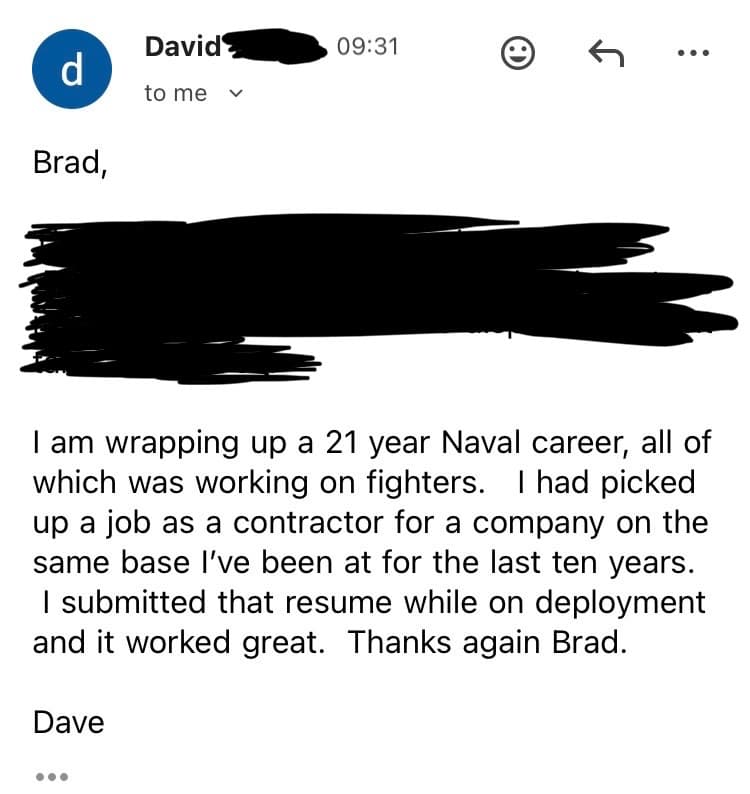
“I am wrapping up a 21 year Naval career, all of which was working on fighters. I had picked up a job as a contractor for a company on the same base I’ve been at for the last ten years. I submitted that resume while on deployment and it worked great. Thanks again Brad. Dave ”
Federal service is where a GSM's plant experience converts with almost no friction, because the same Navy that trained you runs the depots, shipyards, and power facilities that hire for these jobs. The clearest wage-grade target is WG-5378 Powered Support Systems Mechanic, the trade series for technicians who maintain gas turbine and engine-driven support equipment. WG-5352 Industrial Equipment Mechanic covers the pumps, compressors, and rotating machinery you already troubleshoot, and WG-5306 Air Conditioning Equipment Mechanic fits if you crossed into auxiliary and refrigeration plant work.
On the general schedule side, GS-1601 General Facilities and Equipment is the bridge series for plant and equipment operations supervision at federal installations, and it scales from GS-5 through supervisory grades as you take on shop and program responsibility. GS-0802 Engineering Technician opens up if you supported test, overhaul, or engineering documentation work; it values the practical machinery knowledge that a stack of FITREPs can document. The GS-0830 Mechanical Engineering series is reachable later with an engineering degree on the GI Bill, and your hands-on turbine background makes you credible in a way many degree-only candidates are not.
Veterans' Preference adds 5 or 10 points to your federal application score, and the qualification standards for these series weigh demonstrated equipment experience heavily, which works in your favor. Naval Sea Systems Command, the regional maintenance centers, the Army Corps of Engineers, and the Bureau of Reclamation all staff these series. Federal resumes are their own format with their own scoring rules; our federal resume builder handles the page-count and keyword expectations, and the SkillBridge to federal career guide walks the USAJobs process. The GSE rating targets several of these same WG and GS series.
| GS Series | Federal Job Title | Typical Grades | Match | Explore |
|---|---|---|---|---|
| GS-5352 | Industrial Equipment Mechanic | WG-8, WG-10 | View Details → | |
| GS-5378 | Powered Support Systems Mechanic | WG-8, WG-10, WL-10 | View Details → | |
| GS-1601 | General Facilities and Equipment | GS-7, GS-9, GS-11 | View Details → | |
| GS-0802 | Engineering Technician | GS-7, GS-9, GS-11 | View Details → | |
| GS-0830 | Mechanical Engineering | GS-7, GS-9, GS-11 | View Details → | |
| GS-5306 | Air Conditioning Equipment Mechanic | WG-8, WG-10 | View Details → |
Federal hiring uses keyword-matching and structured experience. BMR builds federal-format resumes (USAJobs-ready) with the right keywords, hours/week, and supervisor info — for any GS series above.
Free · No credit card · Federal + civilian resume formats included
Not everyone wants to stay in a related field. These career paths leverage your transferable skills — leadership, risk management, logistics, project planning — in completely different industries.
You can speak the language of the buyer because you ran the equipment. Sales engineers for turbine, pump, and controls vendors close deals that pure salespeople cannot, because they can answer technical objections on the spot.
Running an engineering watch around the clock is running a production floor. The accountability for output, the shift handoffs, and the safety discipline are the same muscles a plant manager uses.
GSMs live by the tech manual and the maintenance record. That same spec-driven, document-everything mindset is exactly what quality inspection rewards in a manufacturing plant.
You already know what good industrial parts look like and which suppliers deliver. That technical buying knowledge is rare in procurement and lets you negotiate from a position of real expertise on MRO and capital equipment.
Selling pumps, bearings, lubricants, or controls to plants means selling to people who do your old job. They trust a rep who has stood the watch, which shortens the sales cycle and builds a durable territory.
You ran the tag-out program and drilled casualty control for years. Industrial safety is that discipline turned into a profession, and your hands-on plant background means you spot real hazards a checklist-only inspector misses.
Engineering watch leadership is operations leadership: you owned uptime, people, and safety for a system that could not stop. That portfolio maps onto general operations management across many industries.
The skills that made you a good Marine, Sailor, Airman, or Soldier transfer further than you think. BMR rewrites your bullets for any of the pivot careers above — without making you sound like you've never done the work.
Free · No credit card · Try unlimited career angles
If you are staying in power generation, marine engineering, or industrial maintenance, your terminology already lands. Plant operators and hiring managers in those fields know what an LM2500 is and what 3M means. This section is for GSMs targeting careers OUTSIDE the engine room, where a hiring manager has never stood an engineering watch and needs the work translated into business language.
The trick is to convert watch-standing and maintenance jargon into outcomes a civilian reader scores: uptime, cost avoidance, safety, and accountability for expensive assets. Here are the common terms and how they read on a non-technical resume. For more patterns, the 50 military terms translated to civilian language glossary and the broader military-to-civilian resume guide go deeper.
| Military term | Civilian translation |
|---|---|
| Engineering Officer of the Watch / propulsion plant watch | Shift operations lead accountable for a high-value production system |
| 3M / Planned Maintenance System | Computerized maintenance management system (CMMS) and preventive maintenance program |
| Casualty control / EOOW casualty drills | Emergency response and equipment-failure recovery procedures |
| Gas turbine readiness / plant lineup | Asset availability and startup configuration management |
Before: Stood EOOW underway and supervised GSMs maintaining the LM2500 main propulsion plant per the 3M PMS.
After: Led a 6-person shift operating and maintaining a $20M+ propulsion system, using a computerized maintenance program to deliver 99% asset availability across an 8-month deployment.
Once your bullets read like that, our resume builder formats them for ATS screening, or you can start building now.
BMR turns your GSM duties and accomplishments into civilian bullets that match the job you're applying for — no manual translation, no rewriting.
Free · No credit card · Tailored to each job posting
Which certifications you need depends on where you're headed. Find your target career path below.
The wrong placement can sink an otherwise strong application. BMR knows where each cert ranks, what to call it, and how to frame it for ATS keyword matching and hiring manager attention.
Free · No credit card · Built around your real certs and clearance
If you are keeping your hands on machinery, focus on credentials the energy and maintenance sectors recognize. SkillBridge is the fastest on-ramp while you are still in uniform: review the SkillBridge program guide and the SkillBridge programs by industry list to find energy and manufacturing host companies. Industry associations worth joining: ASME and the Electric Power Research Institute community for power generation, and SMRP (Society for Maintenance and Reliability Professionals) for reliability and maintenance roles. The GWO Basic Technical Training credential is the standard entry ticket for wind technician work.
If you are leaving machinery work behind, lean on the leadership and project-control side of your record. American Corporate Partners (ACP) offers free year-long mentorship that pairs you with a corporate executive, which is one of the better networking moves for a career changer. The Project Management Professional (PMP) and Six Sigma credentials open operations and program roles; see the Six Sigma for veterans guide for how your process discipline maps over.
Explore every adjacent path with the military-to-civilian career crosswalk, and use the SFL-TAP resources at our transition hub. Build a civilian-ready resume with the military resume builder or a federal one with the federal resume builder. When you are ready to move, get started here.
See also: MM Machinist's Mate, Air Force 2A6X1 Aerospace Propulsion, and the EN Engineman career paths.
Most veterans do this backwards — they wait until terminal leave to start, then panic. Here's the actual sequence that works.
Print this. Tape it to your monitor. Veterans who treat the transition like a 90-day op get hired faster than the ones who treat it like an emergency.
Stop rewriting from scratch every time you apply. BMR turns your military experience into civilian and federal resumes — tailored to each job.