What civilian jobs hire former Navy HTs?
The strongest direct paths are private shipbuilders (Newport News / HII, Bath Iron Works / GD, Bollinger, Austal USA, Fincantieri Marinette Marine), federal civilian shipyards (Norfolk, Portsmouth NH, Puget Sound, Pearl Harbor), refineries on the Gulf Coast and West Coast, large industrial contractors (KBR, Amentum, Parsons, Fluor), and union halls (UA pipefitters, Boilermakers, SMART sheet metal). Common civilian titles include industrial welder, pipefitter, sheet metal worker, structural fabricator, boilermaker, plumber, and welding inspector.
How much do HTs make in civilian welding and trades jobs?
BLS May 2024 medians: welder/cutter/solderer/brazer $48,940; pipefitter/steamfitter $61,550; sheet metal worker $58,780; industrial machinery mechanic $61,170; structural metal fabricator $48,650; boilermaker $73,840. These are medians; specialty welders (TIG on stainless or exotic alloys, pipe welders, certified pressure-vessel welders) clear $80K-$120K with overtime. Federal WG-10 welder pay is locality-adjusted and ranges roughly $30-$45/hr depending on shipyard.
Are federal jobs really the strongest path for HTs?
For most HTs, yes. The four public shipyards plus NAVFAC, DLA, and DoD installations hire welders, pipefitters, sheet metal mechanics, and marine machinery mechanics on a continuous basis. The Federal Wage System (FWS) trades pay schedule has dedicated series for every HT skill — WG-3703 Welding, WG-4204 Pipefitting, WG-3806 Sheet Metal Mechanic, WG-5334 Marine Machinery Mechanic, and more. Combined with Veterans' Preference and the union-represented Metal Trades Council, federal trades work is one of the most reliable lanes any military rate has.
What certifications should I get before separating?
AWS Certified Welder for whatever process and position you want to lead with (SMAW, GMAW, GTAW, FCAW). AWS CWI (Certified Welding Inspector) is the long-term play for inspection and QA roles paying $80K-$120K. OSHA 30-Hour ($150-$200) is cheap and useful for any industrial role. NCCER credentialing if you're going to non-union industrial construction. EPA 608 if you're moving toward HVAC. Apprentice ratio counts in many states for plumbing licensure, so document every plumbing hour from the Navy.
Is my Secret clearance worth anything as a civilian welder?
Yes, more than most welders realize. Public shipyards, NAVSEA, and major defense contractors prefer cleared welders for nuclear-adjacent work, classified ship repair, and submarine maintenance. An active Secret saves the employer $5K-$15K and 6-9 months of clearance processing. Your clearance stays active for 24 months after separation, and longer if you continue cleared work without a gap.
Can I use my GI Bill for welding certifications or trade school?
Yes. Many welding schools, trade colleges, and apprenticeship programs are GI Bill-eligible. Some union apprenticeships qualify under the on-the-job training (OJT) provisions of the GI Bill, which means you draw GI Bill housing allowance while earning apprenticeship wages. AWS credentialing exam fees are also reimbursable under the GI Bill licensing and certification reimbursement program.
Should I go union or non-union as a civilian welder/pipefitter?
Depends on geography and goals. Union (UA, Boilermakers, SMART, Iron Workers, Operating Engineers) generally pays higher wages, has better benefits, runs structured apprenticeship-to-journeyman tracks, and dominates in the Northeast, West Coast, and major metro areas. Non-union (open-shop) is more common in the South and inland markets, often with faster hiring but lower benefits. Helmets to Hardhats is the standard veteran entry point for union locals — many waive apprenticeship hours for Navy A School and shipboard time.
Do I need a state plumbing license to work as a civilian plumber?
Yes, most states require licensure for plumbing work, and the rules vary widely. Some states will count Navy plumbing time toward apprenticeship hours; others will not. The UA pipefitters union has direct-entry programs that handle the licensure pathway. If you want to work residential plumbing as a self-employed contractor, plan on roughly 4 years of apprenticeship hours plus the journeyman exam in most states. Industrial pipefitting on a refinery or shipyard rarely requires the state plumbing license.
How do I write a federal resume for WG-3703 or WG-4204 positions?
Federal resumes follow specific format requirements: 2 pages target length (modern best practice), every job needs hours-per-week worked, supervisor name and contact, GS or WG-equivalent grade level, and detailed duty descriptions matching the FWS qualification standards. List your A School qualifications, every welding process and position you've passed (SMAW 6G, GTAW 6G, etc.), every shipboard piping system worked, and any C School or NDT training. Use the BMR federal resume builder or read the federal resume blog content for full breakdown.
What if I want to leave the trades entirely?
The career pivots in this guide cover that — operations manager, project manager, safety manager, manufacturing supervisor, and quality assurance roles. The skills are highly transferable; the resume just has to do the translation work. Read Military to Civilian Highest Paying Jobs in 2026 and the Military to Civilian Salary guide for broader options. The HT background is one of the most translatable in the Navy because the work is so visibly skilled — the trick is just finding civilian language for shop foreman, repair locker LPO, and 3M coordinator roles.
Where do most HTs end up after separating?
There's no single dominant path. Significant numbers go to public shipyards (federal trades), private shipbuilders (Newport News, Bath, Bollinger, Austal), refineries and pipelines (Gulf Coast, West Coast), union halls (UA, Boilermakers, SMART), and federal facilities work (NAVFAC). The HTs who struggle most are those who don't translate the work properly — civilian recruiters at non-trade companies don't know what an HT is, but they absolutely know what an industrial welder, structural fabricator, and pipefitter are.
Does BMR support HTs specifically?
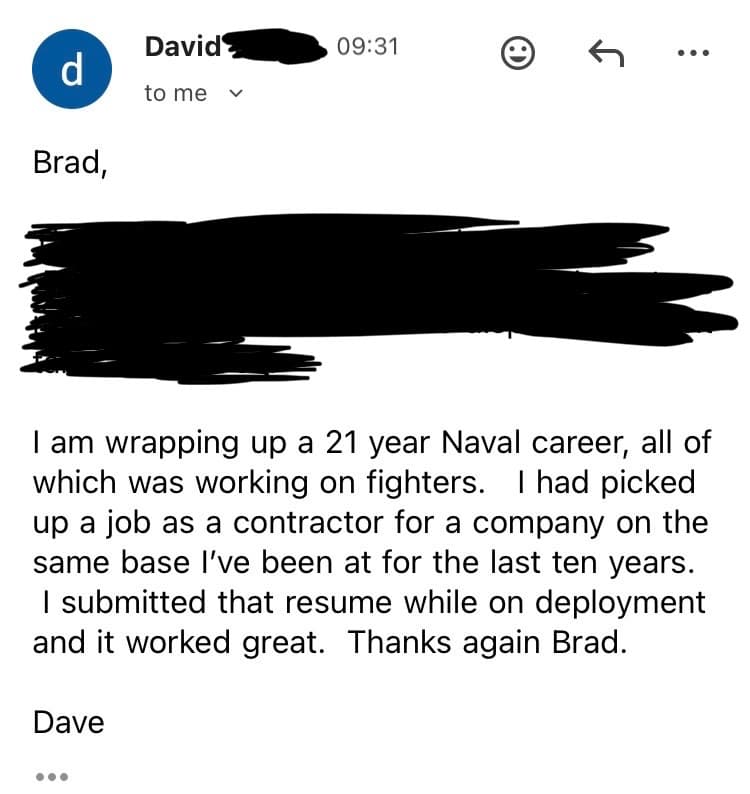
Yes. BMR has built more than 55,000 resumes across every Navy rate, including hundreds of HTs. The AI knows SMAW, GMAW, GTAW, FCAW, plate work, brazing, sheet metal, fire main, CHT, valve maintenance, and the WG-3703 / WG-4204 / WG-3806 federal series, and translates all of it into civilian or federal language automatically. Free for every veteran — 2 tailored resumes, 2 cover letters, LinkedIn optimization, all included.