Loading...
Loading...
The civilian and federal jobs that hire Navy Special Warfare Boat Operator (SWCC)s — with real salaries and the resume that gets callbacks.
Every SB has more options than a Google search will tell you. Below: career paths, BLS salary data, federal GS series, certifications by target career, and how to translate your experience without losing what made you valuable to the Navy in the first place.
Free · No credit card · Tailored resume in under 5 minutes
After the Navy I got hired into 6 federal career fields and tech sales, and sat on federal hiring panels along the way. I spent the last 2 years rebuilding everything I learned into BMR, tuned for how AI actually screens resumes today. This is the system I wish I'd had on day one.
As a Special Warfare Boat Operator (SB), you were Special Warfare Combatant-craft Crewmen (SWCC), the Naval Special Warfare community that operates the Combatant Craft Assault (CCA), Combatant Craft Medium (CCM), and the Special Operations Craft-Riverine (SOC-R) to insert and extract SEAL elements in coastal, riverine, and open-ocean environments. The SB rating was established on 1 October 2006, the same day the SO (Special Warfare Operator) rating stood up for SEALs. Your day was navigation under blackout, high-speed maneuvering through surf and chop, crew-served weapons employment from a moving platform, and keeping diesel waterjet propulsion running when there was no shop to call.
The pipeline that produced you was roughly 62 weeks: Naval Special Warfare Preparatory School at Great Lakes, SWCC indoctrination and Basic Crewman Training, then Crewman Qualification Training in Coronado, and advanced platform and weapons training at Stennis, Mississippi. You earned NEC O52A on completion and a six-year service obligation went with the seat. Assignment to Special Boat Team 12, 20, or 22 followed. Boat captains carried responsibility for the craft, the crew, the navigation solution, and the tactical call in the same breath.
Civilian employers value this background because it pairs three things that rarely sit in one person: command of a vessel under pressure, hands-on diesel and waterjet mechanical competence, and crew-served weapons and small-unit tactics. Maritime security firms, harbor and port operators, and federal maritime law enforcement all hire that exact profile. If you are mapping where the rating goes, start with the military career crosswalk tool, and compare your options against the SO Special Warfare Operator and BM Boatswain's Mate paths, since they share the maritime-operations layer.
I came up in the Navy Diver world, so I shared the Naval Special Warfare and maritime side of the house with you without ever sitting in a SWCC seat. BMR has built more than 60,000 resumes, and the pattern with SB operators is consistent: the experience is elite, but "Special Warfare Boat Operator" reads as a job title with no civilian anchor unless the resume names the vessel command, the propulsion systems, and the operations work in language a hiring manager already uses. The translation is the whole game. — Brad Tachi, Navy Diver veteran & BMR founder
The number that matters when you're deciding what's next: how does civilian pay compare to what you make now?
Military comp is approximate (varies by location/dependents). Civilian is BLS median. Federal includes locality pay. Your real number depends on duty station, family status, GS step, and overtime.
The most direct civilian paths use your vessel-command and maritime-operations experience. Salary figures below are BLS OEWS May 2024 medians.
Maritime vessel operation. Captains, Mates, and Pilots of Water Vessels (BLS median $98,310) run crew boats, tugs, ferries, pilot boats, and harbor craft. Your blackout navigation, station-keeping, and small-craft handling map onto this work directly, though the field is geographically concentrated on coasts, the Gulf, and inland river systems, and most operator roles require U.S. Coast Guard Merchant Mariner Credential endorsements you test into rather than transfer automatically.
Maritime and physical security. Security Management Specialists and corporate security managers (BLS median $66,650 for the management-level 33-9032 group) staff port facilities, maritime terminals, and high-value asset protection. Entry-level Security Guard roles sit lower (BLS median $38,370), so target the supervisory and management tier where your crew-leadership carries weight rather than the gate-guard tier.
Tactical and maritime instruction. Firms running mariner training, force-protection courses, and small-boat handling schools hire former SWCC operators to instruct. Pay tracks the training-and-development market rather than a single BLS line.
Industry conditions are honest to face: maritime operator demand is steady but tied to shipping cycles and offshore energy, and security work ranges widely in pay by sector and clearance. For cross-branch comparison, the Coast Guard BM Boatswain's Mate and Coast Guard ME Maritime Enforcement Specialist pages cover overlapping maritime-security markets, and Marine 0321 Reconnaissance Marine shares the small-unit and waterborne-insertion ground. When you are ready to put this on paper, the military resume builder structures it, or you can build your resume now.
| Civilian Job Title | Industry | BLS Median Salary | Outlook | Match |
|---|---|---|---|---|
Boat Captain / Vessel Operator O*NET: 53-5021.00 | Maritime Transportation | $98,310 | 3% (As fast as average) | strong |
Maritime Security Operator / Manager O*NET: 33-9032.00 | Security | $66,650 | 4% (As fast as average) | strong |
Marine Unit Officer (Law Enforcement / Border) O*NET: 33-1012.00 | Public Safety | $103,580 | 3% (As fast as average) | strong |
Commercial Vessel Operator (Offshore / Harbor) O*NET: 53-5021.00 | Maritime Transportation | $98,310 | 3% (As fast as average) | strong |
Emergency Management Specialist O*NET: 11-9161.00 | Public Safety | $83,960 | 3% (As fast as average) | moderate |
Tactical / Maritime Operations Instructor O*NET: 13-1151.00 | Training | $65,850 | 6% (Faster than average) | moderate |
Ship Engineer (Small-Craft Propulsion) O*NET: 53-5031.00 | Maritime Transportation | $101,320 | 5% (Faster than average) | moderate |
Corporate Security Manager O*NET: 33-9032.00 | Security | $66,650 | 4% (As fast as average) | moderate |
BMR rewrites your SB experience for any of the civilian roles above — keywords, achievements, and language hiring managers actually scan for.
Free · No credit card · 2 tailored resumes included
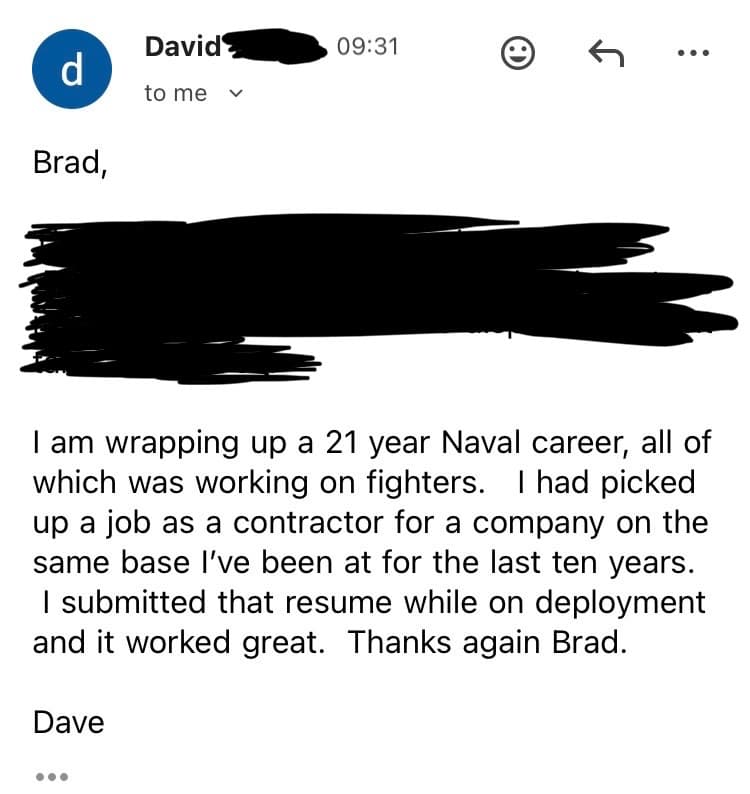
“I am wrapping up a 21 year Naval career, all of which was working on fighters. I had picked up a job as a contractor for a company on the same base I’ve been at for the last ten years. I submitted that resume while on deployment and it worked great. Thanks again Brad. Dave ”
Federal maritime, law enforcement, and emergency-management series are where an SB background converts cleanly, and your active security clearance is a tangible asset in every one of them.
GS-5786 Small Craft Operator is the closest direct federal analog: agencies operating patrol, survey, and support craft hire vessel operators at GS-5 through GS-9 wage-grade-adjacent and GS levels depending on the position. GS-0083 Police covers federal protective and patrol officers, and GS-1801 General Inspection, Investigation, Enforcement and Compliance is the umbrella series Customs and Border Protection uses for marine interdiction agents and many enforcement billets. GS-0089 Emergency Management fits operators moving into continuity, response coordination, and port-security planning.
Broaden from there: GS-0080 Security Administration for physical-security and antiterrorism program work, GS-1701 General Education and Training for federal instructor and curriculum roles, and GS-0018 Safety and Occupational Health Management for operational-safety positions where your risk-management record reads as qualification.
Veterans' Preference adds 5 or 10 points to your federal application score and can be the difference at the certificate stage. Two things matter for SB applicants specifically: federal resumes run long and detailed by design (the opposite of a one-page private resume), and your clearance, if current, should be stated plainly. The federal resume builder handles the OPM format, and the guide to decoding a USAJOBS announcement and the 2026 OPM federal resume format guide walk the specifics. The Navy EOD page shares several of these same GS targets. Ready to start? You can start your federal resume here.
| GS Series | Federal Job Title | Typical Grades | Match | Explore |
|---|---|---|---|---|
| GS-1801 | General Inspection, Investigation, Enforcement | GS-7, GS-9, GS-11 | View Details → | |
| GS-5786 | Boat Operator | GS-5, GS-7, GS-9 | View Details → | |
| GS-2150 | Transportation Operations | GS-9, GS-11, GS-12 | View Details → | |
| GS-0089 | Emergency Management | GS-7, GS-9, GS-11 | View Details → | |
| GS-0083 | Police | GS-5, GS-7, GS-8 | View Details → | |
| GS-1701 | General Education and Training | GS-7, GS-9, GS-11 | View Details → | |
| GS-0080 | Security Administration | GS-7, GS-9, GS-11 | View Details → | |
| GS-0018 | Safety and Occupational Health Management | GS-7, GS-9, GS-11 | View Details → |
Federal hiring uses keyword-matching and structured experience. BMR builds federal-format resumes (USAJobs-ready) with the right keywords, hours/week, and supervisor info — for any GS series above.
Free · No credit card · Federal + civilian resume formats included
Not everyone wants to stay in a related field. These career paths leverage your transferable skills — leadership, risk management, logistics, project planning — in completely different industries.
SWCC operators function in oxygen-starved, high-stress maritime environments and manage casualty situations on the water. That comfort with physiology and life-critical equipment under pressure carries into respiratory care.
Casualty handling on the water and split-second decisions under fire prepare SWCC operators for the pace and stakes of pre-hospital emergency care.
The same discipline you applied to craft readiness inspections and pre-mission standards maps onto examining institutions for compliance with financial regulations.
Operators who ran and maintained complex craft systems can speak to engineers and buyers with credibility most salespeople never earn. Defense, maritime, and industrial-equipment vendors prize that.
SWCC operators live the relationship between physical preparation and performance under load. That lived expertise translates into coaching athletes and building conditioning programs.
If you instructed Crew Qualification Training, you already built and ran a competency-based program. Corporations need exactly that skill to onboard and upskill employees.
The diesel-mechanical and electrical-systems work you did on craft, with no shop to call, maps onto maintaining and repairing high-voltage utility equipment.
The skills that made you a good Marine, Sailor, Airman, or Soldier transfer further than you think. BMR rewrites your bullets for any of the pivot careers above — without making you sound like you've never done the work.
Free · No credit card · Try unlimited career angles
If you are staying in maritime operations or the security industry, your terminology already lands. Port operators and security firms know what a coxswain, a coin box, and a crew-served weapon are. This section is for SB operators targeting careers OUTSIDE the maritime and tactical world, where "SWCC" means nothing to the person reading your resume.
The fix is plain civilian language for what you actually did. A few mappings that travel well:
Before and after, for a non-maritime role:
Before: "Served as boat captain for a SOC-R conducting riverine SWCC operations in support of SEAL elements."
After: "Led a 3-person crew operating a $1M+ specialized vessel in high-risk conditions, owning navigation, equipment readiness, and real-time decision-making with zero crew casualties across 100+ operations."
The military terminology comes off, the responsibility stays on. For more patterns, the 50 military terms translated to civilian language glossary and the guide to explaining military experience in a civilian interview are worth a read. The military resume builder does this translation as you write, or get started here.
BMR turns your SB duties and accomplishments into civilian bullets that match the job you're applying for — no manual translation, no rewriting.
Free · No credit card · Tailored to each job posting
Which certifications you need depends on where you're headed. Find your target career path below.
The wrong placement can sink an otherwise strong application. BMR knows where each cert ranks, what to call it, and how to frame it for ATS keyword matching and hiring manager attention.
Free · No credit card · Built around your real certs and clearance
If your plan is to keep working on or around the water, lean on the credentials the industry recognizes. The U.S. Coast Guard Merchant Mariner Credential (MMC) is the gateway to civilian vessel operation, and your sea time may count toward the endorsements. Maritime security and force-protection firms recruit former SWCC operators directly. SkillBridge can place you with a maritime or security employer before you separate. Compare adjacent maritime roles on the Navy BM Boatswain's Mate and Navy EN Engineman pages.
If you are leaving the water behind, your leadership and risk-management record is the asset. American Corporate Partners (ACP) runs free veteran mentorship that helps map a non-maritime pivot. The GI Bill funds certifications and degrees for project management, emergency management, healthcare, and skilled trades. Your clearance, if current, has real market value off the water. The guide to what a security clearance is worth and the career-change-after-20-years success stories are good starting points.
Use the military resume builder for civilian roles and the federal resume builder for USAJOBS. Explore options with the career crosswalk, and use SFL-TAP transition resources for the formal timeline. See also the Army 18D Special Forces Medical Sergeant path for a cross-branch special-operations comparison. When you are ready, build your resume now.
Most veterans do this backwards — they wait until terminal leave to start, then panic. Here's the actual sequence that works.
Print this. Tape it to your monitor. Veterans who treat the transition like a 90-day op get hired faster than the ones who treat it like an emergency.
Stop rewriting from scratch every time you apply. BMR turns your military experience into civilian and federal resumes — tailored to each job.