Loading...
Loading...
The civilian and federal jobs that hire Air Force Special Reconnaissances — with real salaries and the resume that gets callbacks.
Every 1Z4X1 has more options than a Google search will tell you. Below: career paths, BLS salary data, federal GS series, certifications by target career, and how to translate your experience without losing what made you valuable to the Air Force in the first place.
Free · No credit card · Tailored resume in under 5 minutes
After the Navy I got hired into 6 federal career fields and tech sales, and sat on federal hiring panels along the way. I spent the last 2 years rebuilding everything I learned into BMR, tuned for how AI actually screens resumes today. This is the system I wish I'd had on day one.
Eighteen months. That is how long a resume can sit dead in the water when the experience on it is elite but the language is wrong. Special Reconnaissance is one of the hardest careers in the Air Force to put on paper, because a civilian recruiter reads "special tactics operator" and quietly decides there is no civilian job for it. There is. The problem was never your experience. It is that the way you describe environmental reconnaissance, surveillance, and austere-area data collection reads as "no transferable skills" to someone who has never worn the beret. The translation is what costs the callback, not the work.
As a 1Z4X1 you are the Special Tactics specialist who answers the question every operation starts with: what is actually out there. You deploy ahead of the force by land, sea, or air to read the environment and feed it back to mission planners. That means hands-on environmental and weather reconnaissance, terrain and hydrographic assessment, sensor and surveillance employment, and the strategic, operational, and tactical intelligence that lets a commander commit a force with eyes open. SR grew directly out of the 1W0X2 Special Operations Weather lineage, so the field carries deep atmospheric and physical-science roots on top of the surveillance and air-to-ground integration mission.
The pipeline is long and selective. After Basic Military Training, candidates move through the Special Warfare Preparatory Course and the Assessment and Selection process, then the Special Warfare Candidate Course, dive, airborne, survival, and the Special Reconnaissance Apprentice Course before earning the 3-skill level. The result is a person trained to gather and act on data in places no fixed sensor reaches, under physical and operational stress most careers never approach.
Civilian employers value that for reasons that have nothing to do with combat. You collected environmental data accurately when the cost of being wrong was a mission. You ran small teams in conditions where the plan changed by the hour. You managed risk in environments that punish complacency. Those are the exact instincts that emergency management agencies, environmental and weather operations, corporate security, and high-consequence field operations pay for. If you want to see how other elite Air Force Special Warfare careers translate, compare paths with Combat Control (1Z2X1) and Tactical Air Control Party (1Z3X1), or explore the full military career crosswalk to map your next move.
I separated from the Navy and spent 18 months applying with no callbacks, and my experience was not the issue, the words were. Special Reconnaissance carries that problem at the extreme. "Special tactics operator" reads as a closed door to a recruiter who has never been near this work, when what you actually did was collect decision-grade data and lead under pressure. Fix the translation and the doors open. — Brad Tachi, Navy Diver veteran & BMR founder
The number that matters when you're deciding what's next: how does civilian pay compare to what you make now?
Military comp is approximate (varies by location/dependents). Civilian is BLS median. Federal includes locality pay. Your real number depends on duty station, family status, GS step, and overtime.
Start with a clear-eyed read of the market: there is no civilian job titled "special reconnaissance," and the direct one-to-one matches are few. That is normal for an elite specialty. What you have is a small set of fields where your specific skill signature, environmental data collection, surveillance, and operating in austere conditions, maps cleanly, plus a wider set of pivots covered in the career-change section below.
The strongest direct matches sit in three buckets. First, the weather and physical-science lineage you carry from the 1W0X2 roots. The BLS reports a median wage of $97,450 for atmospheric scientists including meteorologists (May 2024), and operational forecasting roles at private weather firms and field-science contractors value people who have collected and interpreted environmental data under real constraints. Second, intelligence and surveillance analysis. BLS lists a $77,270 median for detectives and criminal investigators (May 2024), and cleared intelligence-analyst roles in the defense sector hire surveillance backgrounds directly. Third, security and protective operations leadership, where first-line supervisors of protective service workers (all other) post a $92,550 median (May 2024).
Geographic reality matters. Weather-operations and field-science roles cluster around NOAA hubs, energy corridors, and agricultural regions. Cleared analyst work concentrates in the DC, San Antonio, Tampa, and Colorado Springs areas where the special-operations and intelligence communities sit. Corporate security leadership follows major metros and critical-infrastructure sites. If you are willing to relocate toward those clusters, the match rate climbs.
Veterans from related reconnaissance and special-warfare fields chase overlapping civilian paths. It is worth comparing how the Marine Corps Reconnaissance (0321) and Navy Special Warfare Operator (SO) backgrounds translate, since hiring managers often see them as interchangeable. For the security-analyst track, the cybersecurity jobs without a degree guide lays out an entry that uses your clearance. When you are ready to put it on paper, the military resume builder structures the bullets, or you can build your resume now.
| Civilian Job Title | Industry | BLS Median Salary | Outlook | Match |
|---|---|---|---|---|
Atmospheric Scientist / Operational Meteorologist O*NET: 19-2021.00 | Weather & Physical Science | $97,450 | 7% (Faster than average) | strong |
Intelligence Analyst O*NET: 33-3021.00 | Defense & Intelligence | $77,270 | -1% (Little change) | strong |
Geospatial / GIS Analyst O*NET: 17-1021.00 | Geospatial | $78,380 | 1% (Little change) | moderate |
Corporate Security Manager O*NET: 33-1099.00 | Corporate Security | $92,550 | 4% (As fast as average) | moderate |
Information Security Analyst O*NET: 15-1212.00 | Cybersecurity | $124,910 | 33% (Much faster than average) | emerging |
Private Detective / Investigator O*NET: 33-9021.00 | Investigations | $52,370 | 5% (Faster than average) | moderate |
Geographer O*NET: 19-3092.00 | Physical Science | $97,200 | 3% (As fast as average) | moderate |
BMR rewrites your 1Z4X1 experience for any of the civilian roles above — keywords, achievements, and language hiring managers actually scan for.
Free · No credit card · 2 tailored resumes included
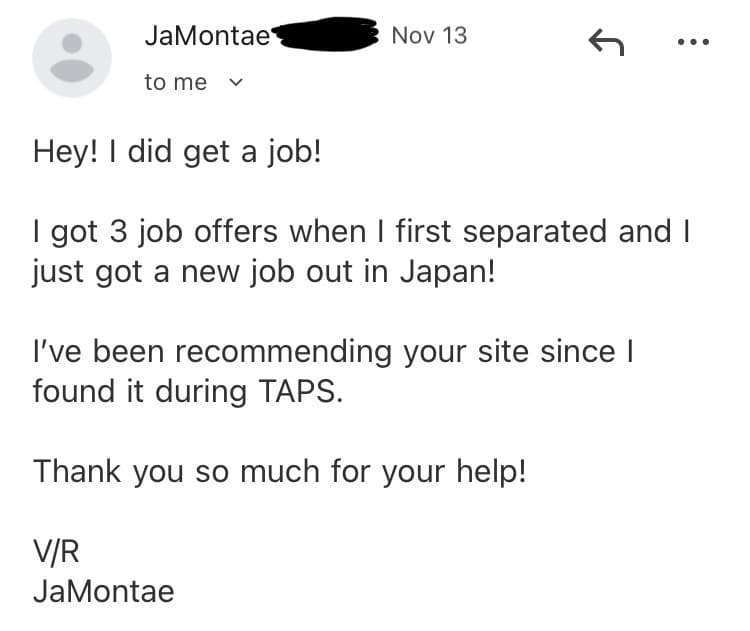
“Hey! I did get a job! I got 3 job offers when I first separated and I just got a new job out in Japan! I’ve been recommending your site since I found it during TAPS. Thank you so much for your help! V/R JaMontae ”
Federal service is where a Special Reconnaissance background often translates with the least friction, because the government already classifies the work you did into specific occupational series and reads a clearance as money in the bank. The trick is matching your experience to the right series and writing to the qualification standard, not just listing deployments.
Your weather and environmental reconnaissance experience points at GS-1301 General Physical Science and GS-1340-adjacent meteorology work carried out under the physical-science umbrella, along with GS-0150 Geography and GS-1370 Cartography for the terrain and geospatial side of the mission. Surveillance and the intelligence product you generated map to GS-0132 Intelligence, one of the highest-leverage series for any special-warfare veteran with a current clearance. The risk-management and force-protection instincts translate to GS-0080 Security Administration and GS-0018 Safety and Occupational Health Management. Field operations and program work cover GS-0089 Emergency Management, GS-0301 Miscellaneous Administration and Program, GS-1801 General Inspection, Investigation and Enforcement, GS-0028 Environmental Protection Specialist, GS-1315 Hydrology, and GS-1350 Geology for the earth-science slice of environmental reconnaissance.
Most transitioning SR veterans qualify around the GS-9 to GS-12 band depending on time in service, education, and the specialized experience they can document. Veterans Preference adds 5 or 10 points to your rated score and can move you up the certificate, but it does not lower the qualification bar, so the resume still has to prove the specialized experience in plain federal language. Read how Veterans Preference points actually work and how to decode a USAJOBS announcement before you apply. The intelligence-analyst resume guide shows how to leverage a clearance for GS-0132 roles. When you are ready, the federal resume builder handles the OPM format, or start your federal resume here.
| GS Series | Federal Job Title | Typical Grades | Match | Explore |
|---|---|---|---|---|
| GS-1301 | General Physical Science | GS-7, GS-9, GS-11 | View Details → | |
| GS-0132 | Intelligence | GS-9, GS-11, GS-12 | View Details → | |
| GS-1370 | Cartography | GS-7, GS-9, GS-11 | View Details → | |
| GS-0080 | Security Administration | GS-9, GS-11, GS-12 | View Details → | |
| GS-0150 | Geography | GS-7, GS-9, GS-11 | View Details → | |
| GS-0018 | Safety and Occupational Health Management | GS-9, GS-11 | View Details → | |
| GS-0028 | Environmental Protection Specialist | GS-7, GS-9, GS-11 | View Details → | |
| GS-0089 | Emergency Management | GS-9, GS-11 | View Details → |
Federal hiring uses keyword-matching and structured experience. BMR builds federal-format resumes (USAJobs-ready) with the right keywords, hours/week, and supervisor info — for any GS series above.
Free · No credit card · Federal + civilian resume formats included
Not everyone wants to stay in a related field. These career paths leverage your transferable skills — leadership, risk management, logistics, project planning — in completely different industries.
Reading terrain, weather, and environmental hazards in remote conditions is the core of both SR reconnaissance and wildfire risk work, and SR veterans bring that judgment ready-made.
Leading a small team through fast-changing, high-consequence field conditions is exactly what fire-ground command requires, and SR veterans have done it where the stakes were highest.
SR training builds deep firsthand knowledge of human performance, physical resilience, and injury prevention under extreme load, which athletic training applies in a clinical setting.
Environmental reconnaissance is field data collection by another name, and SR veterans already gather, document, and interpret environmental readings in difficult conditions.
Planning and coordinating responses in chaotic, resource-limited conditions is daily work for an SR operator and the backbone of emergency management.
SR veterans spend years teaching demanding technical skills to others through the pipeline, which is precisely what corporate training and development requires.
The skills that made you a good Marine, Sailor, Airman, or Soldier transfer further than you think. BMR rewrites your bullets for any of the pivot careers above — without making you sound like you've never done the work.
Free · No credit card · Try unlimited career angles
If you are staying in the weather, intelligence, or security world, your terminology already lands, the hiring managers there speak the same language. This section is for SR veterans targeting careers OUTSIDE the special-warfare and intelligence space, where a recruiter has never heard your job title and needs the work described in business terms.
The pattern is simple: name the outcome and the scale, not the acronym. A civilian hiring manager does not know what an SRAC graduate does, but every one of them understands "collected and reported decision-grade environmental data that drove operational planning." Below are the translations that move an SR background into a non-field resume.
| Military Term | Civilian Translation |
|---|---|
| Environmental reconnaissance | Field data collection and environmental assessment |
| Surveillance and target-area study | Site assessment, monitoring, and situational reporting |
| Special Tactics team element | Small high-performing field team |
| Austere-environment operations | High-risk remote field operations |
| Intelligence product / reporting | Analytical reporting for decision-makers |
Before: Conducted environmental reconnaissance and surveillance in austere areas to support special tactics mission planning.
After: Collected and analyzed environmental and terrain data in remote, high-risk field conditions and produced reporting that informed time-critical operational decisions for senior leadership.
Before: Led a special reconnaissance team element during deployed operations.
After: Led a small specialized field team through changing conditions, sustaining performance and safety while delivering accurate data on a compressed timeline.
For more of these conversions, the 50 military terms translated to civilian language glossary and the guide to turning evaluations into resume bullets are the fastest way to build a full draft. The military resume builder applies these patterns automatically, or you can get started here.
BMR turns your 1Z4X1 duties and accomplishments into civilian bullets that match the job you're applying for — no manual translation, no rewriting.
Free · No credit card · Tailored to each job posting
Which certifications you need depends on where you're headed. Find your target career path below.
The wrong placement can sink an otherwise strong application. BMR knows where each cert ranks, what to call it, and how to frame it for ATS keyword matching and hiring manager attention.
Free · No credit card · Built around your real certs and clearance
If you want to keep working in or near the field, lead with your clearance and your hands-on environmental and surveillance experience. SkillBridge can place you with a defense or field-science employer during your last months of service, and your security clearance is the single most valuable thing you carry into a cleared civilian role. Verify your clearance status before you separate using the clearance-after-separation guide, and see how a surveillance background leverages it in the intelligence-analyst resume guide. American Corporate Partners (ACP) offers free mentorship that pairs you with industry leaders who can open doors a resume cannot.
If you are done with the specialty entirely, the career-change section above maps where your signature transfers. A PMP or an emergency-management certification translates field leadership into language corporate and government employers rank highly, and the GI Bill or VR&E can fund the retraining a true pivot requires. Veterans Preference still applies to any federal pivot, so read the Veterans Preference breakdown and the federal resume format guide before applying.
Start with the military resume builder for private-sector roles or the federal resume builder for GS positions, explore options in the career crosswalk, and build the resume that makes the case with the military resume builder while you are still in. When you are ready to commit, build your resume now.
Related special-warfare and reconnaissance paths: Pararescue (1Z1X1), Army Special Forces Medical Sergeant (18D), and Navy Aerographer's Mate (AG) for the weather-science path.
Most veterans do this backwards — they wait until terminal leave to start, then panic. Here's the actual sequence that works.
Print this. Tape it to your monitor. Veterans who treat the transition like a 90-day op get hired faster than the ones who treat it like an emergency.
Stop rewriting from scratch every time you apply. BMR turns your military experience into civilian and federal resumes — tailored to each job.