Loading...
Loading...
The civilian and federal jobs that hire Air Force Pararescues — with real salaries and the resume that gets callbacks.
Every 1Z1X1 has more options than a Google search will tell you. Below: career paths, BLS salary data, federal GS series, certifications by target career, and how to translate your experience without losing what made you valuable to the Air Force in the first place.
Free · No credit card · Tailored resume in under 5 minutes
After the Navy I got hired into 6 federal career fields and tech sales, and sat on federal hiring panels along the way. I spent the last 2 years rebuilding everything I learned into BMR, tuned for how AI actually screens resumes today. This is the system I wish I'd had on day one.
Pararescue (1Z1X1), the PJs, are the Air Force's personnel-recovery and combat-medicine specialists. If you held this AFSC, you ran the full rescue chain: locating an isolated survivor, reaching them across water, mountains, or contested ground, treating them at the point of injury, and getting them out alive. The training pipeline behind that is one of the longest in the U.S. military. It runs roughly two years through the Pararescue/Combat Rescue Officer Selection Course, the Pararescue Apprentice Course at Kirtland AFB, the Army Combat Diver course, Airborne and Military Free Fall at Fort Moore and Yuma, Army SERE, and the NREMT-Paramedic curriculum. You came out a certified paramedic who can also dive, jump, climb, and shoot.
The work mixed worlds that rarely meet in one person. You managed airway and hemorrhage on a casualty while the tactical situation was still developing. You ran hypoxia and decompression risk on a dive or a high-altitude jump. You stabilized a patient for a hoist extraction off a cliff or a rooftop. Duty stations clustered around the rescue squadrons at Davis-Monthan, Moody, Nellis, Patrick Space Force Base, Kadena, and Aviano, plus the Guardian Angel and Special Tactics squadrons. Civilian employers do not have a slot called "PJ," and that is exactly the translation problem this page solves.
Employers in emergency medicine, fire service, and air-medical transport value this background because you already operated at the ceiling of prehospital care under conditions most providers never see. The paramedic certification is the anchor credential that transfers immediately. To see how the rescue-medicine pipeline lines up across the services, compare the Aerospace Medical Technician (4N0X1) path and the Army 18D Special Forces Medical Sergeant page, or browse every role in the military-to-civilian career crosswalk. For the resume mechanics of moving from a military medic role into civilian EMS, the military-to-EMS and paramedic career guide walks through the certification crosswalk.
BMR has built more than 60,000 resumes across every service, and PJs sit in a strange spot: the credential transfers instantly, but the rescue-and-recovery context gets lost when a paramedic cert is the only line a reviewer reads. I came up as a Navy Diver, so I lived in that same special-operations and dive-medicine world. The hyperbaric calls, the risk math on every dive, the calm when someone else is having the worst day of their life. That experience is real and it is rare. The resume just has to say it in language a fire chief or a flight program director already uses. — Brad Tachi, Navy Diver veteran & BMR founder
The number that matters when you're deciding what's next: how does civilian pay compare to what you make now?
Military comp is approximate (varies by location/dependents). Civilian is BLS median. Federal includes locality pay. Your real number depends on duty station, family status, GS step, and overtime.
The most direct civilian path runs through emergency medical services. Your NREMT-Paramedic certification is the same credential a civilian paramedic carries, so the licensing barrier that stops many transitioning medics is one you already cleared. BLS reports a May 2024 median wage of $58,410 for paramedics (O*NET 29-2043), with the strongest pay sitting in fire-based EMS systems and hospital-affiliated services rather than private ambulance contractors.
Air-medical transport is where the PJ profile is most distinctive. Flight paramedic roles on hospital HEMS programs and air-ambulance services want exactly what you did in uniform: prehospital critical care in an aircraft, hoist and extraction familiarity, and composure in a moving-platform environment. These jobs typically require a paramedic license plus FP-C (Flight Paramedic Certification) and a year or two of high-acuity ground experience first. They report among the higher wages in the paramedic band.
Fire service is the other large door. Most metropolitan departments run fire-based EMS, and a candidate who already holds a paramedic cert moves up the hiring list. BLS lists a May 2024 median of $59,450 for firefighters (O*NET 33-2011). The trade-off is honest: you usually still complete a fire academy and you enter as a recruit regardless of military rank, but the medical credential and the physical standard you already meet are a strong head start.
The longer-horizon medical path is physician assistant. The PA route requires a master's degree from an accredited program, and BLS reports a May 2024 median of $133,260 (O*NET 29-1071). Some PJs use the GI Bill to bridge into a PA program because the clinical exposure and the patient-contact hours make a competitive application. Be realistic about the market: EMS and fire hiring is steady and geographic, air-medical seats are fewer and competitive, and the PA path is a multi-year degree commitment. For career fields that share these civilian destinations across branches, see the Navy Hospital Corpsman and Army 68W Combat Medic pages. The veterans in healthcare guide covers how military medical experience maps to civilian credentialing, and you can structure the whole document in the military resume builder.
| Civilian Job Title | Industry | BLS Median Salary | Outlook | Match |
|---|---|---|---|---|
Paramedic O*NET: 29-2043.00 | Emergency Medical Services | $58,410 | 6% (Faster than average) | strong |
Flight Paramedic O*NET: 29-2043.00 | Air-Medical / HEMS | $58,410 | 6% (Faster than average) | strong |
Firefighter / Fire Medic O*NET: 33-2011.00 | Fire Service | $59,450 | 4% (As fast as average) | strong |
Emergency Medical Technician O*NET: 29-2042.00 | Emergency Medical Services | $40,260 | 6% (Faster than average) | strong |
Physician Assistant (degree path) O*NET: 29-1071.00 | Healthcare | $133,260 | 28% (Much faster than average) | moderate |
Emergency Management Director O*NET: 11-9161.00 | Public Safety | $87,690 | 4% (As fast as average) | moderate |
Critical Care Transport Specialist O*NET: 29-2043.00 | Emergency Medical Services | $58,410 | 6% (Faster than average) | moderate |
BMR rewrites your 1Z1X1 experience for any of the civilian roles above — keywords, achievements, and language hiring managers actually scan for.
Free · No credit card · 2 tailored resumes included
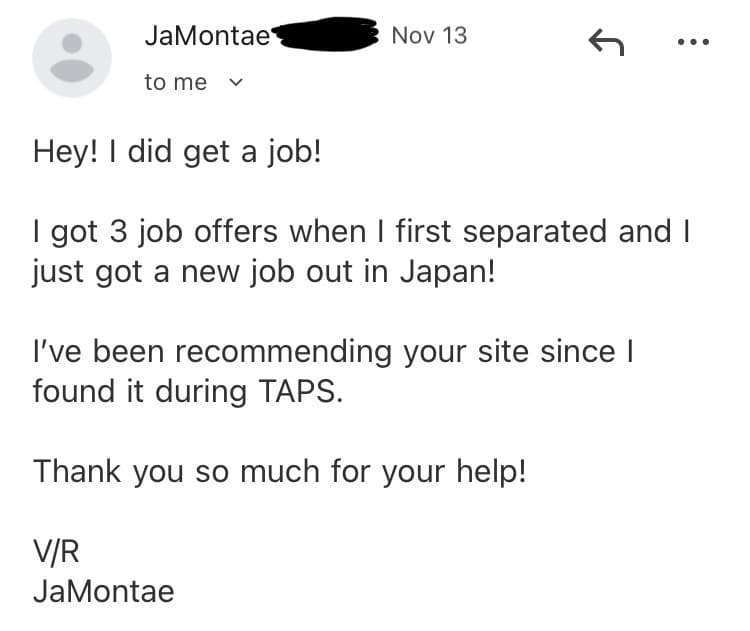
“Hey! I did get a job! I got 3 job offers when I first separated and I just got a new job out in Japan! I’ve been recommending your site since I found it during TAPS. Thank you so much for your help! V/R JaMontae ”
Federal hiring gives a PJ several distinct on-ramps, and they are not all medical. The closest clinical match is the GS-0640 Health Aid and Technician series, where prior paramedic and emergency-care experience qualifies for technician and EMT/paramedic positions inside the VA, DoD medical treatment facilities, and Indian Health Service. Grade placement usually starts around GS-6 to GS-9 depending on whether the role requires independent paramedic practice.
The GS-0081 Fire Protection and Prevention series is a strong target because federal fire departments on military installations run fire-based EMS, and your dual fire-medical readiness fits their structured-firefighter and fire-medic billets. Federal firefighter positions list specific medical and physical standards that a PJ background meets cleanly.
Two management series widen the field beyond the truck. The GS-0089 Emergency Management series hires people who can plan and run response operations, and personnel-recovery and mass-casualty experience maps onto continuity, response coordination, and exercise-planning roles at FEMA, DoD components, and installation emergency-management offices. The GS-0018 Safety and Occupational Health Management series values the risk-assessment discipline that governed every dive, jump, and hazardous extraction you ran. The catch-all GS-0301 Miscellaneous Administration and Program series covers readiness, training, and operations-coordinator roles that do not fit a single technical series.
Veterans' Preference applies to all of these and your time in service counts toward leave accrual and retirement on day one. Federal resumes are their own format, far longer and more detailed than a private-sector resume. The 2026 federal resume format guide and the specialized experience guide show how to write the duty narratives that USAJobs HR specialists score, and the federal resume builder formats it to OPM length. If you want to start a clean federal application right now, you can build your resume here.
| GS Series | Federal Job Title | Typical Grades | Match | Explore |
|---|---|---|---|---|
| GS-0081 | Fire Protection and Prevention | GS-5, GS-7, GS-8 | View Details → | |
| GS-0640 | Health Aid and Technician | GS-6, GS-7, GS-9 | View Details → | |
| GS-0089 | Emergency Management | GS-9, GS-11, GS-12 | View Details → | |
| GS-0018 | Safety and Occupational Health Management | GS-9, GS-11 | View Details → | |
| GS-0188 | Recreation Specialist | GS-7, GS-9 | View Details → | |
| GS-0301 | Miscellaneous Administration and Program | GS-7, GS-9, GS-11 | View Details → |
Federal hiring uses keyword-matching and structured experience. BMR builds federal-format resumes (USAJobs-ready) with the right keywords, hours/week, and supervisor info — for any GS series above.
Free · No credit card · Federal + civilian resume formats included
Not everyone wants to stay in a related field. These career paths leverage your transferable skills — leadership, risk management, logistics, project planning — in completely different industries.
The same risk-control discipline that kept a dive or free-fall profile within survivable limits is exactly what oil, gas, and heavy industry pay safety engineers to apply to their operations.
PJs live inside applied physiology, from hypoxia and decompression to peak conditioning. That knowledge transfers to building and managing performance programs for athletes and tactical professionals.
This is a stretch pivot, but the combat-dive foundation gives you a real head start in an entirely different industry built around underwater construction, inspection, and offshore energy.
PJs spend years building and validating other operators against hard standards. Corporate L and D, technical-rescue schools, and safety-training firms hire exactly that instructional discipline.
Insurance loss-control specialists walk industrial and commercial sites, find what could hurt people, and recommend fixes. That is the risk-assessment loop a PJ ran before every operation, applied to a different industry.
Outdoor-adventure and wilderness-program organizations need leaders who can run safe operations in water and mountain environments. A PJ has done it under far harder conditions.
Refineries, mines, and large construction sites contract dedicated rescue teams for confined-space and high-angle emergencies. The technical-rescue skill set is a direct industrial-sector fit outside emergency medicine.
The skills that made you a good Marine, Sailor, Airman, or Soldier transfer further than you think. BMR rewrites your bullets for any of the pivot careers above — without making you sound like you've never done the work.
Free · No credit card · Try unlimited career angles
If you are staying in EMS, fire, or air-medical work, your terminology already matches the target employer. A flight program director knows what a paramedic, a hoist, and a critical-care transport are. This section is for PJs targeting careers OUTSIDE emergency medicine, where a hiring manager has never heard your job described and reads "Pararescue" as a blank.
The goal is to convert tactical-rescue language into the operational, safety, and training vocabulary that civilian managers in other industries use every day. Pull the underlying function out of the mission context.
For a broader vocabulary list, the 50 military terms translated to civilian language glossary and the guide on explaining military experience without jargon are the fastest way to retrain how you describe the work. Drop the rewritten bullets straight into the military resume builder and it keeps the formatting consistent across the document.
BMR turns your 1Z1X1 duties and accomplishments into civilian bullets that match the job you're applying for — no manual translation, no rewriting.
Free · No credit card · Tailored to each job posting
Which certifications you need depends on where you're headed. Find your target career path below.
The wrong placement can sink an otherwise strong application. BMR knows where each cert ranks, what to call it, and how to frame it for ATS keyword matching and hiring manager attention.
Free · No credit card · Built around your real certs and clearance
Keep your NREMT certification current the moment you separate. A lapse forces re-testing and costs you the credential that makes you hireable. If air-medical is the goal, target FP-C (Flight Paramedic Certification) through the BCEN and stack a year of high-acuity ground 911 experience first. The International Association of Fire Fighters and the National Association of EMTs publish hiring and continuing-education resources. SkillBridge can place you with a fire department or EMS agency before your separation date. The SkillBridge programs by industry guide lists agencies that take transitioning medics.
If you are done with patient care, your safety, risk, and training experience is the lever. The Board of Certified Safety Professionals offers the ASP/CSP path into industrial safety. PMP from PMI opens operations and program-coordination roles. American Corporate Partners (ACP) runs a free year-long mentorship that pairs veterans with corporate leaders, which is the most useful network if you are pivoting fully out of the field. For federal work, study how Veterans' Preference and specialized experience actually get scored before you apply.
Start with the military resume builder for private-sector roles or the federal resume builder for USAJobs. Explore adjacent roles in the career crosswalk, and use the SFL-TAP transition resources while you are still in. When you are ready to apply, build your resume now.
See also: Air Force EOD (3E8X1), Air Force Combat Control (1C2X1), and the Navy Diver page for related special-operations transitions. For interview prep, read the guide on informational interviews for veterans.
Most veterans do this backwards — they wait until terminal leave to start, then panic. Here's the actual sequence that works.
Print this. Tape it to your monitor. Veterans who treat the transition like a 90-day op get hired faster than the ones who treat it like an emergency.
Stop rewriting from scratch every time you apply. BMR turns your military experience into civilian and federal resumes — tailored to each job.