Loading...
Loading...
The civilian and federal jobs that hire Navy Naval Aircrewman (Helicopter)s — with real salaries and the resume that gets callbacks.
Every AWS has more options than a Google search will tell you. Below: career paths, BLS salary data, federal GS series, certifications by target career, and how to translate your experience without losing what made you valuable to the Navy in the first place.
Free · No credit card · Tailored resume in under 5 minutes
After the Navy I got hired into 6 federal career fields and tech sales, and sat on federal hiring panels along the way. I spent the last 2 years rebuilding everything I learned into BMR, tuned for how AI actually screens resumes today. This is the system I wish I'd had on day one.
If you held the AWS rating, you flew in the back of the MH-60S Knighthawk as a Naval Aircrewman (Helicopter). That is a very different job from the rest of the aircrew community. Your signature mission was search and rescue (SAR), and many AWS sailors earned the aviation rescue swimmer qualification at Aviation Rescue Swimmer School (ARSS) in Pensacola before joining the fleet. You jumped out of a hovering helicopter into open ocean to recover a survivor, ran the hoist and rescue litter, treated casualties in the cabin, and got them back to the deck alive.
The rest of the AWS job is just as hands-on. You operated the cabin door gun, rigged and managed external loads for vertical replenishment (VERTREP), supported airborne mine countermeasures (AMCM) with towed sweep gear, and crewed Naval Special Warfare insert and extract runs. On a Knighthawk crew you ran the rescue hoist, the cargo hook, the cabin sensors, and the survival and first-aid kit, often in the same flight. Your training pipeline ran through Naval Aircrew Candidate School and AWS Class A school in Pensacola, with water and land survival, aircrew physiology, and crew-served weapons layered on top.
Civilian employers value this background because it is rare. You made go or no-go calls over a survivor in the water with a swell running and fuel burning down. You managed a rescue hoist and rigging operation where one mistake costs a life. You delivered emergency medical care in a moving aircraft with no second crew to back you up. That blend of water-survival expertise, calm emergency response, and rigging discipline is hard to hire for, and it reads well far outside aviation once it is translated correctly. If you are still mapping where the rating leads, the military career crosswalk tool is a good starting point, and the broader Naval Aircrewman (AW) overview covers the community you came from. The Aircrew Survival Equipmentman (PR) page is worth a look too, since your survival gear and egress training overlap. For a head start on language, the 50 military terms translated to civilian language guide is built for exactly this.
BMR has built more than 60,000 resumes across every rating, and AWS sailors are some of the most undersold people we see. "Rescue swimmer" and "door gunner" tell a hiring manager nothing about the calm, the medical skill, or the rigging precision behind them. The mission is dramatic. The resume has to make the judgment underneath it legible to someone who has never seen a hoist. — Brad Tachi, Navy Diver veteran & BMR founder
The number that matters when you're deciding what's next: how does civilian pay compare to what you make now?
Military comp is approximate (varies by location/dependents). Civilian is BLS median. Federal includes locality pay. Your real number depends on duty station, family status, GS step, and overtime.
The most direct civilian path off the rescue-swimmer side of AWS is emergency medical care. As a paramedic or EMT you are already trained for patient assessment and stabilization under bad conditions, and the U.S. Bureau of Labor Statistics (BLS OEWS, May 2024) reports a median wage of $57,290 for paramedics and $39,410 for EMTs, with employment projected to grow faster than average. Lifeguard and aquatic-safety supervision roles, surface and swiftwater rescue technician positions with county and state agencies, and commercial helicopter aircrew roles supporting offshore oil platforms and air-ambulance operations all draw on the same water-survival and aircrew foundation.
The hoist, rigging, and external-load side of the rating opens a second lane. Riggers and load-handling specialists in construction, offshore wind, and crane operations use the same load-planning and signaling discipline you applied to VERTREP. Helicopter and aviation operations coordinators, and crew schedulers for medevac and utility operators, value aircrew sailors who understand the flight environment from inside the cabin. Be honest with yourself about geography here. Air-ambulance, offshore aviation, and maritime SAR jobs cluster on the coasts, the Gulf, and a handful of trauma-network hubs, and the strongest-paying aviation roles often require an FAA-recognized credential or commercial-aircrew certificate that takes time to earn.
If you want to see how Navy ratings map across to civilian work generally, the military skills for resume list is a useful reference, and the Coast Guard Aviation Survival Technician (AST) page covers the closest civilian-adjacent rescue-swimmer market in another branch. When you are ready to put it on paper, the military resume builder turns flight-hour and rescue records into civilian bullets, or you can build your resume now and start from your rescue and aircrew history.
| Civilian Job Title | Industry | BLS Median Salary | Outlook | Match |
|---|---|---|---|---|
Paramedic O*NET: 29-2043.00 | Emergency Medical Services | $57,290 | 6% (Faster than average) | strong |
Emergency Medical Technician O*NET: 29-2042.00 | Emergency Medical Services | $39,410 | 6% (Faster than average) | strong |
Lifeguard / Aquatic Safety Supervisor O*NET: 33-9092.00 | Recreation & Safety | $31,470 | 2% (Little change) | strong |
Commercial Helicopter Aircrew / Hoist Operator O*NET: 53-2011.00 | Aviation Operations | $61,810 | 4% (As fast as average) | strong |
Rigger / Load-Handling Specialist O*NET: 49-9096.00 | Construction & Industrial | $56,350 | 6% (Faster than average) | moderate |
Aviation Operations Coordinator O*NET: 43-5011.00 | Aviation Operations | $49,540 | 3% (As fast as average) | moderate |
Aviation Safety Inspector O*NET: 53-6051.07 | Aviation Safety | $95,000 | 3% (As fast as average) | moderate |
Search and Rescue Technician O*NET: 33-2011.00 | Public Safety | $52,270 | 3% (As fast as average) | strong |
BMR rewrites your AWS experience for any of the civilian roles above — keywords, achievements, and language hiring managers actually scan for.
Free · No credit card · 2 tailored resumes included
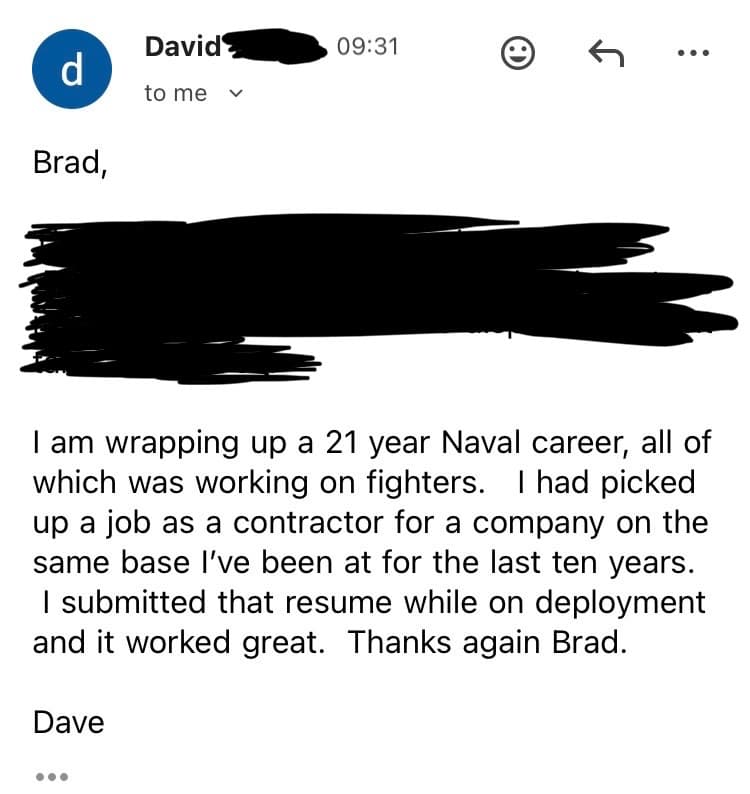
“I am wrapping up a 21 year Naval career, all of which was working on fighters. I had picked up a job as a contractor for a company on the same base I’ve been at for the last ten years. I submitted that resume while on deployment and it worked great. Thanks again Brad. Dave ”
Federal hiring is one of the better fits for an AWS background because the work splits cleanly into aviation safety, emergency response, and program lines that the GS system already has series for. The GS-1825 Aviation Safety series is the clearest match: your aircrew judgment, mishap awareness, and flight-environment knowledge line up with what the FAA and DoD aviation-safety offices screen for, typically at the GS-9 through GS-12 range depending on certification and experience. The GS-0640 Health Aid and Technician series fits sailors who ran the medical side of rescue work and want to stay clinical inside a federal facility.
Beyond those, GS-0089 Emergency Management and GS-0081 Fire Protection and Prevention reward the SAR and aerial-firefighting experience the rating builds, and GS-0018 Safety and Occupational Health Management is a natural landing spot for sailors who managed risk on a flight deck and in the cabin. GS-2150 Transportation Operations and GS-0301 Miscellaneous Administration and Program round out the adjacent options for coordination and program roles. Veterans Preference applies across all of them, and your aircrew log plus any rescue-swimmer or survival quals are the documentation that backs your qualifying experience. The federal resume is its own format, so the federal resume builder is worth using, and the Coast Guard AST page shares several of these same GS targets. When you are ready, you can start your federal resume from your service record.
| GS Series | Federal Job Title | Typical Grades | Match | Explore |
|---|---|---|---|---|
| GS-0640 | Health Aid and Technician | GS-5, GS-6, GS-7 | View Details → | |
| GS-1825 | Aviation Safety | GS-9, GS-11, GS-12 | View Details → | |
| GS-0089 | Emergency Management | GS-7, GS-9, GS-11 | View Details → | |
| GS-0018 | Safety and Occupational Health Management | GS-9, GS-11, GS-12 | View Details → | |
| GS-0081 | Fire Protection and Prevention | GS-6, GS-7, GS-8 | View Details → | |
| GS-8852 | Aircraft Mechanic | WG-8, WG-10, WG-11 | View Details → | |
| GS-0019 | Safety Technician | GS-5, GS-6, GS-7 | View Details → | |
| GS-0301 | Miscellaneous Administration and Program | GS-7, GS-9, GS-11 | View Details → | |
| GS-2150 | Transportation Operations | GS-7, GS-9, GS-11 | View Details → |
Federal hiring uses keyword-matching and structured experience. BMR builds federal-format resumes (USAJobs-ready) with the right keywords, hours/week, and supervisor info — for any GS series above.
Free · No credit card · Federal + civilian resume formats included
Not everyone wants to stay in a related field. These career paths leverage your transferable skills — leadership, risk management, logistics, project planning — in completely different industries.
Rescue swimmers already understand respiratory physiology, hypoxia, and emergency airway management from aircrew training and in-flight care. That foundation transfers cleanly into hospital respiratory therapy.
Few people are as comfortable working in and under open water as a former rescue swimmer. Commercial diving rewards water confidence, physical resilience, and disciplined risk management, all of which the rating builds.
The physical demands of rescue-swimmer work give you a working understanding of conditioning, injury, and recovery that translates into rehabilitation support. Patients respond to someone who has trained hard and recovered from physical strain.
VERTREP and hoist work is suspended-load handling under the worst conditions imaginable. Civilian crane operation is the same discipline on a stable platform, and your rigging instincts are already sharp.
Athletic training blends emergency response with physical conditioning, two things rescue swimmers do daily. You already know how to read a body under strain and act fast when something goes wrong.
Aircrew work means operating safely where small mistakes are fatal. HAZMAT removal rewards exactly that mindset: rigorous procedure, PPE discipline, and a refusal to cut corners on safety.
Coordinating SAR and disaster-relief missions is small-scale emergency management. The leap to directing community or facility emergency operations is a natural one for sailors who ran the cabin during real responses.
The skills that made you a good Marine, Sailor, Airman, or Soldier transfer further than you think. BMR rewrites your bullets for any of the pivot careers above — without making you sound like you've never done the work.
Free · No credit card · Try unlimited career angles
If you are staying in emergency medical, rescue, or aviation work, your terminology already translates. Air-ambulance crews, county rescue teams, and offshore aircrew use the same vocabulary you used in the fleet. This section is for AWS sailors targeting careers OUTSIDE rescue and aviation, where "rescue swimmer," "VERTREP," and "hoist operator" mean nothing to a hiring manager who has never seen a helicopter cabin.
The fix is to translate the judgment and the system, not the acronym. "Conducted aviation rescue swimmer operations" becomes "performed high-risk recovery operations in hazardous environments under strict time and safety constraints." "Rigged external loads for VERTREP" becomes "planned and executed load-handling and rigging operations with zero-defect tolerance for safety-critical lifts." The skill is real. The words have to carry it to someone outside the field. For the full method, the 50 military terms glossary and the military jargon decoder walk through it line by line. The military resume builder applies these translations automatically, or you can get started here and translate your own bullets first.
BMR turns your AWS duties and accomplishments into civilian bullets that match the job you're applying for — no manual translation, no rewriting.
Free · No credit card · Tailored to each job posting
Which certifications you need depends on where you're headed. Find your target career path below.
The wrong placement can sink an otherwise strong application. BMR knows where each cert ranks, what to call it, and how to frame it for ATS keyword matching and hiring manager attention.
Free · No credit card · Built around your real certs and clearance
SkillBridge partners place transitioning aircrew with air-ambulance operators, offshore helicopter services, and county emergency-services agencies. Industry associations worth joining include the Association of Air Medical Services and the National Association of Emergency Medical Technicians for the medical lane, and the Helicopter Association International for the aviation-operations lane. If you held the rescue-swimmer qualification, civilian water-rescue certification through a state EMS or fire academy is usually the fastest bridge to a paid role. The Naval Aircrewman (AW) and Aircrew Survival Equipmentman (PR) pages cover adjacent Navy aircrew paths, and the Air Force Pararescue (1Z1X1) page is the closest cross-branch rescue equivalent.
For non-field roles, lean on Veterans Preference, your clearance if you held one, and the GI Bill to fund a certification that civilian employers recognize. American Corporate Partners (ACP) offers free one-on-one veteran mentorship that helps if you are pivoting into an unfamiliar industry. Map your next step with the career crosswalk tool, work the timing with the ETS transition timeline, and use the SFL-TAP resources your command provides. When the resume is the next move, the military resume builder and federal resume builder handle both tracks, or you can build your resume now.
Most veterans do this backwards — they wait until terminal leave to start, then panic. Here's the actual sequence that works.
Print this. Tape it to your monitor. Veterans who treat the transition like a 90-day op get hired faster than the ones who treat it like an emergency.
Stop rewriting from scratch every time you apply. BMR turns your military experience into civilian and federal resumes — tailored to each job.