Loading...
Loading...
The civilian and federal jobs that hire Air Force Special Mission Aviators — with real salaries and the resume that gets callbacks.
Every 1A1X3 has more options than a Google search will tell you. Below: career paths, BLS salary data, federal GS series, certifications by target career, and how to translate your experience without losing what made you valuable to the Air Force in the first place.
Free · No credit card · Tailored resume in under 5 minutes
After the Navy I got hired into 6 federal career fields and tech sales, and sat on federal hiring panels along the way. I spent the last 2 years rebuilding everything I learned into BMR, tuned for how AI actually screens resumes today. This is the system I wish I'd had on day one.
Here is the thing nobody warns you about when you take off the flight suit: the more specialized your aircrew time, the harder it reads to a civilian recruiter. As a 1A1X3 Special Mission Aviator you employed a 105mm cannon and 30mm chain gun from an AC-130 gunship orbit, ran sensor and fire-control coordination with the crew on a troops-in-contact call, executed low-level night infiltration on NVGs, and managed weapons and aircraft systems while the airplane was maneuvering under fire. That is one of the densest operational backgrounds in the enlisted force. And on a resume it can land as a single line that a hiring manager outside aviation does not know how to read.
The 1A1X3 career field is the enlisted aircrew specialty on Air Force Special Operations Command's special-mission platforms. Special Mission Aviators fly as aerial gunners, flight engineers, and loadmasters on the AC-130J Ghostrider and AC-130W gunships, the CV-22 Osprey, MC-130J Commando II, and non-standard aviation aircraft. The mission set is close air support, air interdiction, armed reconnaissance, infiltration and exfiltration of special operations forces, personnel recovery, and forward arming and refueling point support. The day-to-day work splits into weapons employment and fire control from a gunship orbit, in-flight management of engine and aircraft systems, aerial gunnery and sensor coordination, tactical low-level and NVG flight, airdrop and combat offload, and emergency procedures with the aircraft already airborne in a hostile profile.
Training runs through the enlisted aircrew pipeline at Joint Base San Antonio-Lackland, then aircrew fundamentals, survival training (SERE), and platform-specific qualification at the formal training unit for your assigned airframe. The job carries flying status with recurring physiological and altitude-chamber qualification, and most assignments require a Top Secret clearance with SCI eligibility. Civilian employers value this background because special-mission aircrew make irreversible, time-critical decisions on a multi-million-dollar weapons system, in a crew, under threat, with checklist discipline and zero tolerance for error. If you also flew under the older mobility codes, the related Flight Engineer (1A1X1) and Aircraft Loadmaster (1A2X1) pages cover adjacent paths, and the career crosswalk tool maps your exact shred to civilian work.
When I separated from the Navy I spent 18 months sending out applications and getting nothing back. My experience was not the problem. The way it sat on the page was. Special-mission aircrew carry that problem at the extreme end, because "aerial gunner" or "special mission aviator" reads to a civilian recruiter like a job with no door into their world. The translation is what costs you the callback, not the work you actually did. Fix the page and the experience speaks for itself. — Brad Tachi, Navy Diver veteran & BMR founder
The number that matters when you're deciding what's next: how does civilian pay compare to what you make now?
Military comp is approximate (varies by location/dependents). Civilian is BLS median. Federal includes locality pay. Your real number depends on duty station, family status, GS step, and overtime.
The most direct civilian paths for a Special Mission Aviator sit inside aviation, aviation operations, and protective-service supervision, and the pay holds up because trained, checklist-disciplined aircrew are not common on the open market.
If your background leaned toward the flight engineer or systems side, Avionics Technicians earned a median of $81,390 in May 2024 (BLS OEWS) and Aircraft Mechanics and Service Technicians earned $78,680, both realistic once you pair your systems exposure with an FAA Airframe and Powerplant (A&P) certificate. Commercial Pilots earned a median of $122,670, a path that runs through civilian certificates but where your aircrew time, mission planning, and flight medical carry real weight. On the operations side, Aircraft Cargo Handling Supervisors earned $66,190 and First-Line Supervisors of Security Workers earned $59,900, the latter a common landing spot for aircrew whose record shows armed, high-consequence crew leadership.
The planning and coordination side pays higher. Logisticians earned a median of $80,880 and Transportation, Storage, and Distribution Managers earned $102,010 in May 2024 data, which is the lane for aircrew who ran mission planning, FARP coordination, and crew scheduling. Corporate and defense training organizations also hire experienced aircrew to build and run qualification programs. Training and Development Specialists earned $65,850.
Be honest with yourself about geography and cycle. Special-operations aviation work and the defense maintenance, repair, and overhaul base cluster around AFSOC installations and major aviation hubs, and the airline and cargo market tracks fuel prices and freight volume. Cleared defense contractors who support gunship and special-mission platforms are often the fastest re-entry, because they already speak your mission language. If you are weighing the unmanned and sensor side, the Army Unmanned Aircraft Systems Operator (15W) and Navy Naval Aircrewman Operator (AWO) pages cover adjacent civilian markets worth comparing. Our military pilot to civilian aviation guide walks the certificate ladder without the hype. When you are ready to put it down on paper, the military resume builder structures aircrew experience the way civilian recruiters read it.
| Civilian Job Title | Industry | BLS Median Salary | Outlook | Match |
|---|---|---|---|---|
Avionics Technician O*NET: 49-2091.00 | Aviation | $81,390 | 5% (Faster than average) | strong |
Aircraft Mechanic and Service Technician O*NET: 49-3011.00 | Aviation | $78,680 | 5% (Faster than average) | strong |
Commercial Pilot O*NET: 53-2012.00 | Aviation | $122,670 | 5% (Faster than average) | moderate |
Aircraft Cargo Handling Supervisor O*NET: 53-1041.00 | Aviation Operations | $66,190 | 5% (Faster than average) | strong |
First-Line Supervisor of Security Workers O*NET: 33-1091.00 | Security | $59,900 | 3% (As fast as average) | strong |
Logistician O*NET: 13-1081.00 | Logistics | $80,880 | 13% (Much faster than average) | moderate |
Transportation, Storage, and Distribution Manager O*NET: 11-3071.00 | Logistics | $102,010 | 5% (Faster than average) | moderate |
Training and Development Specialist O*NET: 13-1151.00 | Training | $65,850 | 8% (Faster than average) | moderate |
BMR rewrites your 1A1X3 experience for any of the civilian roles above — keywords, achievements, and language hiring managers actually scan for.
Free · No credit card · 2 tailored resumes included
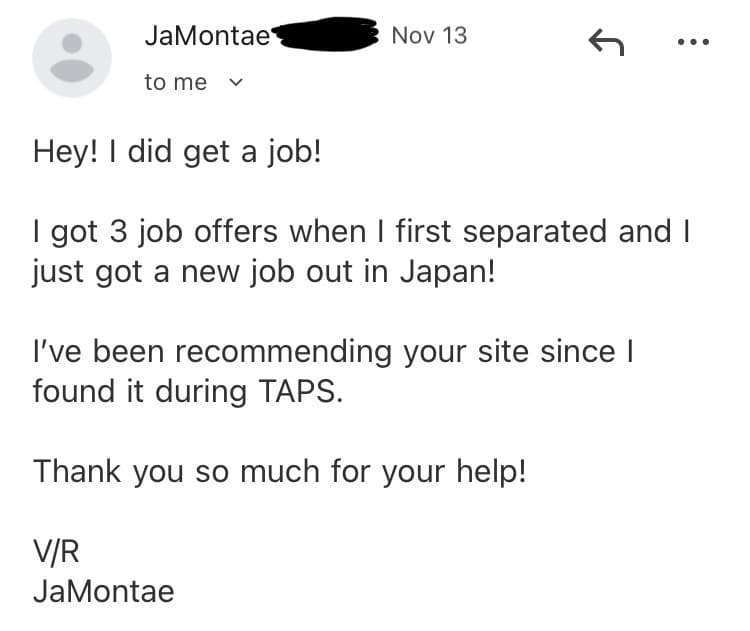
“Hey! I did get a job! I got 3 job offers when I first separated and I just got a new job out in Japan! I’ve been recommending your site since I found it during TAPS. Thank you so much for your help! V/R JaMontae ”
Federal service rewards special-mission aircrew in a way the private market often misses, because the qualification standards reward the exact judgment, systems knowledge, and clearance you already hold. The work is to match your record to the right series and grade.
The most direct fit is the GS-2150 Transportation Operations series, which covers aviation operations, flight scheduling, and mission coordination roles inside the FAA, DoD, and other agencies, typically entering around GS-7 to GS-11 depending on your flight-hour record and post-service education. GS-1825 Aviation Safety is the lane for aircrew moving into FAA and DoD flight-safety and airworthiness work, where your in-flight emergency and systems experience reads directly into the qualification standard, usually GS-9 and up. For the security and protective side, GS-0080 Security Administration fits aircrew with a strong clearance and operations-security background, and GS-0089 Emergency Management is a fit for those who want to run continuity, contingency, and crisis-response programs, both entering around GS-9 to GS-11.
Beyond the direct matches, GS-0301 Miscellaneous Administration and Program and GS-0340 Program Management are broad series that hire transitioning aircrew into operations, plans, and program-coordination roles across nearly every agency, with grade driven by scope and supervisory history. Veterans' Preference applies on top of these standards, and a Top Secret clearance with SCI eligibility is a measurable advantage in the cleared federal hiring pool, where the cost and time to grant a clearance gives you a real edge over equally qualified non-cleared applicants. If you share GS-2150 or GS-1825 targets with other aircrew, the Naval Aircrewman Helicopter (AWS) page covers a parallel federal path. Our USAJobs resume guide for veterans explains how the federal format differs, and you can start your federal resume here.
| GS Series | Federal Job Title | Typical Grades | Match | Explore |
|---|---|---|---|---|
| GS-1825 | Aviation Safety | GS-9, GS-11, GS-12 | View Details → | |
| GS-2150 | Transportation Operations | GS-7, GS-9, GS-11 | View Details → | |
| GS-0080 | Security Administration | GS-7, GS-9, GS-11 | View Details → | |
| GS-0089 | Emergency Management | GS-9, GS-11, GS-12 | View Details → | |
| GS-0301 | Miscellaneous Administration and Program | GS-7, GS-9, GS-11 | View Details → | |
| GS-0340 | Program Management | GS-11, GS-12, GS-13 | View Details → |
Federal hiring uses keyword-matching and structured experience. BMR builds federal-format resumes (USAJobs-ready) with the right keywords, hours/week, and supervisor info — for any GS series above.
Free · No credit card · Federal + civilian resume formats included
Not everyone wants to stay in a related field. These career paths leverage your transferable skills — leadership, risk management, logistics, project planning — in completely different industries.
Special-mission aircrew run contingency planning and crisis response as a daily function, which is the core of emergency management.
Aircrew operate calmly through life-or-death calls with strict procedures, the same composure paramedics need on emergency scenes.
Aircrew instructors build and run rigorous qualification programs, which is exactly what corporate learning-and-development leaders do.
The operating room rewards the same procedural precision, anticipation, and composure aircrew use in a hostile flight profile.
Aircrew judgment of physical risk and rapid acute assessment carries into sideline injury evaluation and athlete care.
The firehouse crew model, hazardous-environment work, and emergency procedural discipline mirror the special-mission aircrew environment.
AC-130 sensor operators spend every sortie turning live imagery and coordinates into precise, verifiable position data. Survey and mapping crews do the same work on the ground with total stations, GNSS receivers, and GIS software, where attention to coordinate accuracy matters more than any degree.
The skills that made you a good Marine, Sailor, Airman, or Soldier transfer further than you think. BMR rewrites your bullets for any of the pivot careers above — without making you sound like you've never done the work.
Free · No credit card · Try unlimited career angles
If you are staying inside aviation, aviation safety, or special-operations support, your terminology already lands. Recruiters at airlines, MRO shops, and cleared defense contractors know what an aerial gunner, a fire-control orbit, and FARP support are. This section is for the roles OUTSIDE aviation, where a hiring manager has never seen "TIC," "AC-130 orbit," or "NVG low-level" and your real skills disappear into the jargon.
The fix is to name the underlying skill in plain business language while keeping the scale and the stakes intact. You made weapons-release and systems calls in seconds with lives on the line. In civilian terms that is real-time, high-consequence decision-making under pressure. You coordinated a crew across weapons, sensors, and flight systems. That is multi-team operational coordination. Describe the work, not the airframe.
For more on this, our 50 military terms translated to civilian language glossary and the EPR translation guide for airmen are built for this exact problem. When you are ready to draft bullets, the military resume builder turns special-mission aircrew duties into recruiter-ready language.
BMR turns your 1A1X3 duties and accomplishments into civilian bullets that match the job you're applying for — no manual translation, no rewriting.
Free · No credit card · Tailored to each job posting
Which certifications you need depends on where you're headed. Find your target career path below.
The wrong placement can sink an otherwise strong application. BMR knows where each cert ranks, what to call it, and how to frame it for ATS keyword matching and hiring manager attention.
Free · No credit card · Built around your real certs and clearance
Use these resources to move from special-mission aircrew to your next role, whether you stay close to aviation or leave it entirely.
Pursue the FAA Airframe and Powerplant (A&P) certificate if your record leaned toward systems and the flight-engineer side, and look at SkillBridge fellowships with cleared defense contractors who support gunship and special-mission platforms, since they already speak your mission language. Professional groups like the Professional Aviation Maintenance Association and the National Air Transportation Association are worth joining early for the network. Compare adjacent aircrew markets on the Flight Engineer (1A1X1) and Army UAS Operator (15W) pages.
For the federal route, study the USAJobs format and qualification standards before you apply, and lean on your clearance as a hiring advantage. For the private sector, certifications like PMP (project management) and the Certified Safety Professional credential open operations and safety roles. American Corporate Partners (ACP) runs free veteran mentorship that is genuinely useful for non-field pivots. Map your options with the career crosswalk tool, use SFL-TAP transition resources while you are still in, and read our veteran interview preparation guide before your first civilian interview. See also the Navy AWO and Aircraft Loadmaster (1A2X1) pages for related career paths. When you are ready, build your resume now.
Most veterans do this backwards — they wait until terminal leave to start, then panic. Here's the actual sequence that works.
Print this. Tape it to your monitor. Veterans who treat the transition like a 90-day op get hired faster than the ones who treat it like an emergency.
Stop rewriting from scratch every time you apply. BMR turns your military experience into civilian and federal resumes — tailored to each job.